War at home and trade abroad made Muromachi Bizen the busiest forge region in Japan: a century of Sengoku demand after the Ōnin War, and export missions to Ming China carrying blades by the tens of thousands.
 NihontoWatchNihontoWatch
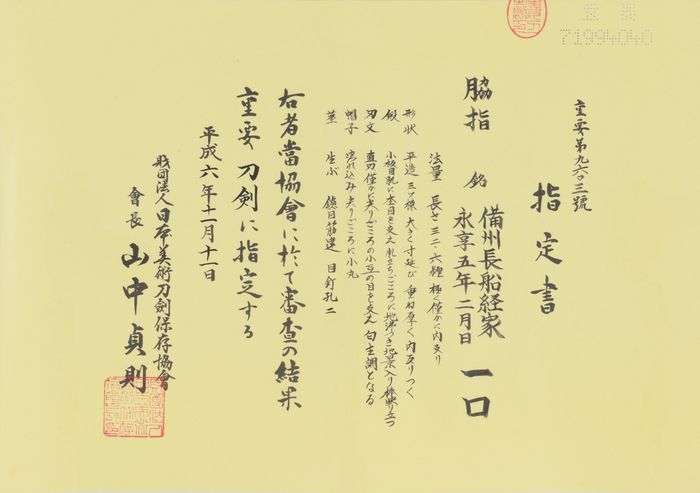
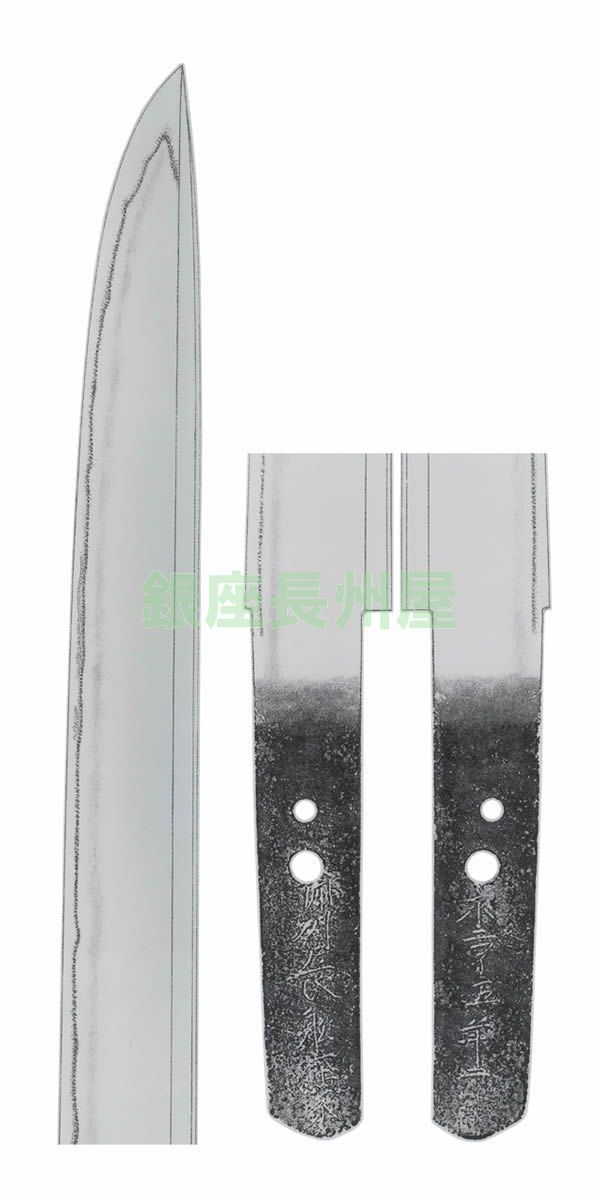
長舩盛光や康光に並ぶ名流として遍く知られる経家の匠銘は、鎌倉後期正応頃の畠田守家の子と伝える初祖に始まり、以降数代を重ねて栄えている(注1)。中でも応永から永享頃を活躍期とする経家に優品が多く、折からの戦闘様式の変化に伴い、片手で打ち振るうに適した打刀や、応永備前の特徴を顕著にする腰開き互の目乱刃の(注2)平造小脇差を遺している。 この脇差は、高位の武士が室内の備えとするべく用いたもので、典型的応永備前の姿格好。特別の要求によって企画され、良質の素材を選別して鍛造されたものであろう、安定感のある身幅でごくわずかに内反りとなり、物打辺りが張ってふくらも豊か。特筆すべきは三分三厘(一センチ)に及ぶ驚異なる重ねで肉厚く、三ツ棟に仕立てられ、さらに研ぎ減りのない健体を保っている点。地鉄は小杢を交えた小板目鍛えで、微細な地沸で覆われてしっとりとした絹目のような肌合いを呈し、柔らか味のある地景が過ぎることなく配されて品位が高い。加えて、暗帯部を伴うゆったりと湾れた直映りが顕著に現れ、焼刃から映りに煙り込むような働きも窺えてこれも備前上工の特質。刃文は匂口に柔らか味のある直刃で、所々地中に牙のような尖刃が交じって変化を生み出し、刃中にも淡い小足が入って景色を成す。帽子も蝋燭の芯のように先端がわずかに尖って返る。茎には細鑚による繊細な銘字が刻されている。 注1...応安頃には小反派の長舩光久の子とも伝える経家がある。 注2...応永備前に紛れる乱刃の作例では、重美指定の加賀大聖寺前田家伝来の太刀がある。
NihontoWatchOffered by Choshuya
This piece has sold
Get an email when a new Osafune Tsuneie piece hits the market.







Bizen-den · Bizen · around 1429-1462
Fujishiro Chu-jo saku · Tōken Taikan top 31%
1 piece on the market now
Tsuneie is transmitted as a swordsmith of the Hatakeda branch within the Osafune school of Bizen Province. Although the Meikan and related signature references place the first generation in the mid-Kamakura period around the Shoo era (1288-1293), and examples bearing Oan-era dates of the Nanbokucho period are also recorded, extant works that predate the Oei era are exceedingly rare. Tsuneie stands alongside Iesuke as one of the capable smiths of Oei-Bizen, coming after the foundational masters Morimitsu and Yasumitsu, and his workmanship closely resembles that of Yasumitsu from the same period. Despite being recorded as "Osafune" and transmitted as Hatakeda lineage, the NBTHK observes that there are no grounds — whether in workmanship, the character of the signature, or any other point — by which one could distinguish his production from Osafune work.
Tsuneie's forging characteristically shows ko-itame-hada closely worked, with ji-nie adhering and bo-utsuri clearly standing — hallmarks that plainly display the style of Oei-Bizen. His tempering frequently features gunome with opened bases into which choji is mixed, often with small ashi and yo, and a nioiguchi that tends toward tightness and is saeru — bright and clear. However, the NBTHK further notes that Tsuneie was also adept at producing quiet suguha tempers, demonstrating a versatility beyond his more florid work. Both tachi and wakizashi often show a build that is long in proportion to a standard mihaba, with notably thick kasane, lending a dignified and imposing presence.
The finest designated examples by Tsuneie are praised as especially well-executed works, excellent in both jigane and hamon, with a splendidly florid temper of gunome and choji. The NBTHK consistently commends those pieces in which both ji and ha are kenzen — sound and well-preserved — and in which the workmanship is well ordered. The well-refined jigane is described as bright and clear, and the dignified shape with its thick kasane is deemed particularly appealing. Tsuneie's position as a representative smith of Oei-era Bizen is firmly established, sharing common traits with his contemporaries while maintaining a workmanship of consistent refinement.
Where Tsuneie stands among comparable artisans: across all of nihontō, and within tradition, era, and period. The tiers (Foremost · Leading · Major · Notable) weigh official designations from the NBTHK and Japan's Agency for Cultural Affairs, together with historical honors of lasting repute such as the Sansaku and Meibutsu-chō.
Select a lens to see how it's measured.
Years he was demonstrably active, proven by signed-and-dated blades
Bizen-den · Bizen
186 pieces on the market now
No single workshop in the history of Japanese swordmaking grew larger or lasted longer than Osafune, the riverside village in Bizen Province whose name became, across three centuries, a byword for the province's mainline. Its de facto founder was Mitsutada (光忠), working at Osafune in the middle Kamakura period; tradition makes him the son of Chikatada, and the genealogies derive his line from the Ko-Bizen Masatsune group already settled in the village. His blades, bold and imposing with a jigane so refined the sources say it can at a glance suggest Kyoto work, were treasured from old as the swords of commanders, and from his hand the school spread immediately: his sons Nagamitsu (長光) and Sanenaga (眞長), his grandson Kagemitsu (景光), and outward through pupils and collaterals until, by the late Kamakura years, Osafune was less a family than an industry. The line is conventionally read as a three-generation spine, Mitsutada founding it, Nagamitsu setting its classical standard, Kagemitsu bringing both temper and forging to their finished form before handing the manner to his pupil Chikakage (近景), whose echo of the master is so close that signed Kagemitsu blades are sometimes read as Chikakage daimei. What binds the membership is a shared steel before any shared temper. The forging is itame mixed with mokume, tightening on the finest blades into a dense ko-itame; fine ji-nie adheres, chikei enter, and over all of it stands the midare-utsuri that anchors even the most Kyoto-like jigane back to Bizen. On that floor the founding generation tempers a flamboyant choji-midare mixed with gunome: Mitsutada's tadpole-headed kawazuko-choji, Nagamitsu's round-topped plump choji, the deep nioi with ko-nie, the bright nioiguchi. From here the school divides by hand and by era. Sanenaga draws the calm pole, a gentle chu-suguha of tightened nioiguchi; Kagemitsu completes the slanting, square-shouldered kataochi-gunome over a suguha base, the family's last great Kamakura invention, carried on by his close kinsman Kagemasa (景政). The Nanbokucho generation then turns toward Soshu-den: Kanemitsu (兼光), fourth master of the mainline, pioneers a broad notare and is read, with Chogi (長義), as the head of Soden-Bizen, the Bizen wing that worked Soshu nie into a jigane that still throws a Bizen utsuri.
Chogi is called the most un-Bizen of Bizen smiths, his ear-shaped mimigata his tell; around him Nagashige (長重), Yoshikage (義景), Tomomitsu (倫光) and Kanenaga (兼長) press the Soshu side by degrees, while Motoshige (元重), of a separate Hatakeda descent, carries an Aoe-tinged squared, slanting ha. Two generations later the Oei revival returns to Kamakura: Yasumitsu (康光) and Morimitsu (盛光), the twin pillars of Oei-Bizen, revive the tachi shape and the choji temper over a wide-waisted koshibiraki-gunome, both finishing in the pointed rosoku-no-shin (candle-wick) boshi that gives the late date away. For the collector the school is a school of discriminations, and to kantei it is to read those fine partitions. The constant midare-utsuri over a bright ko-itame fixes the province; the boshi then sorts the maker, Mitsutada's pointed midare-komi against Nagamitsu's composed ko-maru Sansaku turn, Kagemitsu's contained return, the candle-wick tongue of Oei. Within a single phase the calls turn on a half-step: Nagamitsu's plump crests against Sanenaga's cooler nioiguchi, Kagemasa's freer play against Kagemitsu's tighter order, Nagashige read out of Chogi by a nie that surpasses his brother's. The standing of the best is matched by their patrimony. Mitsutada, Nagamitsu and Kagemitsu each hold National Treasures and stand at the head of Fujishiro's Sai-jo saku; their named blades, the Daihannya Nagamitsu, the Kogaryu Kagemitsu, the O-Kanemitsu, passed through Nobunaga, Ieyasu, Uesugi Kenshin and the great daimyo houses. Because Nagamitsu and the Nanbokucho masters signed and survived in number, Osafune offers what most peerage names cannot, a deep field of Tokubetsu Juyo and Juyo work that a patient collector may still realistically hold. Through every register the same hand declares itself: the bright steel, the vivid reflection, and a temper that runs, across three centuries, as the spine of Bizen. Learn more →
| Smith | Era | Designated |
|---|---|---|
| Mitsutada光忠 | 1238-1239 | 60 |
| Nagamitsu長光 | 1274-1304 | 254 |
| Kagemitsu景光 | 1303-1336 | 142 |
| Sanenaga眞長 | 1299-1309 | 68 |
| Kanemitsu兼光 | 1323-1370 | 235 |
Bizen in the Muromachi period
War at home and trade abroad made Muromachi Bizen the busiest forge region in Japan: a century of Sengoku demand after the Ōnin War, and export missions to Ming China carrying blades by the tens of thousands.
A blade of top-grade workmanship and condition, formally judged to rank with a nationally recognized Important Art Object (Jūyō Bijutsuhin). Awarded only at the NBTHK’s competitive annual examination.
Of Japan’s roughly 2.5 million registered swords, only 12,348 (about 1 in 202) have ever attained Jūyō.
The NBTHK (Nihon Bijutsu Tōken Hozon Kyōkai, the Society for the Preservation of Japanese Art Swords) is a public-interest incorporated foundation founded in 1948 and supervised by Japan’s Agency for Cultural Affairs (Bunkachō); it is based at the Japanese Sword Museum in Tokyo. Its expert panels physically examine each submitted work (shinsa) and issue a certificate (kanteishō) ranking it by artistic and historical merit. NBTHK papers are the most widely recognized standard of authentication for Japanese swords and fittings.
NBTHK official siteIf, due to our fault, the item differs significantly from its proper condition, the item may be returned. Cooling-off is within one week of the item's arrival.