War at home and trade abroad made Muromachi Bizen the busiest forge region in Japan: a century of Sengoku demand after the Ōnin War, and export missions to Ming China carrying blades by the tens of thousands.
 NihontoWatchNihontoWatch
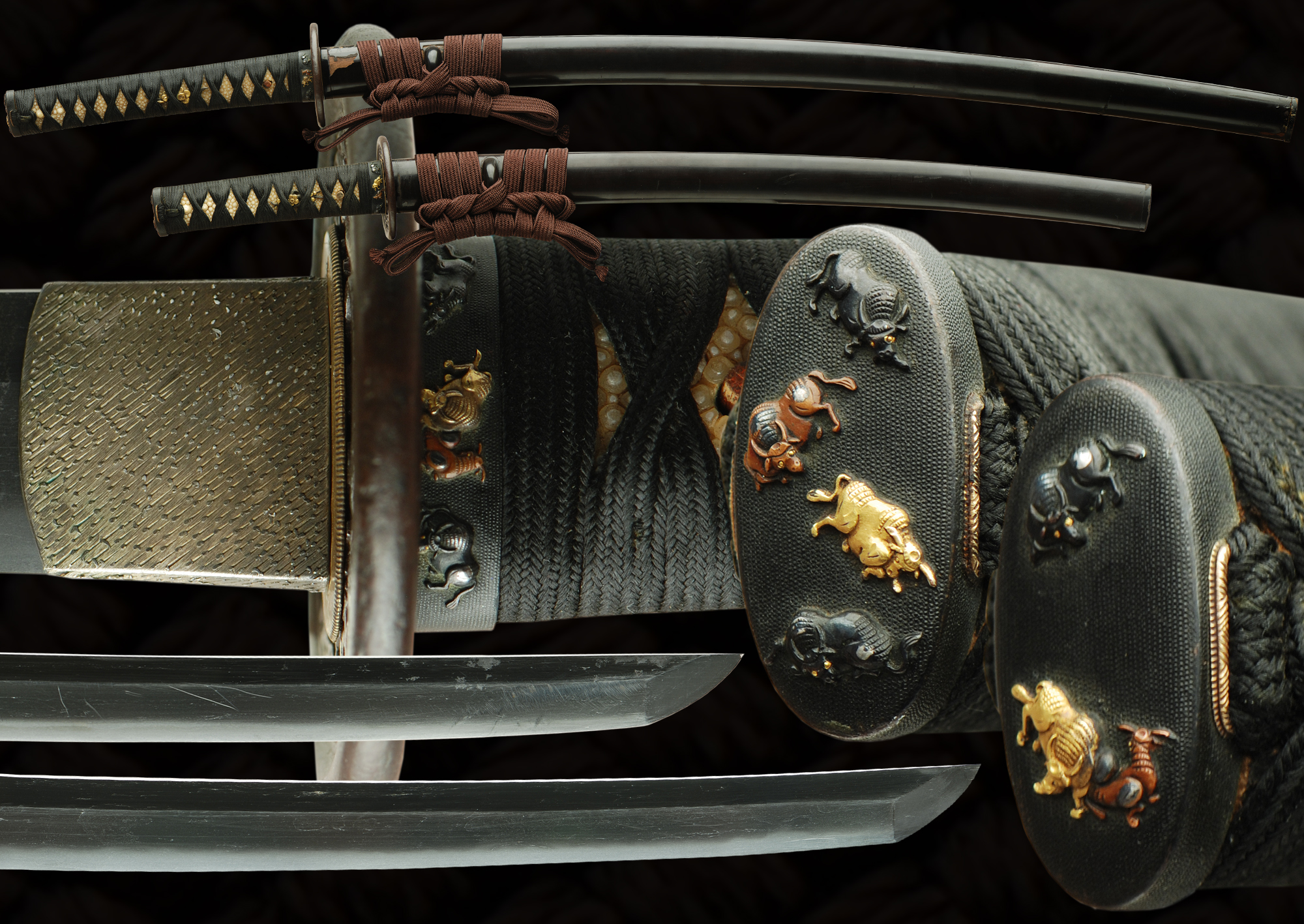
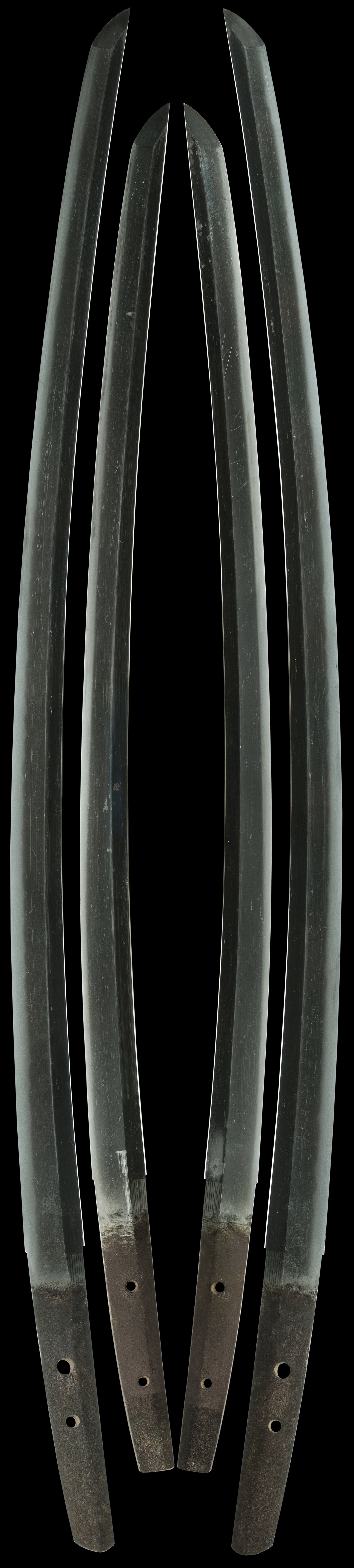
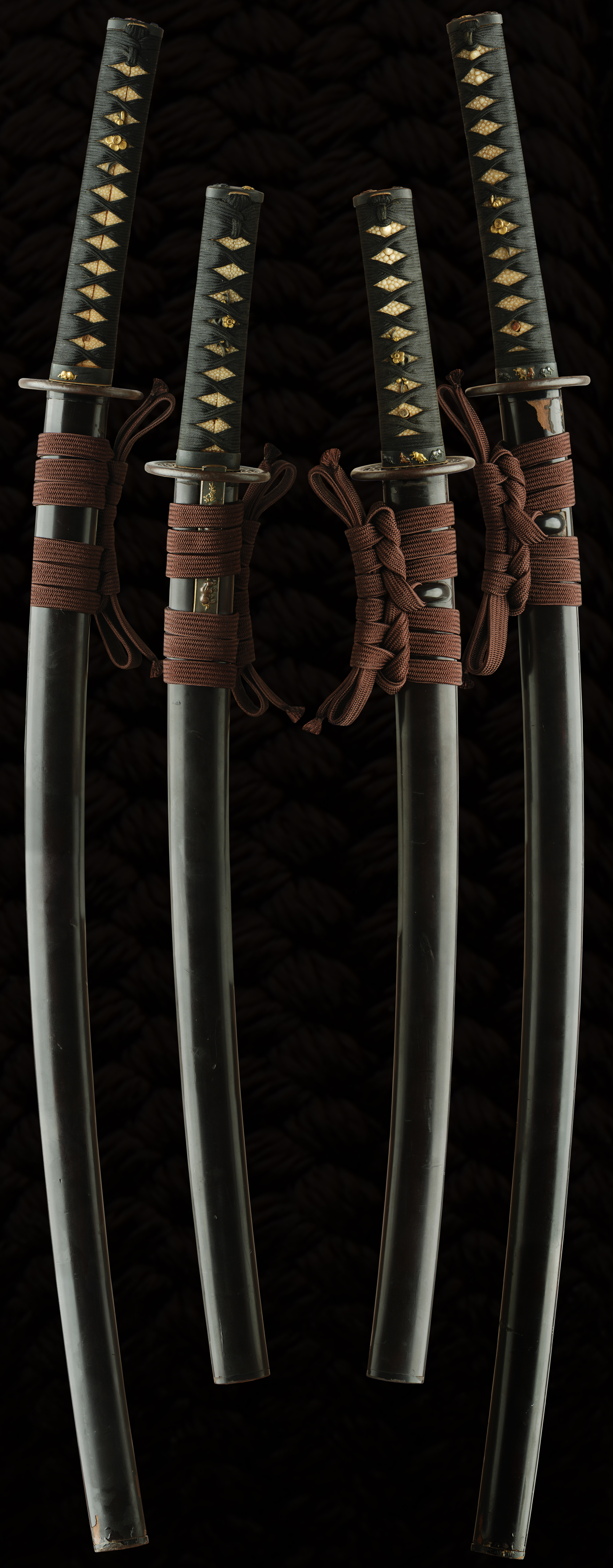
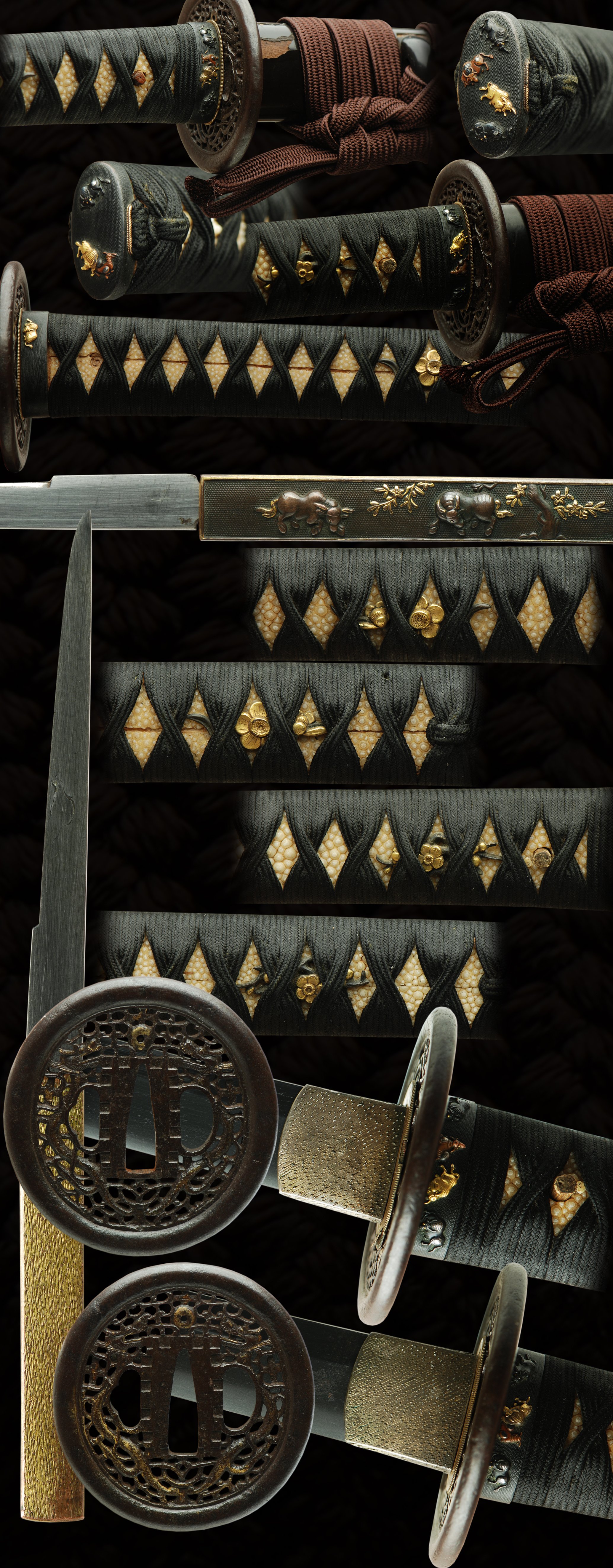
A True Samurai Daisho, These swords are mounted in an Oxen theme of very nice quality. The Motif is of oxen and are in pristine condition finished in shakudo, gold and copper with a fine nanako. The kodzuka is of oxen also with gold back finish. The saya are black with a brown sageo. The tsuba are nanban style but not your ordinary type. This daisho set are thick with a rounded rim that sings when tapped gently. There are dragons and a hidden Christian theme of crucifix’. The menuki appear to be Sakura of gold and shakudo finish. The ito is black and the same (rayskin have a beautiful patina). The habaki are an original matching silver foil with quite a patina finished in a rain storm pattern, just splendid. The katana is ubu, and loaded with activity. Within the Sugu-ha, gunome can be seen, there is hotsure, sunagahi and kinsugi. The hada is a dense and beautiful itame and mokume mix with some masame. It is signed katsumitsu and the signature looks good. The wakazashi an O-suriage piece, this sword has a hamon based in sugu-ha. The hada appears to be an itame nagare with ji-nie. The blades are both from the koto period. The wearing of daishō was limited to the samurai class, and became a symbol or badge of their rank. Daishō may have became popular around the end of the Muromachi(1336 to 1573)as several early examples date from the late sixteenth century an edict in 1629 defining the duties of a samurai required the wearing of a daishō when on official duty. During the meiji period, an edict was passed in 1871 abolishing the requirement of the wearing of daishō by samurai, and in 1876 the wearing of swords in public by most of Japan’s population was banned; this ended the use of the daishō as the symbol of the samurai, and the samurai class was abolished soon after the sword ban. DAI SHO This sword is on consignment.
Offered by Nihonto Antiques
This piece has sold
10 on the market
Get an email when new Katsumitsu School work hits the market.

Bizen-den · Bizen
10 pieces on the market now
The Katsumitsu school (勝光) grew within the Osafune workshops of Bizen province during their late-Muromachi phase, the period that the trade calls Sue-Bizen, when the smiths of the village worked in a shared idiom and signed their blades with the day and month of their making. The name Katsumitsu was carried by more than a dozen smiths from the middle of the Muromachi period onward, and the published sources single out those who cut a personal title above the mei: Ukyo-no-suke Katsumitsu, the senior of the line, and his son Jirozaemon-no-jo Katsumitsu, both counted among the most skilled of the Sue-Bizen makers and ranked beside Yosozaemon-no-jo Sukesada and Gorozaemon-no-jo Kiyomitsu as representative smiths of the late Bizen tradition. The line is inseparable from the Munemitsu branch, for Sakyo-no-shin Munemitsu was Ukyo-no-suke's younger brother, and the two hands together produced the joint blades long prized under the name Munekatsu gassaku. The genealogy continues into Jirobei-no-jo Harumitsu, son of Jirozaemon-no-jo Katsumitsu, whose own dated work survives across the Eisho, Daiei and Kyoroku eras of the early sixteenth century. The collective hand of the school is built on the open-waisted, double-structured gunome, the koshi-no-hiraita and fukushiki-gunome line that is the diagnostic late-Bizen signature, set over a well-packed ko-itame carrying ji-nie and fine chikei, in places a little standing or flowing. On the older and finer pieces a midare-utsuri rises over this steel, while on the latest blades the classical reflection has largely gone, the jigane itself looking powerful where the ji-nie lies fine as dust. The work is nioi-prevailing with ko-nie, ashi and yo entering richly, the nioiguchi clear and tightening, with small tobiyaki interspersed; the boshi answers the hamon, running midare-komi to a ko-maru or a pointed tendency with a turnback, and across both faces lie the devotional carvings of Sue-Bizen, a kurikara, bonji with suken, and shrine names such as Hachiman Daibosatsu and Amaterasu Kotaijin, which the sources are careful to ascribe to collaborating horimonoshi rather than to the smiths' own hands. Within this shared Bizen-den idiom the masters diverge by degree.
The Katsumitsu hands mix choji into the gunome most freely, the published record placing the conspicuous choji first in Katsumitsu and next in Munemitsu, for a more flamboyant effect than the plainer compound gunome general to the group; Munemitsu, by contrast, holds an established reputation as a superior maker of suguha, working a bright, smaller-scaled straight temper over an archaic-flavoured steel with standing utsuri. Harumitsu carries a quieter, more legible version of the same opened gunome, occasionally reaching back toward the older Oei-Bizen manner. To kantei a Katsumitsu blade is to weigh the high-grade chumon-uchi of the named masters against the bulk output of the Sukesada-era forges. The signed and dated pieces of the senior hands, with their bright choji-mixed gunome, their command of a clear suguha, and their fine devotional horimono, mark the upper edge of late-Bizen workmanship; Fujishiro grades both Katsumitsu hands Jo-jo saku and Harumitsu at the Jo-saku level. The school's signed and dated work survives in fair number, and its standing rests on documented joint blades and special-order commissions: the joint naginata-zukuri with Yosozaemon-no-jo Sukesada, dated Eisho 18 and incised Hagun-no-ken and Sanshin-soku-ittai, commissioned by Ukita Yoshie and treasured as an heirloom of the Sendai Date family; the Munekatsu katana and wakizashi, several forged on campaign at Kojima in Bitchu and valued for the light they throw on the smiths' movements; and the joint Katsumitsu-Harumitsu tanto and katana, prized as documentary material for the late Osafune genealogy. The patrimony runs through blades signed Bishu Osafune Katsumitsu recorded in Honma's inventory of the Imperial collection, through the joint katana inscribed Ichigo-ikkoshi held at Nogi Shrine, and through the old daimyo houses, each grounded in its own provenance. A signed Jirozaemon-no-jo or Ukyo-no-suke Katsumitsu, a dated Munemitsu, or a stout Harumitsu naginata comes to market only from time to time, and a dated, devotionally carved example, the kind on which one smith once wrote that nothing could surpass it, is a rewarding thing for a collector of late Bizen to encounter. Learn more →
| Smith | Era | Designated |
|---|---|---|
| Katsumitsu勝光 | 1490-1529 | 29 |
| Katsumitsu勝光 | 1469-1487 | 12 |
| Katsumitsu勝光 | 1528-1532 | 0 |
| Katsumitsu勝光 | 1492-1501 | 2 |
Bizen in the Muromachi period
War at home and trade abroad made Muromachi Bizen the busiest forge region in Japan: a century of Sengoku demand after the Ōnin War, and export missions to Ming China carrying blades by the tens of thousands.
We offer a 48 hour inspection period for all Antique items shipped within the United States only. If the item is not to your satisfaction, we will gladly refund your money less any shipping and handling fees. All sales are final after the 48 hour inspection period. Please note that all discounted items are a final sale and not returnable.