NihontoWatch MonNihontoWatchBETA
MarketEncyclopedia
NihontoWatch Mon

NihontoWatchBETA

Market
Encyclopedia
Overview·Kantei·Designations·Work Types·Signatures·School
OverviewKanteiDesignationsWork TypesSignaturesSchool
  1. Schools
  2. Goto
  3. Nobukiyo

Goto Nobukiyo

信清

Jūyō
Vol. 48, No. 251 · Mitokoromono

Goto Nobukiyo

信清

6 ranked works

SchoolGotoTraditionIeboriGeneration3rd genTypeTosogu MakerCodeOZA007
1Tokubetsu Jūyō5Jūyō Tōken

Overview

Miyata Nobukiyo (宮田信清), art name Kakumeisai, was born in Kyoto in Bunka 14 (1817) under the surname Kinoshita. At fifteen he was adopted into the Miyata family, hereditary shrine priests of Kamo Shrine. The following year he entered the school of Gotō Kakujō Mitsuyasu, sixth-generation head of the Gotō Rihee branch, where he received his foundational training in (official-house carving). At twenty-three he traveled to and studied under Gotō Mitsuaki, sixteenth head of the mainline Gotō house, deepening his command of orthodox Gotō technique. He became independent in Tenpō 14 (1843), establishing a workshop at Kayabachō in Nihonbashi, and later served as a retained metalworker to the Nanbu clan. He died in Meiji 17 (1884) at the age of sixty-eight.

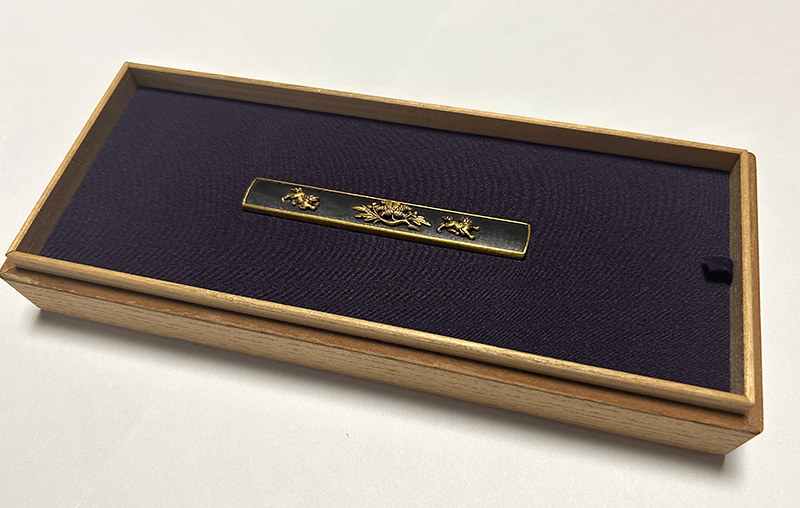
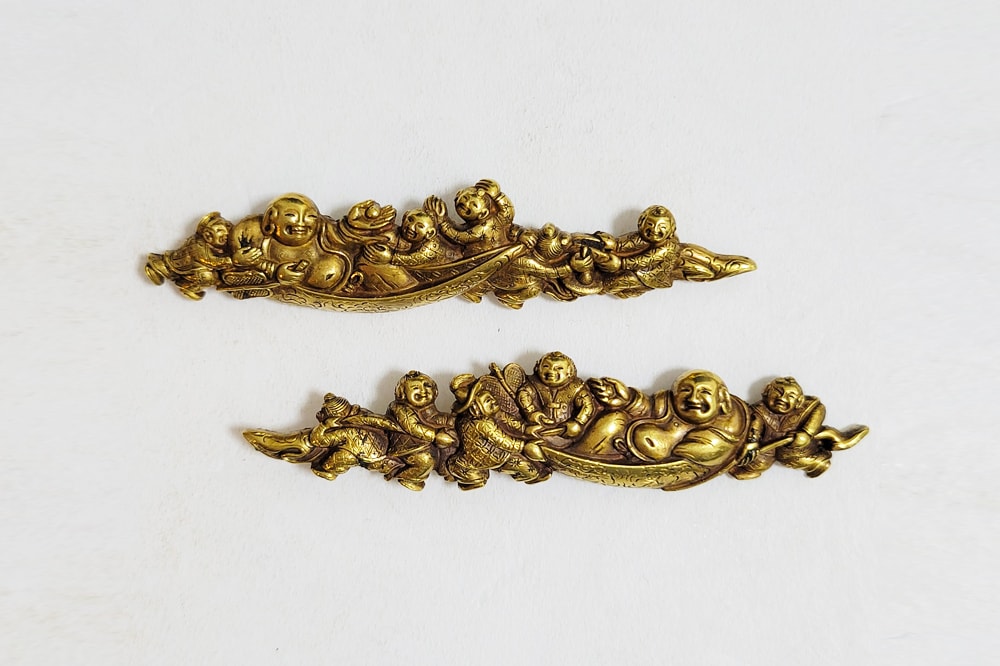
Nobukiyo's work is distinguished by its faithful transmission of Gotō-school methods executed with refined precision. His characteristic idiom employs grounds of exceptional density, producing the deep "wet crow-feather" luster prized in superior . Upon these grounds he renders figural and heraldic subjects — dragons and tigers, auspicious creatures, seasonal flower roundels, vine arabesques — in high relief, finished with restrained and occasional accents. His complete ensembles frequently encompass , , , , , and , unified by a single decorative program. The often feature yōbori (modeled carving) on gold grounds, while his range from signed guards to iron-cored leather constructions finished in tomo .

Nobukiyo occupies a distinctive position among late- metalworkers as a practitioner who absorbed roughly a decade of disciplined Gotō-school training and channeled it into complete ensembles of elevated, formal character. His surviving works are comparatively few, making preserved matched sets especially valuable for understanding the full scope of his style. The consistently careful workmanship, dignified compositional planning, and chromatic restraint across his oeuvre exemplify the highest standards of Gotō-lineage metalwork in the closing decades of the period.
Kantei

3 descriptive axes: material (the orthodox shakudo-nanako house grounds, with suaka and shibuichi besides) x technique (takabori and katachibori with gold and silver iro-e, the Goto-ryu hand) x themes (the house crests and orthodox dragon, tiger and auspicious subjects). The corpus is thin (six objects) and his hand is overwhelmingly the faithful Goto-ryu foundation, so genuine separators are few: the load-bearing one is the Mino-bori carving named on his Tokugawa-crest work.

Miyata Nobukiyo (1817-1884) is a late- metalwork artist who worked the orthodox Goto style as an independent master. Born in Kyoto under the family name Kinoshita, he was adopted at fifteen into the Miyata house, hereditary priests of the Kamo Shrine; at sixteen he entered the gate of Goto Mitsuyasu of the Rihei cadet branch, then went up to at twenty-three to refine his hand under the sixteenth main-house head Mitsuteru, becoming independent at twenty-five and later a retained metalworker of the Nanbu clan. He is filed under the Goto attribution, and the corpus bears this out: his complete sets of fittings are repeatedly judged to carry the Goto-ryu manner faithfully. Within that faithful house hand his one named departure is a -carving () treatment used on his Tokugawa-crest grounds. His surviving work is comparatively few.

Diagnostic discriminators

the records describe the one-set fittings of his hollyhock-crest daisho as Mino-carving-style sukishita-takabori; it is the one carving register the corpus names as distinct from his otherwise faithful Goto-ryu hand. Low-n: it is stated on a single object (the附属-replete daisho, designated both Tokuju and Juyo), so it is flagged as a thinly-supported tell.

Material (grounds)

The orthodox house ground, worked in fine above all, with solid gold on the , plain and , and and kezuri- (a spliced two-metal field) on individual pieces.

Technique

relief and for the , finished with gold, silver and iro-e in the Goto-ryu manner, with applied and the sukishita- he used in the -carving register, and gold iro-e on the reverse plate.

Themes (house crests and orthodox subjects)

The Tokugawa three-leaf hollyhock crest with scrolling vine on his Nanbu mounts, and the orthodox subjects of the house: dragons and tigers, the four numinous creatures, and auspicious clouds.

Crests, dragons and auspicious beasts

The Tokugawa hollyhock crest in arabesque, dragons and the dragon-and-tiger pair, the four numinous creatures, and auspicious clouds, all in the orthodox Goto-ryu hand.

Full iconography

Signature chronology

Recorded signatures

Documentary note

Nobukiyo signs his complete fitting-sets, dominantly with the surname-prefixed Miyata Nobukiyo and on the , , and , with the bare given-name Nobukiyo and on the of one mount, and with his go Kakumeisai (Kakumeisai Miyata Nobukiyo) on a four-numinous-creatures set; he also used the go Jurakusai. Within the mounts the unsigned grounds are read with the signed pieces as one-set work. Genuine discriminators are scarce here. The corpus is thin (six objects, only one Tokuju) and his hand is repeatedly judged to carry the Goto-ryu manner faithfully (his work expresses the house method), which is foundation, not a separator; the records also note his surviving work is comparatively few. The one carving register named as distinct is the treatment above, and it rests on a single object, so this profile scopes him honestly to the faithful Goto-ryu foundation plus that single low-n tell. A in the corpus ( 37-245) is a multi-artist mount whose is by Egawasai Katsura Sorin, its and bashin by Nobukiyo, and its by Kiyotoshi; those Sorin and Kiyotoshi marks are co-fitters' signatures, not Nobukiyo's.

Scholarship

A single setsumei (Juyo 48-251) notes that he studied the Goto house carving for about ten years, so that his four-numinous-creatures set is said to gather the Goto-ryu manner in complete and elevated form. It is one notice, scoped to that one set.

Designations

Kokuhō—
Jūyō Bunkazai—
Jūyō Bijutsuhin—
Gyobutsu—
Tokubetsu Jūyō1
Jūyō Tōken5

Elite Standing

0.00 across 6 designated works

Top 100% among makers

Work Types

Distribution across 6 ranked works

Other
6100%

Signatures

Signature types across 6 ranked works

Currently Available

Goto School

Other artisans of the Goto school

  1. 1.Goto Joshin後藤乗真6 for sale67designated
  2. 2.Goto Yujo後藤祐乗1 for sale41designated
  3. 3.Goto Kenjo後藤顕乗1 for sale45designated
  4. 4.Goto Sojo後藤宗乗53designated
  5. 5.Goto Tokujo後藤徳乗2 for sale31designated
  6. 6.Goto Eijo後藤栄乗9 for sale31designated
  7. 7.Goto Teijo後藤程乗10 for sale41designated
  8. 8.Goto Renjo後藤廉乗4 for sale33designated
  9. 9.Goto Tsujo後藤通乗1 for sale29designated
  10. 10.Goto Enjo後藤延乗3 for sale19designated
  11. 11.Goto Kojo後藤光乗1 for sale25designated
  12. 12.Goto Hojo後藤方乗1 for sale16designated

Nobukiyo

Nobukiyo(信清) was a maker of Japanese sword fittings (tōsōgu) of the Goto school.

The work follows the Iebori tradition.

Designated works by Nobukiyo include 1 Tokubetsu Jūyō, 5 Jūyō.