
Particulars
- Maker
- Mitsutada 光忠
- Type
- Tachi
- Period
- Mid-Kamakura period
- Measurements
- Nagasa 66.9 cm, sori 2.2 cm
- Papers
- Tokubetsu Jūyō Tōken, NBTHK 6th shinsa, 1978
- Collection
- Private collection
A tachi by Mitsutada, founder of the Osafune school, mid-Kamakura period. It is one of only two known blades signed with his long signature, Bizen no Kuni Osafune Mitsutada; the other, in the imperial collection, is the earliest blade known to name Osafune as its place of making. Its shortening has left this one only the first character. It is also one of five blades that link the flamboyant unsigned works attributed to Mitsutada with his more restrained signed work. Formerly owned by the Kan’in-no-miya princely house.
The second long signature
The Imperial Household’s Nagamei Mitsutada bears the signature “Bizen no Kuni Osafune Mitsutada.”
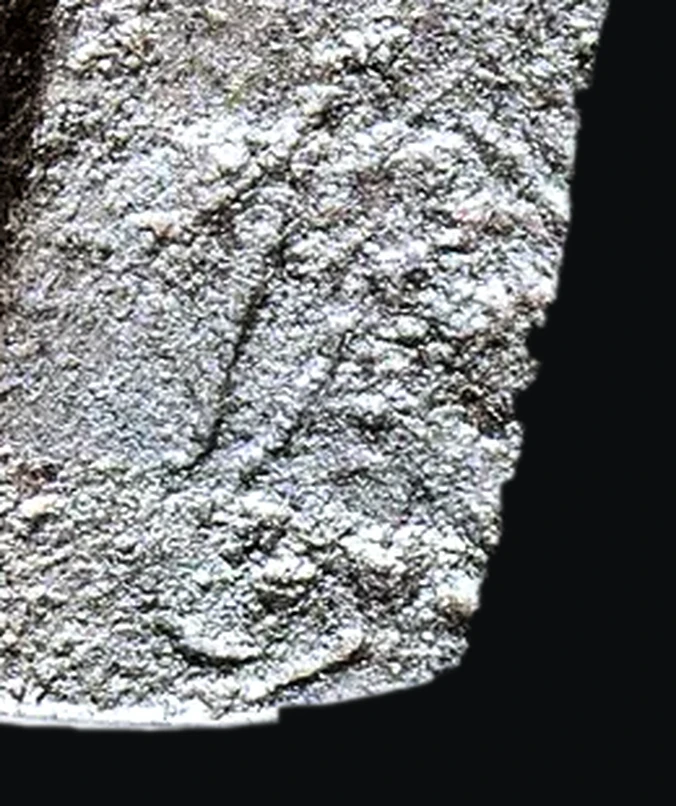
Such long nagamei was thought to be unique with a single sword on the record. However, in 1971, a second sword surfaced with a partially remaining nagamei reached Dr. Honma Junji. At the time, it was still the prevailing opinion that Ko-Bizen Mitsutada and Osafune Mitsutada were different smiths, and upon inspection, Honma remarked that certain stylistic elements were reminiscent of the Ko-Bizen smith of the same name. The sword bears the remnant of the long signature “Bizen no Kuni Osafune Mitsutada” (備前国長船光忠) with just the character 備 (Bi) and the first radical of 前 (Zen) remaining after the blade was shortened. It traces its provenance to the noble Kan’in-no-miya (閑院宮家) branch of the imperial family.1
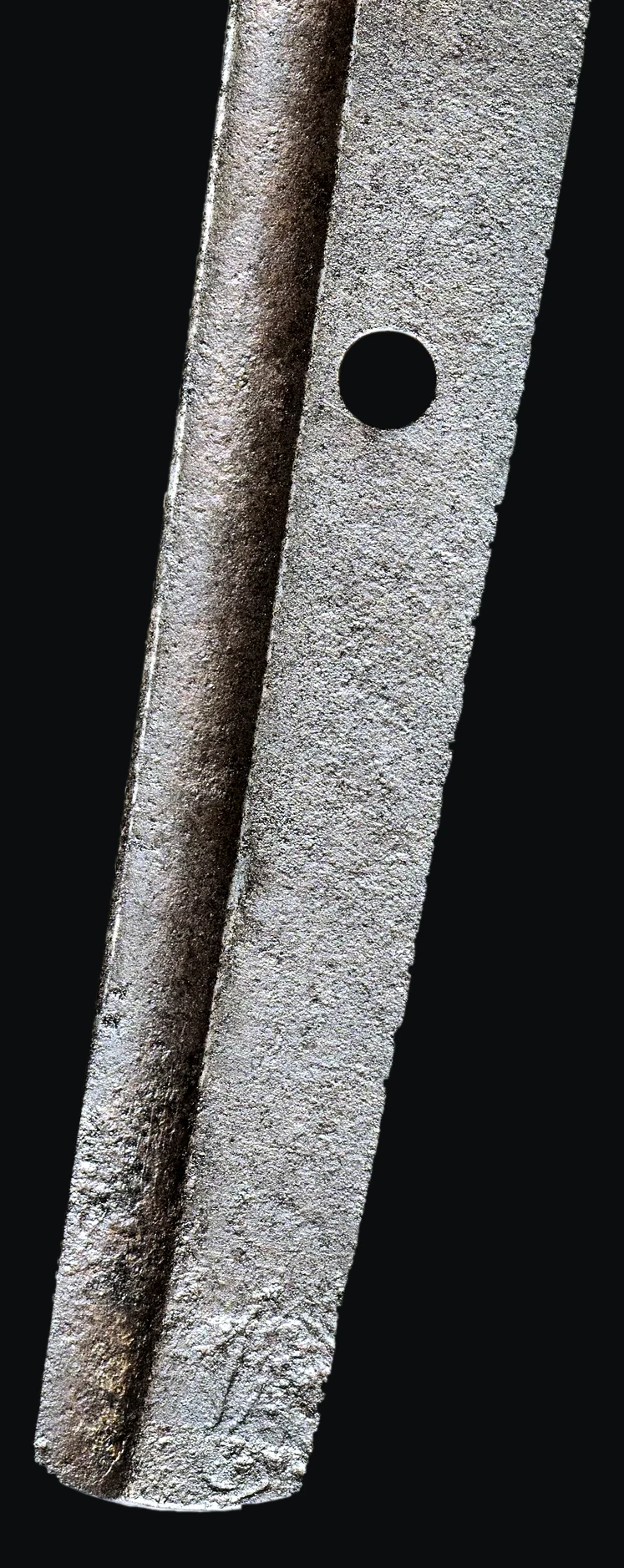
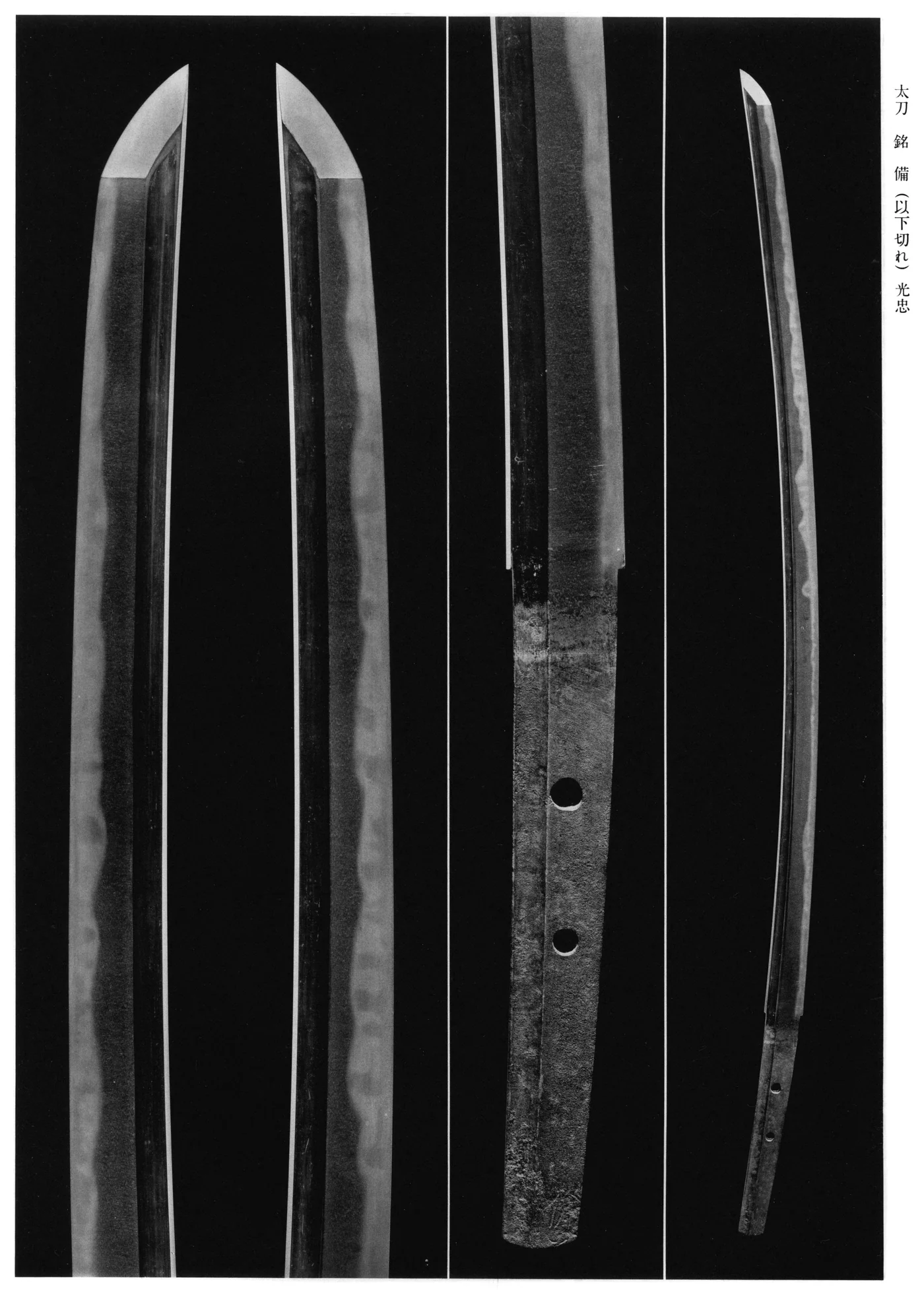
In contrast to the Nagamei Mitsutada, its hamon expresses the gorgeous flamboyance with kawazu no ko-chōji that is so typical for Mitsutada’s prime period of activity. For this reason, it can be said that its existence further reinforces the observed continuity between the Nagamei Mitsutada and the archetypical mumei types.
Form and proportions
While the tachi is of normal dimensions, it retains a deep koshizori, and was probably originally around 80 to 85 cm, with the shortening having led to the partial loss of the signature. The blade is crowned with an Ikubi kissaki, and retains a healthy boshi with a sharp kaeri. The sugata differs from the imposing archetype of Mitsutada, in that its motohaba, sakihaba, and kasane are of normal dimensions, but with the ashi not traversing too deep towards the ha, we can say that it has not lost much substance over the last 750 years. Closer inspection reveals that the dimensions almost perfectly match those of the Nagamei Mitsutada in terms of motohaba, sakihaba, and sori.
The NBTHK’s description of 1978 gives a length of 66.9 cm and a sori of 2.2 cm, a width of 2.65 cm at the base and 1.85 cm at the yokote, and a kasane of 0.55 cm, and records the form as somewhat slender, shinogi-zukuri with an iori-mune and a compact chū-kissaki, and, though shortened, still high in its koshi-zori. A bō-hi is cut on each face, carried through the tang on the omote and run off into it on the ura; the tang has a kurijiri, katte-sagari file marks and two peg-holes.2
Hamon and jihada
With the hamon rising gradually before peaking in a spectacular fashion at the mid-section, we recognize an element that is typical of the master. The Kan’in Mitsutada shares many traits in common with the Gyobutsu, such as an abundance of tobiyaki and the luster of its jihada.
Overall, the work exalts great depth and clarity born from the interplay of its flamboyant hamon, the dark antai, and the shimmering utsuri, and with all elements being tastefully in balance, it can be said that it truly exemplifies the ideal of Kamakura Bizen works. The florid elements of the hamon are formed with a wide and bright nioiguchi and rich ko-nie, creating ashi and yo, and near the kissaki, fine kinsuji slither in different directions.
The dense ko-itame jihada glitters with exceedingly fine ji-nie like fresh snow under moonlight, and on the basis of its luster, the blade could be mistaken for a work of the Awataguchi school.
As Dr. Honma Junji remarked, the sword shows a certain ancient flair reminiscent of Ko-Bizen, and this impression likely stems from the unaffected quality of the hamon executed with fine ko-nie along with the abundance of tobiyaki. This unaffectedness, or natural form emerging without contrived effort, is a trait shared with other grandmasters of Nihonto and, arguably, of great artists in general.
The NBTHK’s description of 1978 records the steel as a close itame with ji-nie, a little chikei and a vivid midare-utsuri, and the temper line as a chōji-midare mixed with kawazu-no-ko chōji and gunome, with tobiyaki; ashi and yō enter well, the nioi is deep, ko-nie are well formed, and kinsuji appear. The bōshi runs in as midare-komi and turns back from a pointed tip.2
The swordsmith
Mitsutada worked in Bizen during the mid-Kamakura period and is regarded as the founder of the Osafune school. His surviving works include signed tachi and shortened, unsigned blades attributed through their workmanship.
The NBTHK’s description of 1978 records that he is said to have been the son of Chikatada, and that, since no work by Chikatada is known, he is in effect the founder of the main line of the Osafune smiths. His manner, it continues, is a robust form with a lavish temper line mixing kawazu-no-ko chōji. Most of those works are unsigned; of the signed works most carry two characters only and are, by comparison, ordinary in form and modest in workmanship.2
The Kenwaroku, compiled by the Kenwakai in 1912, already records the same observation: it writes that Mitsutada mostly signed in two characters, and now and then cut 備前国長船光忠 or 長船光忠, and it records one tachi signed in the seven characters, in the house of Baron Iwasaki, with a blade length of 2 shaku 3 sun 7 bu and a half and grooves on both faces.3
「光忠の銘は多くは二字であるが、偶に『備前國長船光忠』とも、又は『長船光忠』と切つたるものもある」
“Mitsutada’s signature is mostly of two characters, but now and then he cut 備前國長船光忠, or 長船光忠.”
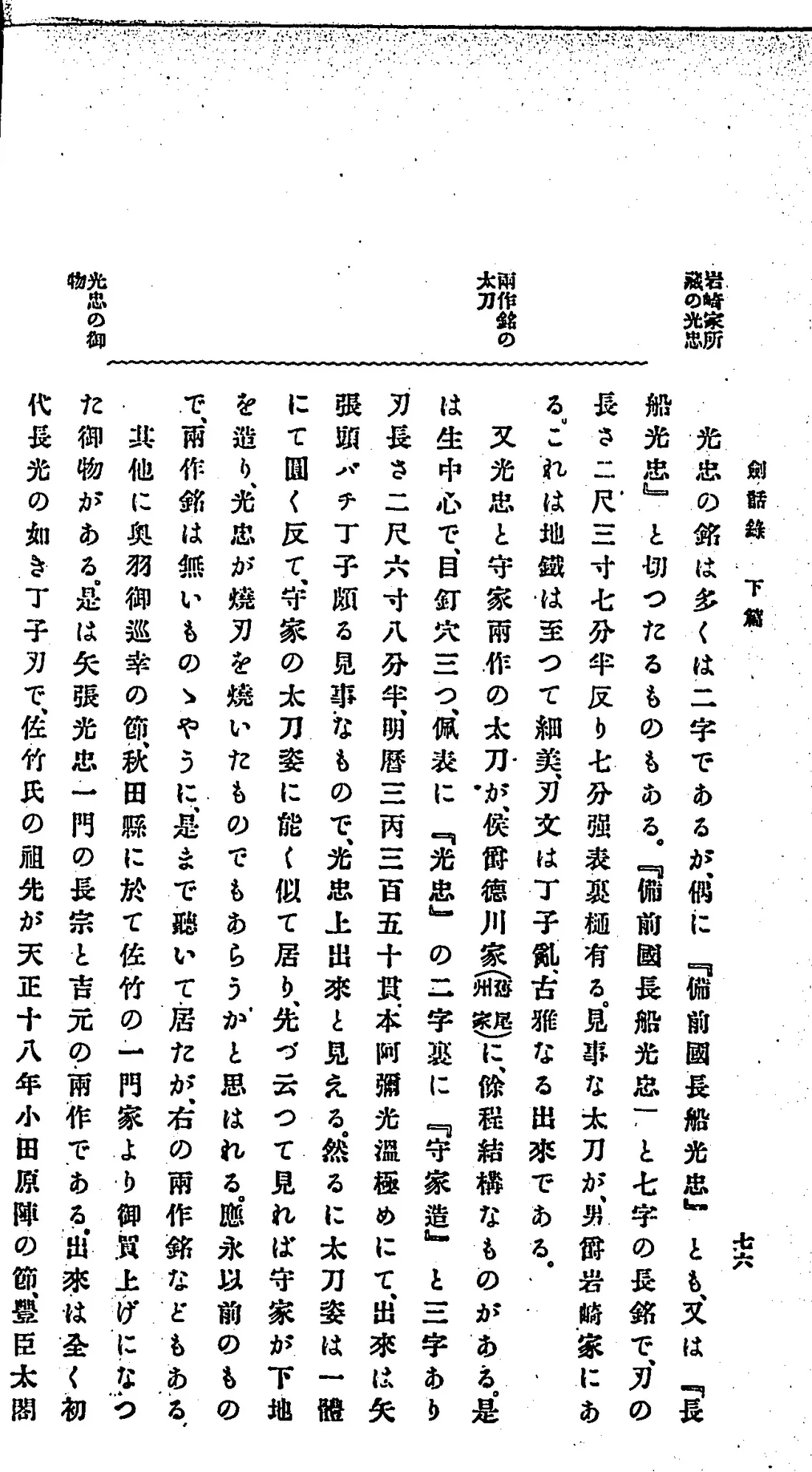
The long-signed tachi of the Iwasaki house is, it appears, the one in the imperial collection today. The catalogue of the imperial swords Gyoken (1998) records that on 29 December 1933 Iwasaki Koyata presented to Emperor Shōwa, in celebration of the birth of the Crown Prince, a tachi signed 備前国長船光忠, and that while Mitsutada ordinarily signed in two characters, the long signature is found on this work alone (通常は光忠二字銘であり、長銘はこの作に限る). It is this signature that the NBTHK set beside the one character left on the tang of the Kan’in Mitsutada in 1978.4
Honma sensei’s examination, and the papers
Honma Junji recorded his examination of the sword on 1 May 1971 in his Kantō hibishō: a tachi, “Bi… (cut off below) (Mitsutada)”, of 2.2 shaku, with two peg-holes, of normal width and originally deep in its koshi-zori. “The wide nioiguchi, the ko-nie-based hamon, and the nie-laden bōshi with its pointed kaeri are typical characteristics of Mitsutada,” he wrote, and the work is in part like the imperial tachi signed in the long signature; most signed Mitsutada he had seen resembled Nagamitsu, “but this blade is different and is fairly close to the style of Ko-Bizen Mitsutada of the same name.” He closes: “It is said that this blade was the guntō of Prince Kan’in Haruhito.”1
On 5 April 1954 the NBTHK had designated the sword Tokubetsu Kichō Tōken, entered as 太刀銘備前(以下切)伝備前光忠: a tachi signed 備前, the rest cut away, attributed to Mitsutada of Bizen, the attribution still qualified by 伝, “by tradition”.5
On 1 June 1971, a month after Honma’s examination, it was designated Jūyō Tōken at the 20th shinsa, item 167. The description calls the tachi, with the one character 備 remaining, “a tachi appraised as the work of Osafune Mitsutada” (長船光忠の作と鑑せられる太刀である), and closes: “Judged by its workmanship and the manner of its signature, the tradition concerning this tachi is correct” (この太刀はその作風、銘振りから鑑して、所伝は正しい).6
On 9 March 1978 it was designated Tokubetsu Jūyō Tōken at the 6th shinsa, item 18. The description notes that the imperial collection holds one signed 備前国長船光忠, “and the signature of this tachi is close to it” (この太刀は銘がそれに近似している). The tachi, it continues, is ordinary in form, yet has the lavish temper line Mitsutada excelled in and the pointed midare-komi bōshi characteristic of him, and it concludes that the blade joins the two bodies of his work.2
「小出来なものと豪壮華麗なものを同人作と結びつける尺度ともなり、出来が優れ資料的価値も高い」
“It also serves as a standard by which the modest works and the robust, flamboyant works may be recognised as the work of one smith; the workmanship is excellent, and its value as evidence high.”
Tanobe sensei’s examination
In November 2024 Tanobe Michihiro (Tanzan) wrote a sayagaki on the shirasaya. It records 備 and the upper part of 前 at the end of the tang, and notes that, apart from signatures of two characters, the only surviving blade signed 備前國長船光忠 is the one in the imperial collection. The hand of the remnant, he writes, closely resembles that signature, and, taken with the workmanship, leaves no doubt that the blade is the same smith’s; and, as on the imperial tachi, the groove is carried through into the tang and the signature cut on the flat beside it (see the tang above).7
In his extensive sayagaki, we learn that Tanobe Michihiro was manifestly moved studying the blade. He uses a highly florid and rare language to describe the piece as magnificent and full of lustrous beauty. He goes so far as to write kusshi-no-yūhin, translated here as “outstanding masterwork” but which literally means “countable on fingers masterwork”. This is exceedingly high praise, and he very rarely uses such expressions. In a sample of over 250 sayagaki, kusshi-no-yūhin appears just 11 times. What is almost unimaginable is that it is used here to qualify a work of Mitsutada, which can be understood to mean that this is one of the best extant works of the master.8
「同工壮年ノ屈指ノ優品而艶ヤカナ美シサヲ湛ヘ見事也」
“An outstanding masterwork from the prime of Mitsutada’s career; a magnificent blade full of lustrous beauty.”
Seasoned students know that the Tokubetsu Jūyō level has a very long tail of excellence extending well into Jūyō Bunkazai, and arguably all the way to National treasure. This sword, along with the Satake Mitsutada, is likely situated close to the edge of the distribution.
An imperial provenance
As for the provenance of the sword, it is no less remarkable. It was mounted as a war sword belonging to His Highness Prince Haruhito (閑院宮春仁王). Prince Haruhito was the son of Prince Kan’in Kotohito (閑院宮載仁親王), one of the most important figures in the history of 20th-century Imperial Japan, serving as mentor to the Emperor, Field Marshal of the Imperial Guard, and the longest serving Chief of the Army General Staff.
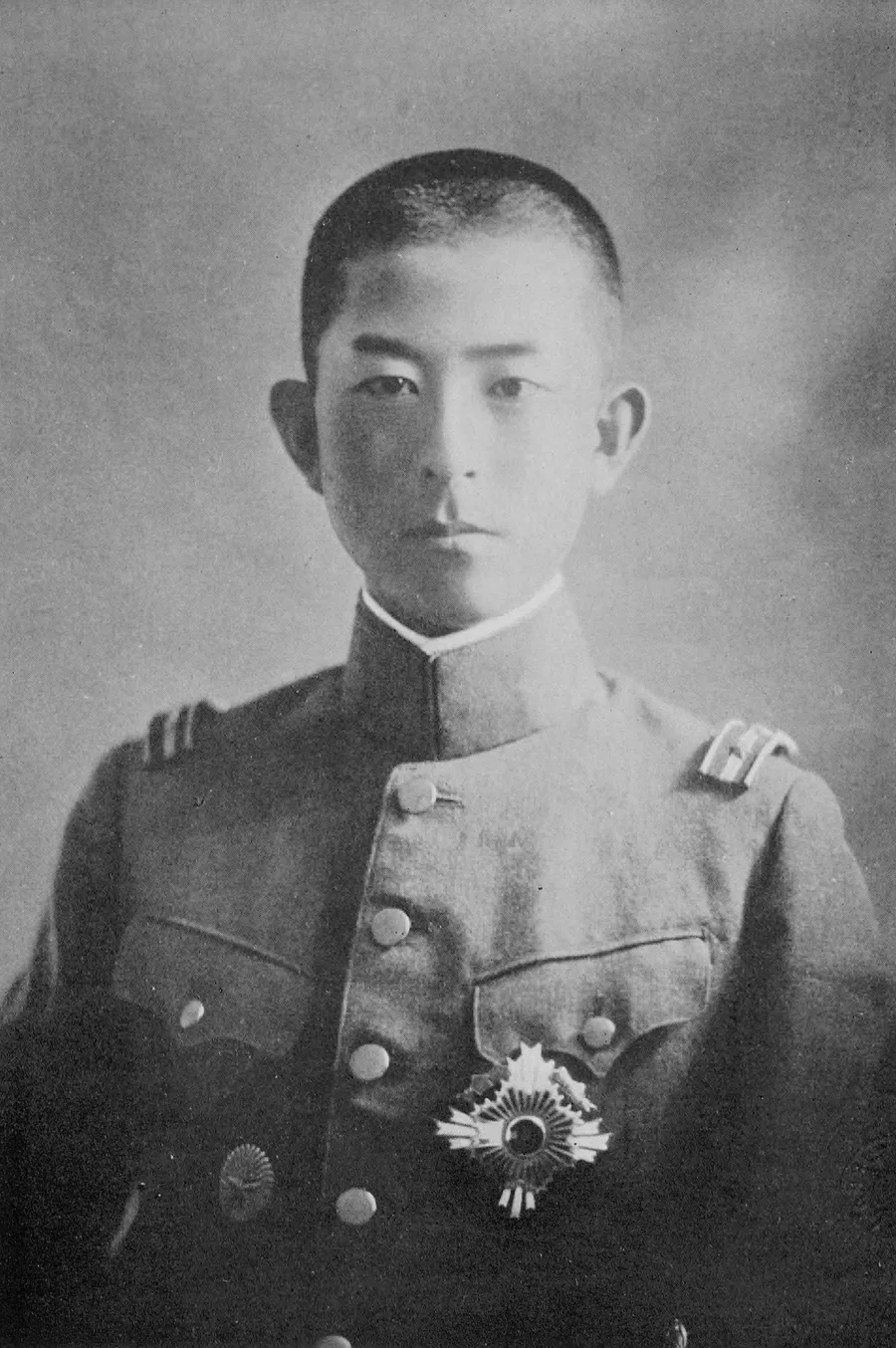
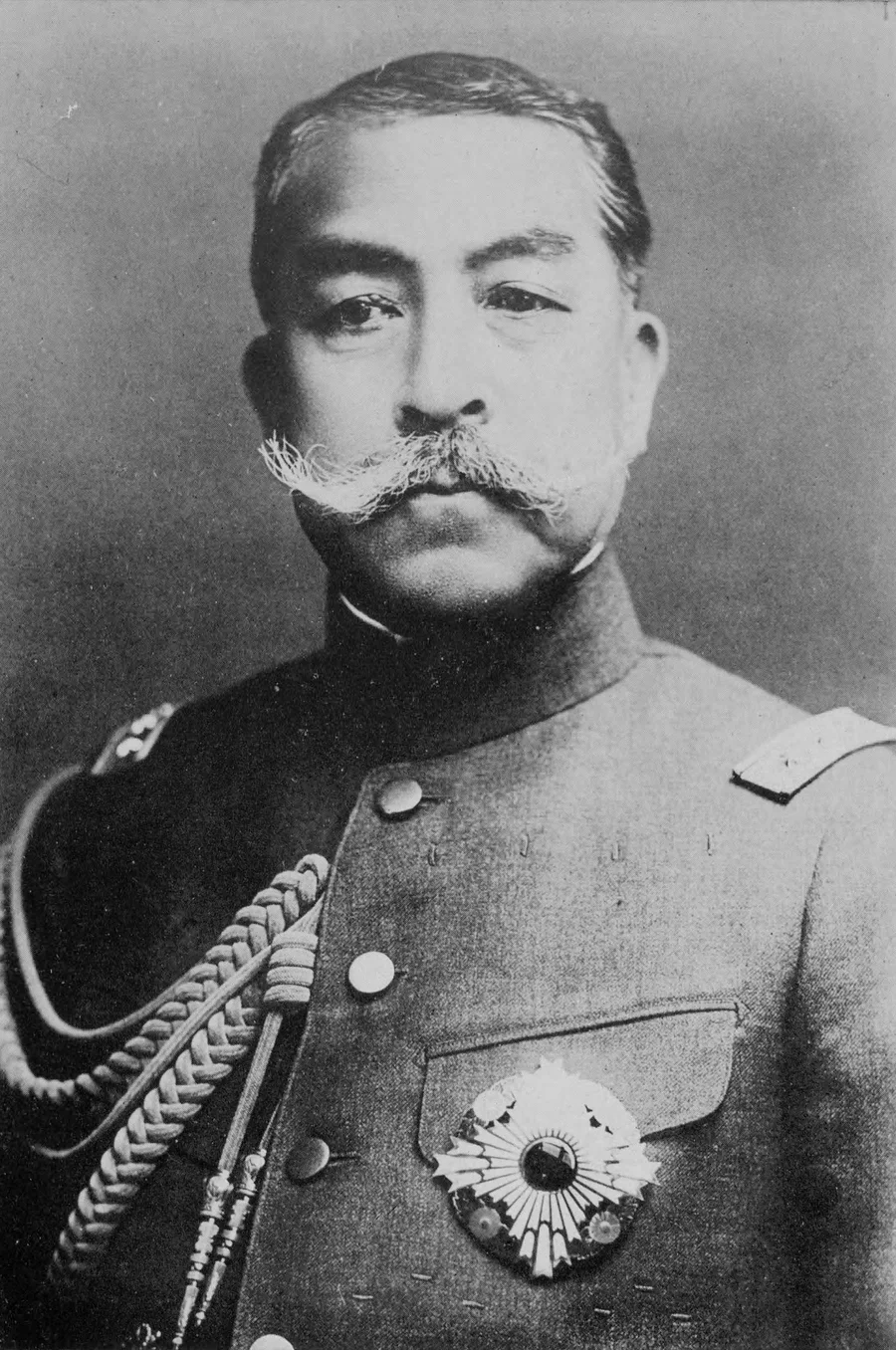
In 1946, Prince Kan’in Haruhito took action to protect the sword from any risk of confiscation by the allies. He placed the sword for safekeeping into the Imperial House Museum, which would later become the Tokyo National Museum. We often hear that Showa 26 (1951) Torokusho are the earliest issued licenses for possession, but this is not accurate. There is an earlier type, when the society was dealing with the chaos of the immediate aftermath of the war and the bureaucratic and legal apparatus had not devised the modern licensing system. The Prince was able to obtain such a license for possession on the 14th of October 1946, five years before the starting date of the new torokusho system. Through no small feat of fate, this document has survived to this day.9
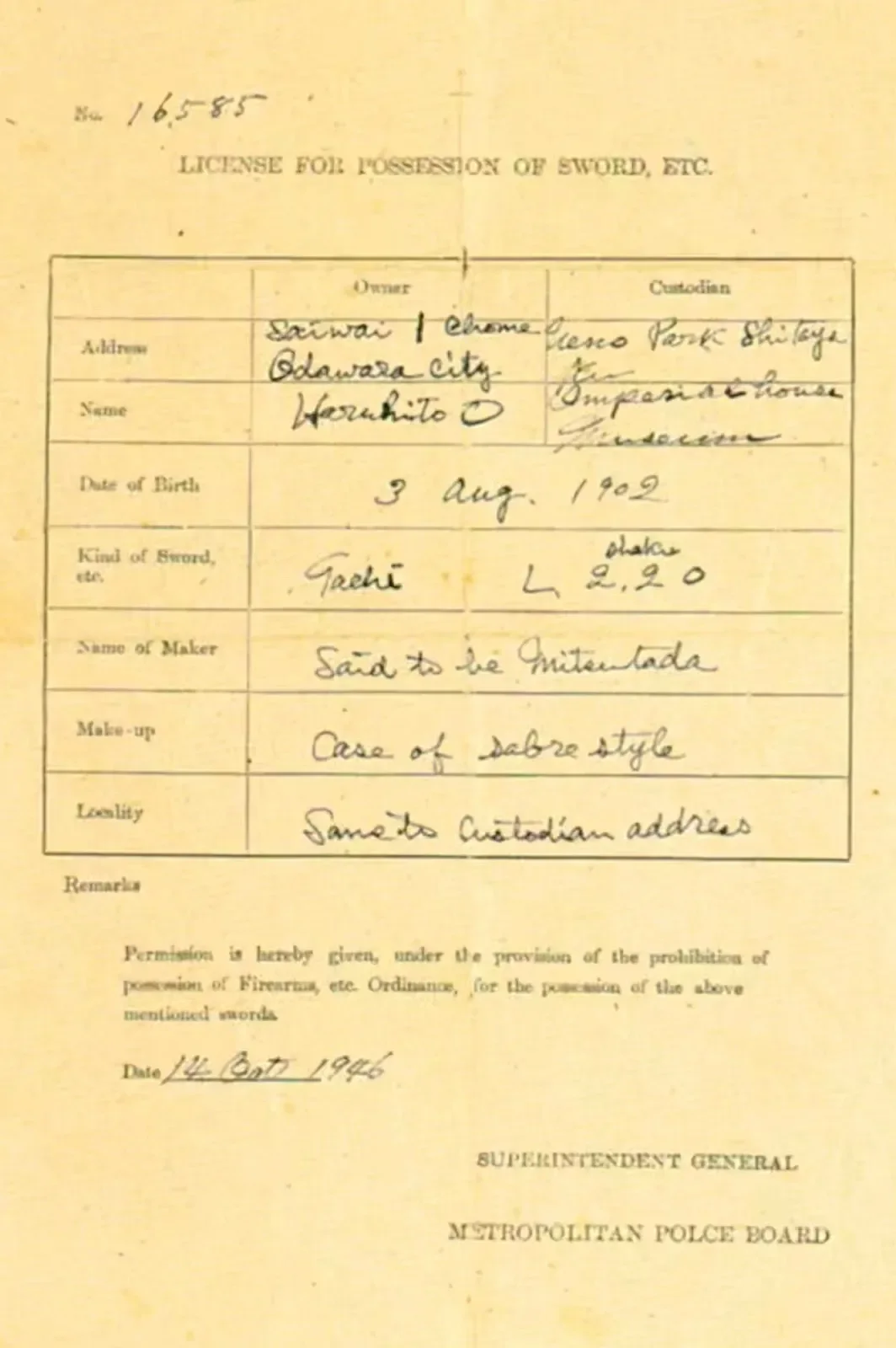
The licence, No. 16585, issued by the Superintendent General of the Metropolitan Police Board, is made out to “Haruhito O” for a tachi of 2.20 shaku, “Said to be Mitsutada”, in a case “of sabre style”, with the Imperial House Museum, Ueno, as custodian. It has come down with the blade, and its 2.20 shaku, about 66.7 cm, is within 3 mm of the blade’s 66.9 cm. Among the Mitsutada tachi recorded in those years, a tachi designated Jūyō Bunkazai measures 82.4 cm, the Sagara tachi is signed 光忠 in two characters, and the Toda tachi keeps four characters of its signature, 備前國長; the single 備 of a long signature is this blade’s.10
In 1961, 1963, and 1964, three swords with Kan’in-no-miya provenance passed Jūyō under different names. The Kan’in Mitsutada, however, would not surface for another ten years, until 1971, when it was brought to Dr. Honma Junji for examination. To give an indication of how rare this is, there are only six blades in the records of the NBTHK marked as former imperial property, whereas we have 749 swords with Daimyo provenance, and of these, 147 with the high-level provenance to the Tokugawa family. Of course, it is important to know that for understandable reasons of social unease, many great treasures originating from the collections of the elite have had their provenance obfuscated to preserve discretion, and hence it is necessary to take this data with a grain of salt. Thanks to the passage of time, unease surrounding provenance has gradually subsided and there is now considerably more openness and interest into reconnecting these treasures with their history.11
The war mounts
The blade’s mounts of the 1930s survive, now apart from it: Type 94 army mounts with the silver crest of the Kan’in-no-miya, a tsuba stamped Shōwa 10 (1935), and an occupation tag reading “LT GEN HARU KANIN 15-217”.12
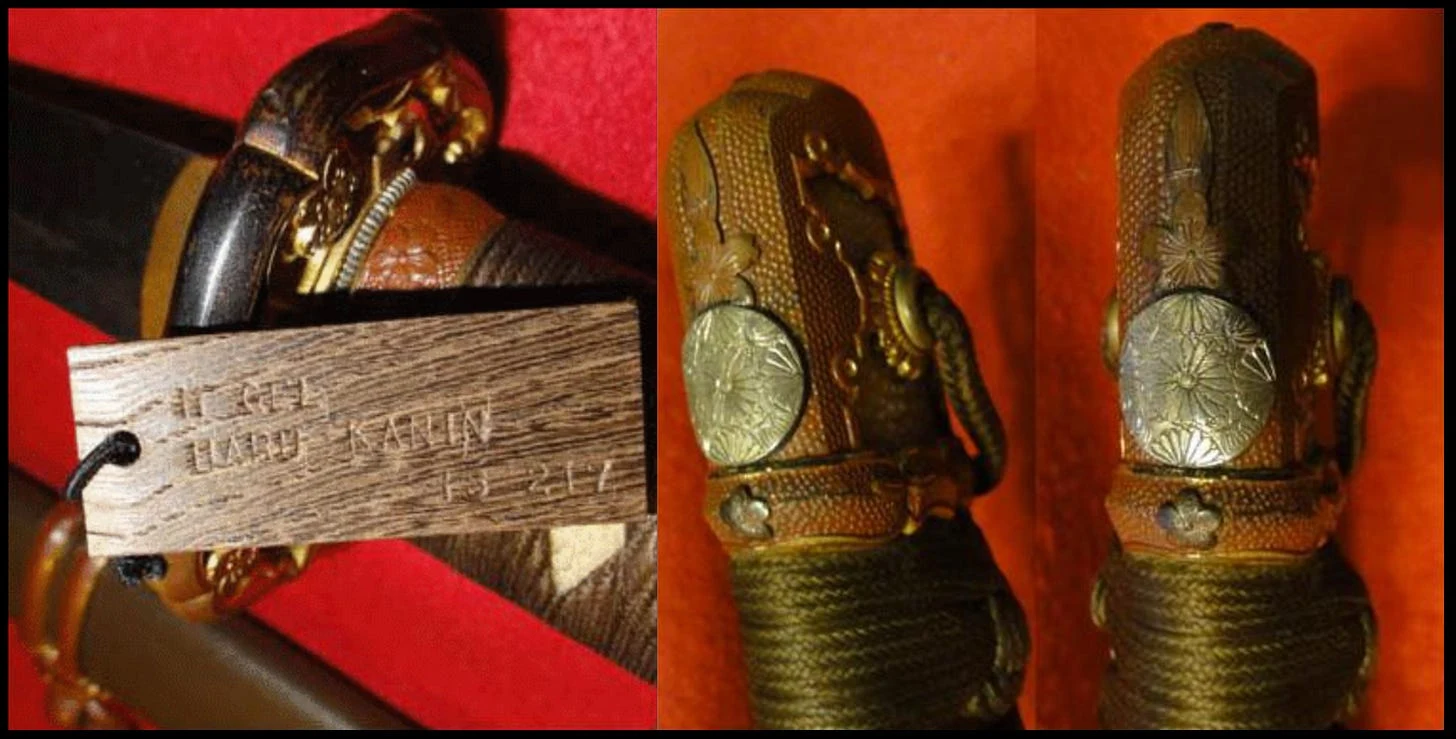
The gunto is an early Type 94 and this can be inferred from the curved tsuka, thick tsuba, and a low position of the sarute. These early type 94 koshirae began production in 1934 and were issued specifically to commissioned officers. This particular mount was ordered early on, in 1935, as evidenced by the marking on the tsuba. The kashira bears a finely crafted silver crest of the Kan’in-no-miya family.
Such early Type 94 mounts are rare, and were ordered through the officer’s club and custom fitted to the blades provided. For this reason, it is in these early war mounts that we most often find ancient heirloom blades.
We know the dimensions, with a total length of 91 cm and a handle length of 23cm, and from here, we can deduct that the length of the saya was approximately 68cm, and with the Kan’in Mitsutada having a nagasa of 67 cm in length, we have a perfect match. Next, we check if the sori of the blade, standing at 2.2cm with its pronounced koshizori typical of the Kamakura period, matches the sori of the Type 94 mounts. Here again, we find a match. As a final check, we can compare the position of the mekugi-ana with the tsuka, and we find that it overlaps perfectly with the top most mekugi-ana of the blade, and with all these elements matching, we can conclude with a high degree of confidence that the Kan’in Mitsutada was the original blade of this Type 94 gunto.12
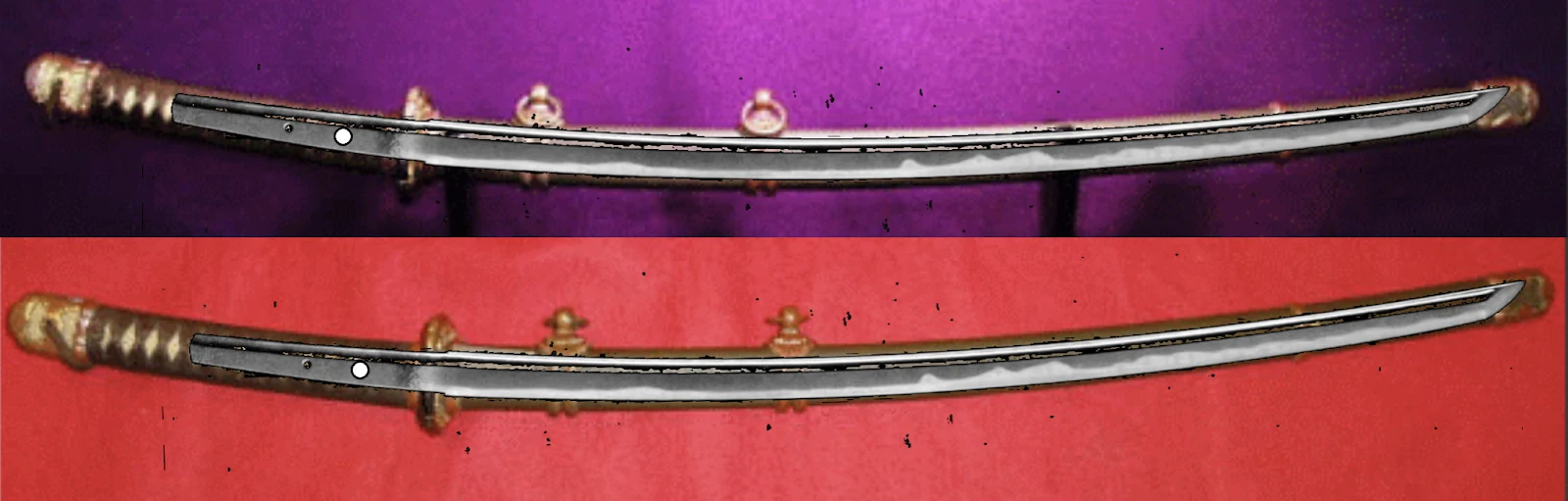
The mounts appear to have been made for Prince Kan’in Kotohito, Haruhito’s father, or by his order, and to have passed to Haruhito on Kotohito’s death in May 1945. If so, the sword was probably in the house from about 1935, the date on the tsuba.13
While it may seem surprising, it was not unusual for such highly important treasure blades to be mounted as Gunto. For example, it is well known that admiral Tōgō Heihachirō (東郷 平八郎) was bestowed an important sword by Emperor Meiji, bearing a gakumei to the famous Ichimonji master Yoshifusa. This important blade was mounted in a Navy admiral’s mounts, and is still extant today. It has been elevated to Jūyō Bunkazai after the war.
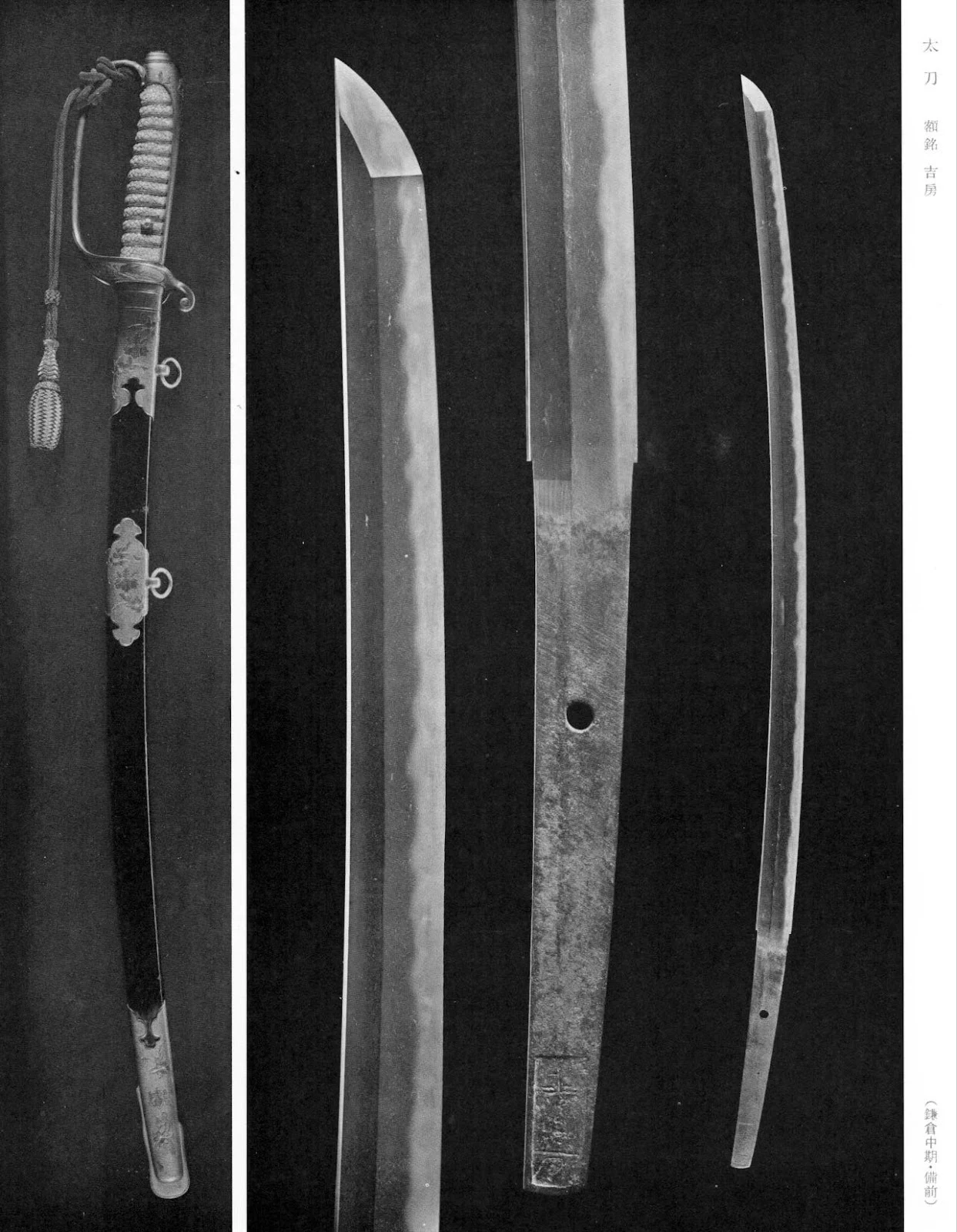
After the war the swords of the house were, it appears, sold together between 1946 and 1948 and dispersed, each with a note in the prince’s hand. The account comes from a sword dealer’s memoir.14
The Kan’in Mitsutada
The Kan’in Mitsutada is an important link between Mitsutada’s more restrained signed works and the flamboyant mumei blades attributed to him. The remnant of its long signature and its brilliant chōji-midare establish its documentary significance, while Tanobe sensei’s examination recognises it as a masterpiece of the smith’s prime.
Five such linking blades are recorded, each a meitō in its own right: the Satake Mitsutada, a two-character signed tachi from the Satake, daimyō of Akita, designated Tokubetsu Jūyō in 2002; the Takamatsu Mitsutada, signed in two characters, from the Takamatsu-no-miya and now in the Tokyo National Museum, an Important Cultural Property; the Sagara Mitsutada, signed in two characters, from the Sagara clan, a Jūyō Bijutsuhin; the long-signed tachi in the imperial collection, the only complete long signature by Mitsutada and the earliest blade known to name Osafune as its place of making; and the Kan’in Mitsutada.15
The museum’s record rests the house’s holding of the sword on the licence of 1946, issued to Prince Kan’in Haruhito, and on it the museum names the sword the Kan’in Mitsutada, formerly in the collection of the Kan’in-no-miya.9
Provenance
Formerly in the Collection of the Kan’in-no-miya Princely House
Mid-Kamakura period
Made in Bizen by Mitsutada, founder of the Osafune school, and signed with a long signature.
Per the papers
c. 1935–1945
In Type 94 army mounts with the silver crest of the Kan’in-no-miya, made, it appears, for Prince Kan’in Kotohito; it passes to his son Prince Haruhito in 1945.
Well supported
1946
A possession licence of 14 October names “Haruhito O”, identified by provenance research as Prince Kan’in Haruhito (閑院宮春仁王), with the Imperial House Museum, Ueno, as custodian.
Established
1946–1948
The swords of the Kan’in-no-miya are dispersed, it appears, through the dealer Iida Kunitarō.
Well supported
1954
Designated Tokubetsu Kichō Tōken by the NBTHK (5 April).
Established
1971
Designated Jūyō Tōken, NBTHK 20th shinsa (1 June, item 167).
Established
1978
Designated Tokubetsu Jūyō Tōken, NBTHK 6th shinsa (9 March, item 18).
Established
2024
Sayagaki by Tanobe Michihiro (Tanzan), November.
Established
Enter the case
The work in its KATANA BAKO case, in the museum’s rooms.
Notes
- 1Honma Junji, Kantō hibishō, vol. 1, the entry of 1 May 1971. ↩
- 2NBTHK, Tokubetsu Jūyō Tōken, 6th shinsa, designated 9 March 1978, item 18: the designation record and the description of the work. ↩
- 3Kenwaroku, vol. 2 (ed. the Kenwakai, 1912), p. 76 (National Diet Library, pid 854114, frame 46). ↩
- 4Gyoken (ed. Mainichi Shinbunsha, supervised by Ogasawara Nobuo, 1998) (National Diet Library, pid 14013237, frame 60). ↩
- 5Tokubetsu kichō tōken bunrui mokuroku (1957), the entry for the sword (National Diet Library, pid 2497066, frame 41). ↩
- 6NBTHK, Jūyō Tōken, 20th shinsa, designated 1 June 1971, item 167: the designation record and the description of the work. ↩
- 7Sayagaki by Tanobe Michihiro (Tanzan) on the shirasaya, dated 甲辰霜月, November 2024, read in full from photographs of the scabbard. ↩
- 8The count is the original essay’s (2025), made in a sample of more than 250 sayagaki by Tanobe. ↩
- 9License for Possession of Sword No. 16585, issued 14 October 1946 by the Superintendent General of the Metropolitan Police Board; the original document accompanies the sword. ↩
- 10The tachi attributed to Mitsutada designated Jūyō Bunkazai (National Diet Library, pid 12634817, frame 69); the Sagara tachi, the lists of works certified Jūyō Bijutsuhin, item 576 (pid 12743662, frame 10); the Toda tachi, Jūyō bijutsuhin-tō nintei bukken mokuroku (pid 12416521, frame 71). ↩
- 11The figures are the original essay’s (2025), counted in the NBTHK’s records, as are the three Kan’in swords of 1961 to 1964. ↩
- 12Photographs and measurements of the mounts, in the museum’s research file. ↩
- 13Nihontō zenshū, vol. 7, on the scabbards made for the Kan’in revised-pattern army swords (National Diet Library, pid 2474929, frame 130). ↩
- 14A sword dealer’s memoir, listed with the sources of the Record of Provenance. ↩
- 15The five linking blades as identified in the study Grandmaster Mitsutada (2025), with their designations and provenance as given there. ↩
Private collection
The presentation
- The case
- KATANA BAKO, by Keisuke Nakamura
- Film and presentation
- The Meihin Museum
- The full-length photographs
- Paul Kremers, tsuba.info
- The papers
- NBTHK, Tokubetsu Jūyō Tōken, 6th shinsa, 1978
- Research
- Grandmaster Mitsutada (2025)