Edo was the sword’s age of connoisseurship: the Hon’ami appraisers, the shogunal register of famous blades of 1719, and a thriving literature turned the sword into an object of study even as it ceased to be drawn in war.
 NihontoWatchNihontoWatch
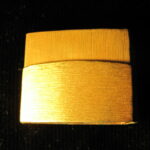
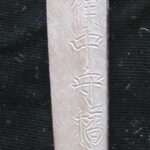
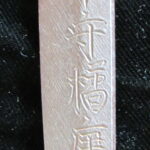
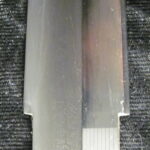
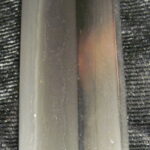
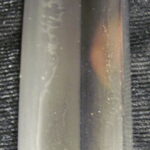
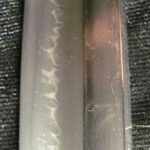
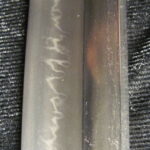
Q836. Katana signed Bitchu no Kami Tachibana Yasuhiro. Nagasa: 27 7/16″ 69.6 cm. Sori: 1.75 cm. Moto haba: 3.1 cm. Moto kasane: .8 cm. Saki haba: 2 cm. Saki kasane: .5 cm. Nakago nagasa: 7 7/16″ 19 cm. Overall in shirasaya: 38 1/2″ 98 cm. Shinogi zukuri, shallow koshi zori, iore mune, and chu kissaki. The hada is ko itame with utsuri; in the shinogi ji it is a fine masame. The hamon begins with a straight yaki dashi and becomes wide variations of chogi with leggy ashi, hotsure, and tobiyaki, all in a bright nioi guchi covered in finest ko-nie. The boshi is slightly undulating and ends in a bit of hakkikake in ko-maru with a long kaeri that shows as mune-yaki down the back of the blade. The katana is wider and thicker than the standard model; it is impressively heavy. It is mounted with a quite nice double gold foil habaki and in well made shirasaya. It is in polish and comes with a Tokubetsu Hozon paper from the NBTHK in Tokyo, dated 2009 and attesting to the quality and validity of the signature. This blade is flawless. 1st generation Yasuhiro was the 2nd son of the founder of the Kishu Ishido School: Tosa Shogen Tameyasu. The Ishido School and its various branches arose in early Edo and made their mark in copying work of early Bizen Ichimonji. Yasuhiro worked in the latter half of the 17th century; he is rated Chujosaku and Wazamono in Fujishiro’s Nihon Toko Jiten. My pictures don’t do justice to the bright and clear choji hamon on this one; I can guarantee you’ll like it better in hand. 3 pounds, 1 ounce.
NihontoWatchKishu Ishido School紀州石堂派
Offered by Japanese Sword Books and Tsuba
This piece has sold
3 on the market
Get an email when new Kishu Ishido School work hits the market.
Shinto · Kii
3 pieces on the market now
| Smith | Era | Designated |
|---|---|---|
| Masatoshi正俊 | — | 1 |
The Edo period (1615 to 1868)
Edo was the sword’s age of connoisseurship: the Hon’ami appraisers, the shogunal register of famous blades of 1719, and a thriving literature turned the sword into an object of study even as it ceased to be drawn in war.
A Hozon-certified blade judged to show notably superior workmanship and a better state of preservation. The bar is higher: re-tempered blades and most unsigned Muromachi/Edo works are excluded.
The NBTHK (Nihon Bijutsu Tōken Hozon Kyōkai, the Society for the Preservation of Japanese Art Swords) is a public-interest incorporated foundation founded in 1948 and supervised by Japan’s Agency for Cultural Affairs (Bunkachō); it is based at the Japanese Sword Museum in Tokyo. Its expert panels physically examine each submitted work (shinsa) and issue a certificate (kanteishō) ranking it by artistic and historical merit. NBTHK papers are the most widely recognized standard of authentication for Japanese swords and fittings.
NBTHK official site3-day return window from receipt.