NihontoWatch MonNihontoWatch
Market
Encyclopedia
Kantei
NihontoWatch MonNihontoWatch
Market
Encyclopedia
Kantei

Description

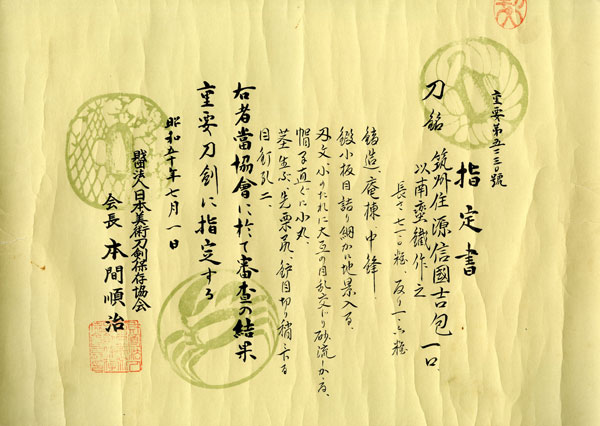
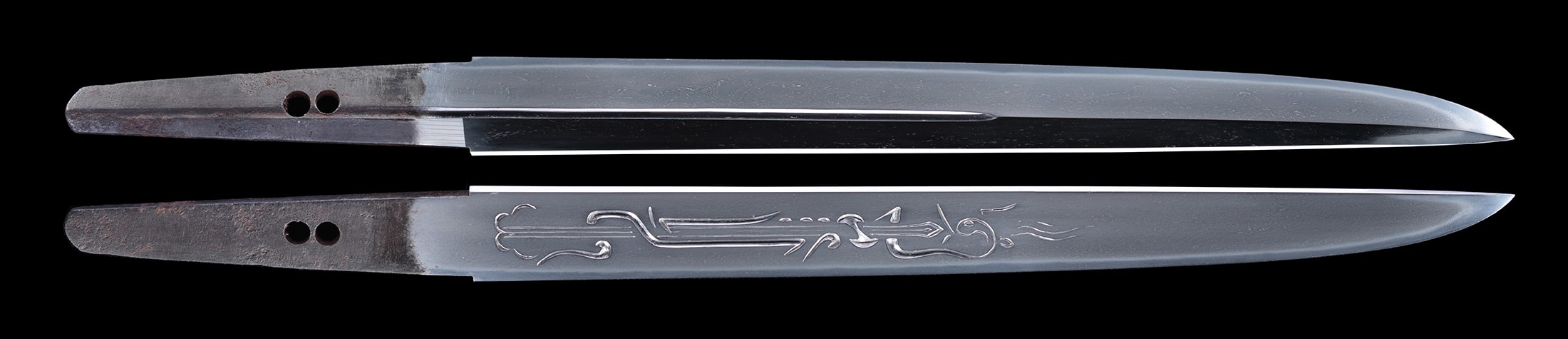
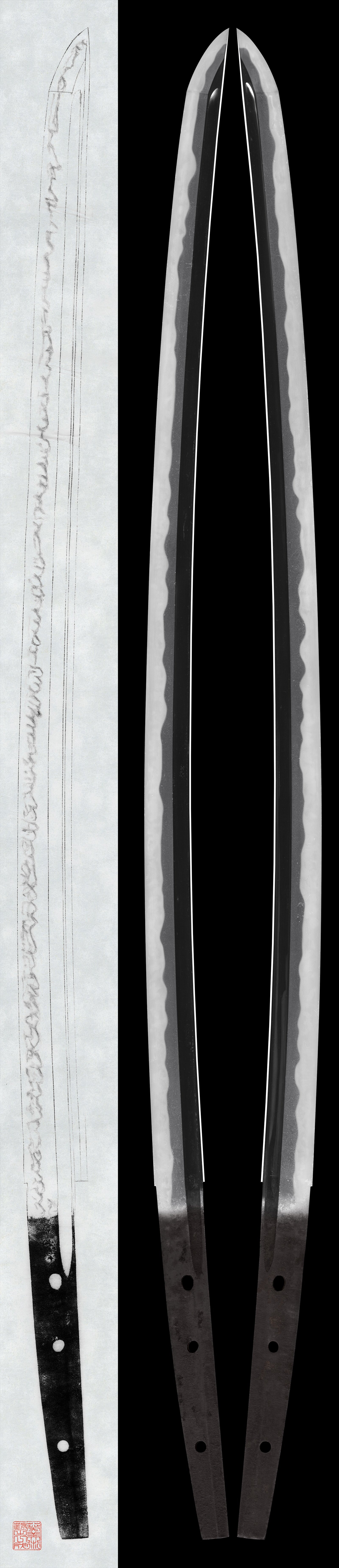
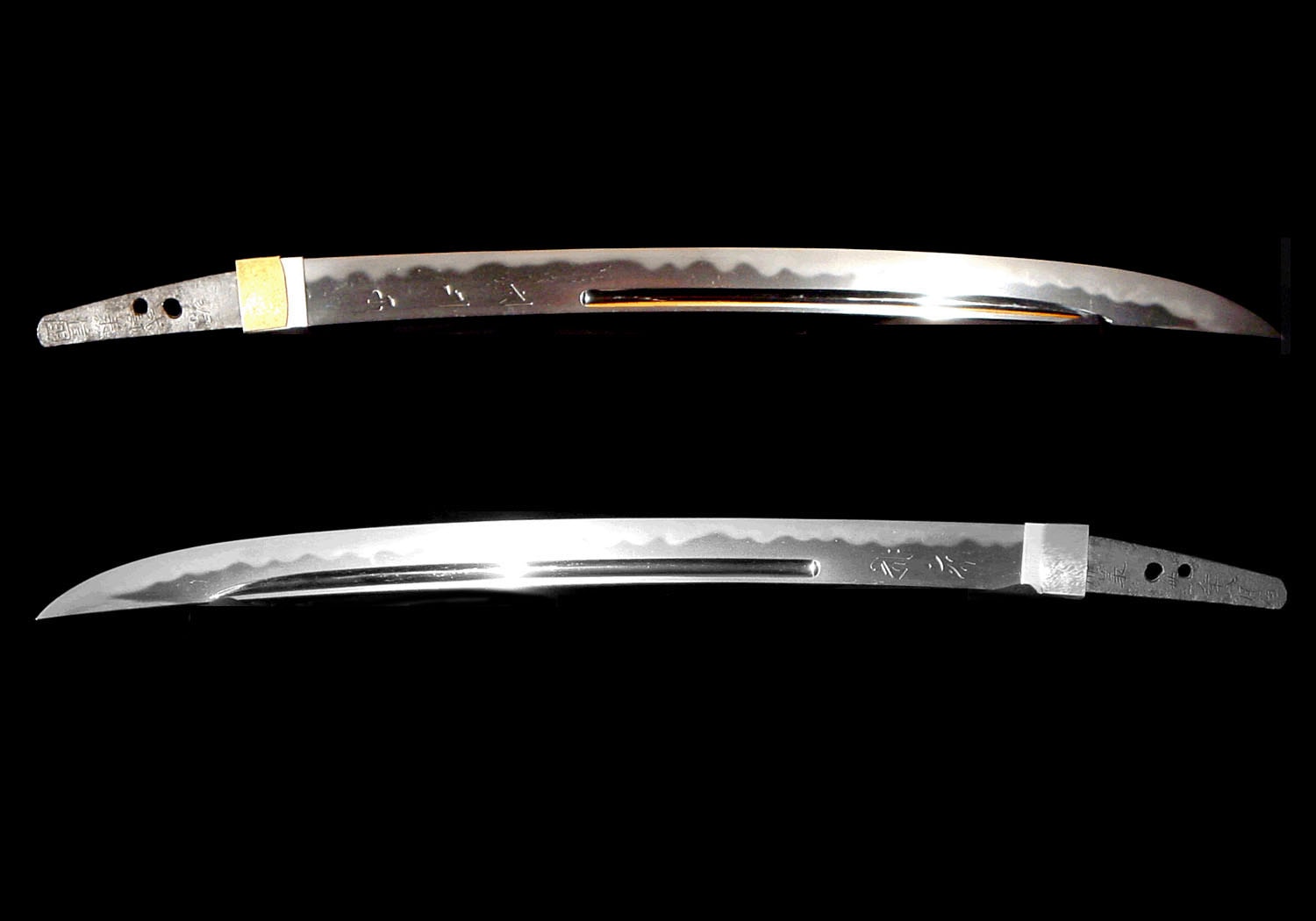
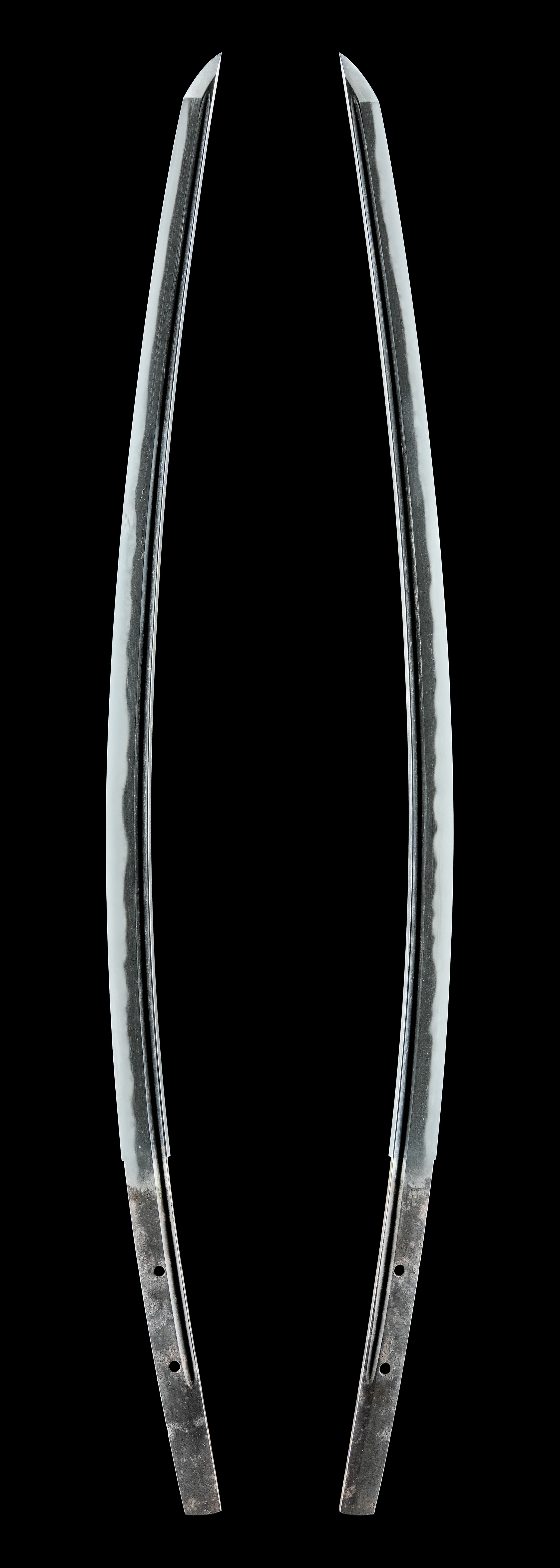
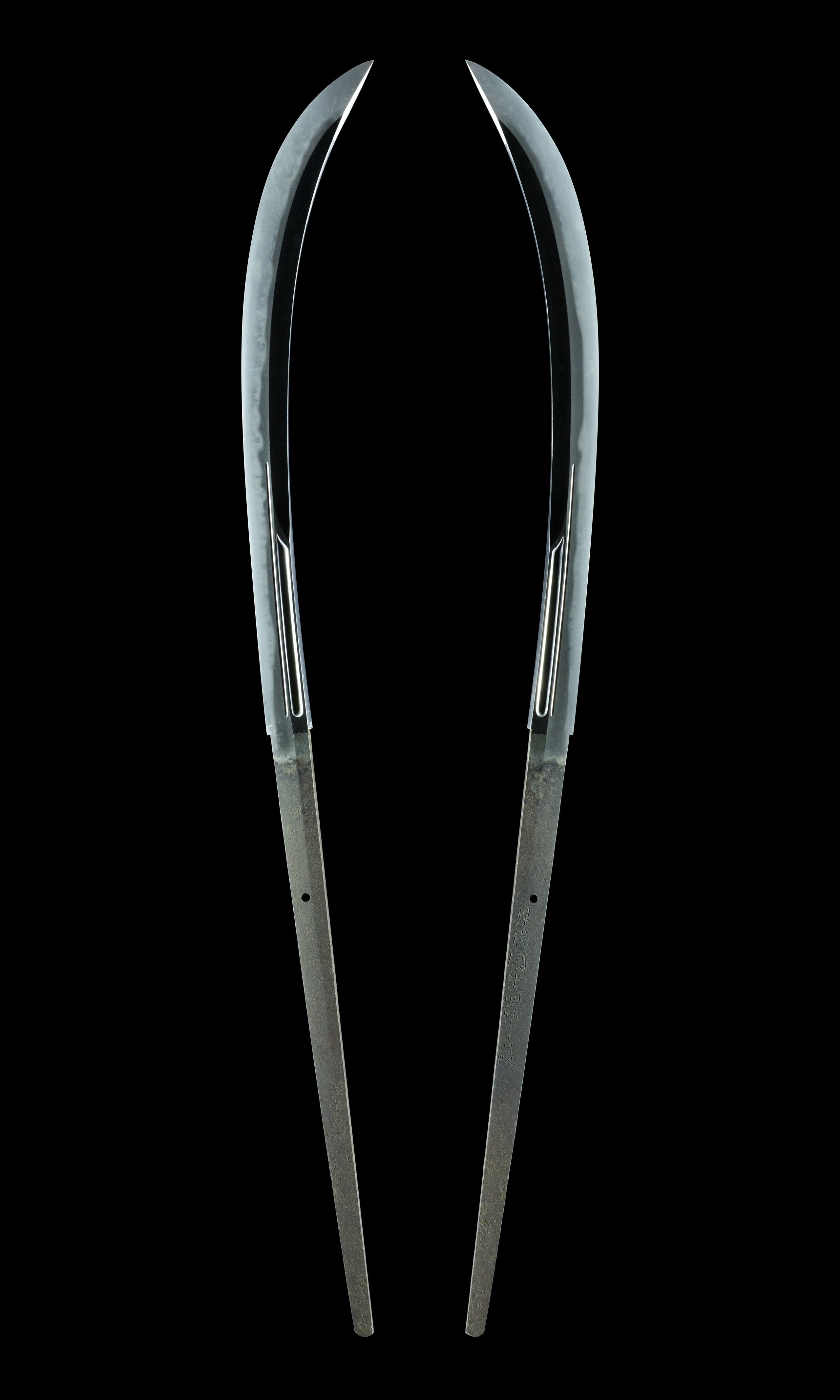
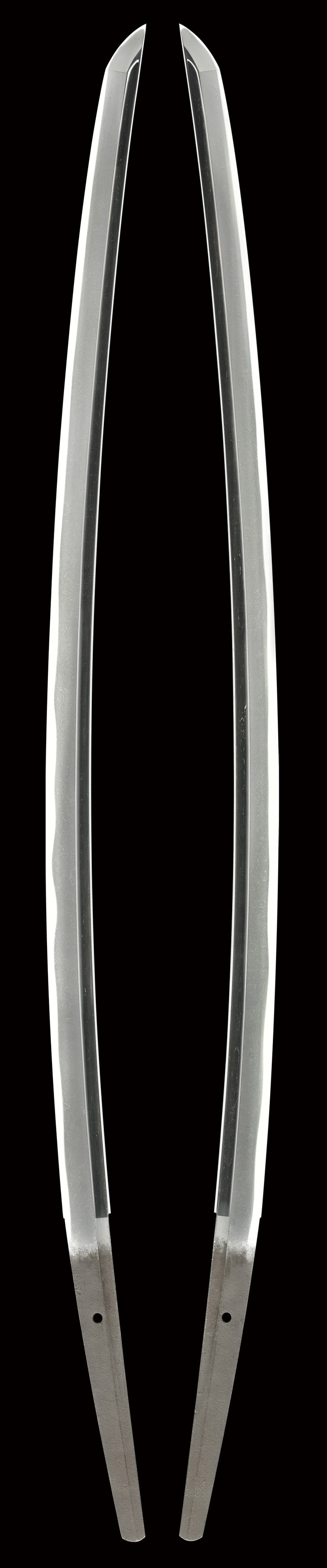
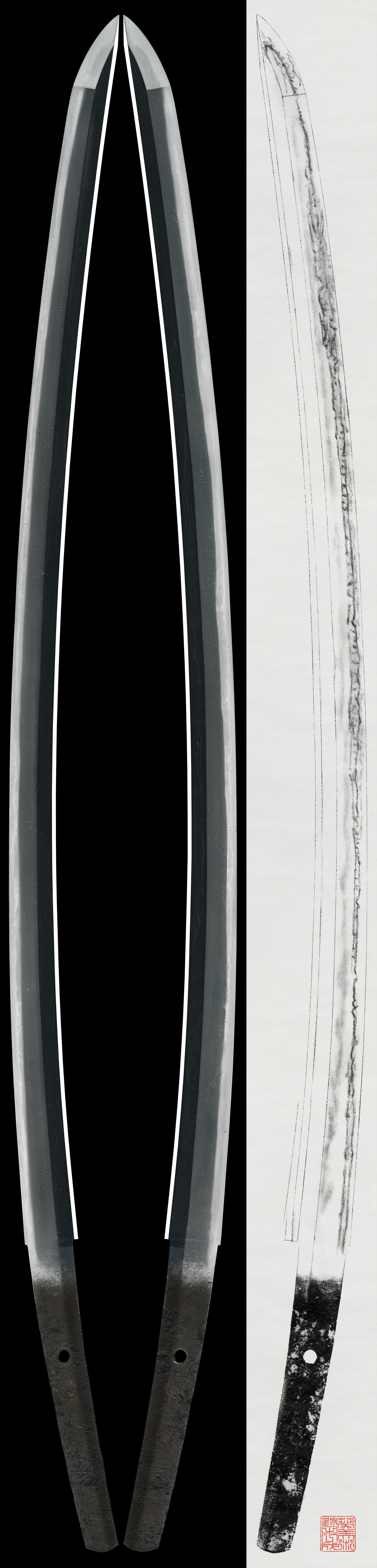
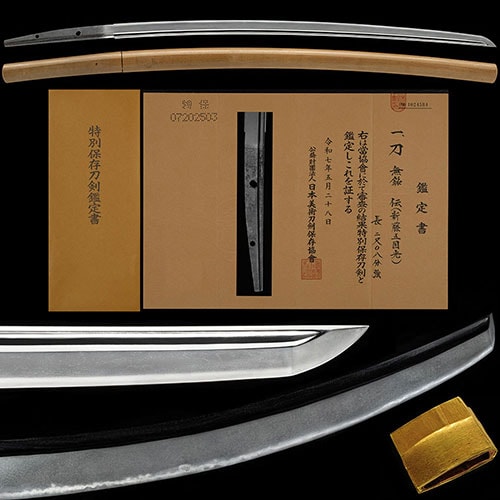
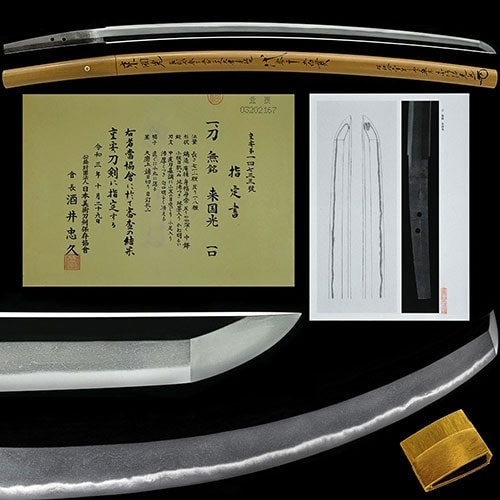
This is a katana by Minamoto no Nobukunii Yoshikane from Chikuzen province, made with Nanban-tetsu (foreign iron). It features a ko-itame hada with fine chikei and a hamon of large choji mixed with o-gunome midare. The blade is certified as a 23rd session Juyo Token by the NBTHK.

NBTHK Setsumei

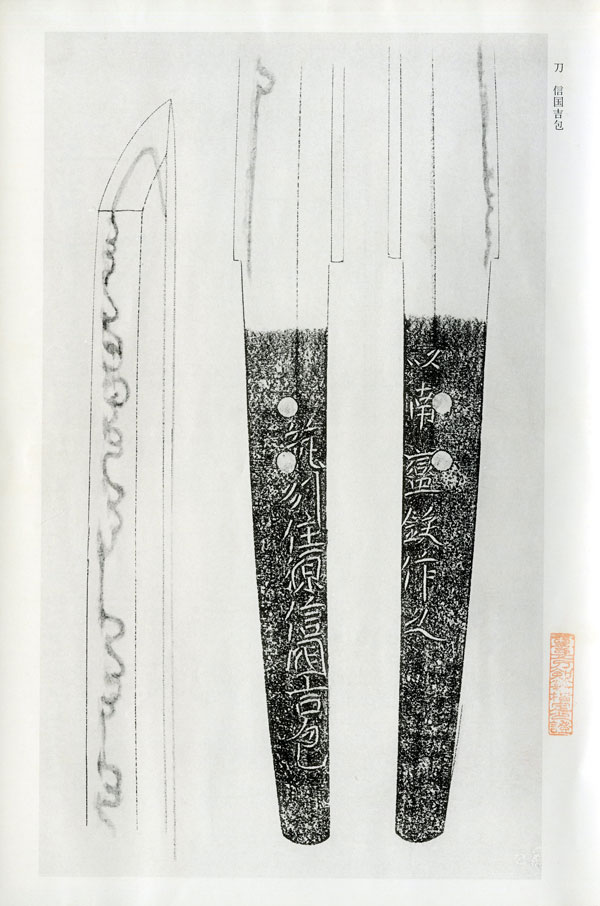
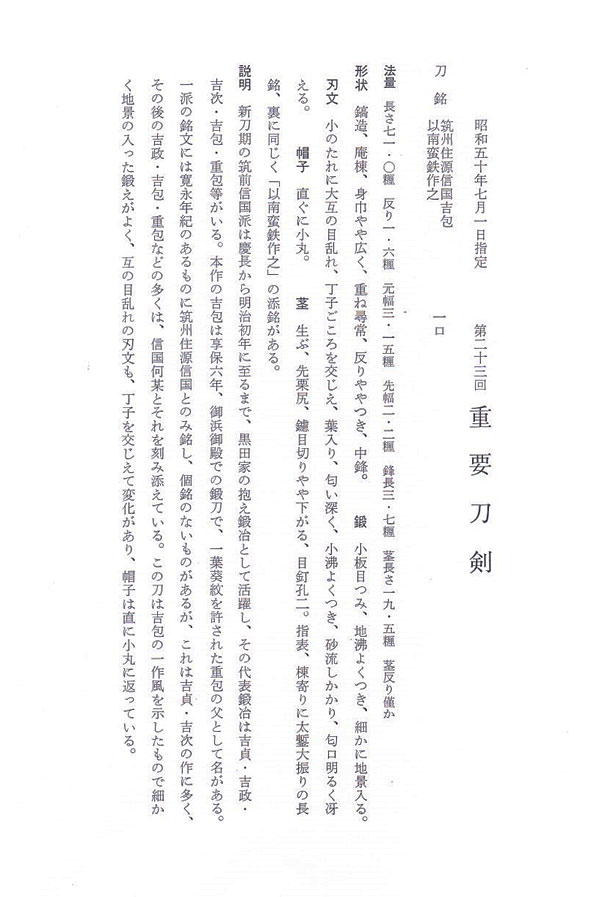
Jūyō-Tōken, 23rd Session — Designated July 1, 1975 Katana, mei: Chikushū-jū Minamoto Nobukuni Yoshikane (吉包) Measurements Nagasa 71.0 cm, sori 1.6 cm, motohaba 3.15 cm, sakihaba 2.2 cm, kissaki-nagasa 3.7 cm, nakago-nagasa 19.5 cm, nakago-sori slight Description Keijō: shinogi-zukuri, iori-mune; mihaba somewhat wide, kasane standard, sori slightly pronounced, chū-kissaki. Kitae: ko-itame closely forged; ji-nie well applied, with fine chikei entering intricately. Hamon: ko-notare mixed with large gunome-midare, incorporating a chōji-flavor; with ashi; nioi is deep, ko-nie well applied, with sunagashi; the nioiguchi is bright and clear. Bōshi: straight (sugu) with ko-maru. Horimono: None. Nakago: ubu; kurijiri; file marks are kiri with a slight downward tendency; two mekugi-ana. On the omote, close to the mune, there is a long signature cut with bold, thick chisel strokes; on the ura there is, likewise, an added inscription reading “I nanban tetsu kore o tsukuru” (“made using nanban tetsu ”). Artisan Chikushū-jū Minamoto Nobukuni Yoshikane (吉包) Era Shintō period, mid-Edo (Kyōhō era; tradition states Kyōhō 6 ) Explanation The Chikuzen Nobukuni lineage in the Shintō period was active from the Keichō era through the early Meiji years as retained smiths of the Kuroda family. Representative makers within this group include Yoshisada, Yoshimasa, Yoshitsugu, Yoshikane, and Shigekane. The Yoshikane of the present sword is known as the father of Shigekane, who was permitted the use of the hitotsuba aoi crest; Yoshikane’s name is also associated with a commission carried out at the Ohama Palace in Kyōhō 6 (1721). Among the inscriptions used by this lineage, there are examples bearing Kan’ei dates that are signed simply “Chikushū-jū Minamoto Nobukuni” without an individual name; this is frequently seen on works by Yoshisada and Yoshitsugu. Thereafter, many works by later smiths such as Yoshimasa, Yoshikane, and Shigekane commonly add the personal name by carving “Nobukuni so-and-so.” This katana demonstrates one of Yoshikane’s characteristic manners. The forging is well executed, showing dense steel with finely interwoven chikei, and the gunome-midare temper—mixed with chōji elements—displays varied movement. The bōshi turns back in a straightforward ko-maru.

NihontoWatch MonNihontoWatch
MarketEncyclopediaKantei
Swords›Yamashiro-den›Nobukuni›Katana: Chikusyu ju Minamoto no Nobukunii Yoshikane, made with Nanban-tetsu (23rd Juyo Token)
katanaJūyō
Nobukuni School

Katana: Chikusyu ju Minamoto no Nobukunii Yoshikane, made with Nanban-tetsu (23rd Juyo Token)

mei · Nobukuni · Kanbun (1661-1673) · nagasa 71.1cm · sori 1.8cm

¥6,800,000
Visit seller website →
KatanaJūyō
Could you name the smith from the blade alone? Today’s kantei →
Nobukuni School — 1 of 15
Nobukuni School — 2 of 15
Nobukuni School — 3 of 15
Nobukuni School — 4 of 15
Nobukuni School — 5 of 15
Nobukuni School — 6 of 15
Nobukuni School — 7 of 15
Nobukuni School — 8 of 15
Nobukuni School — 9 of 15
Nobukuni School — 10 of 15
Nobukuni School — 11 of 15
Nobukuni School — 12 of 15
Nobukuni School — 13 of 15
Nobukuni School — 14 of 15
Nobukuni School — 15 of 15
1 / 15
1 / 15
Nobukuni School — 1 of 15Nobukuni School — 2 of 15Nobukuni School — 3 of 15Nobukuni School — 4 of 15Nobukuni School — 5 of 15Nobukuni School — 6 of 15Nobukuni School — 7 of 15Nobukuni School — 8 of 15Nobukuni School — 9 of 15Nobukuni School — 10 of 15Nobukuni School — 11 of 15Nobukuni School — 12 of 15Nobukuni School — 13 of 15Nobukuni School — 14 of 15Nobukuni School — 15 of 15
KatanaJūyō
Could you name the smith from the blade alone? Today’s kantei →
Measurements & details
Smith
Nobukuni School
Type
Katana
School
Nobukuni
Period
Kanbun (1661-1673)
Province
Chikuzen
Signature
Signed(0% of this smith's designated works are signed)
Measurements
Nagasa 71.1cmSori 1.8cmMotohaba 3.15cmSakihaba 2.2cm
Description

This is a katana by Minamoto no Nobukunii Yoshikane from Chikuzen province, made with Nanban-tetsu (foreign iron). It features a ko-itame hada with fine chikei and a hamon of large choji mixed with o-gunome midare. The blade is certified as a 23rd session Juyo Token by the NBTHK.

NBTHK Zufu Commentary

Juyo #23

AI translation — may contain errors

-, 23rd Session — Designated July 1, 1975

, : Chikushū-jū Minamoto Yoshikane (吉包)

Measurements 71.0 cm, 1.6 cm, 3.15 cm, 2.2 cm, 3.7 cm, 19.5 cm, slight

Description Keijō: , ; somewhat wide, standard, slightly pronounced, . : closely forged; well applied, with fine entering intricately. : mixed with large , incorporating a -flavor; with ; is deep, well applied, with ; the is bright and clear. : straight () with . : None. : ; ; file marks are with a slight downward tendency; two . On the , close to the , there is a long signature cut with bold, thick chisel strokes; on the there is, likewise, an added inscription reading “I nanban tetsu kore o ” (“made using nanban tetsu [imported steel]”).

Artisan Chikushū-jū Minamoto Yoshikane (吉包)

Era period, mid- (Kyōhō era; tradition states Kyōhō 6 [1721])

Explanation The lineage in the period was active from the Keichō era through the early Meiji years as retained smiths of the Kuroda family. Representative makers within this group include Yoshisada, Yoshimasa, Yoshitsugu, Yoshikane, and Shigekane.

The Yoshikane of the present sword is known as the father of Shigekane, who was permitted the use of the hitotsuba crest; Yoshikane’s name is also associated with a commission carried out at the Ohama Palace in Kyōhō 6 (1721).

Among the inscriptions used by this lineage, there are examples bearing ’ei dates that are signed simply “Chikushū-jū Minamoto ” without an individual name; this is frequently seen on works by Yoshisada and Yoshitsugu. Thereafter, many works by later smiths such as Yoshimasa, Yoshikane, and Shigekane commonly add the personal name by carving “ so-and-so.”

This demonstrates one of Yoshikane’s characteristic manners. The forging is well executed, showing dense steel with finely interwoven , and the temper—mixed with elements—displays varied movement. The turns back in a straightforward .

About the school

Nobukuni

信国

Yamashiro-den · Yamashiro

31 pieces on the market now

›

Few Kyoto houses bridged two traditions as deliberately as Nobukuni (信国), the Yamashiro-den lineage whose work runs from the Nanbokucho period through Muromachi and on, in a western branch, into the shinto age. The first generation, the smith the NBTHK counts as shodai, is the master of the Enbun, Koan and Joji years; the older registers placed a founding Nobukuni back in the Kenmu era, but the published sources set that legend aside, since no work survives so early and the style of the oldest dated blades connects directly with that of Sadamune. Two inheritances meet in him. By blood he belongs to the Ryokai line, recorded as son or grandson of Ryo Hisanobu and therefore of Rai descent; by training he is said to have studied under Soshu Sadamune, counted among the Sadamune Santetsu, the three brilliant pupils. The name then passed on: a change-of-generation Nobukuni with Eitoku, Shitoku and Meitoku dates stands at the close of Nanbokucho, and in early Muromachi come the so-called Oei Nobukuni, Saemon-no-jo and Shikibu-no-jo, conventionally the third generation. The published commentary keeps these hands apart and notes that several smiths of the same signature appear within the Nanbokucho period alone. Through Muromachi the line moved to Buzen and then Chikuzen, where it served the Kuroda house of Fukuoka as retained smiths and flourished as the Chikuzen Nobukuni group of Yoshisada, Yoshimasa, Yoshitsugu, Yoshikane and Shigekane. A single steel underlies the whole school. The jigane is an itame mixed with mokume that flows toward the ha and stands into masame, with thick ji-nie and chikei entering frequently; on the finer-forged pieces a streak-like nie-utsuri rises, and that masame-tinged surface is read as the visible token of the Ryokai pedigree.

Over it the temper divides into the manners the sources name together: a suguha expressing the Kyoto tradition, refined in ko-nie with fine hotsure and a niju-ba tendency, carried on tanto and ko-wakizashi; and a ko-notare mixed with gunome inheriting the Sadamune style, laid thick in nie, with kinsuji, sunagashi, hotsure and conspicuous yubashiri, on the most flamboyant pieces stringing into a two-tiered ha. From the late Nanbokucho succession into the Oei generation a third range enters, a gunome-led midare whose tell is paired gunome linked across the valleys by a low ko-notare into a yahazu, arrow-notch, profile, with muneyaki, tobiyaki and niju-ba on the liveliest blades. Above all stands the carving the sources call the house art, the horimono of bonji, kurikara, suken, gomabashi, sanko-ken and the invocation of Hachiman Daibosatsu, often layered one over another in kasanebori; few smiths of the age are so consistently identified by what they carved. The Chikuzen branch carried the masame-leaning itame forward and added a choji-midare with midare-utsuri, Yoshikane reaching toward Soshu-den with deep nioi and thick nie, Shigekane ranked highest in skill within his group and noted as a copyist of meibutsu who emulated Fudo Kuniyuki at the Hama Palace. To kantei Nobukuni is to read the Kyoto traces that part him from Sadamune: the nie-utsuri, the niju-ba, and the hada that drifts into masame along the ha. Within the long succession the shodai remains the touchstone, his dated work the standard against which unsigned blades and generation questions are resolved, the reversed left-form kuni marking the Oei Saemon-no-jo, the yahazu the daigawari hand. The best members rank Jo-jo saku under Fujishiro, and the carving reputation is the constant thread, distinguishing these blades from the plainer utilitarian grooving of contemporary Bizen. Provenance runs through the great houses: the Kuroda wakizashi once carried by Kuroda Nagamasa, a Hongan-ji meibutsu held to have been cherished by Rennyo Shonin, the signed Arao Nobukuni descended in the Asano of Geishu, pieces in the Sanada, Tosa Yamauchi and Tamura families, and a tachi bestowed on the Owari Tokugawa. Examples rest today in the Tokugawa Art Museum, the Kyoto National Museum, shrines such as Atsuta and Ise, and long-held private collections, with the Chikuzen smiths' shogunal-command pieces preserving the historical episodes that produced them. Learn more →


12 recorded smiths173 designated works
Leading smiths
SmithEraDesignated
Nobukuni信國1356-136170
Nobukuni信國1383-139233
Nobukuni信國1394-142844
Yoshikane吉包1661-16867
Masanobu正信1356-13614
Explore the Nobukuni school →

Historical context

The Edo period (1615 to 1868)

›

Under the Tokugawa peace the daishō became a regulated uniform, and demand gathered in the castle towns, above all Edo itself. The craft split two ways: brilliant display work for connoisseurs, and tested blades whose cutting results were sometimes inlaid in gold.

The Edo period (1615 to 1868) →

NBTHK Certificate
Jūyō Tōken重要刀剣
Important Sword
›

A blade of top-grade workmanship and condition, formally judged to rank with a nationally recognized Important Art Object (Jūyō Bijutsuhin). Awarded only at the NBTHK’s competitive annual examination.

About the NBTHK›

The NBTHK (Nihon Bijutsu Tōken Hozon Kyōkai, the Society for the Preservation of Japanese Art Swords) is a public-interest incorporated foundation founded in 1948 and supervised by Japan’s Agency for Cultural Affairs (Bunkachō); it is based at the Japanese Sword Museum in Tokyo. Its expert panels physically examine each submitted work (shinsa) and issue a certificate (kanteishō) ranking it by artistic and historical merit. NBTHK papers are the most widely recognized standard of authentication for Japanese swords and fittings.

NBTHK official site→
Seller
T
Token-Net
Established 1981 · 45 yrs on the market
🇯🇵Ships from Japan
›
✓Verified dealertoken-net.com
Settles in JPY
✓Ships worldwideWire transferCredit card
Return policy

Within one week of the item's arrival (cooling-off is possible within Japan only). For defects that differ from the purchase conditions, we will accept the return and refund the payment. For other cases such as overseas, we will consult separately.

View all of Token-Net’s listings→View this item on the dealer’s site→

Previously sold — Nobukuni School

View all →
Katana Yamadaiya
Tokubetsu Kichō
Katana - Tokubetsu Kichō - by Nobukuni School - Tokubetsu Kicho Token: Mumei (Nobukuni)Katana - Tokubetsu Kichō - by Nobukuni School - Tokubetsu Kicho Token: Mumei (Nobukuni)
Sold

Katana

ByNobukuni School
SOLD
Choshuya
Katana - by Nobukuni School - Signed Nobukuni YoshinaoKatana - by Nobukuni School - Signed Nobukuni Yoshinao
Sold

Katana

ByNobukuni School
SOLD
World Seiyudo
Tokuho
Katana - Tokuho - by Nobukuni School - Nobukuni - NBTHK Tokubetsu Hozon TokenKatana - Tokuho - by Nobukuni School - Nobukuni - NBTHK Tokubetsu Hozon Token
Sold

Katana

ByNobukuni School
SOLD
Shoubudou
Tokuho
Katana - Tokuho - by Nobukuni School - Chikuzen jyu Minamoto Nobukuni YoshimasaKatana - Tokuho - by Nobukuni School - Chikuzen jyu Minamoto Nobukuni Yoshimasa
Sold

Katana

ByNobukuni School
SOLD
Choshuya
Katana - by Nobukuni School - Chikushu Ju Minamoto Nobukuni Masatsune, Keio 2nd Year, August, Lucky DayKatana - by Nobukuni School - Chikushu Ju Minamoto Nobukuni Masatsune, Keio 2nd Year, August, Lucky Day
Sold

Katana

ByNobukuni School
SOLD
Touken Komachi
Tanto - by Nobukuni School - Mumei, attributed to Shikibunojo Nobukuni, in ShirasayaTanto - by Nobukuni School - Mumei, attributed to Shikibunojo Nobukuni, in Shirasaya
Sold

Tantō

ByNobukuni School
SOLD
Eirakudo
Tokuho
Katana - Tokuho - by Nobukuni School - Nobukuni - Tokubetsu Hozon TokenKatana - Tokuho - by Nobukuni School - Nobukuni - Tokubetsu Hozon Token
Sold

Katana

ByNobukuni School
SOLD
Choshuya
Wakizashi - by Nobukuni School - Katagiriba-zukuri Wakizashi: Mumei Saemon no Jo NobukuniWakizashi - by Nobukuni School - Katagiriba-zukuri Wakizashi: Mumei Saemon no Jo Nobukuni
Sold

Wakizashi

ByNobukuni School
SOLD

More from the Nobukuni school

View all →
Aoi Art
Hozon
Katana - Hozon - by Nobukuni School - Mumei (Chikuzen Nobukuni)Katana - Hozon - by Nobukuni School - Mumei (Chikuzen Nobukuni)

Katana

ByNobukuni School
¥550,000
Samurai Shokai
Hozon
Katana - Hozon - by Nobukuni Yoshikane - Chikuzen Nobukuni YoshikaneKatana - Hozon - by Nobukuni Yoshikane - Chikuzen Nobukuni Yoshikane

Katana

ByNobukuni Yoshikane
¥570,000
Nihonto.com
Jūyō
Wakizashi - Jūyō - by Nobukuni - Juyo Token Wakizashi by Shikibu no Jo NobukuniWakizashi - Jūyō - by Nobukuni - Juyo Token Wakizashi by Shikibu no Jo Nobukuni

Wakizashi

ByNobukuni
¥47,750
Eirakudo
Tokuho
Katana - Tokuho - by Nobukuni School - Nobukuni - Tokubetsu Hozon TokenKatana - Tokuho - by Nobukuni School - Nobukuni - Tokubetsu Hozon Token

Katana

ByNobukuni School
¥1,200,000
Toushin
Hozon
Katana - Hozon - by Nobukuni School - Oei Nobukuni - MumeiKatana - Hozon - by Nobukuni School - Oei Nobukuni - Mumei

Katana

ByNobukuni School
¥599,500
Yazawa Shokai
Tokuho
Tanto - Tokuho - by Nobukuni School - Yamamura Masanobu - Late Nanbokucho Period, Mumei, HirazukuriTanto - Tokuho - by Nobukuni School - Yamamura Masanobu - Late Nanbokucho Period, Mumei, Hirazukuri

Tantō

ByNobukuni School
¥300,000
Yakiba
Tokuho
Tanto - Tokuho - by Nobukuni School - Nobukuni Tanto / Nambokucho PeriodTanto - Tokuho - by Nobukuni School - Nobukuni Tanto / Nambokucho Period

Tantō

ByNobukuni School
¥7,500
Toushin
Tokuho
Naginata - Tokuho - by Nobukuni Yoshimasa - Minamoto Nobukuni Heishiro YoshimasaNaginata - Tokuho - by Nobukuni Yoshimasa - Minamoto Nobukuni Heishiro Yoshimasa

Naginata

ByNobukuni Yoshimasa
¥550,000

More from the Yamashiro tradition

View all →
Eirakudo
Jūyō
Katana - Jūyō - by Rai Kunimitsu - Rai Kunimitsu - Juyo TokenKatana - Jūyō - by Rai Kunimitsu - Rai Kunimitsu - Juyo Token

Katana

ByRai Kunimitsu
Ask
Hyozaemon
Jūyō
Tachi - Jūyō - by Ayanokoji Sadatoshi - Ayanokoji SadatoshiTachi - Jūyō - by Ayanokoji Sadatoshi - Ayanokoji Sadatoshi

Tachi

ByAyanokoji Sadatoshi
¥4,800,000
Samurai Nippon
Tokujū
Katana - Tokuju - by Awataguchi Kuniyoshi - Mumei (Attributed to Awataguchi Kuniyoshi)Katana - Tokuju - by Awataguchi Kuniyoshi - Mumei (Attributed to Awataguchi Kuniyoshi)

Katana

ByAwataguchi Kuniyoshi
Ask
Aoi Art
Tokuho
Katana - Tokuho - by Ayanokoji School - Mumei (Attributed to Ayanokoji)Katana - Tokuho - by Ayanokoji School - Mumei (Attributed to Ayanokoji)

Katana

ByAyanokoji School
Starting Bid¥1,750,000
Winners Auction
Tokuho
Tachi - Tokuho - by Fujishima Tomoshige - TomoshigeTachi - Tokuho - by Fujishima Tomoshige - Tomoshige

Tachi

ByFujishima Tomoshige
Starting Bid¥600,000
Eirakudo
Tokuho
Katana - Tokuho - by Shintogo Kunimitsu - Shintogo Kunimitsu - Tokubetsu Hozon TokenKatana - Tokuho - by Shintogo Kunimitsu - Shintogo Kunimitsu - Tokubetsu Hozon Token

Katana

ByShintogo Kunimitsu
¥7,500,000
Eirakudo
Jūyō
Katana - Jūyō - by Rai Kunimitsu - Rai Kunimitsu - Juyo TokenKatana - Jūyō - by Rai Kunimitsu - Rai Kunimitsu - Juyo Token

Katana

ByRai Kunimitsu
Ask
Yazawa Shokai
Tokuho
Tachi - Tokuho - by Rai Kuniyuki - Consignment: Rai Kuniyuki Mid-Kamakura Period, Blade Length 69.7cm, Sori 1.9cm, in Shirasaya with Tachi KoshiraeTachi - Tokuho - by Rai Kuniyuki - Consignment: Rai Kuniyuki Mid-Kamakura Period, Blade Length 69.7cm, Sori 1.9cm, in Shirasaya with Tachi Koshirae

Tachi

ByRai Kuniyuki
¥3,000,000

Swords

  • Katana
  • Wakizashi
  • Tantō
  • Tachi
  • Naginata
  • Yari
  • Japanese Swords
  • Samurai Swords

Fittings

  • Tsuba
  • Fuchi-Kashira
  • Kozuka
  • Menuki
  • Sword Guards (Tsuba)

Armor

  • Kabuto
  • Samurai Armor
  • All Samurai Armor

By Certification

  • Tokujū
  • Jūyō
  • Tokuho
  • Hozon

Resources

  • Dealer Directory
  • Artist Directory
  • The Daily Kantei
  • Glossary
  • Browse All
Nihontowatch© 2026
TermsPrivacyCookiesAbout

¥6,800,000

View on Token-Net

Description

This is a katana by Minamoto no Nobukunii Yoshikane from Chikuzen province, made with Nanban-tetsu (foreign iron). It features a ko-itame hada with fine chikei and a hamon of large choji mixed with o-gunome midare. The blade is certified as a 23rd session Juyo Token by the NBTHK.

NBTHK Setsumei

Jūyō-Tōken, 23rd Session — Designated July 1, 1975 Katana, mei: Chikushū-jū Minamoto Nobukuni Yoshikane (吉包) Measurements Nagasa 71.0 cm, sori 1.6 cm, motohaba 3.15 cm, sakihaba 2.2 cm, kissaki-nagasa 3.7 cm, nakago-nagasa 19.5 cm, nakago-sori slight Description Keijō: shinogi-zukuri, iori-mune; mihaba somewhat wide, kasane standard, sori slightly pronounced, chū-kissaki. Kitae: ko-itame closely forged; ji-nie well applied, with fine chikei entering intricately. Hamon: ko-notare mixed with large gunome-midare, incorporating a chōji-flavor; with ashi; nioi is deep, ko-nie well applied, with sunagashi; the nioiguchi is bright and clear. Bōshi: straight (sugu) with ko-maru. Horimono: None. Nakago: ubu; kurijiri; file marks are kiri with a slight downward tendency; two mekugi-ana. On the omote, close to the mune, there is a long signature cut with bold, thick chisel strokes; on the ura there is, likewise, an added inscription reading “I nanban tetsu kore o tsukuru” (“made using nanban tetsu ”). Artisan Chikushū-jū Minamoto Nobukuni Yoshikane (吉包) Era Shintō period, mid-Edo (Kyōhō era; tradition states Kyōhō 6 ) Explanation The Chikuzen Nobukuni lineage in the Shintō period was active from the Keichō era through the early Meiji years as retained smiths of the Kuroda family. Representative makers within this group include Yoshisada, Yoshimasa, Yoshitsugu, Yoshikane, and Shigekane. The Yoshikane of the present sword is known as the father of Shigekane, who was permitted the use of the hitotsuba aoi crest; Yoshikane’s name is also associated with a commission carried out at the Ohama Palace in Kyōhō 6 (1721). Among the inscriptions used by this lineage, there are examples bearing Kan’ei dates that are signed simply “Chikushū-jū Minamoto Nobukuni” without an individual name; this is frequently seen on works by Yoshisada and Yoshitsugu. Thereafter, many works by later smiths such as Yoshimasa, Yoshikane, and Shigekane commonly add the personal name by carving “Nobukuni so-and-so.” This katana demonstrates one of Yoshikane’s characteristic manners. The forging is well executed, showing dense steel with finely interwoven chikei, and the gunome-midare temper—mixed with chōji elements—displays varied movement. The bōshi turns back in a straightforward ko-maru.

NihontoWatch MonNihontoWatch
MarketEncyclopediaKantei
Swords›Yamashiro-den›Nobukuni›Katana: Chikusyu ju Minamoto no Nobukunii Yoshikane, made with Nanban-tetsu (23rd Juyo Token)
katanaJūyō
Nobukuni School

Katana: Chikusyu ju Minamoto no Nobukunii Yoshikane, made with Nanban-tetsu (23rd Juyo Token)

mei · Nobukuni · Kanbun (1661-1673) · nagasa 71.1cm · sori 1.8cm

¥6,800,000
Visit seller website →
KatanaJūyō
Could you name the smith from the blade alone? Today’s kantei →
Nobukuni School — 1 of 15
Nobukuni School — 2 of 15
Nobukuni School — 3 of 15
Nobukuni School — 4 of 15
Nobukuni School — 5 of 15
Nobukuni School — 6 of 15
Nobukuni School — 7 of 15
Nobukuni School — 8 of 15
Nobukuni School — 9 of 15
Nobukuni School — 10 of 15
Nobukuni School — 11 of 15
Nobukuni School — 12 of 15
Nobukuni School — 13 of 15
Nobukuni School — 14 of 15
Nobukuni School — 15 of 15
1 / 15
1 / 15
Nobukuni School — 1 of 15Nobukuni School — 2 of 15Nobukuni School — 3 of 15Nobukuni School — 4 of 15Nobukuni School — 5 of 15Nobukuni School — 6 of 15Nobukuni School — 7 of 15Nobukuni School — 8 of 15Nobukuni School — 9 of 15Nobukuni School — 10 of 15Nobukuni School — 11 of 15Nobukuni School — 12 of 15Nobukuni School — 13 of 15Nobukuni School — 14 of 15Nobukuni School — 15 of 15
KatanaJūyō
Could you name the smith from the blade alone? Today’s kantei →
Measurements & details
Smith
Nobukuni School
Type
Katana
School
Nobukuni
Period
Kanbun (1661-1673)
Province
Chikuzen
Signature
Signed(0% of this smith's designated works are signed)
Measurements
Nagasa 71.1cmSori 1.8cmMotohaba 3.15cmSakihaba 2.2cm
Description

This is a katana by Minamoto no Nobukunii Yoshikane from Chikuzen province, made with Nanban-tetsu (foreign iron). It features a ko-itame hada with fine chikei and a hamon of large choji mixed with o-gunome midare. The blade is certified as a 23rd session Juyo Token by the NBTHK.

NBTHK Zufu Commentary

Juyo #23

AI translation — may contain errors

-, 23rd Session — Designated July 1, 1975

, : Chikushū-jū Minamoto Yoshikane (吉包)

Measurements 71.0 cm, 1.6 cm, 3.15 cm, 2.2 cm, 3.7 cm, 19.5 cm, slight

Description Keijō: , ; somewhat wide, standard, slightly pronounced, . : closely forged; well applied, with fine entering intricately. : mixed with large , incorporating a -flavor; with ; is deep, well applied, with ; the is bright and clear. : straight () with . : None. : ; ; file marks are with a slight downward tendency; two . On the , close to the , there is a long signature cut with bold, thick chisel strokes; on the there is, likewise, an added inscription reading “I nanban tetsu kore o ” (“made using nanban tetsu [imported steel]”).

Artisan Chikushū-jū Minamoto Yoshikane (吉包)

Era period, mid- (Kyōhō era; tradition states Kyōhō 6 [1721])

Explanation The lineage in the period was active from the Keichō era through the early Meiji years as retained smiths of the Kuroda family. Representative makers within this group include Yoshisada, Yoshimasa, Yoshitsugu, Yoshikane, and Shigekane.

The Yoshikane of the present sword is known as the father of Shigekane, who was permitted the use of the hitotsuba crest; Yoshikane’s name is also associated with a commission carried out at the Ohama Palace in Kyōhō 6 (1721).

Among the inscriptions used by this lineage, there are examples bearing ’ei dates that are signed simply “Chikushū-jū Minamoto ” without an individual name; this is frequently seen on works by Yoshisada and Yoshitsugu. Thereafter, many works by later smiths such as Yoshimasa, Yoshikane, and Shigekane commonly add the personal name by carving “ so-and-so.”

This demonstrates one of Yoshikane’s characteristic manners. The forging is well executed, showing dense steel with finely interwoven , and the temper—mixed with elements—displays varied movement. The turns back in a straightforward .

About the school

Nobukuni

信国

Yamashiro-den · Yamashiro

31 pieces on the market now

›

Few Kyoto houses bridged two traditions as deliberately as Nobukuni (信国), the Yamashiro-den lineage whose work runs from the Nanbokucho period through Muromachi and on, in a western branch, into the shinto age. The first generation, the smith the NBTHK counts as shodai, is the master of the Enbun, Koan and Joji years; the older registers placed a founding Nobukuni back in the Kenmu era, but the published sources set that legend aside, since no work survives so early and the style of the oldest dated blades connects directly with that of Sadamune. Two inheritances meet in him. By blood he belongs to the Ryokai line, recorded as son or grandson of Ryo Hisanobu and therefore of Rai descent; by training he is said to have studied under Soshu Sadamune, counted among the Sadamune Santetsu, the three brilliant pupils. The name then passed on: a change-of-generation Nobukuni with Eitoku, Shitoku and Meitoku dates stands at the close of Nanbokucho, and in early Muromachi come the so-called Oei Nobukuni, Saemon-no-jo and Shikibu-no-jo, conventionally the third generation. The published commentary keeps these hands apart and notes that several smiths of the same signature appear within the Nanbokucho period alone. Through Muromachi the line moved to Buzen and then Chikuzen, where it served the Kuroda house of Fukuoka as retained smiths and flourished as the Chikuzen Nobukuni group of Yoshisada, Yoshimasa, Yoshitsugu, Yoshikane and Shigekane. A single steel underlies the whole school. The jigane is an itame mixed with mokume that flows toward the ha and stands into masame, with thick ji-nie and chikei entering frequently; on the finer-forged pieces a streak-like nie-utsuri rises, and that masame-tinged surface is read as the visible token of the Ryokai pedigree.

Over it the temper divides into the manners the sources name together: a suguha expressing the Kyoto tradition, refined in ko-nie with fine hotsure and a niju-ba tendency, carried on tanto and ko-wakizashi; and a ko-notare mixed with gunome inheriting the Sadamune style, laid thick in nie, with kinsuji, sunagashi, hotsure and conspicuous yubashiri, on the most flamboyant pieces stringing into a two-tiered ha. From the late Nanbokucho succession into the Oei generation a third range enters, a gunome-led midare whose tell is paired gunome linked across the valleys by a low ko-notare into a yahazu, arrow-notch, profile, with muneyaki, tobiyaki and niju-ba on the liveliest blades. Above all stands the carving the sources call the house art, the horimono of bonji, kurikara, suken, gomabashi, sanko-ken and the invocation of Hachiman Daibosatsu, often layered one over another in kasanebori; few smiths of the age are so consistently identified by what they carved. The Chikuzen branch carried the masame-leaning itame forward and added a choji-midare with midare-utsuri, Yoshikane reaching toward Soshu-den with deep nioi and thick nie, Shigekane ranked highest in skill within his group and noted as a copyist of meibutsu who emulated Fudo Kuniyuki at the Hama Palace. To kantei Nobukuni is to read the Kyoto traces that part him from Sadamune: the nie-utsuri, the niju-ba, and the hada that drifts into masame along the ha. Within the long succession the shodai remains the touchstone, his dated work the standard against which unsigned blades and generation questions are resolved, the reversed left-form kuni marking the Oei Saemon-no-jo, the yahazu the daigawari hand. The best members rank Jo-jo saku under Fujishiro, and the carving reputation is the constant thread, distinguishing these blades from the plainer utilitarian grooving of contemporary Bizen. Provenance runs through the great houses: the Kuroda wakizashi once carried by Kuroda Nagamasa, a Hongan-ji meibutsu held to have been cherished by Rennyo Shonin, the signed Arao Nobukuni descended in the Asano of Geishu, pieces in the Sanada, Tosa Yamauchi and Tamura families, and a tachi bestowed on the Owari Tokugawa. Examples rest today in the Tokugawa Art Museum, the Kyoto National Museum, shrines such as Atsuta and Ise, and long-held private collections, with the Chikuzen smiths' shogunal-command pieces preserving the historical episodes that produced them. Learn more →

12 recorded smiths173 designated works
Leading smiths
SmithEraDesignated
Nobukuni信國1356-136170
Nobukuni信國1383-139233
Nobukuni信國1394-142844
Yoshikane吉包1661-16867
Masanobu正信1356-13614
Explore the Nobukuni school →
Historical context

The Edo period (1615 to 1868)

›

Under the Tokugawa peace the daishō became a regulated uniform, and demand gathered in the castle towns, above all Edo itself. The craft split two ways: brilliant display work for connoisseurs, and tested blades whose cutting results were sometimes inlaid in gold.

The Edo period (1615 to 1868) →
NBTHK Certificate
Jūyō Tōken重要刀剣
Important Sword
›

A blade of top-grade workmanship and condition, formally judged to rank with a nationally recognized Important Art Object (Jūyō Bijutsuhin). Awarded only at the NBTHK’s competitive annual examination.

About the NBTHK›

The NBTHK (Nihon Bijutsu Tōken Hozon Kyōkai, the Society for the Preservation of Japanese Art Swords) is a public-interest incorporated foundation founded in 1948 and supervised by Japan’s Agency for Cultural Affairs (Bunkachō); it is based at the Japanese Sword Museum in Tokyo. Its expert panels physically examine each submitted work (shinsa) and issue a certificate (kanteishō) ranking it by artistic and historical merit. NBTHK papers are the most widely recognized standard of authentication for Japanese swords and fittings.

NBTHK official site→
Seller
T
Token-Net
Established 1981 · 45 yrs on the market
🇯🇵Ships from Japan
›
✓Verified dealertoken-net.com
Settles in JPY
✓Ships worldwideWire transferCredit card
Return policy

Within one week of the item's arrival (cooling-off is possible within Japan only). For defects that differ from the purchase conditions, we will accept the return and refund the payment. For other cases such as overseas, we will consult separately.

View all of Token-Net’s listings→View this item on the dealer’s site→

Previously sold — Nobukuni School

View all →
Katana Yamadaiya
Tokubetsu Kichō
Katana - Tokubetsu Kichō - by Nobukuni School - Tokubetsu Kicho Token: Mumei (Nobukuni)Katana - Tokubetsu Kichō - by Nobukuni School - Tokubetsu Kicho Token: Mumei (Nobukuni)
Sold

Katana

ByNobukuni School
SOLD
Choshuya
Katana - by Nobukuni School - Signed Nobukuni YoshinaoKatana - by Nobukuni School - Signed Nobukuni Yoshinao
Sold

Katana

ByNobukuni School
SOLD
World Seiyudo
Tokuho
Katana - Tokuho - by Nobukuni School - Nobukuni - NBTHK Tokubetsu Hozon TokenKatana - Tokuho - by Nobukuni School - Nobukuni - NBTHK Tokubetsu Hozon Token
Sold

Katana

ByNobukuni School
SOLD
Shoubudou
Tokuho
Katana - Tokuho - by Nobukuni School - Chikuzen jyu Minamoto Nobukuni YoshimasaKatana - Tokuho - by Nobukuni School - Chikuzen jyu Minamoto Nobukuni Yoshimasa
Sold

Katana

ByNobukuni School
SOLD
Choshuya
Katana - by Nobukuni School - Chikushu Ju Minamoto Nobukuni Masatsune, Keio 2nd Year, August, Lucky DayKatana - by Nobukuni School - Chikushu Ju Minamoto Nobukuni Masatsune, Keio 2nd Year, August, Lucky Day
Sold

Katana

ByNobukuni School
SOLD
Touken Komachi
Tanto - by Nobukuni School - Mumei, attributed to Shikibunojo Nobukuni, in ShirasayaTanto - by Nobukuni School - Mumei, attributed to Shikibunojo Nobukuni, in Shirasaya
Sold

Tantō

ByNobukuni School
SOLD
Eirakudo
Tokuho
Katana - Tokuho - by Nobukuni School - Nobukuni - Tokubetsu Hozon TokenKatana - Tokuho - by Nobukuni School - Nobukuni - Tokubetsu Hozon Token
Sold

Katana

ByNobukuni School
SOLD
Choshuya
Wakizashi - by Nobukuni School - Katagiriba-zukuri Wakizashi: Mumei Saemon no Jo NobukuniWakizashi - by Nobukuni School - Katagiriba-zukuri Wakizashi: Mumei Saemon no Jo Nobukuni
Sold

Wakizashi

ByNobukuni School
SOLD

More from the Nobukuni school

View all →
Aoi Art
Hozon
Katana - Hozon - by Nobukuni School - Mumei (Chikuzen Nobukuni)Katana - Hozon - by Nobukuni School - Mumei (Chikuzen Nobukuni)

Katana

ByNobukuni School
¥550,000
Samurai Shokai
Hozon
Katana - Hozon - by Nobukuni Yoshikane - Chikuzen Nobukuni YoshikaneKatana - Hozon - by Nobukuni Yoshikane - Chikuzen Nobukuni Yoshikane

Katana

ByNobukuni Yoshikane
¥570,000
Nihonto.com
Jūyō
Wakizashi - Jūyō - by Nobukuni - Juyo Token Wakizashi by Shikibu no Jo NobukuniWakizashi - Jūyō - by Nobukuni - Juyo Token Wakizashi by Shikibu no Jo Nobukuni

Wakizashi

ByNobukuni
¥47,750
Eirakudo
Tokuho
Katana - Tokuho - by Nobukuni School - Nobukuni - Tokubetsu Hozon TokenKatana - Tokuho - by Nobukuni School - Nobukuni - Tokubetsu Hozon Token

Katana

ByNobukuni School
¥1,200,000
Toushin
Hozon
Katana - Hozon - by Nobukuni School - Oei Nobukuni - MumeiKatana - Hozon - by Nobukuni School - Oei Nobukuni - Mumei

Katana

ByNobukuni School
¥599,500
Yazawa Shokai
Tokuho
Tanto - Tokuho - by Nobukuni School - Yamamura Masanobu - Late Nanbokucho Period, Mumei, HirazukuriTanto - Tokuho - by Nobukuni School - Yamamura Masanobu - Late Nanbokucho Period, Mumei, Hirazukuri

Tantō

ByNobukuni School
¥300,000
Yakiba
Tokuho
Tanto - Tokuho - by Nobukuni School - Nobukuni Tanto / Nambokucho PeriodTanto - Tokuho - by Nobukuni School - Nobukuni Tanto / Nambokucho Period

Tantō

ByNobukuni School
¥7,500
Toushin
Tokuho
Naginata - Tokuho - by Nobukuni Yoshimasa - Minamoto Nobukuni Heishiro YoshimasaNaginata - Tokuho - by Nobukuni Yoshimasa - Minamoto Nobukuni Heishiro Yoshimasa

Naginata

ByNobukuni Yoshimasa
¥550,000

More from the Yamashiro tradition

View all →
Eirakudo
Jūyō
Katana - Jūyō - by Rai Kunimitsu - Rai Kunimitsu - Juyo TokenKatana - Jūyō - by Rai Kunimitsu - Rai Kunimitsu - Juyo Token

Katana

ByRai Kunimitsu
Ask
Hyozaemon
Jūyō
Tachi - Jūyō - by Ayanokoji Sadatoshi - Ayanokoji SadatoshiTachi - Jūyō - by Ayanokoji Sadatoshi - Ayanokoji Sadatoshi

Tachi

ByAyanokoji Sadatoshi
¥4,800,000
Samurai Nippon
Tokujū
Katana - Tokuju - by Awataguchi Kuniyoshi - Mumei (Attributed to Awataguchi Kuniyoshi)Katana - Tokuju - by Awataguchi Kuniyoshi - Mumei (Attributed to Awataguchi Kuniyoshi)

Katana

ByAwataguchi Kuniyoshi
Ask
Aoi Art
Tokuho
Katana - Tokuho - by Ayanokoji School - Mumei (Attributed to Ayanokoji)Katana - Tokuho - by Ayanokoji School - Mumei (Attributed to Ayanokoji)

Katana

ByAyanokoji School
Starting Bid¥1,750,000
Winners Auction
Tokuho
Tachi - Tokuho - by Fujishima Tomoshige - TomoshigeTachi - Tokuho - by Fujishima Tomoshige - Tomoshige

Tachi

ByFujishima Tomoshige
Starting Bid¥600,000
Eirakudo
Tokuho
Katana - Tokuho - by Shintogo Kunimitsu - Shintogo Kunimitsu - Tokubetsu Hozon TokenKatana - Tokuho - by Shintogo Kunimitsu - Shintogo Kunimitsu - Tokubetsu Hozon Token

Katana

ByShintogo Kunimitsu
¥7,500,000
Eirakudo
Jūyō
Katana - Jūyō - by Rai Kunimitsu - Rai Kunimitsu - Juyo TokenKatana - Jūyō - by Rai Kunimitsu - Rai Kunimitsu - Juyo Token

Katana

ByRai Kunimitsu
Ask
Yazawa Shokai
Tokuho
Tachi - Tokuho - by Rai Kuniyuki - Consignment: Rai Kuniyuki Mid-Kamakura Period, Blade Length 69.7cm, Sori 1.9cm, in Shirasaya with Tachi KoshiraeTachi - Tokuho - by Rai Kuniyuki - Consignment: Rai Kuniyuki Mid-Kamakura Period, Blade Length 69.7cm, Sori 1.9cm, in Shirasaya with Tachi Koshirae

Tachi

ByRai Kuniyuki
¥3,000,000

Swords

  • Katana
  • Wakizashi
  • Tantō
  • Tachi
  • Naginata
  • Yari
  • Japanese Swords
  • Samurai Swords

Fittings

  • Tsuba
  • Fuchi-Kashira
  • Kozuka
  • Menuki
  • Sword Guards (Tsuba)

Armor

  • Kabuto
  • Samurai Armor
  • All Samurai Armor

By Certification

  • Tokujū
  • Jūyō
  • Tokuho
  • Hozon

Resources

  • Dealer Directory
  • Artist Directory
  • The Daily Kantei
  • Glossary
  • Browse All
Nihontowatch© 2026
TermsPrivacyCookiesAbout

¥6,800,000

View on Token-Net
NihontoWatch MonNihontoWatch
Market
Encyclopedia
Kantei
NihontoWatch MonNihontoWatch
Market
Encyclopedia
Kantei