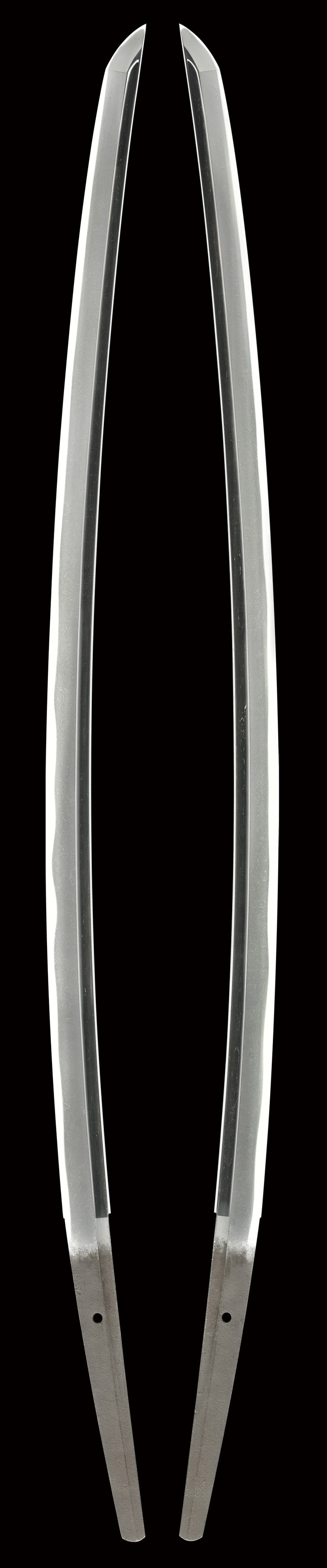
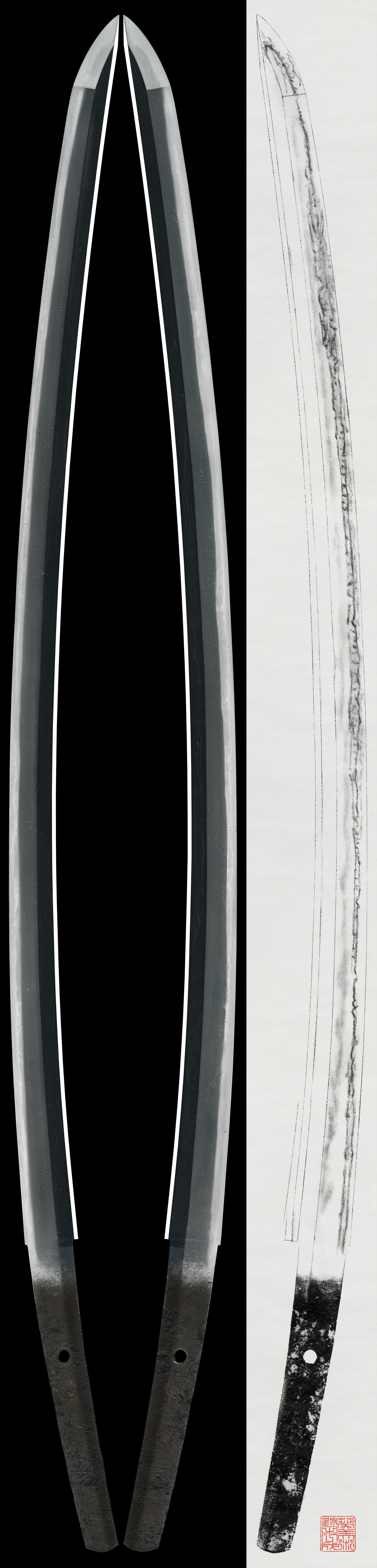
A dated Enbun 3 (1358), a of Koan 1 (1361), and further dated pieces reaching Joji 5 and 5 (1372) frame the working life of of Yamashiro, the Kyoto master whom the counts as the first generation of his name. The old registers placed a founding back in the Kenmu era, but the published sources set that legend aside: no work dated to Kenmu or its vicinity survives, no extant blade can be appraised so early, and the style of the oldest dated works connects directly with that of Sadamune, so that "the prevailing view today regards the Enbun and Joji smith as the first generation". Two lines meet in him. By blood he belongs to the Ryokai school, recorded in the transmitted genealogies as the son or grandson of Ryo Hisanobu, himself Ryokai's son, and therefore of descent; by training he is the pupil of Sadamune, counted among the Sadamune (貞宗三哲), the three brilliant pupils. The published sources rank him a representative smith of the period.
His style, the writes in a standing formula, "is in broad outline of two kinds: the one , the other a whose main tone is a Sadamune-style ". What binds the two manners is the steel itself. Whether the is straight or irregular, the flows conspicuously toward the and takes on , and the published record reads this trait, with the of the Enbun 3 and Koan 1 dated works, as what makes the Ryokai pedigree credible. On a of the tenth session the judges write that "above all, the that inclines to and flows near the edge suggests his connection to the Ryokai line." The is mixed with , thick, entering incessantly; on many pieces a rises toward the , and niju-ba appears along the .
The principal manner of the surviving work is the Sadamune style. Over the flowing the temper runs in a mixed with and , and enter, and the lies thick and bright. and work constantly through the , fray the , and spill above the temper; on the more flamboyant pieces the string intermittently along the until, as the published sources write of the Kuroda , they produce "the appearance of a kind of two-tiered ". The runs or into with . A signed from the Tosa Yamauchi family is praised as workmanship that thoroughly vindicates the Sadamune-pupil tradition, "yet compared with Sadamune the stand out somewhat, and exactly there the look of shows itself." To this manner belongs the carving the published sources call his house art: , , , and , frequently layered one over another, on one judged "skillfully layered in the manner of Daishinbo."
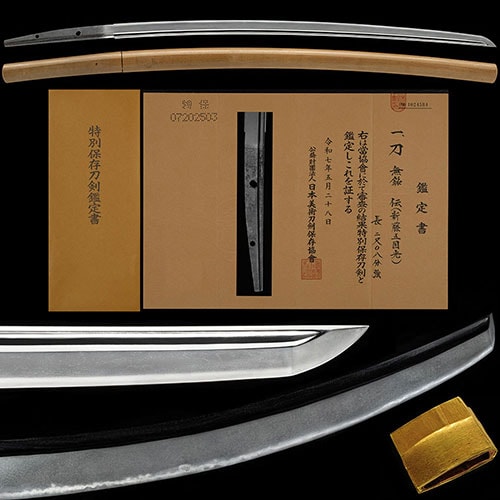
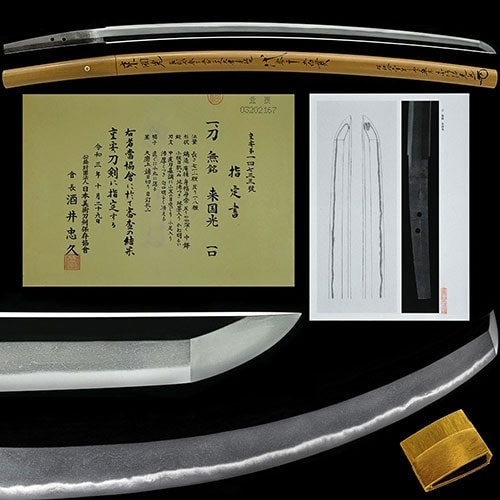
The second manner is the of his ancestry. His earliest dated works carry it, and a signed is praised for "a dignified that strictly preserves the tradition of Kyoto work." These blades show a , at times a , in , the tight or deep, the finely frayed with , and a niju-ba tendency appearing, and slight near the ; beneath lies the flowing, masa-tinged with . Most of the corpus consists of , and of the build the published sources name the Enbun-Joji type: wide in the , , thin in the , shallow in the . The long blades are nearly all , wide with little taper, the extended or reaching , at times with a deep wheel-like . One is recorded as his kawari-, "a construction that at first sight could be confused with Yamato work." His signature is a two-character cut centrally below the , the dated pieces adding the nengo on the ; of his designated works twenty-eight are signed against forty unsigned, one shortened preserves the original as a , and the gold-inlaid attributions added later by the are appraisals, not signatures.
The name outlived him. At the very end of stands a change-of-generation with dates of Eitoku, Shitoku and Meitoku, and in early the so-called Oei , smiths bearing the titles Saemon-no-jo and Shikibu-no-jo; every generation favored the and the , and from late into Oei a -led entered the school's range beside them. The line continued through and later moved to Buzen and then , where it flourished into the age. Within that long succession the remains the touchstone: the published sources resolve unsigned blades and generation questions by holding a piece against his dated work, and the Bijutsuhin record preserves Honma Junji's caution over one whose character departs from the forms usual in the first and second generations. His own blades are told from Sadamune's by the Kyoto traces they carry: the , the niju-ba, and the that drifts into along the .
Fujishiro grades him Jo-jo , and sixty-nine designated works stand on the official record: four Important Cultural Properties, seven and fifty-two . The provenance attached to his blades runs through the great houses. The Kuroda , with the gold-inlaid possession mark of Kuroda no Kami and a cutting attestation, is said to have been the personal sword of Kuroda Nagamasa, presented to the shogunal house, granted to the Hotta, and passed at last to the Akita Satake; a small is a Hongan- "traditionally said to have been especially cherished by Rennyo Shonin"; the signed called Arao descended in the Asano family of Geishu with a Koon of Manji 1 (1658); other pieces were transmitted in the Sanada of Matsushiro, the Tosa Yamauchi and the Tamura, and a was bestowed by the shogunal house upon the Owari Tokugawa in Koka 2 (1845). Of recorded whereabouts today, examples rest in the Tokugawa Art Museum and the Kyoto National Museum among other public and long-private collections. The four Important Cultural Properties are patrimony, preserved beyond the market; the fifty-nine blades in the and tiers are for the greater part held closely, and a signed of the comes to the market only rarely, a notable occasion when it does.