Muromachi turned sword making into an industry: the uchigatana rose with massed infantry warfare, Osafune and Seki produced bundle swords beside custom orders, and the Ming trade carried Japanese blades abroad by the tens of thousands.
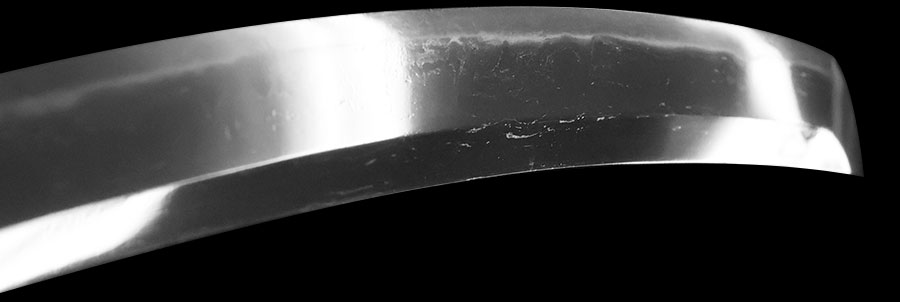
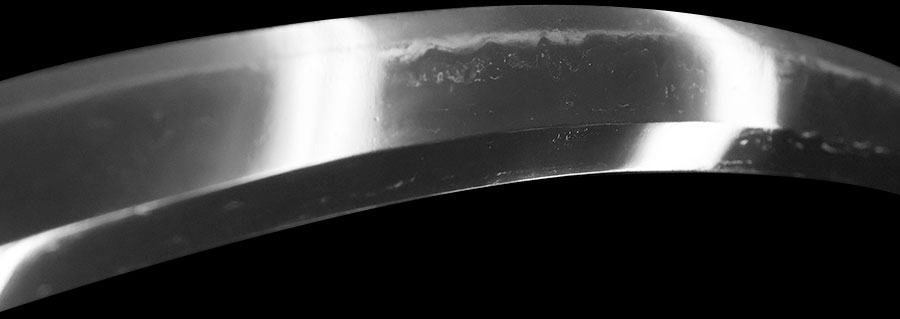
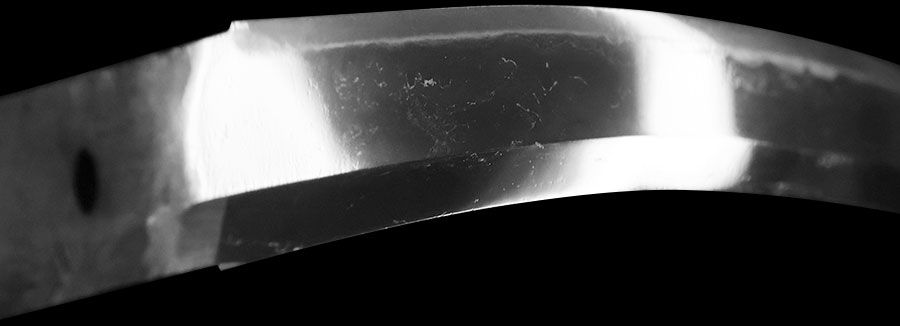
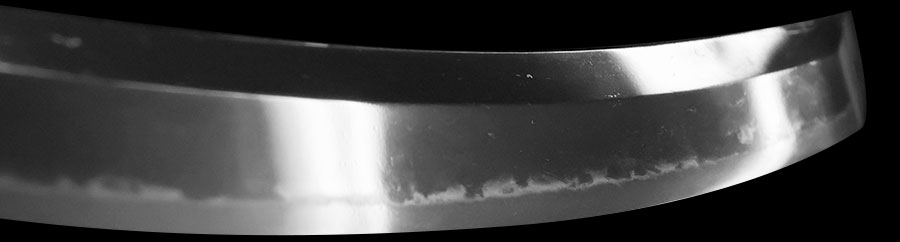
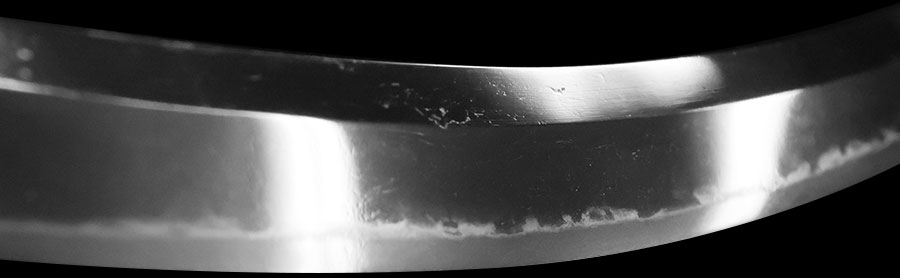
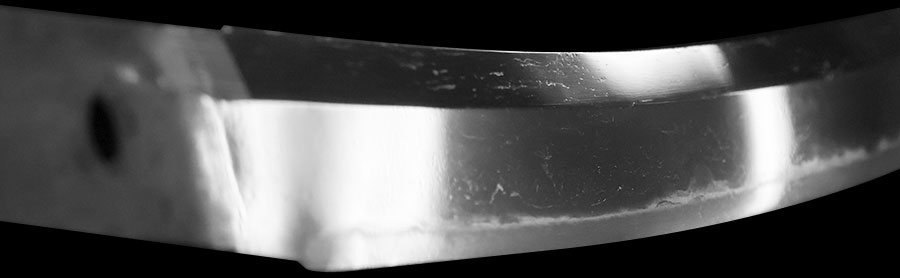
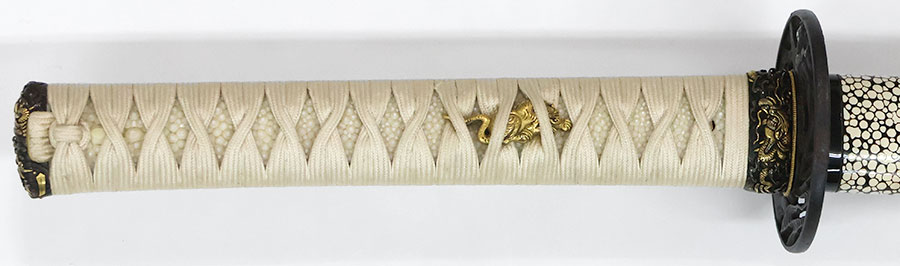
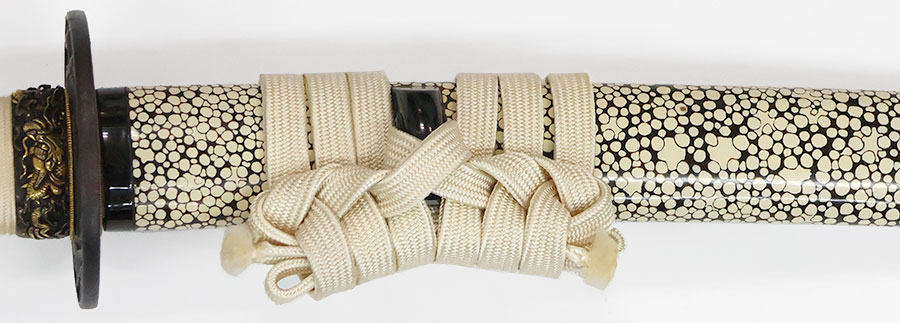
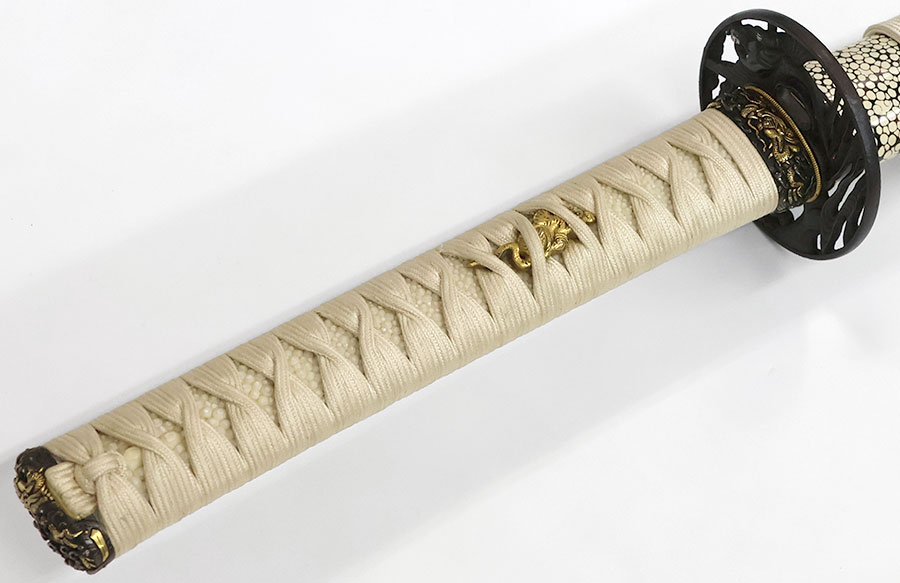
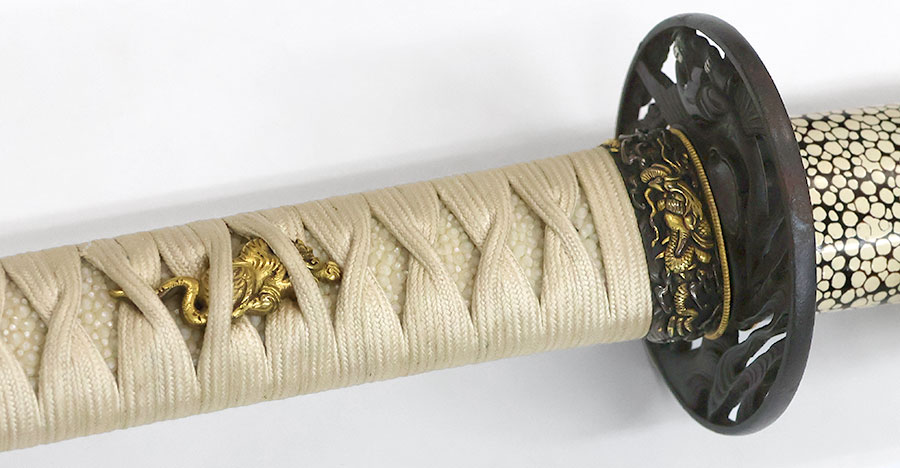
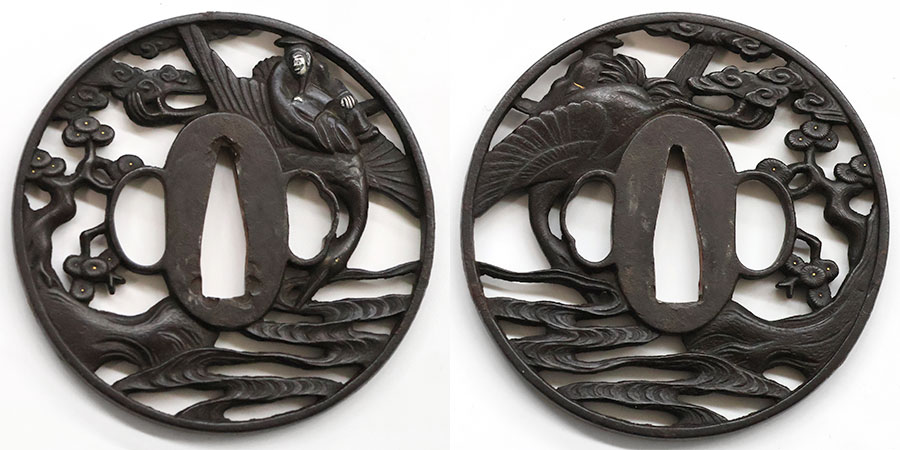
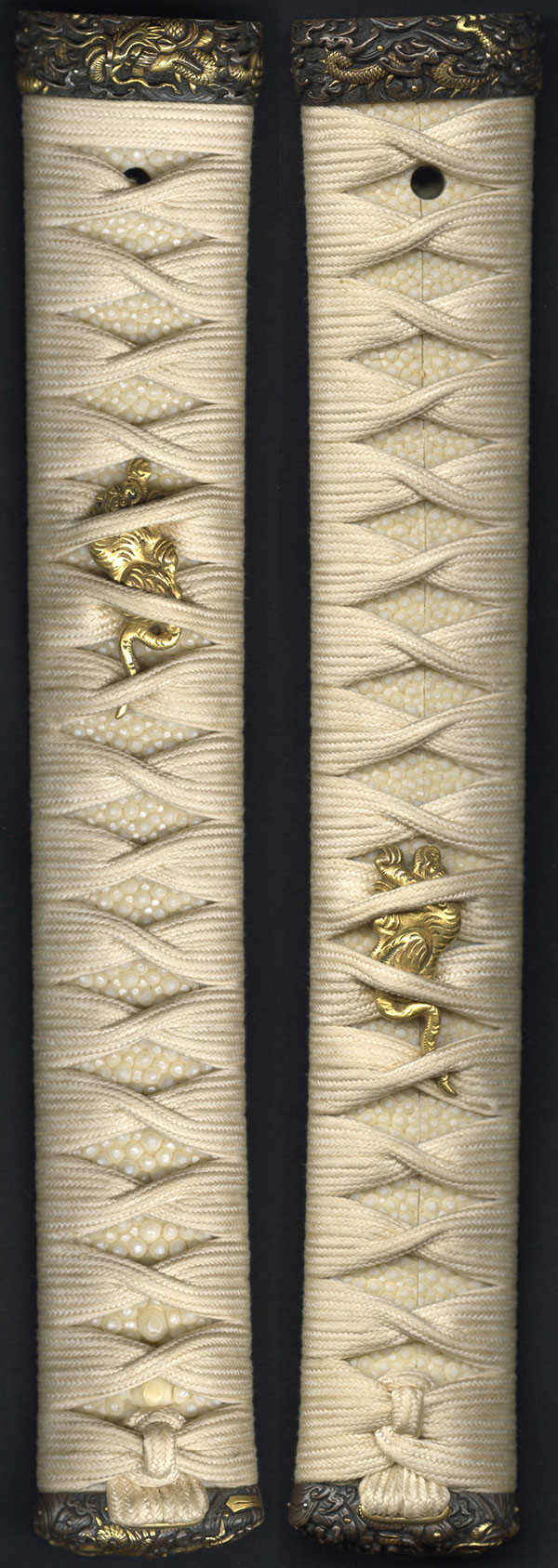
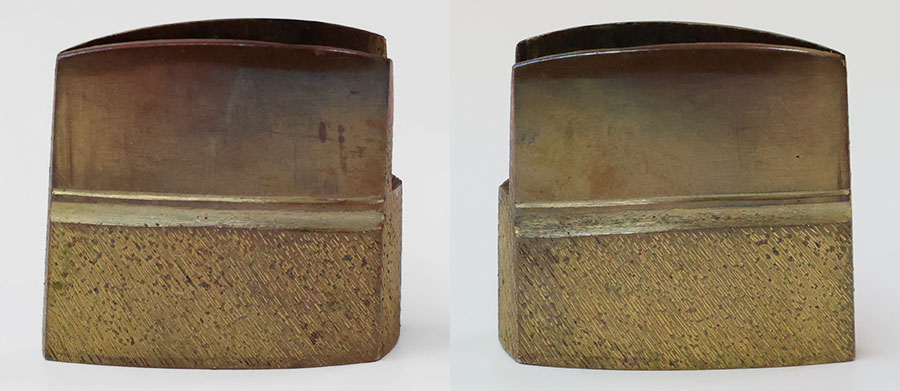
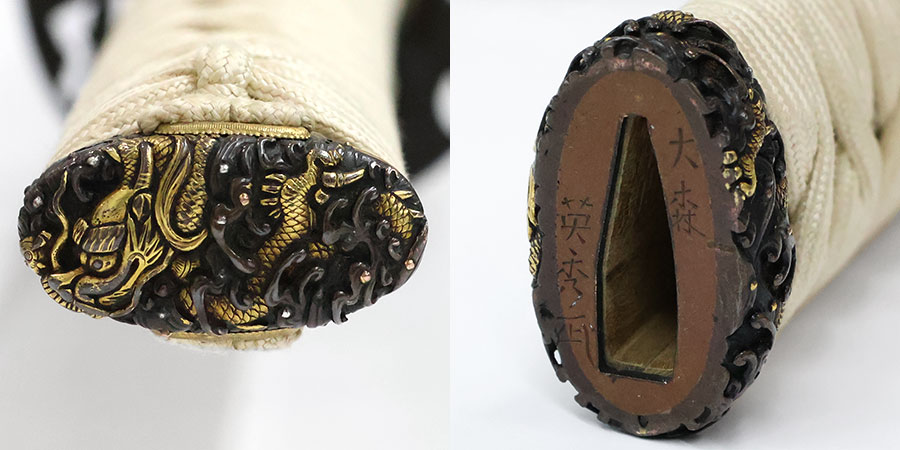
It has appeared, it has appeared! A celebrated masterpiece by Mino Akasaka Senjuin Hisakatsu has appeared, named with the auspicious connotation of "continuing to win eternally." While Mino Akasaka Senjuin is famous and many swordsmith names are listed in the directories (meikan), in reality, one rarely sees actual surviving works; thus, this sword by Hisakatsu is wonderful and precious. This sword is a typical example of Yamato-den, serving as proof that the Mino Akasaka Senjuin school migrated from Yamato to Mino. The sugata of this sword exhibits the high shinogi characteristic of Yamato-den, with a difference between the moto-mihaba and saki-mihaba and a slight sori. The dimensions were crafted to be easy to use, suited for the nukiuchi style of that era. The jigane is forged in itame-hada mixed with masame-hada in places, displaying abundant jinie and chikei that provide the profound flavor of a koto. The hamon is a suguha-style tempered in nioi-deki with ko-nie, showing double-edged nijuba and uchinoke along the habuchi. Within the ha, there are sunagashi and kinsuji, displaying wonderful and magnificent hataraki. While Magoroku Kanemoto is the most famous representative smith of Akasaka Senjuin among extant works, the swordsmith Hisakatsu also flourished in Mino Akasaka during the Eisho era of the Muromachi period (circa 1500, 524 years ago). His surviving works are few and highly valuable. The luxurious Edo-period koshirae, featuring a kairagi-same saya, adds even more splendor to this sword by Mino Akasaka Senjuin Hisakatsu. On this occasion, an elderly connoisseur (sukisha) has entrusted this to us, saying, "I have grown old, so please pass this precious zaimei masterpiece by the swordsmith Hisakatsu to the next generation at an affordable price." Therefore, we are offering it at a special bargain price. Please by all means enjoy this masterpiece with the auspicious name of Mino Akasaka Senjuin Hisakatsu.
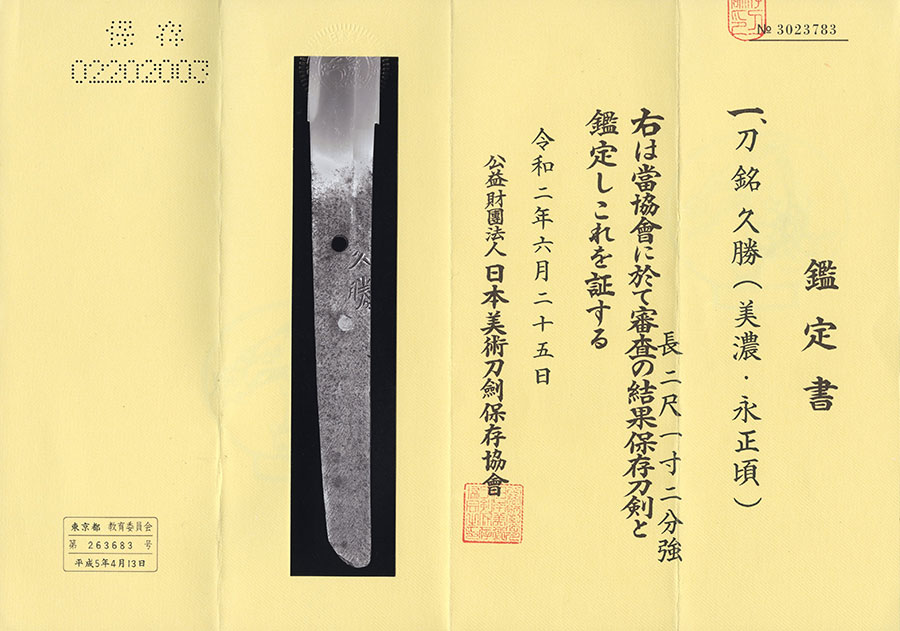
Certificate reading — 銘 久勝
 NihontoWatch
Muromachi · nagasa 64.7cm · sori 2cm















Mino · around 1504-1521
Tōken Taikan top 76%
3 pieces on the market now
The Muromachi period (1392 to 1573)
Muromachi turned sword making into an industry: the uchigatana rose with massed infantry warfare, Osafune and Seki produced bundle swords beside custom orders, and the Ming trade carried Japanese blades abroad by the tens of thousands.
Certifies a genuine blade worth preserving: a signature confirmed correct, or, if unsigned, an era, province, and school that the NBTHK can reliably identify.
The NBTHK (Nihon Bijutsu Tōken Hozon Kyōkai, the Society for the Preservation of Japanese Art Swords) is a public-interest incorporated foundation founded in 1948 and supervised by Japan’s Agency for Cultural Affairs (Bunkachō); it is based at the Japanese Sword Museum in Tokyo. Its expert panels physically examine each submitted work (shinsa) and issue a certificate (kanteishō) ranking it by artistic and historical merit. NBTHK papers are the most widely recognized standard of authentication for Japanese swords and fittings.
NBTHK official siteFor returns due to customer circumstances, the cost is the customer's responsibility. For returns due to our mis-shipment or a defective item, we bear the cost.
¥850,000
It has appeared, it has appeared! A celebrated masterpiece by Mino Akasaka Senjuin Hisakatsu has appeared, named with the auspicious connotation of "continuing to win eternally." While Mino Akasaka Senjuin is famous and many swordsmith names are listed in the directories (meikan), in reality, one rarely sees actual surviving works; thus, this sword by Hisakatsu is wonderful and precious. This sword is a typical example of Yamato-den, serving as proof that the Mino Akasaka Senjuin school migrated from Yamato to Mino. The sugata of this sword exhibits the high shinogi characteristic of Yamato-den, with a difference between the moto-mihaba and saki-mihaba and a slight sori. The dimensions were crafted to be easy to use, suited for the nukiuchi style of that era. The jigane is forged in itame-hada mixed with masame-hada in places, displaying abundant jinie and chikei that provide the profound flavor of a koto. The hamon is a suguha-style tempered in nioi-deki with ko-nie, showing double-edged nijuba and uchinoke along the habuchi. Within the ha, there are sunagashi and kinsuji, displaying wonderful and magnificent hataraki. While Magoroku Kanemoto is the most famous representative smith of Akasaka Senjuin among extant works, the swordsmith Hisakatsu also flourished in Mino Akasaka during the Eisho era of the Muromachi period (circa 1500, 524 years ago). His surviving works are few and highly valuable. The luxurious Edo-period koshirae, featuring a kairagi-same saya, adds even more splendor to this sword by Mino Akasaka Senjuin Hisakatsu. On this occasion, an elderly connoisseur (sukisha) has entrusted this to us, saying, "I have grown old, so please pass this precious zaimei masterpiece by the swordsmith Hisakatsu to the next generation at an affordable price." Therefore, we are offering it at a special bargain price. Please by all means enjoy this masterpiece with the auspicious name of Mino Akasaka Senjuin Hisakatsu.
Certificate reading — 銘 久勝
NihontoWatchMuromachi · nagasa 64.7cm · sori 2cm
Mino · around 1504-1521
Tōken Taikan top 76%
3 pieces on the market now
The Muromachi period (1392 to 1573)
Muromachi turned sword making into an industry: the uchigatana rose with massed infantry warfare, Osafune and Seki produced bundle swords beside custom orders, and the Ming trade carried Japanese blades abroad by the tens of thousands.
Certifies a genuine blade worth preserving: a signature confirmed correct, or, if unsigned, an era, province, and school that the NBTHK can reliably identify.
The NBTHK (Nihon Bijutsu Tōken Hozon Kyōkai, the Society for the Preservation of Japanese Art Swords) is a public-interest incorporated foundation founded in 1948 and supervised by Japan’s Agency for Cultural Affairs (Bunkachō); it is based at the Japanese Sword Museum in Tokyo. Its expert panels physically examine each submitted work (shinsa) and issue a certificate (kanteishō) ranking it by artistic and historical merit. NBTHK papers are the most widely recognized standard of authentication for Japanese swords and fittings.
NBTHK official siteFor returns due to customer circumstances, the cost is the customer's responsibility. For returns due to our mis-shipment or a defective item, we bear the cost.
¥850,000

