After the Ōnin War broke the Ashikaga order, a century of Sengoku warfare armed nearly every province in Japan. The era rewards a discriminating eye: routine work exists in quantity, and beside it stand custom blades of the first rank.
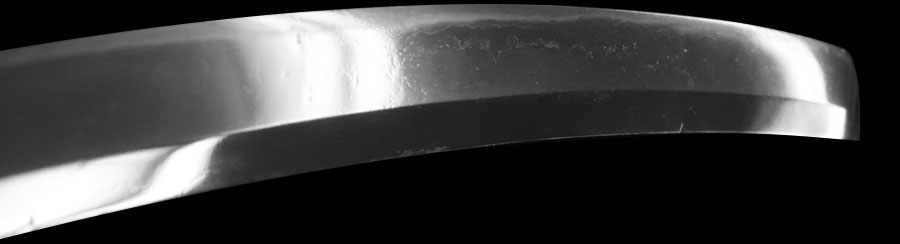
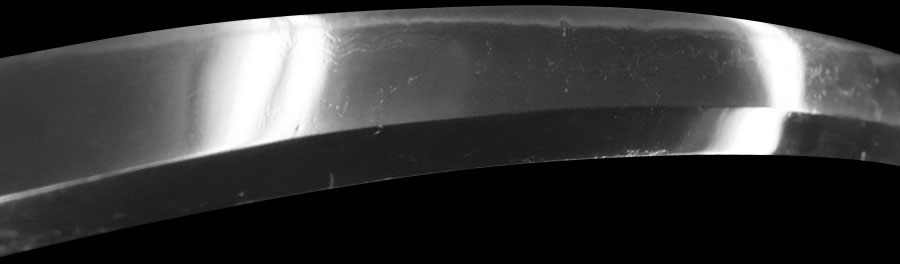
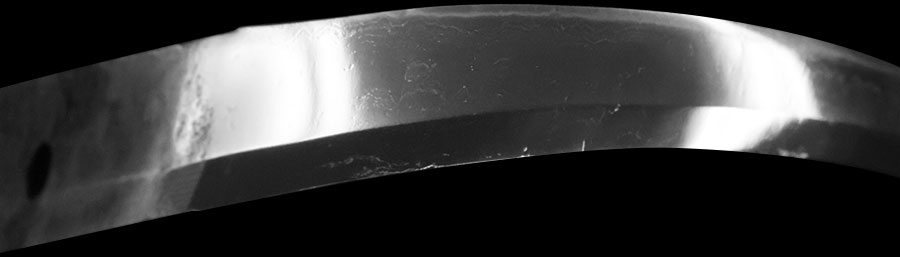
It has arrived, it has arrived—a masterpiece by Mino Akasaka Senjuin Hisakatsu, a name chosen for its auspicious meaning of "eternal victory." This sword brilliantly proves its toughness even now, over 500 years later, bearing *homare-kizu* (scars of honor) from the traces of fierce combat in two locations: 14cm from the *kissaki* and 18.5cm from the *moto*. This was the same era when Yoso Saemon-no-jo Sukesada flourished in Bizen to the west, and Izumi no Kami Fujiwara Kanesada and Magoroku Kanemoto were active in Mino. While the Mino Akasaka Senjuin school is famous and many swordsmith names appear in the *meikan* (genealogies), in reality, one almost never sees their actual works; thus, this sword by Hisakatsu is wonderful and precious. This sword exhibits a typical *Yamato-den* style and serves as proof that the Mino Akasaka Senjuin school migrated from Yamato to Mino. As for the *sugata*, it was originally a sword of 2 *shaku* 3 *sun*, but a later samurai—wishing to cherish this masterpiece that proved its strength through its "scars of honor" as his own *sashiryo*—shortened it to match his own swordsmanship. It displays an elegant *Yamato-den* silhouette with a slightly high *shinogi*, a difference between the *moto-mihaba* and *saki-mihaba*, and shallow *sori*. The *jigane* is *itame-hada* mixed with *masame-hada* in places, showing a very atmospheric *chikei* characteristic of *koto*. The *hamon* is a *suguha* style in *nioi-deki* with *ko-nie*, and within the blade, the *masame* forging pattern mingles to create *nijuba* and *uchinoke*, showing wonderful activity with *sunagashi* and *kinsuji*. While Magoroku Kanemoto is the most famous extant representative of the Akasaka Senjuin lineage, the swordsmith Hisakatsu was also active in Mino Akasaka during the Eisho era of the Muromachi period (circa 1500, 525 years ago); his surviving works are few and highly valuable. On this occasion, an elderly connoisseur has entrusted this to us, saying, "I have grown old, so please pass this precious *zaimei* masterpiece by Hisakatsu to the next generation at an affordable price." Because there are some minor *ha-kobore* (nicks in the edge) and *o-hada* in the *ji*, we are offering it at a special bargain price. Please enjoy this masterpiece by Mino Akasaka Senjuin Hisakatsu, whose auspicious name and proven toughness have survived through fierce combat to this day.
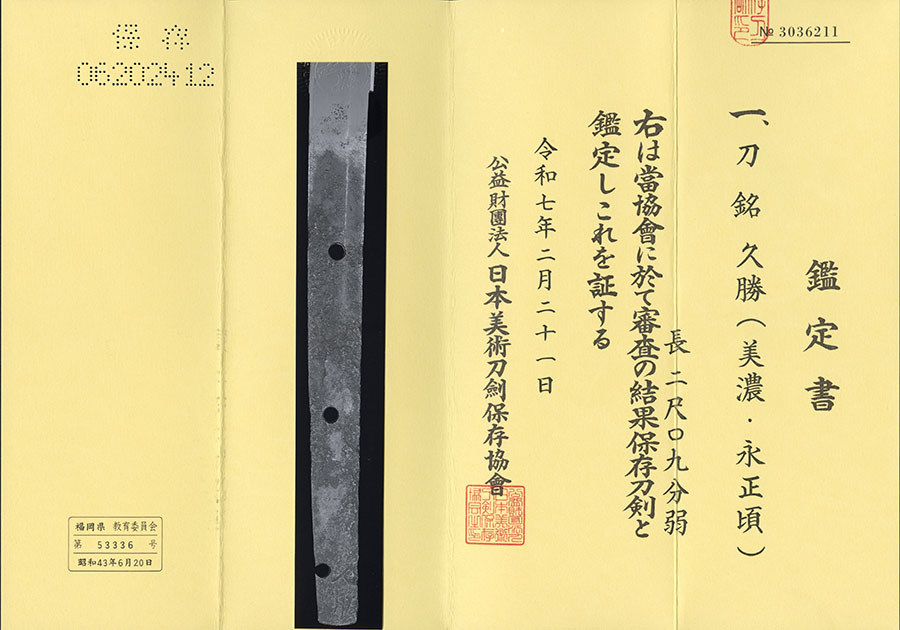
Certificate reading — 銘 久勝
 NihontoWatch
Eisho (1504-1521) · nagasa 63.4cm · sori 1.2cm












Mino · around 1504-1521
Tōken Taikan top 76%
3 pieces on the market now
The Muromachi period (1392 to 1573)
After the Ōnin War broke the Ashikaga order, a century of Sengoku warfare armed nearly every province in Japan. The era rewards a discriminating eye: routine work exists in quantity, and beside it stand custom blades of the first rank.
Certifies a genuine blade worth preserving: a signature confirmed correct, or, if unsigned, an era, province, and school that the NBTHK can reliably identify.
The NBTHK (Nihon Bijutsu Tōken Hozon Kyōkai, the Society for the Preservation of Japanese Art Swords) is a public-interest incorporated foundation founded in 1948 and supervised by Japan’s Agency for Cultural Affairs (Bunkachō); it is based at the Japanese Sword Museum in Tokyo. Its expert panels physically examine each submitted work (shinsa) and issue a certificate (kanteishō) ranking it by artistic and historical merit. NBTHK papers are the most widely recognized standard of authentication for Japanese swords and fittings.
NBTHK official siteFor returns due to customer circumstances, the cost is the customer's responsibility. For returns due to our mis-shipment or a defective item, we bear the cost.
¥360,000
It has arrived, it has arrived—a masterpiece by Mino Akasaka Senjuin Hisakatsu, a name chosen for its auspicious meaning of "eternal victory." This sword brilliantly proves its toughness even now, over 500 years later, bearing *homare-kizu* (scars of honor) from the traces of fierce combat in two locations: 14cm from the *kissaki* and 18.5cm from the *moto*. This was the same era when Yoso Saemon-no-jo Sukesada flourished in Bizen to the west, and Izumi no Kami Fujiwara Kanesada and Magoroku Kanemoto were active in Mino. While the Mino Akasaka Senjuin school is famous and many swordsmith names appear in the *meikan* (genealogies), in reality, one almost never sees their actual works; thus, this sword by Hisakatsu is wonderful and precious. This sword exhibits a typical *Yamato-den* style and serves as proof that the Mino Akasaka Senjuin school migrated from Yamato to Mino. As for the *sugata*, it was originally a sword of 2 *shaku* 3 *sun*, but a later samurai—wishing to cherish this masterpiece that proved its strength through its "scars of honor" as his own *sashiryo*—shortened it to match his own swordsmanship. It displays an elegant *Yamato-den* silhouette with a slightly high *shinogi*, a difference between the *moto-mihaba* and *saki-mihaba*, and shallow *sori*. The *jigane* is *itame-hada* mixed with *masame-hada* in places, showing a very atmospheric *chikei* characteristic of *koto*. The *hamon* is a *suguha* style in *nioi-deki* with *ko-nie*, and within the blade, the *masame* forging pattern mingles to create *nijuba* and *uchinoke*, showing wonderful activity with *sunagashi* and *kinsuji*. While Magoroku Kanemoto is the most famous extant representative of the Akasaka Senjuin lineage, the swordsmith Hisakatsu was also active in Mino Akasaka during the Eisho era of the Muromachi period (circa 1500, 525 years ago); his surviving works are few and highly valuable. On this occasion, an elderly connoisseur has entrusted this to us, saying, "I have grown old, so please pass this precious *zaimei* masterpiece by Hisakatsu to the next generation at an affordable price." Because there are some minor *ha-kobore* (nicks in the edge) and *o-hada* in the *ji*, we are offering it at a special bargain price. Please enjoy this masterpiece by Mino Akasaka Senjuin Hisakatsu, whose auspicious name and proven toughness have survived through fierce combat to this day.
Certificate reading — 銘 久勝
NihontoWatchEisho (1504-1521) · nagasa 63.4cm · sori 1.2cm
Mino · around 1504-1521
Tōken Taikan top 76%
3 pieces on the market now
The Muromachi period (1392 to 1573)
After the Ōnin War broke the Ashikaga order, a century of Sengoku warfare armed nearly every province in Japan. The era rewards a discriminating eye: routine work exists in quantity, and beside it stand custom blades of the first rank.
Certifies a genuine blade worth preserving: a signature confirmed correct, or, if unsigned, an era, province, and school that the NBTHK can reliably identify.
The NBTHK (Nihon Bijutsu Tōken Hozon Kyōkai, the Society for the Preservation of Japanese Art Swords) is a public-interest incorporated foundation founded in 1948 and supervised by Japan’s Agency for Cultural Affairs (Bunkachō); it is based at the Japanese Sword Museum in Tokyo. Its expert panels physically examine each submitted work (shinsa) and issue a certificate (kanteishō) ranking it by artistic and historical merit. NBTHK papers are the most widely recognized standard of authentication for Japanese swords and fittings.
NBTHK official siteFor returns due to customer circumstances, the cost is the customer's responsibility. For returns due to our mis-shipment or a defective item, we bear the cost.
¥360,000

