 NihontoWatchNihontoWatch
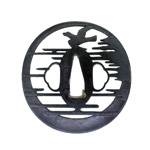
The Bamen school is famous for the emergence of Tsunemasa, who devised a unique specialty in sukashi tsuba. The name Bamen is sometimes written with the characters 馬免, and they were originally a group of kabuto makers and smiths whose origins trace back to the Sengoku period as a clan residing in Echizen Province. The name Bamen was a surname granted by the Honda family, the lords of the domain. Many in this lineage were engaged in smithing-related work in Maruoka-cho, Echizen Province until the end of the Edo period, including agricultural tools, kabuto, and firearms. Tsunemasa was commonly known as Ichijuro. Due to the unusual surname Bamen, various old books recorded him as originating from a mask maker (bamen-shi), but it is believed his master was the kinkō Kikuchi Tsunekatsu. The lack of commonality in their styles is because Tsunemasa was raised in the family business of ironwork and studied the techniques of various sukashi tsuba schools of the same period; however, the calligraphy seen in the character "Tsune" (序) closely resembles that of Tsunekatsu (序克). Tsunemasa was born in Kanpo 1 (1741), and his survival can be confirmed until the end of Bunka to the early years of Bunsei. He lived in Shitaya Okachi-machi. He signs "Bamen Tsunemasa (kaō)" on the left side of the seppa-dai. There are nenkī such as Kansei 5, Kansei 10, and Bunka 6, and gyōnen-mei of 68, 70, 72, 73, and 75 years of age have been personally seen. Examples including place names have mei such as "Bushu Junin Bamen Tsunemasa" or the soe-mei "I Nanban-tetsu zo shi". He specialized in a technique of carving out the ground of tsuba in tetsu-ji maru-gata to create the design as a yo-sukashi in a silhouette-like style. Popular sukashi tsuba schools at the time included the Akasaka, Akao, and Bushu Ito schools, but his yo-sukashi tsuba technique, which incorporated their respective strengths and aesthetically sublimated them, had a great influence on each school. In this tsuba, the tanren of the ji-tetsu is refined and beautiful, the composition is bold with excellent design, and it skillfully incorporates a sense of perspective in its expression; the sharpness of the tagane-zukai is outstanding.
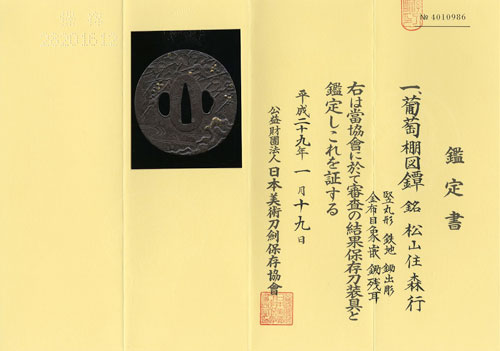
Certificate reading — 銘 松山住森行
NihontoWatchOffered by Sanmei
4 on the market

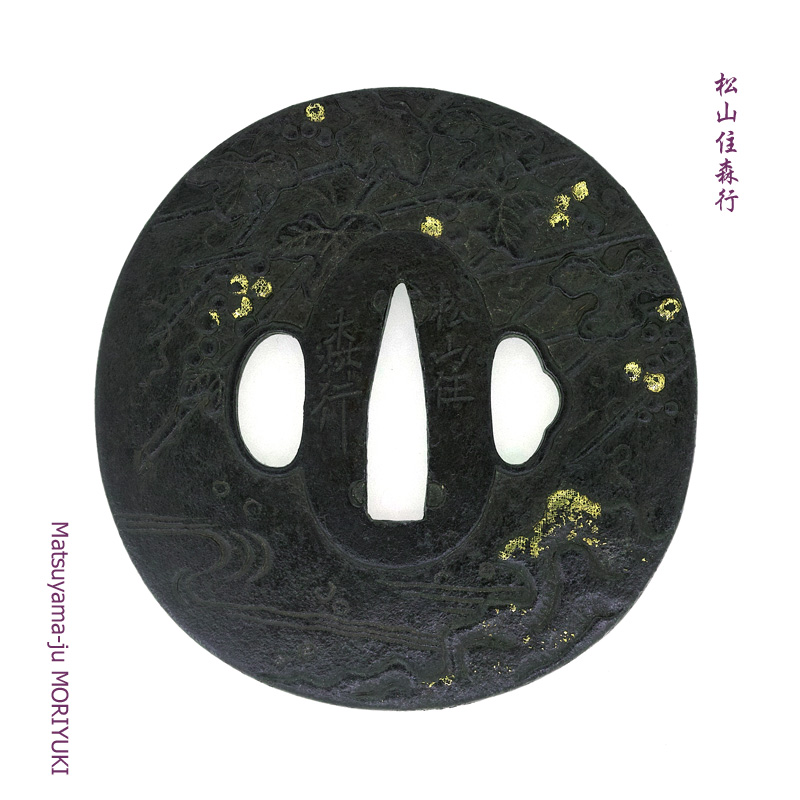
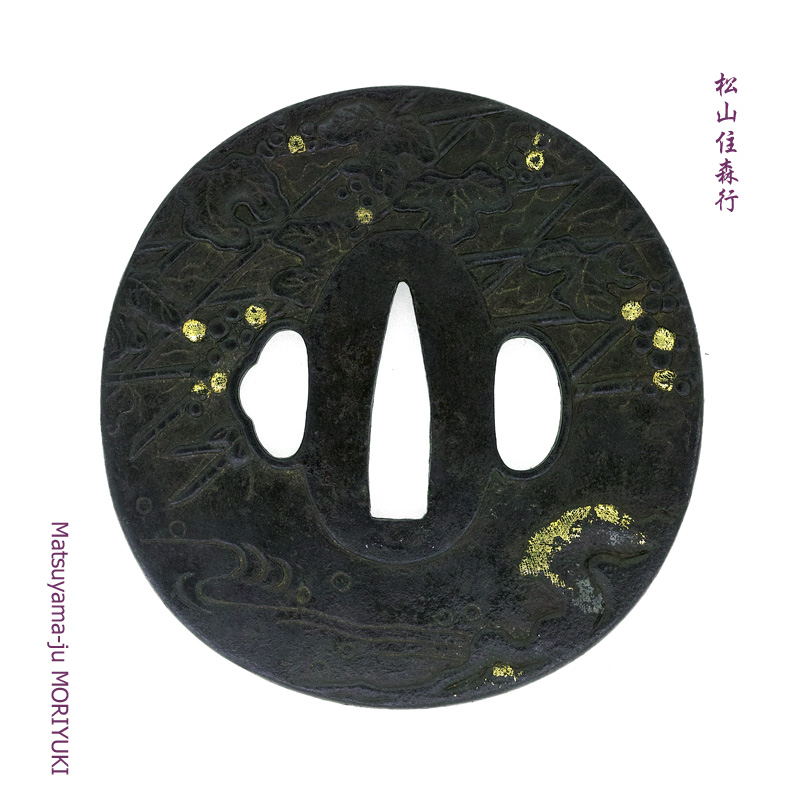
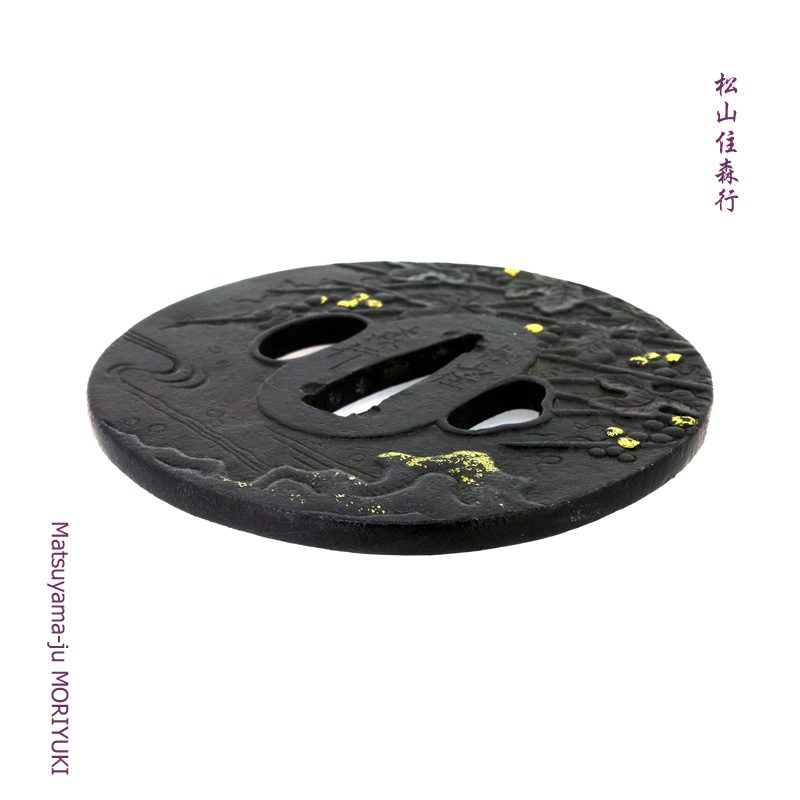
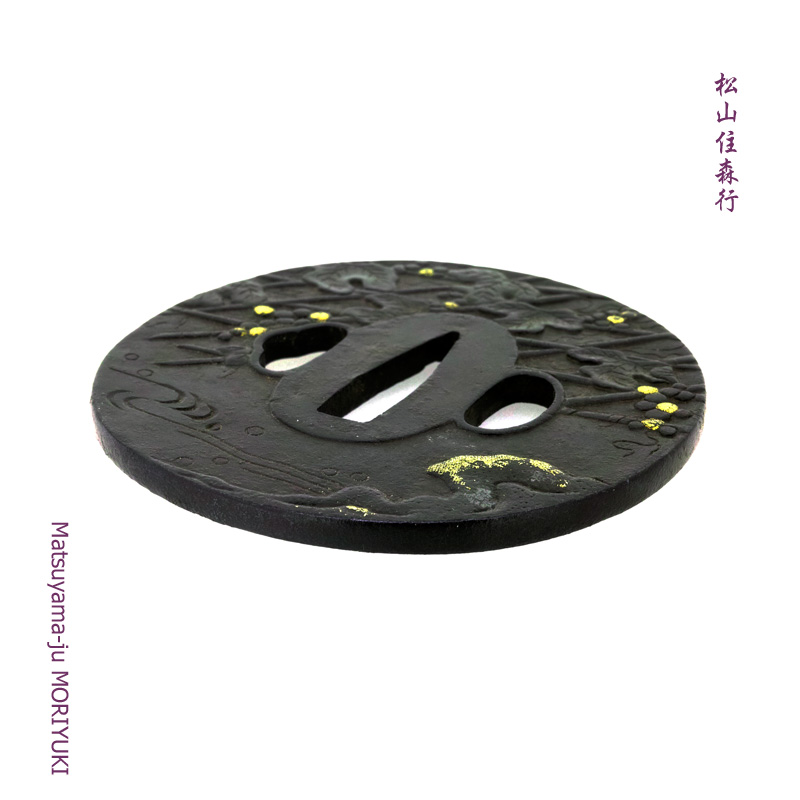
Machine translation from the shop's Japanese · may contain errors ·
Katchushi · Echizen
4 pieces on the market now
Katchushi · Echizen
4 pieces on the market now
| Smith | Era | Designated |
|---|---|---|
| Bamen Tsunemasa馬面序政 | — | 0 |
Certifies a genuine fitting worth preserving: a correct signature, or, if unsigned, an identifiable era and school, with recognized artistic and craft value.
The NBTHK (Nihon Bijutsu Tōken Hozon Kyōkai, the Society for the Preservation of Japanese Art Swords) is a public-interest incorporated foundation founded in 1948 and supervised by Japan’s Agency for Cultural Affairs (Bunkachō); it is based at the Japanese Sword Museum in Tokyo. Its expert panels physically examine each submitted work (shinsa) and issue a certificate (kanteishō) ranking it by artistic and historical merit. NBTHK papers are the most widely recognized standard of authentication for Japanese swords and fittings.
NBTHK official siteFor a return, please contact us within 7 days of the item's arrival. If specification changes such as dimensions were made at the customer's request, a return cannot be accepted. Shipping and transfer fees are the customer's responsibility.
Price on request