The divided-courts war impoverished the court society that had sustained Kyōto’s most refined work. With the last Rai masters the classic line effectively closed, while Hasebe and Nobukuni carried the new Sōshū manner into the capital.
 NihontoWatchNihontoWatch
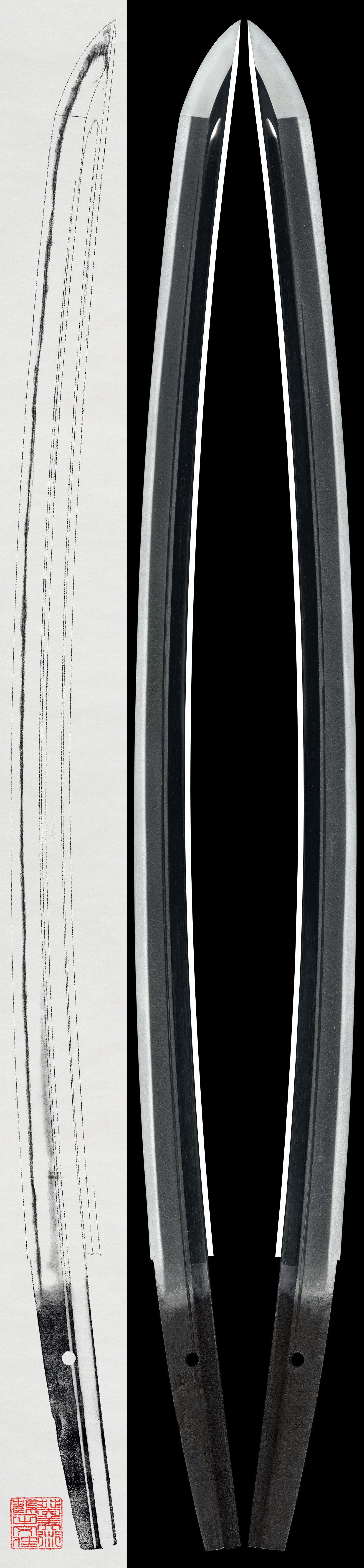
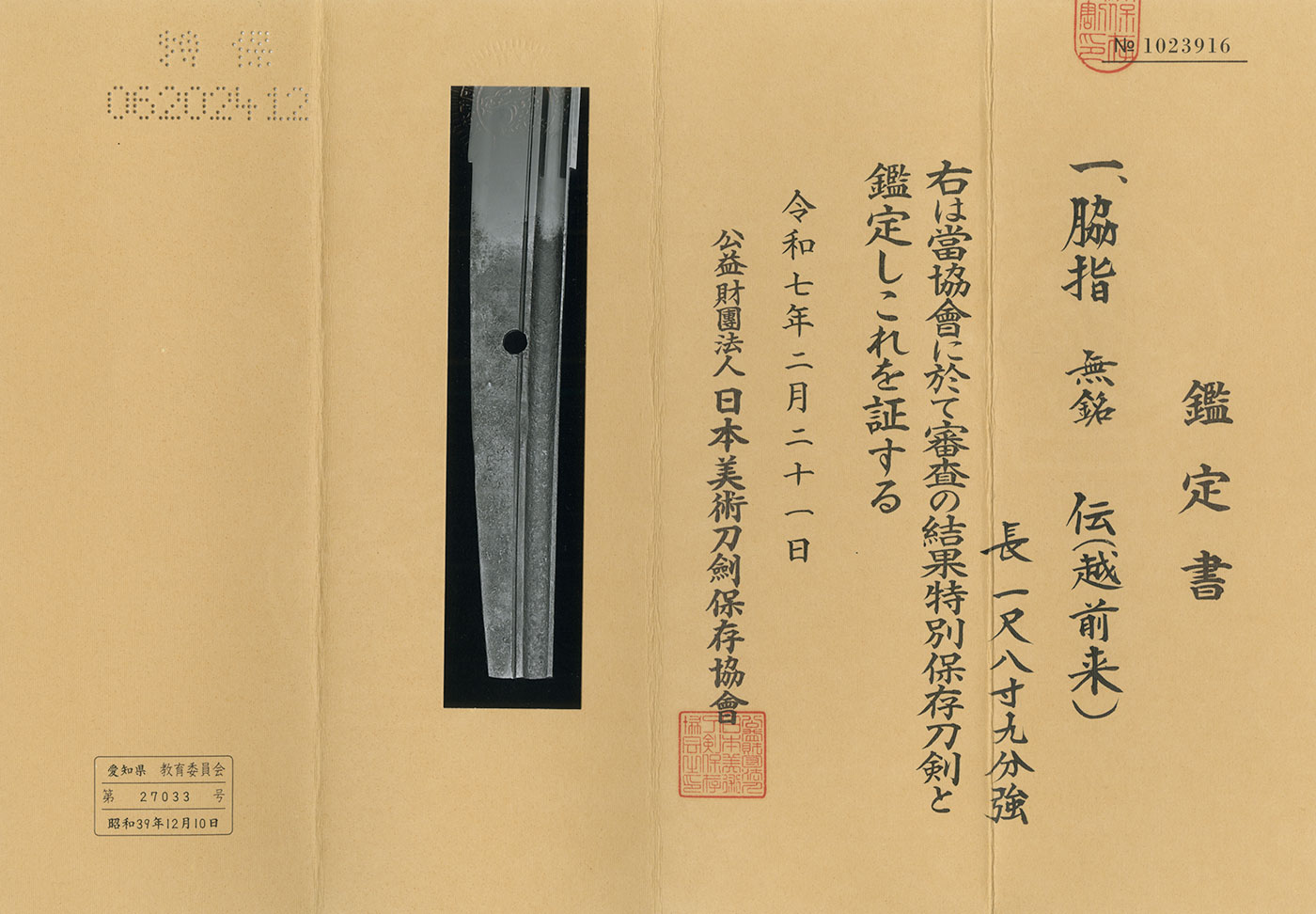
Ordering Number: AS25686Wakizashi in Shirasaya (NBTHK Tokubetsu Hozon Token)Signature: Mumei (Unsigned) (Den Echizen Rai)無銘(伝 越前来)(We divide 4 sections for each sword as Saijyo Saku, Jyojyo Saku, Jyo Saku and Regular Saku).This blade is ranked as Jo-saku among works attributed to Mumei (Den Echizen Rai).Habaki: Shakudo habaki.Blade Length: 57.5 cm (22.64 in).Curvature: 1.6 cm (0.63 in).Mekugi Hole: 1.Width at Base (Motohaba): 2.81 cm (1.11 in).Width at Yokote: 2.29 cm (0.90 in).Thickness of rim (Kasane): 0.55 cm (0.22 in).Sword Weight: 445 g.Shape: O-suriage mumei wakizashi with a relatively wide mihaba, substantial kasane, and bohi carved on both sides.Jigane: Well-forged ko-itame hada producing a fine-quality steel surface. The blade has deep curvature and a well-proportioned shape with an elongated kissaki.Hamon: Nioi-deki suguha. The boshi becomes notare and returns in a ko-maru form.Features: At the beginning of the Nanbokucho period, Chiyozuru Kuniyasu and Echizen Yasuyuki appeared in Echizen Fuchu, present-day Takefu City. The term Echizen Rai refers to the group of swordsmiths of the Rai tradition who relocated to Echizen and forged swords there. As they were disciples of Rai Kuniyasu of Kyoto, they became known collectively as the Echizen Rai school. They flourished during the latter half of the Nanbokucho period. This example is a wakizashi of nearly katana length, featuring deep curvature and exceptionally graceful proportions.NBTHK Tokubetsu Hozon Token.AoiArt estimation paper: Whole Oshigata.Please note: The price does not include the international shipping fees.Auction Starting Price:450,000JPYPlace BidRelated Items:
NihontoWatchOffered by Aoi Art
This piece has sold
5 on the market
Get an email when new Echizen Rai School work hits the market.



Yamashiro-den · Echizen
5 pieces on the market now
| Smith | Era | Designated |
|---|---|---|
| Echizen越前 | 1336-1392 | 1 |
Yamashiro in the Nanbokuchō period
The divided-courts war impoverished the court society that had sustained Kyōto’s most refined work. With the last Rai masters the classic line effectively closed, while Hasebe and Nobukuni carried the new Sōshū manner into the capital.
A Hozon-certified blade judged to show notably superior workmanship and a better state of preservation. The bar is higher: re-tempered blades and most unsigned Muromachi/Edo works are excluded.
The NBTHK (Nihon Bijutsu Tōken Hozon Kyōkai, the Society for the Preservation of Japanese Art Swords) is a public-interest incorporated foundation founded in 1948 and supervised by Japan’s Agency for Cultural Affairs (Bunkachō); it is based at the Japanese Sword Museum in Tokyo. Its expert panels physically examine each submitted work (shinsa) and issue a certificate (kanteishō) ranking it by artistic and historical merit. NBTHK papers are the most widely recognized standard of authentication for Japanese swords and fittings.
NBTHK official siteIf you wish to return an item, please notify us within 3 days of receipt. After this period we cannot accept cancellations. Please ship the return to us within 5 business days. Cancellation is conditional on the item being kept in the same condition as at the time of sale, so please handle it with care.