Muromachi turned sword making into an industry: the uchigatana rose with massed infantry warfare, Osafune and Seki produced bundle swords beside custom orders, and the Ming trade carried Japanese blades abroad by the tens of thousands.
 NihontoWatchNihontoWatch
This wakizashi was crafted in Etchû province during the turbulent Muromachi Period, circa the turn of the sixteenth century. Etchû sits on the northern coast of Honshû, facing the Sea of Japan – a region with its own distinct forging tradition shaped by proximity to the Soshu and Yamato schools as much as by local Bizen influence. The Ko-Uda school traces its origins to Kunimitsu, who worked in the Uda district of Yamato Province around 1317, at the close of the Kamakura era. As no confirmed works by Kunimitsu survive, his students Kunifusa and Kunimune – both associated with the Go Norishige school – are regarded as the true founders of the tradition. Uda Hirakuni was a pupil of Kunikiyo, and this blade shows clearly why the school attracted such enduring respect. The workmanship is a confident synthesis of Sôshû, Yamato and Bizen characteristics operating in natural harmony, rather than in tension. The jihada is a striking mix of itame with large swirling chikei, the dark lines threading through the steel with a life of their own. Against this, the hamon runs in bright gunome midare loaded with kinsuji and sunagashi – an exceptionally active and vivid nie-based temper that rewards close study in good light. The blade has been greatly shortened (ô-suriage) at some point in its history – common for swords that saw extended working life – but it retains its character entirely. The silver and gold habaki is beautifully made and an object of interest in its own right.
NihontoWatchOffered by Unique Japan
This piece has sold
Get an email when a new Uda Hirakuni piece hits the market.

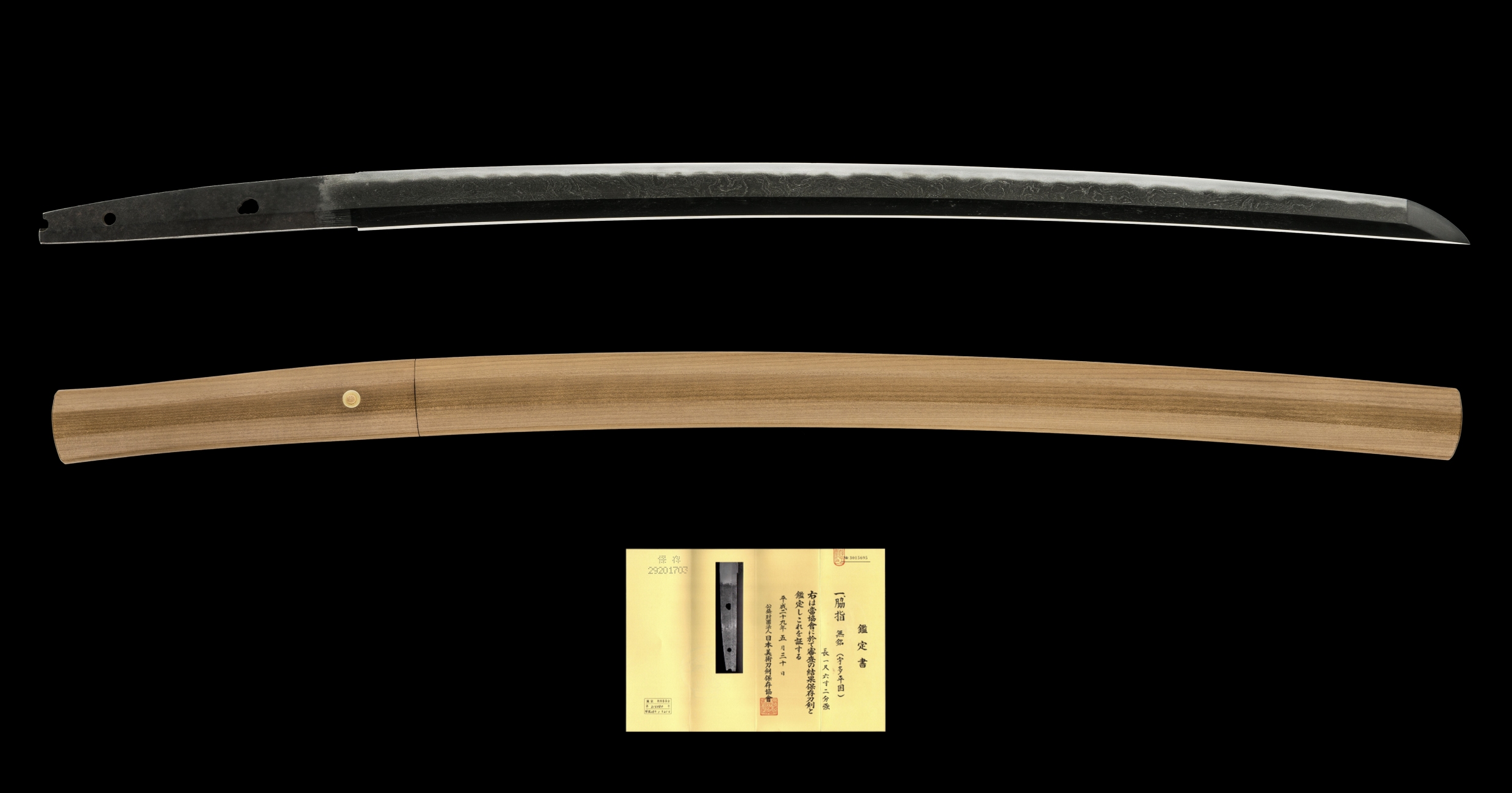
Wakimono · Etchu · around 1492-1501
Fujishiro Jo saku · Tōken Taikan top 49%
1 piece on the market now
Where Hirakuni stands among comparable artisans: across all of nihontō, and within tradition, era, and period. The tiers (Foremost · Leading · Major · Notable) weigh official designations from the NBTHK and Japan's Agency for Cultural Affairs, together with historical honors of lasting repute such as the Sansaku and Meibutsu-chō.
Select a lens to see how it's measured.
Wakimono · Etchu
Phase: Uda宇多· 1390–1596
25 pieces on the market now
Where Ko-Uda closes with the Nanbokuchō generations, the chapter that follows opens in early Muromachi and runs to the end of the period. The setsumei draw the boundary plainly: works that descend no later than Nanbokuchō are called Ko-Uda, while everything thereafter is referred to simply as Uda. This later phase is the long Muromachi continuation in Etchū, where the Kuni-named line that began with Ko-Nyūdō Kunimitsu of Uda District in Yamato extends across successive generations sharing single names. Kunihisa, read by the meikan as son of Kunifusa and active from the Ōei era, runs through several generations down to the close of Muromachi; Kunimune carries from Nanbokuchō into Muromachi with dated pieces around Bunmei; and the later registers add Kuninaga, Kuniyoshi, Hirakuni, Sanekuni, Kunikiyo, Tomohisa, and Kunitsugu, names the sources place from Eikyō through Tenshō. Because individuals individuate little, a signed blade of this phase is appraised as the manner of its dated moment rather than the hand of one smith. The steel of the later phase keeps the school's northern foundation while standardizing its expression. The setsumei describe itame mixed with mokume, the grain overall standing (hada-dachi) and tending to flow (nagare), with ji-nie adhering and chikei entering; the jigane leans blackish, and a shirake-utsuri stands distinctly in the ji, sometimes with ji-madara mottling. Over this the temper most often opens as a suguha-based or chū-suguha line into which ko-gunome runs continuously from base to point, ashi and yō entering, ko-nie adhering along a bright nioiguchi, with sunagashi and occasional kinsuji.
A second, more agitated face mixes gunome, ko-notare and pointed togariba with thick nie, yubashiri and tobiyaki that on a Kuninaga wakizashi tend toward hitatsura. Against the earlier Ko-Uda this reads more regularized: where the early generations stayed close to their Yamato and Sōshū models with archaic ji-ha, the later hands settle into the elongated Ōei tantō form (broad for its width, with uchizori) and, in the katana, the wide sun-nobi sugata of advancing Muromachi. The Kunitsugu katana shows this drift toward coarseness directly, its itame standing and rough, the nie uneven and the temper darkening at the edge. To separate later Uda from Ko-Uda is to read the steel before the temper. The whitish, standing jigane with its blackish cast and shirake-utsuri returns a blade to this phase even when a nie-laden midare recalls Sōshū at first glance, and a tightly forged ko-itame may, as with the better Kunihisa pieces, approach Rai Kunimitsu or Rai Kunitsugu before the dark northern grain brings it home. Distinctive markers recur across the named smiths: the bōshi that becomes pointed and is tempered down with a long kaeri, the flaring (susodoshii) nakago-jiri, somewhat coarse rounded nie mixed within the ha, and the particular shaping of the character kuni in the signature. Dated and signed pieces anchor the chronology, from a Kunihisa tantō of Ōei 7 to a Kunimune wakizashi placed around Bunmei and Hirakuni and Sanekuni works set near Tenbun. Provenance for the phase tends toward settled holding, with examples recorded in Honma's inventory of the Imperial collection rather than circulating. Learn more →
| Smith | Era | Designated |
|---|---|---|
| Kunihisa國久 | 1394-1428 | 10 |
| Kunimune國宗 | 1429-1479 | 5 |
| Tomotsugu友次 | 1381-1384 | 3 |
| Kunimune國宗 | 1394-1428 | 3 |
| Kunitsugu國次 | 1469-1487 | 3 |
The Muromachi period (1392 to 1573)
Muromachi turned sword making into an industry: the uchigatana rose with massed infantry warfare, Osafune and Seki produced bundle swords beside custom orders, and the Ming trade carried Japanese blades abroad by the tens of thousands.
Certifies a genuine blade worth preserving: a signature confirmed correct, or, if unsigned, an era, province, and school that the NBTHK can reliably identify.
The NBTHK (Nihon Bijutsu Tōken Hozon Kyōkai, the Society for the Preservation of Japanese Art Swords) is a public-interest incorporated foundation founded in 1948 and supervised by Japan’s Agency for Cultural Affairs (Bunkachō); it is based at the Japanese Sword Museum in Tokyo. Its expert panels physically examine each submitted work (shinsa) and issue a certificate (kanteishō) ranking it by artistic and historical merit. NBTHK papers are the most widely recognized standard of authentication for Japanese swords and fittings.
NBTHK official siteAll swords come with a three-day inspection period beginning from the date of delivery. If not satisfied, the sword may be returned within this period for a full refund of the purchase price. Outside of this period, all sales are final. Swords purchased on a layaway payment plan are not eligible for the three-day inspection period.