Muromachi turned sword making into an industry: the uchigatana rose with massed infantry warfare, Osafune and Seki produced bundle swords beside custom orders, and the Ming trade carried Japanese blades abroad by the tens of thousands.
 NihontoWatchNihontoWatch
The toroku-sho for this tanto lists the sori as "uchi-zori," but I believe this is a mistake. While it is true that there is almost no sori and the kissaki curves inward ever so slightly, it is correctly a chukan-zori. If possible, I would have liked it to be judged as "sori: none," but ultimately it is a matter of the judge's decision and classification standards. One should avoid taking this literally and concluding that this is a tanto made with takenoko-zori from the time of forging, unless it were a copy. There are no tanto with takenoko-zori from the start other than copies. If one exists, it is the result of being worn down by polishing. This tanto is chukan-zori. The kissaki has entered a state of curving slightly inward due to being worn down by polishing over the ages. Since it is a work from around the middle Muromachi period, this wear is naturally within the range of tolerance. Considering the age, it may be in the better category. The nakago bears a charming mei of Uda Kunimune... I speculate it is the work of the fourth generation Kunimune from around the Bunmei era, between the middle and late Muromachi periods. Honami Koson wrote that many works by Kunimune, regardless of the generation, closely resemble Yamato Tegai Kanenaga. He added that, somewhere, the characteristics of a wakimono will appear... Hmm, looking at this work, that may be exactly right. While the nioiguchi is tight, it has a softness, and with no muranie, the habuchi is clear and well-executed. At the same positions on the omote and ura near the habaki-moto, there is a hamon of kuichigai-ba on the sashi-omote side and niju-ba on the sashi-ura side. The remnants of Tegai are visible. And, right around where the yokote would be, again on both the omote and ura, there is a single small gunome with a shallow head... This is it, the "wakimono characteristic" he mentioned; it is interesting. Those who are negative might disparage it as being out of place, unrefined, or ultimately second-rate, but depending on how you look at it, it is a perfectly acceptable hataraki (our shop might be a group of maniacal enthusiasts). Therefore, this work, which directly exhibits the characteristics exactly as pointed out by Koson, can be called a typical work of Kunimune, to put it in a positive light. The jihada is ko-itame mixed with itame; in particular, from around the upper half, the nagare-kokoro itame becomes stronger, and the areas where chikei follow the hadame are one of the highlights. Furthermore, the utsuri from the yaki-dashi and the hiraji give an impression like the shirake-utsuri of Mino. The yaki-haba is quite narrow, and naturally, the way the hoso-suguba extends like a white thread is the very image of an archaic form. If one does not fuss over small details like jihada or nioiguchi, the flavor is no different from Rai or Awataguchi. The era is around Bunmei so they should not be compared, but compared to works by famous smiths or schools that have been poorly worn down by polishing, this may be a much more kenzen and enjoyable work. I believe you will be convinced of its degree of kenzen-do if you look at the image from the mune...
Offered by Asahi Token
25 on the market

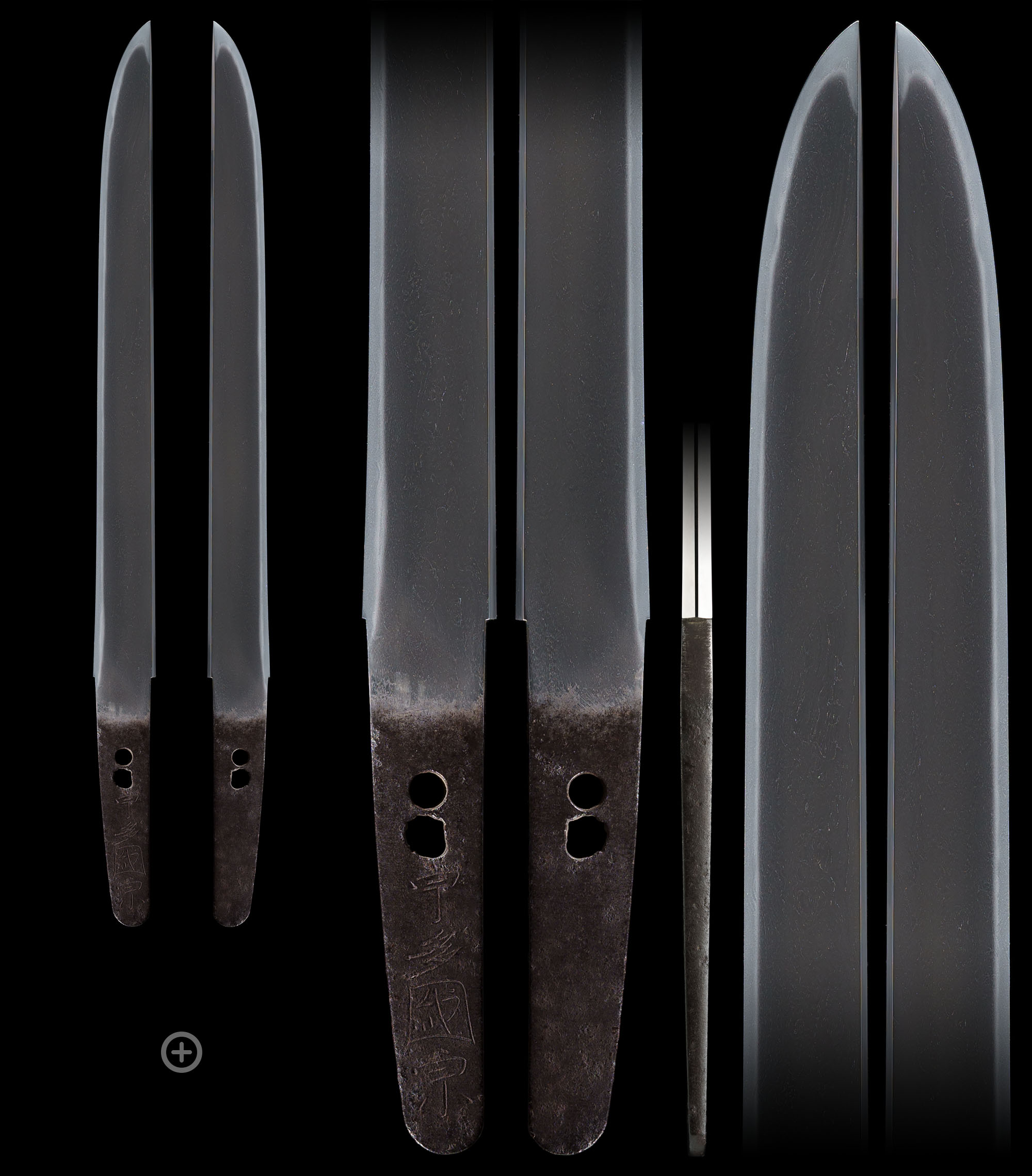
As written by the shop
Machine translation from the shop's Japanese · may contain errors ·
Wakimono · Etchu
25 pieces on the market now
Among the provincial lineages that carried the Yamato-den northward, the Uda school (宇多) of Etchu province holds a distinct place. Its origin lies in the late Kamakura period, when the monk-smith Kunimitsu, remembered as Ko-Nyudo Kunimitsu, migrated from Uda District in Yamato to Etchu around the close of the era. From this founder descended a long line of Kuni-named smiths; the reference registers carry Kunifusa and Kunimune as sons of the founder, Kunitsugu and Kunihisa among the generations that followed, the studio names recurring through the Oei, Hotoku, Bunmei and Tenbun eras down to the end of Muromachi and on into shinto times. The school worked the tanto (broad for its length, with little curvature) more readily than the tachi or uchigatana, and because its smiths individuate little, a signed Uda blade is read less as one hand than as the manner of its period. The school is identified first off the steel rather than the temper. The shared forging is an itame that runs and tends to stand, flowing toward masame and mixing mokume, with standing o-hada and ji-nie throughout; the steel turns whitish and at times blackish, so that a shirake-utsuri or faint bo-utsuri stands in the ji. Over this northern jigane the temper ranges from a chu-suguha opening shallowly into ko-notare and ko-midare to a vigorous gunome carrying pointed elements, ashi and yo entering, ko-nie well adhered along a tight nioiguchi. The Yamato activity of hotsure and kuichigai-ba names the old province along the habuchi, while kinsuji and sunagashi run through nearly every surviving blade.
From this base the corpus divides: a quieter Yamato-rooted suguha face, seen on the tanto; a Soshu-leaning midare face traced to Kunifusa's study under Etchu Norishige, in which the nie thickens and grows at times coarse with yubashiri and broadened yakihaba; and a refined register in which a compacted ko-itame gathers abundant ji-nie and a round, luminous nie scatters through the yakiba. Ko-Uda, the earlier work of the Nanbokucho and early Muromachi generations, reads cleaner and closer to its Yamato and Soshu models; the later Uda hands run coarser and more provincial in character. To kantei an Uda blade is to find its Yamato roots wearing a coarser northern character. The whitish, standing jigane with its masame tendency and shirake-utsuri returns the blade to the school when the temper alone might recall a Yamashiro or Soshu hand; a nie-laden example reads as Soshu at first glance and is brought home by the dark, standing steel and the nioiguchi that holds rather than glows. The best members close the distance to their models: Kunihisa, the Oei-era hand the published sources read against the founder, forged a ko-itame bright enough that the judges found his finest wakizashi and tanto all but mistakable for Rai Kunimitsu or Kunitsugu, while his standing itame and shirake-utsuri keep him within Uda. Kunimune and Kunitsugu carry the same two faces over the one northern steel, the dated and signed pieces (a Bunmei 11 katana, a Bunmei 17 yari) valued as research material for the school as much as for their make. Signed Uda blades are uncommon, so the school's standing rests heavily on mumei attributions read by jigane and temper. Provenance tends toward long, settled holding, with designated work resting in shrines and museums, and some recorded in Honma's inventory of the Imperial collection, rather than circulating, so that a signed Uda piece comes to a private collector only from time to time and with patience, a clear window onto how the Yamato tradition was carried into the northern provinces. Learn more →
| Smith | Era | Designated |
|---|---|---|
| Kunihisa國久 | 1394-1428 | 10 |
| Kunimune國宗 | 1429-1479 | 5 |
| Tomotsugu友次 | 1381-1384 | 3 |
| Kunimune國宗 | 1394-1428 | 3 |
| Kunitsugu國次 | 1469-1487 | 3 |
The Muromachi period (1392 to 1573)
Muromachi turned sword making into an industry: the uchigatana rose with massed infantry warfare, Osafune and Seki produced bundle swords beside custom orders, and the Ming trade carried Japanese blades abroad by the tens of thousands.
A Hozon-certified blade judged to show notably superior workmanship and a better state of preservation. The bar is higher: re-tempered blades and most unsigned Muromachi/Edo works are excluded.
The NBTHK (Nihon Bijutsu Tōken Hozon Kyōkai, the Society for the Preservation of Japanese Art Swords) is a public-interest incorporated foundation founded in 1948 and supervised by Japan’s Agency for Cultural Affairs (Bunkachō); it is based at the Japanese Sword Museum in Tokyo. Its expert panels physically examine each submitted work (shinsa) and issue a certificate (kanteishō) ranking it by artistic and historical merit. NBTHK papers are the most widely recognized standard of authentication for Japanese swords and fittings.
NBTHK official siteReturns are accepted within 7 days of the item's arrival, provided its condition has not changed since the time of sale. Once the return is confirmed, the payment is promptly refunded to your designated account.
¥1,100,000