 NihontoWatchNihontoWatch
鍛えの良い鉄地に、優れた意匠を詳細で精巧な彫技で展開する。武州伊藤派の大きな魅力であり特徴だが、江戸後期になると本作のような赤銅地の優れた作品も見られるようになる。主題は源氏物語葵巻中の車争いの場面である。鐔の左側に立体的に交差する細い蔓と抑揚のある葵の葉を、右側には乱れた車の前簾を描き、切羽台を挟んで上下に冠が配されている。雅やかな雰囲気で、事件を象徴する事物を濃密に描写し留守模様としている。正利は江戸詰めの美作国津山藩工。伊藤家門人中最も優れた鐔工である伊藤正常に学んだ。作域が広く、構図も巧みな優れた鐔工である。
NihontoWatchOffered by Choshuya
This piece has sold
Get an email when a new Ito Masatoshi piece hits the market.

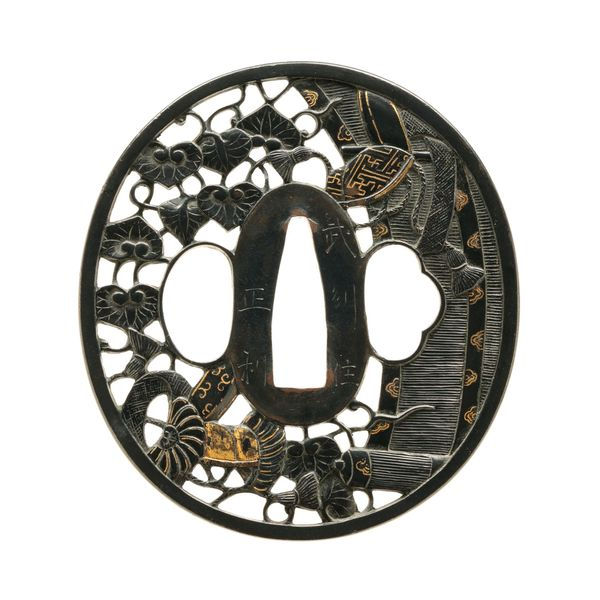
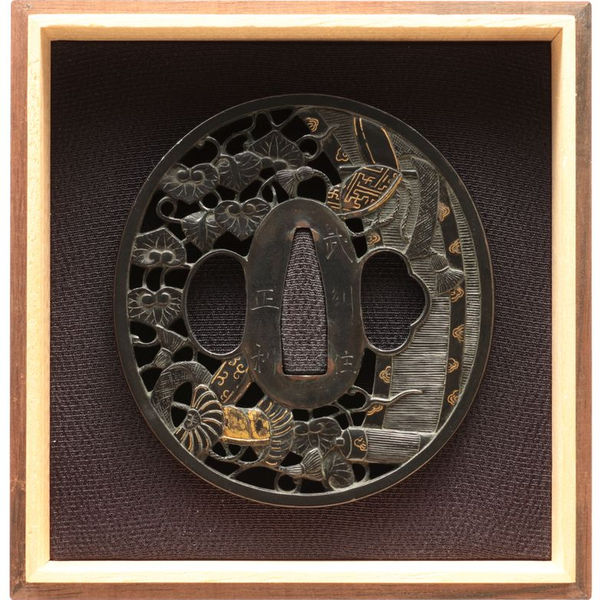
As written by the shop
Iron-tsuba · Musashi
2 pieces on the market now
Iron-tsuba · Musashi
53 pieces on the market now
The Ito school (伊藤派) was a prolific kinkō lineage based in Kanda, Edo, in Musashi province. The line was established by Masanaga (正長, d. 1727), who received appointment as official tsuba maker (kōgi o-kakae tsubashi) to the Tokugawa Shogunate following an audience with Shogun Ienobu in 1710. Successive heads bore the character 正 (Masa-) in their art names, producing ten recorded generations from the Genroku era through the Meiji period. The second-generation master Masatsune (正恒) developed ito-sukashi (糸透かし), the school's signature technique of extremely fine saw-cut openwork. The tenth and final head, Itō Katsumi (伊藤勝見, 1829--1910), originally named Masataka (正隆), entered the school of Tanaka Seiju (田中清寿) at twelve, was adopted into his master's household at seventeen, and received the rank of Hōkyō (法橋) while still young, together with the art name Tōryūsai (東竜斎). After parting ways with Seiju, Katsumi studied maki-e under Shibata Zeshin (柴田是真), and in Man'en 1 (1860) was adopted into the Itō Masahiro family, becoming the tenth-generation head. This dual formation -- kinkō discipline under the Tanaka lineage and lacquer refinement under Zeshin -- profoundly shaped the school's late output.
The Ito school's collective style is characterised by mastery of zōgan (象嵌, inlay) and iroe (色絵, polychrome metalwork) deployed with what the setsumei repeatedly describe as precision and accuracy. Works are executed on plates of iron, shibuichi (四分一), oboro-gin (朧銀), or shakudō (赤銅), frequently with nanako-ji (魚子地) grounds. The technical repertoire encompasses takabori (高彫, high relief), sukidashi takabori (鋤出高彫), katakiribori (片切彫), fine kebori (毛彫, hairline engraving), suemon-zōgan (据文象嵌), and nunome-zōgan (布目象嵌), often combined within a single composition. Masatsune's work employs shippō (七宝, cloisonné enamel) on iron plate, as seen in a unified uchigatana koshirae signed "Bushū-jū Masatsune" whose tsuba, fuchi-kashira, kurikata, and kaerizuno are coordinated as a single aesthetic programme[[c:1]] with raden (螺鈿, mother-of-pearl) and gold uchikomi (打込) work. Katsumi's mature output favours figural and narrative subjects: the Frog Battle after the celebrated Chōjū-giga scrolls attributed to Toba Sōjō, Gama Sennin with his toad beneath a willow, and Daisē Fudō Myōō realised with emphatic devotional presence. "[[c:6]] The Ito school occupies a distinctive place in the tsuba canon as a Musashi-based lineage that sustained high-level production across the entire Edo period. Its works were widely disseminated through the sankin-kōtai system, as samurai from all provinces acquired Ito tsuba during their attendance in Edo. "[[c:7]] That his tsuba depicting the Chōjū-giga Frog Battle is described as a "forceful work from his later years"[[c:5]] whose "composition, which successfully preserves the spirit of the original painting, is outstanding" confirms the school's enduring capacity to unite pictorial invention with metalworking virtuosity. Learn more →
| Smith | Era | Designated |
|---|---|---|
| Katsumi勝見 | — | 4 |
| Masafusa正房 | 1670 | 1 |
| Sadatsune貞恒 | — | 0 |
| Masayoshi正備 | — | 0 |
| Masakane正金 | — | 0 |
Certifies a genuine fitting worth preserving: a correct signature, or, if unsigned, an identifiable era and school, with recognized artistic and craft value.
The NBTHK (Nihon Bijutsu Tōken Hozon Kyōkai, the Society for the Preservation of Japanese Art Swords) is a public-interest incorporated foundation founded in 1948 and supervised by Japan’s Agency for Cultural Affairs (Bunkachō); it is based at the Japanese Sword Museum in Tokyo. Its expert panels physically examine each submitted work (shinsa) and issue a certificate (kanteishō) ranking it by artistic and historical merit. NBTHK papers are the most widely recognized standard of authentication for Japanese swords and fittings.
NBTHK official siteIf, due to our fault, the item differs significantly from its proper condition, the item may be returned. Cooling-off is within one week of the item's arrival.