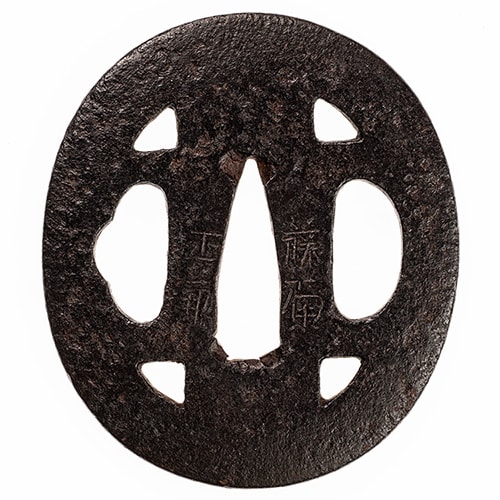
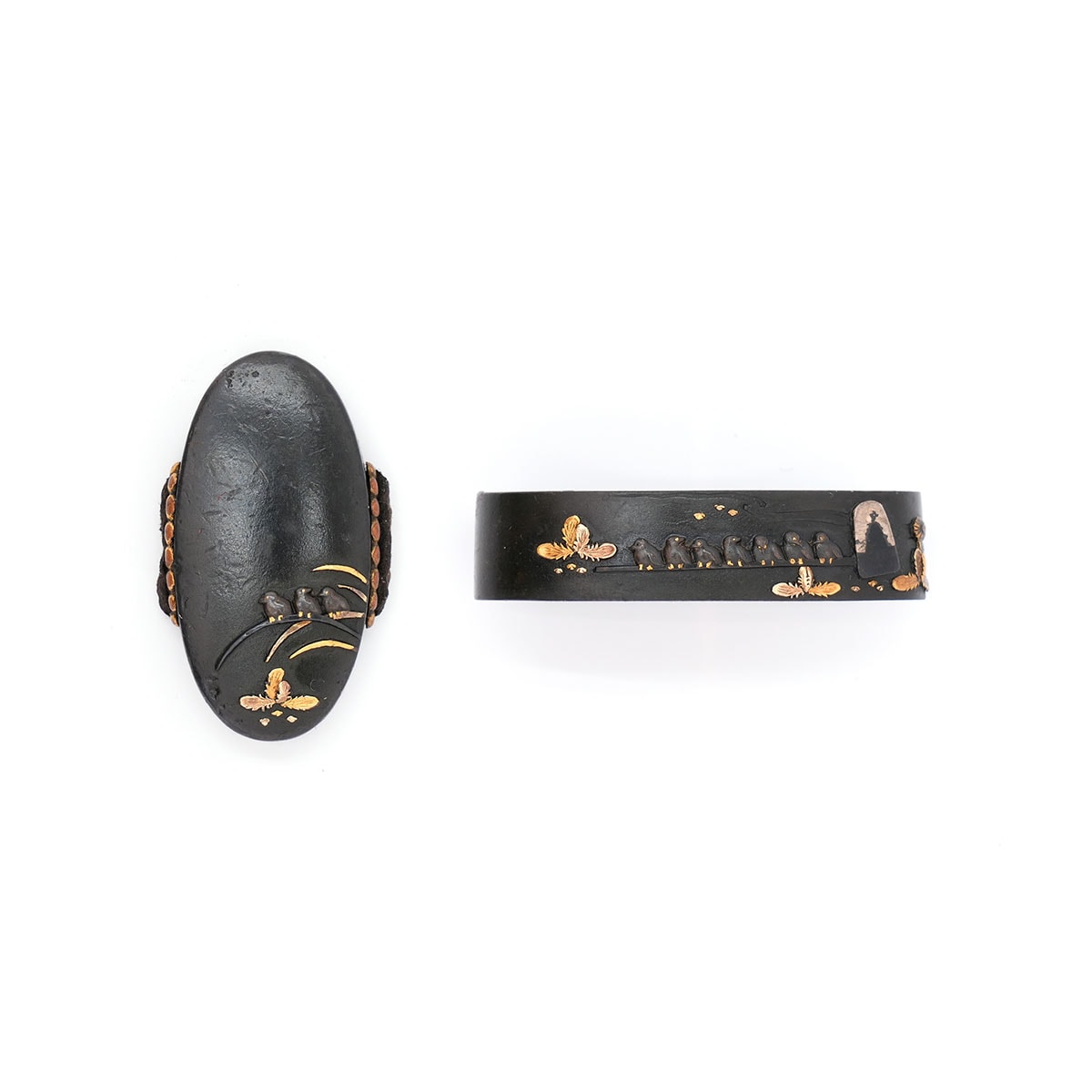
Katsumi was born in in Bunsei 12 (1829). At the age of twelve he entered the school of Tanaka Seijū, and in Kōka 1 (1844), at seventeen, he was adopted into his master's household and took the name Kiyoshige. While still young he was awarded the court title Hōkyō, and his teacher permitted him the art name Tōryūsai. After falling out with Seijū, however, he left the Tanaka house. Thereafter he studied under Shibata Zeshin, and in Man'en 1 (1860) he was adopted into the Masahiro family, taking the name Masataka and becoming the tenth head of the house — recognized as the principal line of Bushū makers. He changed his name to Katsumi in his late thirties and used the art name Ōkei Inshi in his mature period. He died in Meiji 43 (1910) at the age of eighty-two.
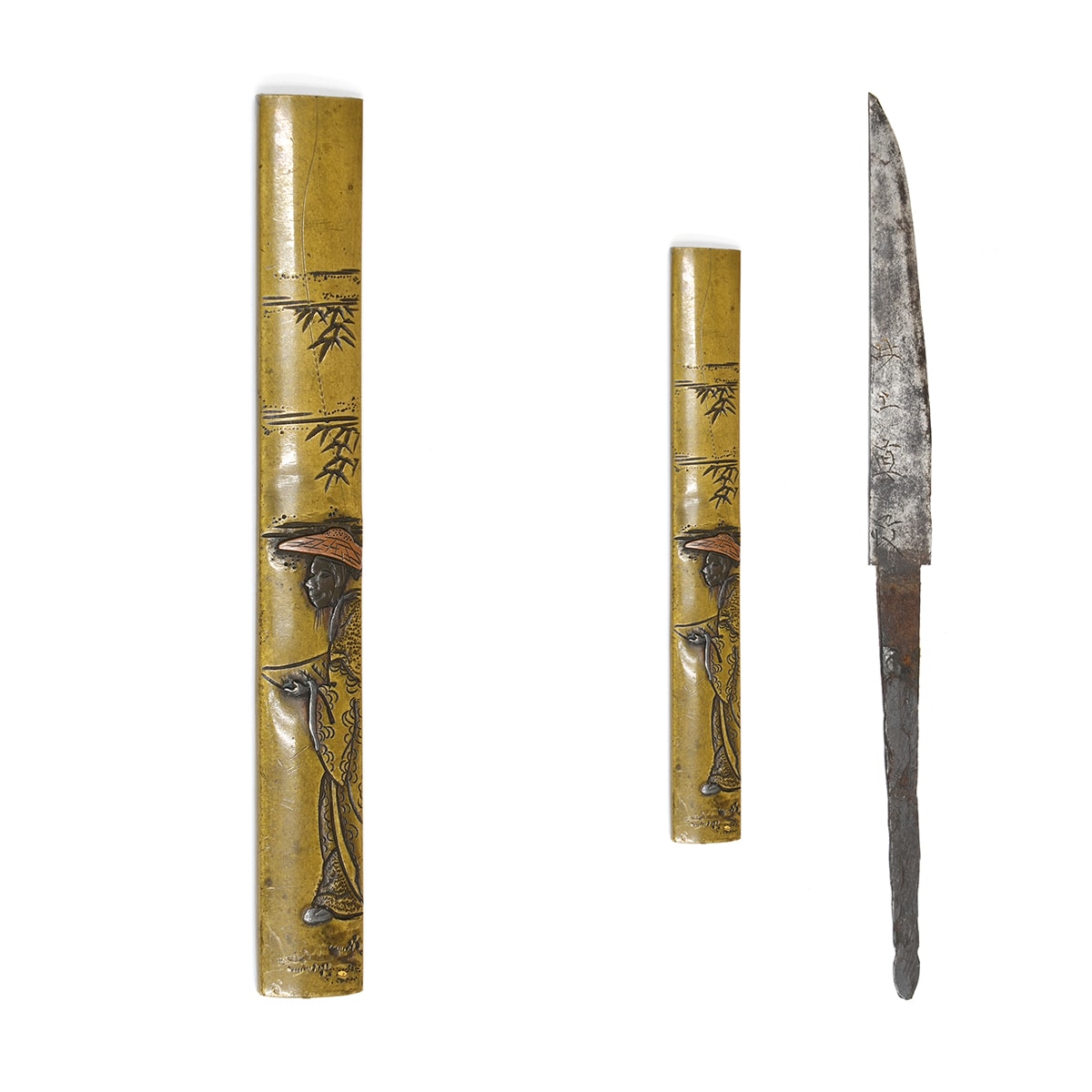
Katsumi's technical command encompasses the full range of metalworking disciplines transmitted through the Tōryūsai school: with polychrome , inlay in gold, silver, and , , and — all deployed with precision. In his Chōjū-giga from his seventy-sixth year, the techniques of and are deployed to their fullest extent, while the composition successfully preserves the spirit of the original painting. His Daisei Fudō Myōō makes extensive use of and in keeping with Seijū's circle, resulting in a compelling image in which the awe-inspiring power of Fudō Myōō seems to unfold directly before the viewer's eyes.
The consistently identifies Katsumi's works as pieces that reveal his true strength — a forceful, firmly grounded technique enriched by cross-disciplinary training under Zeshin. His collaborative with Hōkyō Kiyoshige constitutes valuable material for the study of the Tōryūsai school, clearly demonstrating the individual strengths of both makers. Whether in the spirited narrative compositions of his later years or the emphatic sculptural presence of his mature devotional subjects, Katsumi's oeuvre abundantly demonstrates the achievements of a master who stood at the confluence of the Tōryūsai and traditions.
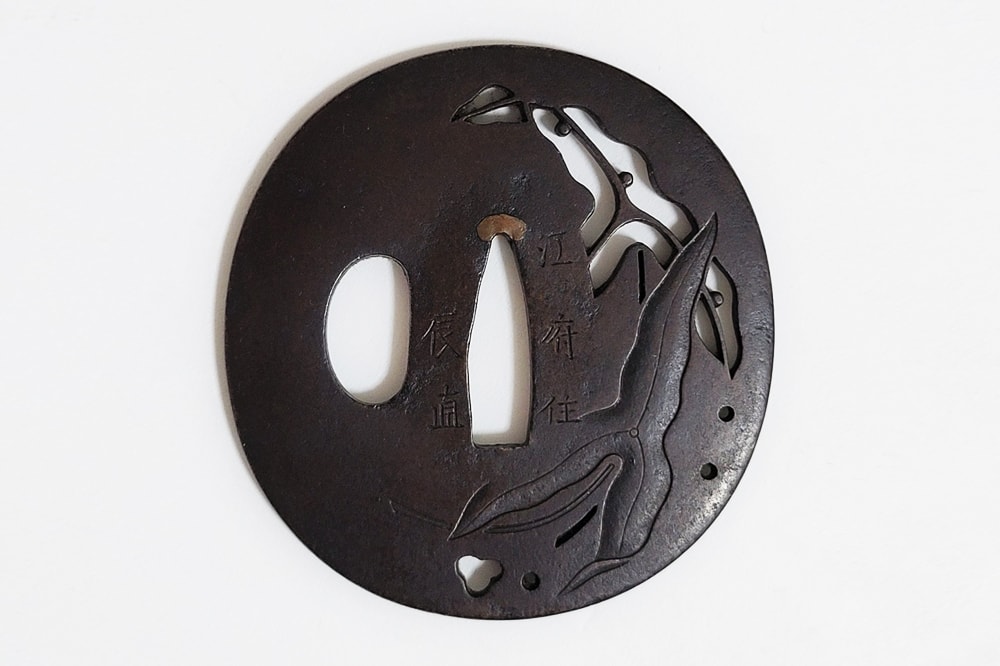
Kantei
3 descriptive axes: material (the Edo soft-metal palette of his Toryusai training, with worked iron grounds: shakudo and shakudo-nanako, shibuichi, suaka, oborogin, brass, and a hammered-iron ground) x technique (a dense high relief enriched with polychrome iro-e and inlay, with sukidashi-takabori, katakiri and kebori line, applied suemon and nunome-zogan) x themes (caricatural narrative and figural subjects, above all the Choju-giga frog-battle, with the toad immortal, Fudo Myoo, and peony-and-butterfly). With only a handful of works the one load-bearing discriminator that separates him from his Toryusai-line training is the humorous Choju-giga frog-battle subject after Toba Sojo.
Katsumi (1829-1910), an metalwork artist, was born in and entered Tanaka Kiyotoshi (Toryusai) as a pupil at the age of twelve. Adopted into his teacher's house at seventeen in 1844, he took the name Kiyoshige and was raised young to the rank of Hokyo, permitted by his teacher-father to use the Toryusai go; he then fell out with Kiyotoshi and left the Tanaka house. He afterwards studied lacquer under the painter-lacquerer Shibata Zeshin, and in 1860 was adopted into the Masahiro house as Masataka, becoming the tenth head of the line, taking the name Katsumi in his late thirties. His surviving designated works are and a carried in the dense Toryusai-line high relief, enriched throughout with polychrome iro-e and inlay, and within that idiom his most personal contribution is the humorous frog-battle after the Choju-giga animal scrolls of Toba Sojo, a caricatural narrative subject he made his own.
Diagnostic discriminators
unique vs his Toryusai (Tanaka Kiyotoshi) training line, whose repertoire is not this caricatural subject
Material (grounds)
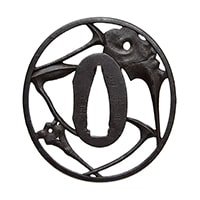
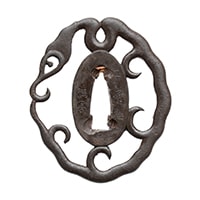
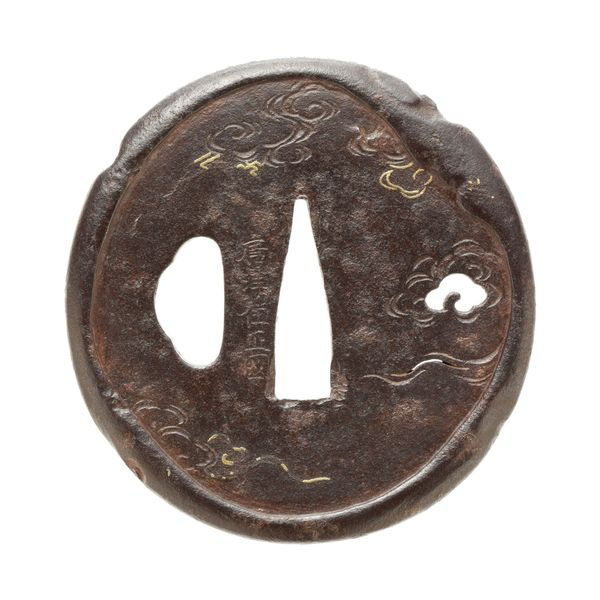
He works the soft-metal grounds of his Toryusai training and beyond, adapting the surface to the subject: and polished grounds, and the - ground, and brass, and a hammered-iron () ground on his Fudo Myoo .
Technique
His hand is a dense high relief enriched throughout with gold, silver, , brass and copper-alloy iro-e and inlay; he commands , the katakiri and fine line he carries from his Toryusai training, applied inlay, and , which the records single out as accurate and superior.
Themes (narrative and figural)
His subjects are above all caricatural and figural: the frog-battle after the Choju-giga scrolls of Toba Sojo, carved front and back with wrestling frogs and the toad immortal peering through the , treated with playful wit; the wrathful Fudo Myoo on a hammered-iron ; and peony-and-butterfly on a .
Choju-giga caricature
Wrestling and brawling frogs after the Choju-giga animal scrolls attributed to Toba Sojo, with the toad immortal conversing with his toad, staged across front and back of the with humour.
Deities and naturalistic subjectsless firmly established
The wrathful Fudo Myoo recreated on the plate with force, and the naturalistic peony-and-butterfly rendered richly in well-coloured metals.
Full iconography
Signature chronology
Dated signatures
Recorded signatures
Documentary note
Every piece in his designated corpus signs Katsumi, his last name, in four forms: the fullest Katsumi Masataka (the family name with the adoptive-house name Masataka), the literati go form Okei-inshi Katsumi, the age-dated seventy-six-elder Katsumi, and the bare Katsumi with a and a year-mark (the Keio-2/1866 ). His earlier name Kiyoshige, taken on his first adoption into the Tanaka house in 1844 and surrendered when he left it, does not appear on any work here and is biography only; it should not be confused with the separate Kiyoshige who succeeded as the second-generation head of the Toryusai line.
Scholarship
After leaving the Tanaka house he studied maki-e lacquer under the painter-lacquerer Shibata Zeshin, a training the records recite in every account of him.
Katsumi(勝見) was a maker of Japanese sword fittings (tōsōgu) of the Ito school in Musashi province, active during the Late Edo / Bakumatsu (mid-19th c.) period.