 NihontoWatchNihontoWatch
These hon-menuki feature the auspicious motif of minogame, which represent longevity. The two minogame huddling together in a slightly small form are perhaps a married couple. Since they represent a wish for long life, they are likely a couple rather than parent and child. They are clad in mino (moss and algae) as proof of their long life, but at first, I mistakenly thought this mino was body hair and believed they were fluffy because they were old. (Please forgive my pathetic ignorance.) Setting the motif aside, the design has no particular highlights to speak of, but the form of the turtles with their heads peeking out from their shells is rather cute or charming; they do not give a realistic impression and look almost like anime characters. If possible, I would have liked to see some dynamism or movement. Alternatively, delicate carving would have been good, or if the heads and faces were made mythological like a dragon, or if there were some unusual deformation, the image would likely have been quite different. Because there is little unevenness in the overall form, the urayuki appears to lack variation, but the jinita is pitch-black shakudo, and it is a thin tsukuri with pressing that is not bad. The ashi are in-yo-ne, but whether these are ubu or later additions is a point where opinions would differ even when looking at the chikane. Looking at the whole, the period is Edo Zenki; at first glance it looks old, but while Edo Shoki might be possible, it cannot be raised as far as the Momoyama period. The certificate states Ko-Kinko, and while this shop will not use that as a shield to claim it is a work from the very beginning of the Edo period or before the Momoyama period, I leave the judgment of the interpretation to all of you.
NihontoWatchOffered by Asahi Token

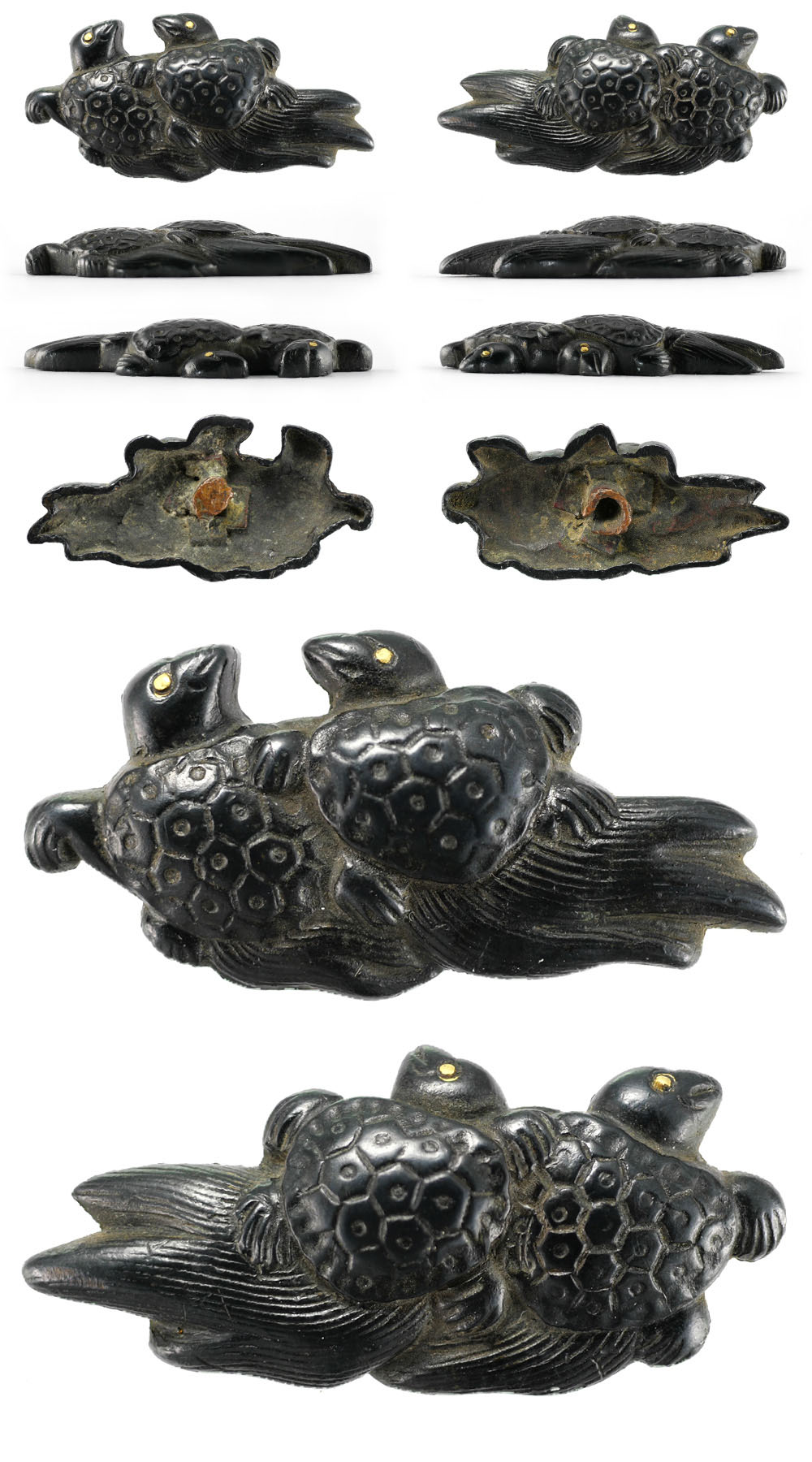
Edo
Unsigned
Hozon (NBTHK)
As written by the shop
Machine translation from the shop's Japanese · may contain errors ·
Certifies a genuine fitting worth preserving: a correct signature, or, if unsigned, an identifiable era and school, with recognized artistic and craft value.
The NBTHK (Nihon Bijutsu Tōken Hozon Kyōkai, the Society for the Preservation of Japanese Art Swords) is a public-interest incorporated foundation founded in 1948 and supervised by Japan’s Agency for Cultural Affairs (Bunkachō); it is based at the Japanese Sword Museum in Tokyo. Its expert panels physically examine each submitted work (shinsa) and issue a certificate (kanteishō) ranking it by artistic and historical merit. NBTHK papers are the most widely recognized standard of authentication for Japanese swords and fittings.
NBTHK official siteReturns are accepted within 7 days of the item's arrival, provided its condition has not changed since the time of sale. Once the return is confirmed, the payment is promptly refunded to your designated account.
¥50,000