 NihontoWatchNihontoWatch
Even if we say millet, you must not compare it to the style of Araki Tomei's millet ear designs. His works are in a special realm, items of a different dimension that a shop like ours has no business with; even if I saw one, I could not handle it. Rather than saying it has a different flavor, this is a menuki that I can introduce with ease. That said, far from stepping back, this menuki has highlights so strong they seem to say "look at me," and I would like to boldly show them off and appeal to you. How about it, this plump and gentle curvilinear beauty. There is no harshness to be felt anywhere in its length, width, or height. And it is old-fashioned. There is no reality in the design; no, it is not needed. The gentle presence created by this relaxed form is irresistibly good. It did not become like this due to years of rubbing. Well, some wear might be involved, but looking at the recessed areas, this was the style from the beginning. The koshi is extremely high, with strong kukuri, and a somewhat large taihai... it has a figure that seems to embody the ideal of practicality. If this were mounted on a tsuka, it would bulge out and surely have fitted the hand perfectly. Well, once we enter the Edo period, this bulging would come to be disliked or avoided. The carving also maintains its generosity with broad kebori, possessing a flowing softness. The quail placed at the top stands as if buried in and assimilated with the millet, as if avoiding standing out. It is not emphasized with iroe, but merely has tsuyu-zogan placed here and there... rather than the intent of the motif, one could say the selling point and highlight of this work is the form itself. Well, the splendid pressure-relief on the urayuki also makes a good impression, reflecting the shape demanded by this era. With quite intense pressure-relief and a thin jinita, it is a workmanship suitable for a work of the late Muromachi period. Incidentally, the rugged ashi attached are later additions, and it is clear that these were originally menuki without ashi. Given this degree of kukuri and construction, ashi should not have been necessary. The production period is likely at least late Muromachi. If not for the silver tsuyu-zogan, one could even raise the age a bit more. This menuki conveys its antiquity just by looking at it; how about it, you do not need to be intimidated by comparing it to the work of Tomei. This one has an antiquity that Tomei absolutely does not have (I would hate to be told this is sour grapes, so I tried to act big...).
Offered by Asahi Token

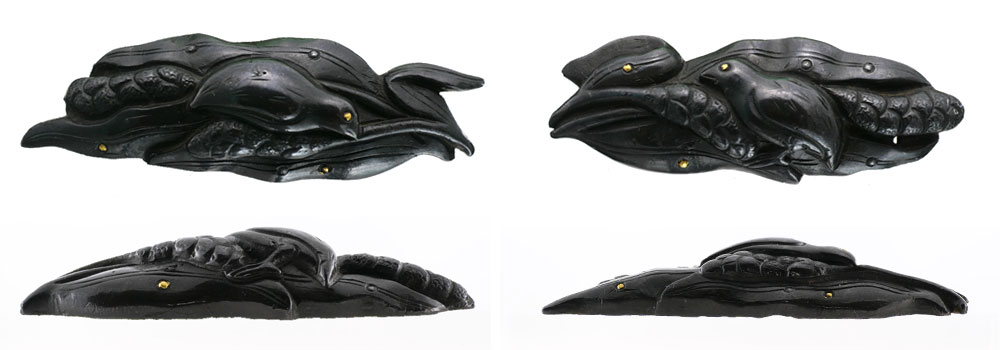
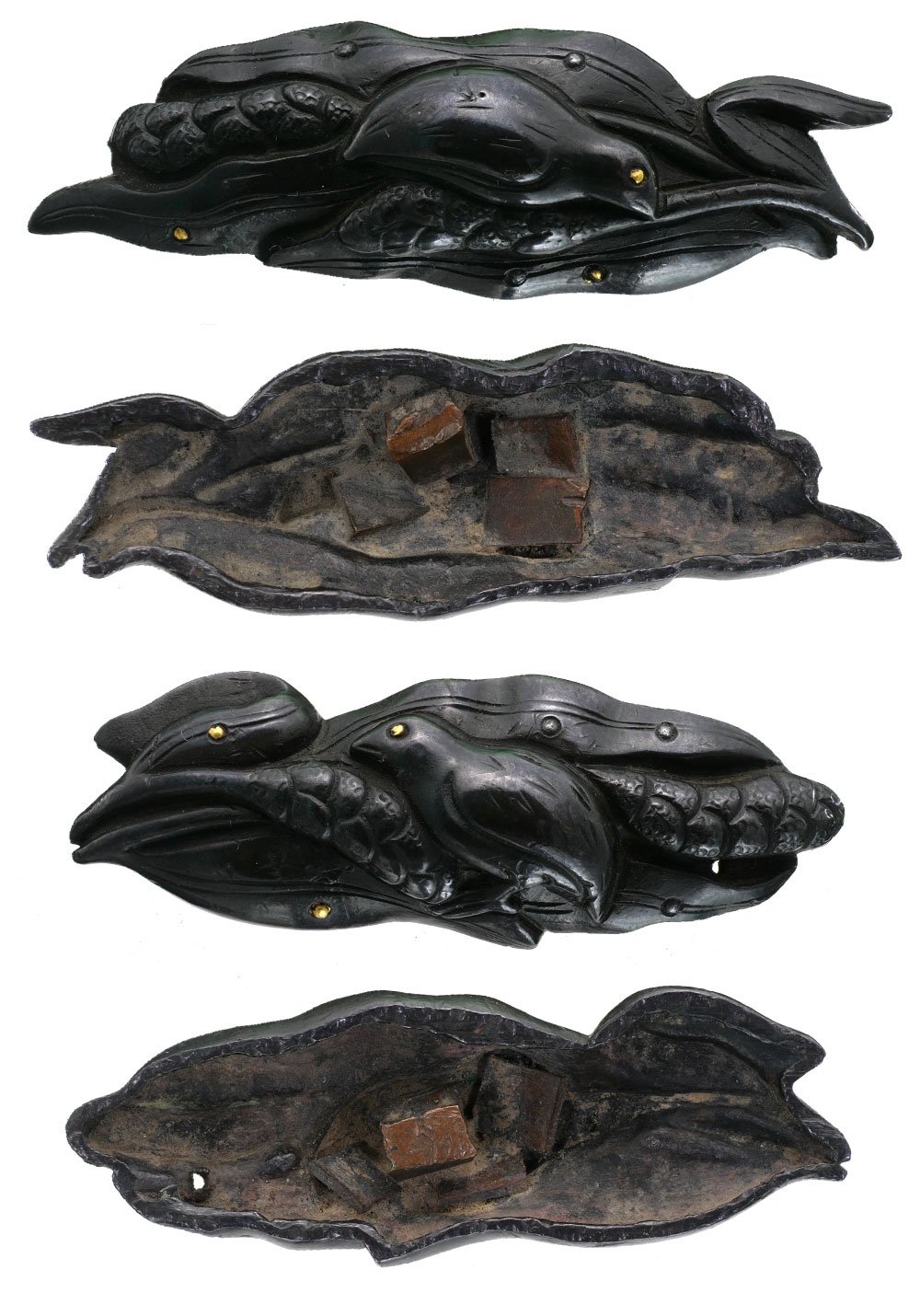
Muromachi
Unsigned
Hozon (NBTHK)
As written by the shop
Machine translation from the shop's Japanese · may contain errors ·
Certifies a genuine fitting worth preserving: a correct signature, or, if unsigned, an identifiable era and school, with recognized artistic and craft value.
The NBTHK (Nihon Bijutsu Tōken Hozon Kyōkai, the Society for the Preservation of Japanese Art Swords) is a public-interest incorporated foundation founded in 1948 and supervised by Japan’s Agency for Cultural Affairs (Bunkachō); it is based at the Japanese Sword Museum in Tokyo. Its expert panels physically examine each submitted work (shinsa) and issue a certificate (kanteishō) ranking it by artistic and historical merit. NBTHK papers are the most widely recognized standard of authentication for Japanese swords and fittings.
NBTHK official siteReturns are accepted within 7 days of the item's arrival, provided its condition has not changed since the time of sale. Once the return is confirmed, the payment is promptly refunded to your designated account.
¥130,000