 NihontoWatchNihontoWatch
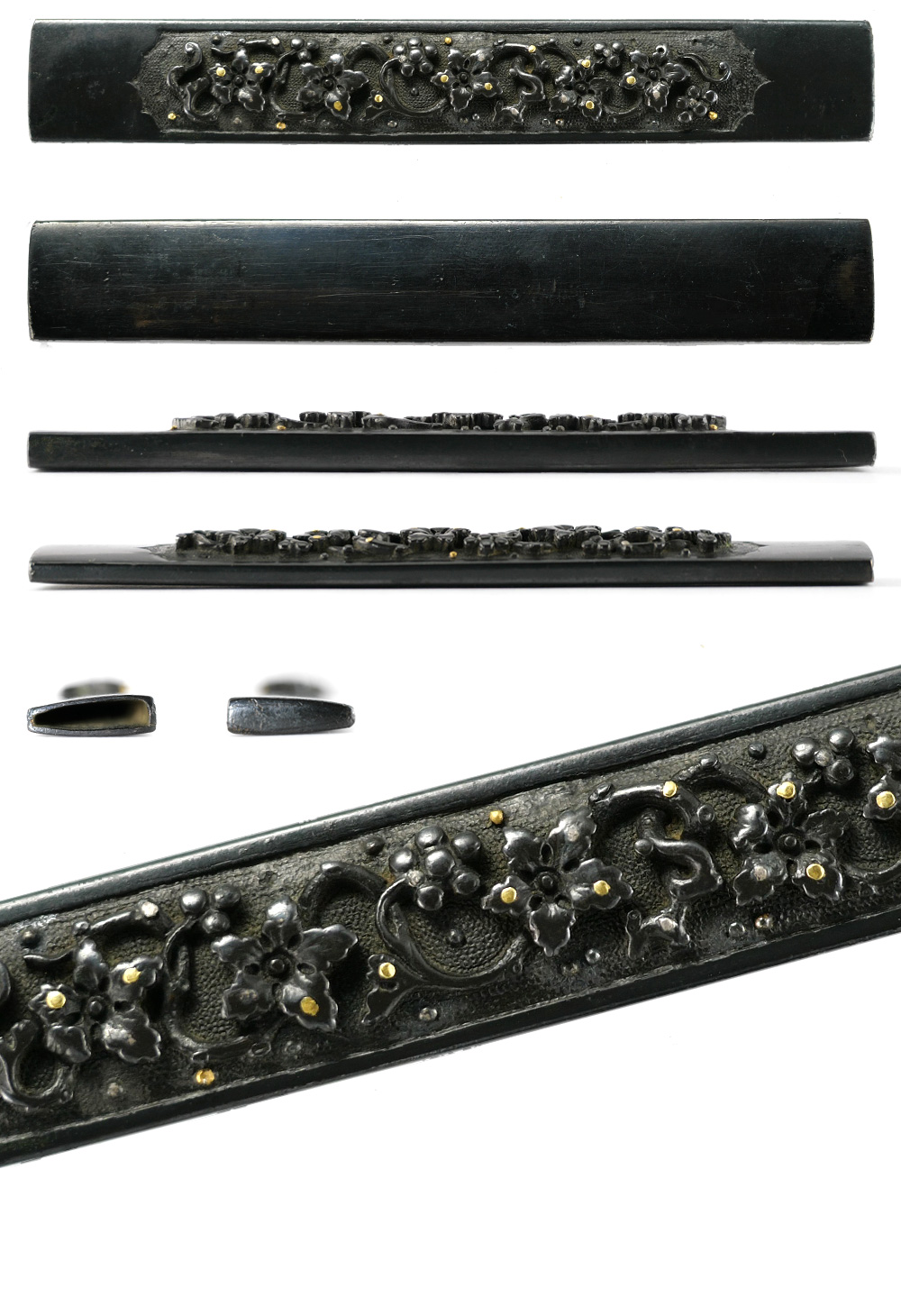
This kozuka features a design of grapes (likely wild grapes) arranged in a karakusa style with an exotic composition. Depending on how one looks at it, it could be said that the design was influenced by Middle Eastern or Western culture and art. While this type of design is seen quite often, it was certainly one of the expressive methods popular among kinko of that time. The composition itself gives the viewer a sophisticated impression. I believe it is a design that would hold up well even today, not just in the Taisho Roman era. Since this was made several hundred years ago, I am impressed by the power of a sensibility that continues to inspire across eras. The kiwame for this kozuka, which features the complex lines of the grapes carved in a sukidashi style, is Ko-Mino. I say sukidashi style because it is not jibori but rather a suemon attached with brazing. If it is suemon, the basis for the Ko-Mino kiwame—which is characterized by sukidashi-bori—becomes tenuous... however, since one can confirm in various places that the nanako grains are half-hidden by the mon, it must be considered suemon. Please do not suggest that the nanako was applied with a half-broken nanako-tagane. Furthermore, nanako is applied even in narrow areas where a tagane would not fit. Well, since it is a grape motif, a Mino style may be fine. While the condition seems very good, this piece was originally a kogai; it is a kogai-naoshi kozuka remade by cutting out the frame containing the mon. It seems they struggled considerably during the reconstruction, as some messy processing marks can be seen around the mayugata and the edges. The nanako grains are also uneven in many places, so it cannot be called a high-grade item, but setting aside the fine details and looking at it as a whole, I find it to be a quite charming kozuka. It cannot be grouped with works found on yamagane jidai-kogai with similar motifs. Considering that gold and silver tsuyu-zogan are applied to a shakudo-ji, it is an item that can be called a reasonably skillful work for its time. The era is late Muromachi. One could also say Momoyama. This is a guess based on the form of the design and the workmanship of the carving. I would like to place the body in the early Edo period, but it might go down as far as the mid-Edo period. I would be happy if you could enjoy this kozuka, including these kiwame.
NihontoWatchOffered by Asahi Token
29 on the market

Ko-Mino School
Pre-Edo
Unsigned
Tokuho (NBTHK)
As written by the shop
Machine translation from the shop's Japanese · may contain errors ·
Kinko · Mino
29 pieces on the market now
The Ko-Mino school emerged during the mid-to-late Muromachi period, arising at approximately the same time as the Gotō family within the broader tradition of early metalworkers (ko-kinkō). While the Gotō lineage served the Ashikaga shogunal house from the first master Yūjō onward, Ko-Mino artisans operated outside official patronage, maintaining independence and at times working within the cultural sphere of the imperial capital. The school's chronological span extended through the Momoyama period, resulting in a notably wide range of workmanship across generations. Despite this temporal breadth, Ko-Mino developed a distinctive aesthetic identity separate from contemporary schools, establishing patterns and techniques that would define the tradition for generations. The defining characteristic of Ko-Mino work lies in its powerfully sculptural carving method, often described as "Mino's deep carving" (Mino no fukabori). On tsuba, kōgai, and kozuka, crests and motifs are executed with sharply rising chisel edges and pronounced three-dimensional relief achieved through sukidashi-bori and takabori techniques. In menuki, thin metal plates are worked with dramatic alternations of height and depth, frequently incorporating extensive openwork piercings (sukashi) that heighten the sense of movement and sculptural presence.
Materials typically include shakudō and yamagane with nanako-ji grounds, embellished with refined gold and silver iroe applied either through uttori (smooth, untextured reserves) or delicate inlay (zōgan). Thematically, Ko-Mino artisans favored autumn grasses—chrysanthemums, bush clover, patrinia—rendered with rich poetic sentiment, as well as grapevines (symbolizing the martial way through wordplay on budō), seaweed and shells (mogai-zu), pine trees, peonies with lions, and dragons. The so-called "Mino dragon" (Mino-ryū) represents a particularly distinctive motif, characterized by a tightly drawn body with numerous piercings and the dragon grasping the sacred jewel from the side, in marked contrast to Gotō dragons. " The school's impact on sword-fitting metalwork extended beyond technical innovation to encompass aesthetic philosophy—balancing sculptural dynamism with refined elegance (gami), and harmonizing powerful carving with delicate surface enrichment. Works exhibit characteristic structural features such as slender kōgai forms with long shafts, finely constricted necks, sharply rising mimikaki heads, and typical warabite terminals. The school's influence persisted into the Edo period, when appreciation for its bold relief carving gave rise to the designation "Mino deep carving," though later works in this manner represent a distinct development from the original Ko-Mino tradition. Through their mastery of three-dimensional carving and their introduction of fresh currents into sword-mounting aesthetics, Ko-Mino artisans established an enduring legacy that balances sculptural presence with courtly refinement. Learn more →
A Hozon-certified fitting of notably superior craftsmanship and condition, often with signature or workmanship of high reference value.
The NBTHK (Nihon Bijutsu Tōken Hozon Kyōkai, the Society for the Preservation of Japanese Art Swords) is a public-interest incorporated foundation founded in 1948 and supervised by Japan’s Agency for Cultural Affairs (Bunkachō); it is based at the Japanese Sword Museum in Tokyo. Its expert panels physically examine each submitted work (shinsa) and issue a certificate (kanteishō) ranking it by artistic and historical merit. NBTHK papers are the most widely recognized standard of authentication for Japanese swords and fittings.
NBTHK official siteReturns are accepted within 7 days of the item's arrival, provided its condition has not changed since the time of sale. Once the return is confirmed, the payment is promptly refunded to your designated account.
¥300,000