 NihontoWatchNihontoWatch
The kanteisho states ouka sukashi. Certainly, cherry blossoms are carved into the top and bottom. However, what on earth are the motifs carved on the left and right? ...I do not know. The shapes, partitioned by thick borders as if to enclose those areas, look like uchiwa fans, but in this era they should be sensu folding fans, and there are no bamboo ribs from the midpoint. It seems certain they are some kind of object, and in the recessed areas, gold nunome zogan and some kind of flower-like patterns resembling pine needles are scattered about. I would like to associate them with something related to cherry blossoms, but I am defeated; I give up. Regarding the theme described in the kanteisho, they likely had no choice but to write "ouka," which is the only identifiable shape. Regardless of the theme, as for the coloring, elaborate techniques that cannot be seen without looking closely are incorporated in abundance. First, near the tips of the cherry blossom petals, nunome zogan is applied in addition to gold tsuyu zogan. There are also traces of nunome zogan on the parts resembling the ribs of the uchiwa on the left and right. And in the recessed areas, perhaps to apply zogan, there are nunome yasurime marks over the entire surface, upon which gold fragments are scattered and patterns like pine needles are carved. The workmanship of yasurime marks for applying nunome zogan can be seen in various places. It seems to be a work with quite delicate craftsmanship. The taihai has a rounded, plump impression, and the glossy, moist tetsu-aji is damp and has a sense of presence. It seems like a somewhat refined and elegant tsuba meant for display, but it is by no means flashy and a practical strength can also be felt; to say it is a work that is somehow elusive, just like its theme, might be rude to this piece.
NihontoWatchOffered by Asahi Token
This piece has sold
Get an email when new Bushu School work hits the market.

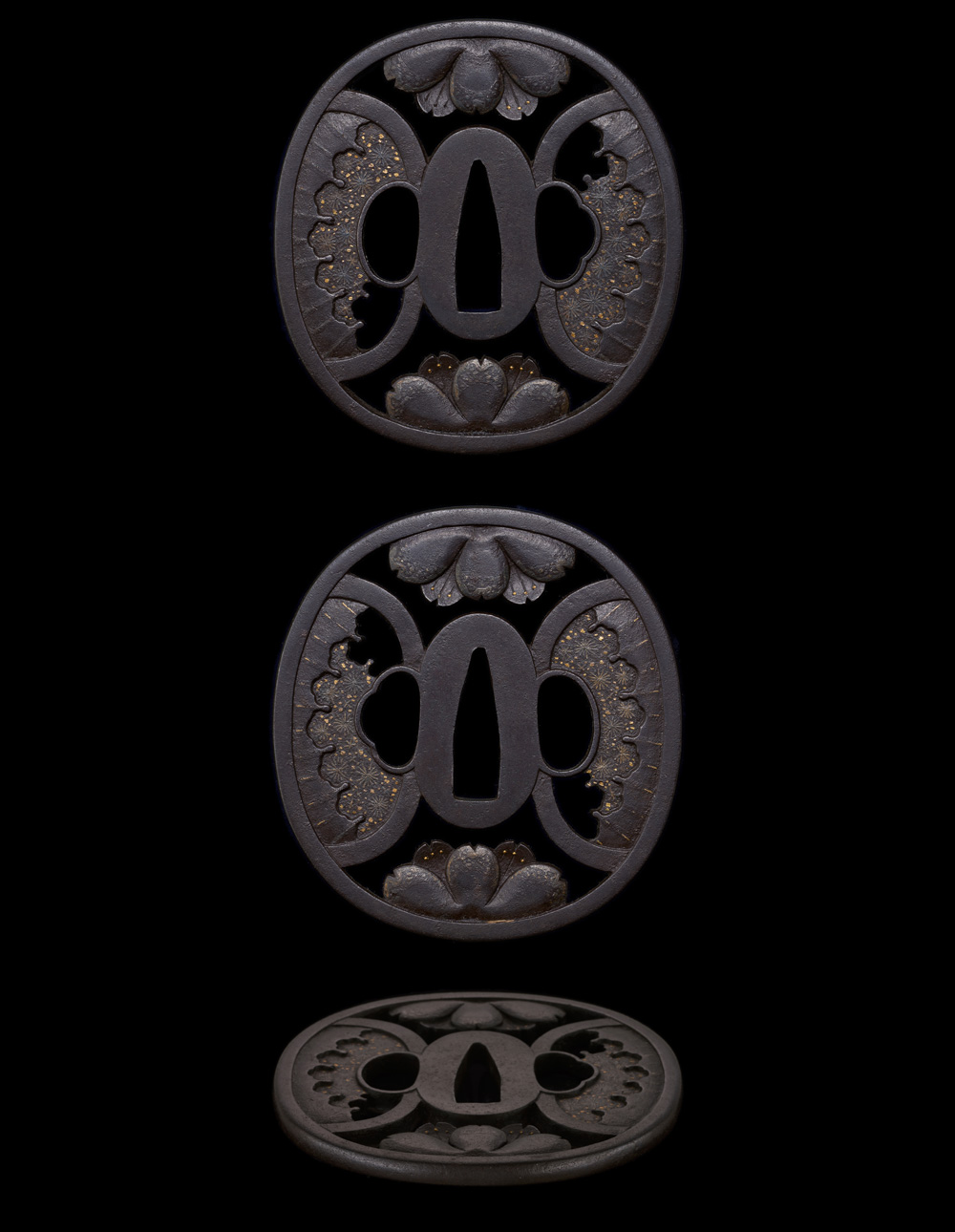
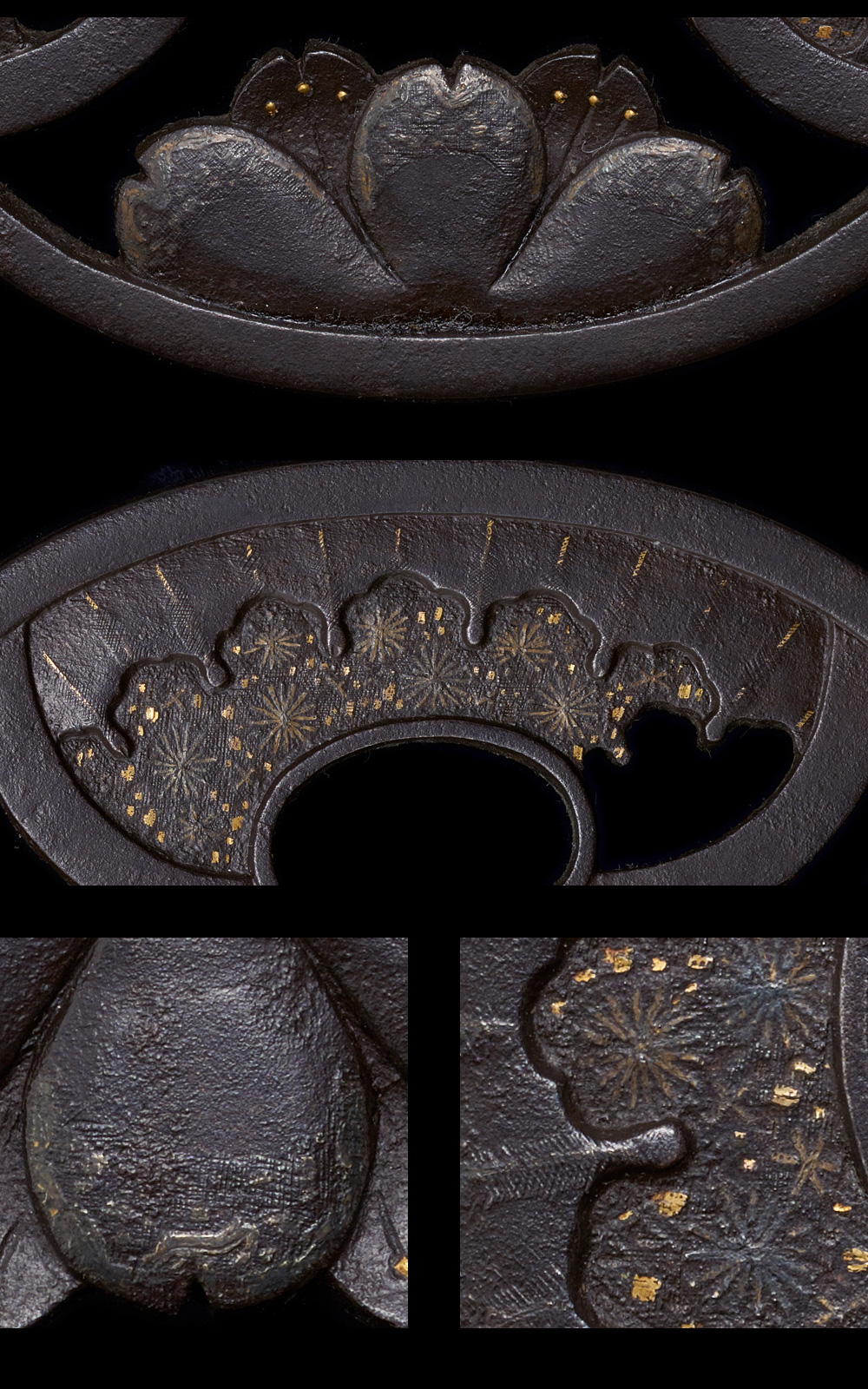
As written by the shop
Machine translation from the shop's Japanese · may contain errors ·
Iron-tsuba · Musashi
Certifies a genuine fitting worth preserving: a correct signature, or, if unsigned, an identifiable era and school, with recognized artistic and craft value.
The NBTHK (Nihon Bijutsu Tōken Hozon Kyōkai, the Society for the Preservation of Japanese Art Swords) is a public-interest incorporated foundation founded in 1948 and supervised by Japan’s Agency for Cultural Affairs (Bunkachō); it is based at the Japanese Sword Museum in Tokyo. Its expert panels physically examine each submitted work (shinsa) and issue a certificate (kanteishō) ranking it by artistic and historical merit. NBTHK papers are the most widely recognized standard of authentication for Japanese swords and fittings.
NBTHK official siteReturns are accepted within 7 days of the item's arrival, provided its condition has not changed since the time of sale. Once the return is confirmed, the payment is promptly refunded to your designated account.