The Shintō era was largely invented in Kyōto: Umetada Myōju’s workshop trained the movement, Horikawa Kunihiro raised a generation, and the Hon’ami appraisers, who held no forge, governed the meaning of famous blades.
 NihontoWatchNihontoWatch
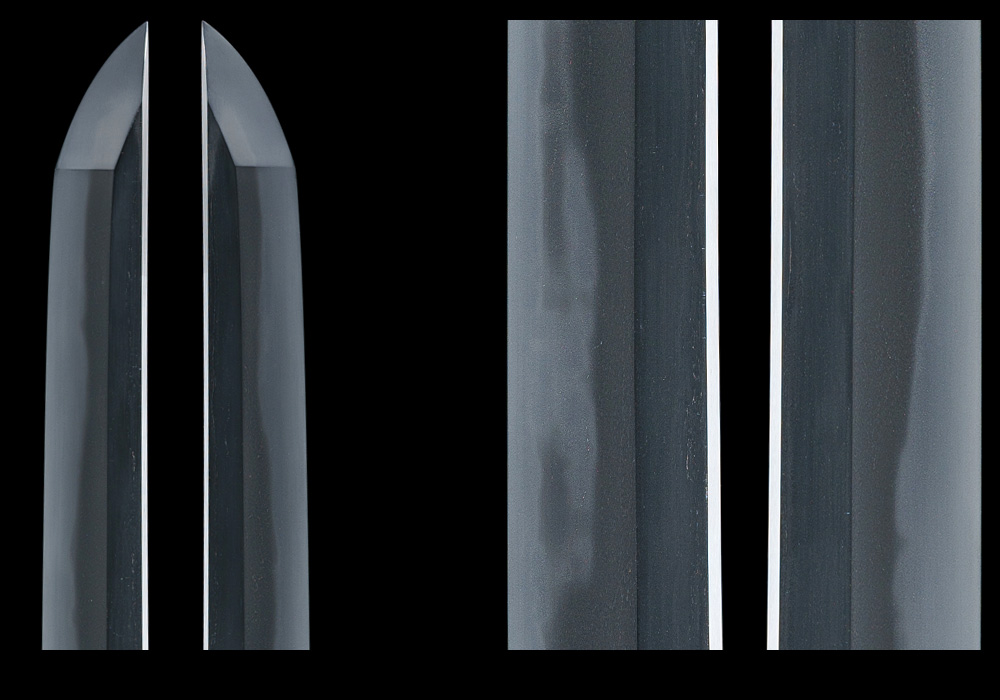
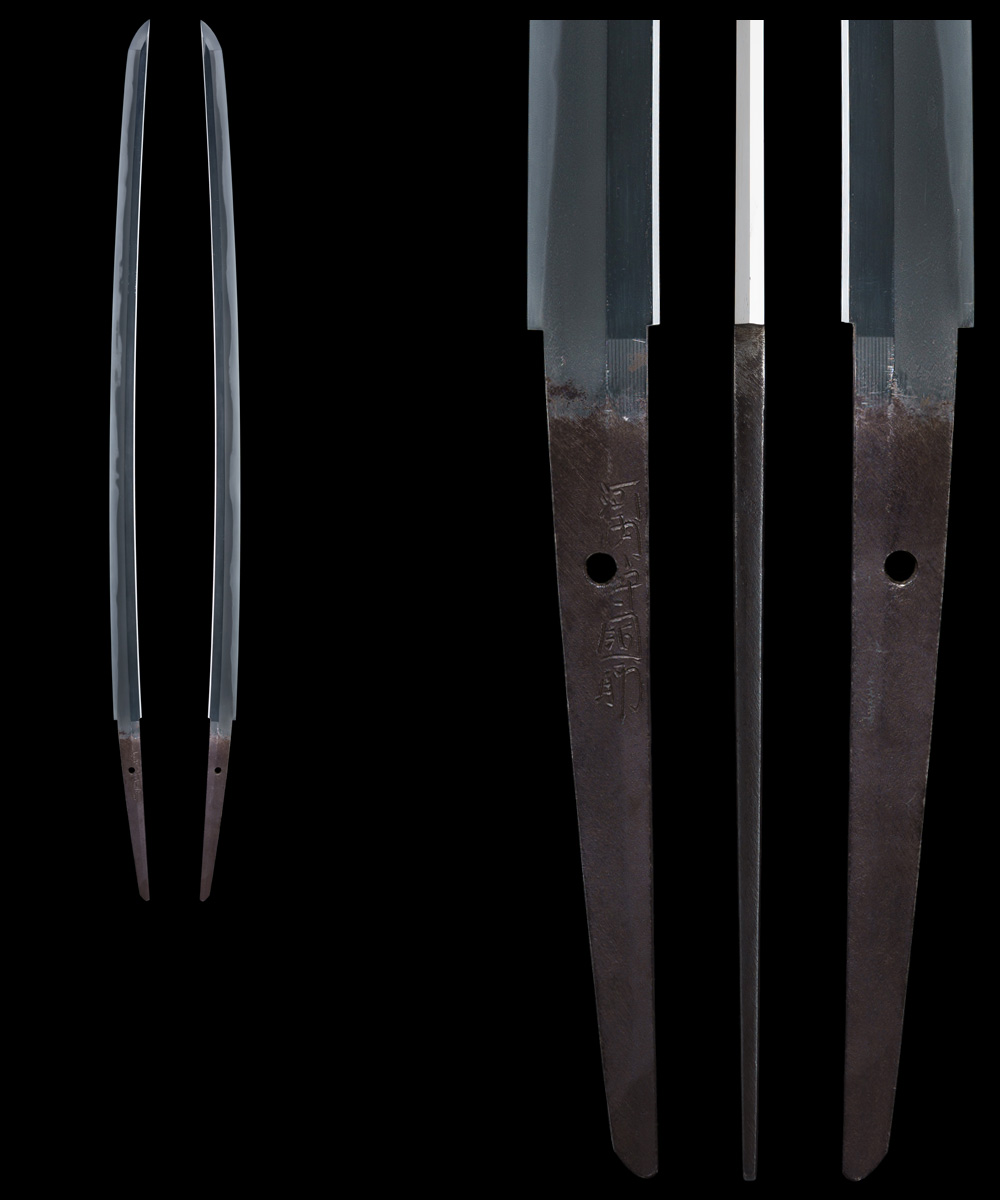
The overall tone of the hamon follows a pattern of repeating shallow notare, but this katana displays different shapes and hataraki on the omote and ura. It is a blade that leaves one uncertain whether to view it as a Shinto Tokuden intended for display, or as a Koto hamon intended for combat. The sashimote begins with a Kyo-yakidashi, and upon entering the middle section with notare, it becomes irregular in a hako-midare style with tobiyaki and nijuba-style hataraki; beyond that, it continues toward the kissaki with small notare and a ko-midare style. Perhaps following that flow, the kissaki is also somewhat irregular. The sashiura shows a Kyo-yakidashi followed by about seven continuous, regular cycles of shallow notare-midare, giving the impression of a well-controlled hamon. The head of each notare is in a gunome-choji style, and the kissaki is slightly notare-like. At first glance, the hamon differs on the omote and ura, but in both, the overall flow consists of continuous notare, and ko-ashi work frequently. If one looks at this hamon normally, one might see the sashiura as the intended hamon and the sashimote as a hamon that did not go well. However, this hamon is an aggressive technique called Konotegashiwa. It is a method where the omote and ura hamon were intentionally made different. This is a rare hamon for Kunisuke, and one can see his stance of daring to challenge a novel and difficult hamon while staking his survival as a swordsmith. However, even though the hamon are different, both are Yamashiro-den style hamon inherited from Kunihiro. On the omote side, in addition to the considerably irregular and hotsure hataraki, there are also nijuba-style areas, so I would like to speculate that he strongly brought out these Yamashiro-den style hataraki. Furthermore, there is no muranie or spilled aranie, and it is a magnificent hamon with a clear habuchi. It may be a sword where Kunisuke captured the trends of the time as they transitioned from the combat swords of the past to swords for display. The sugata has a shallow sori, there is a slight difference between the moto and saki, and the mihaba is a little narrow. Since the nagasa is long at 2 shaku 5 sun, it gives a smart impression, but the kasane is thick and it has toughness. Also, the matsubakado remains sufficiently, and it is in a considerably kenzen condition. The sugata itself is very similar to the swords of Oya Kunisada from the same period. That is natural, as the two who were fellow students and made swords in Settsu at the same time are the founders of Osaka Shinto whose skills are difficult to rank one above the other. However, it is the impression of this shop, but I feel Kunisuke is closer to the sakuiki of Kunihiro. No, to be precise, it might be more correct to say he is closer to Kunitomo. I feel Oya Kunisada has more works that are a bit more innocent...
Offered by Asahi Token
Horikawa Kunisuke is a name with Jūyō-designated work, and we couldn’t find current papers for this piece. Treat the name as unproven until papers say otherwise. — Hoshi Ask me first
5 on the market

As written by the shop
Machine translation from the shop's Japanese · may contain errors ·
Horikawa school, Osaka Shinto (Settsu); Ishido-derived · Settsu · around 1624-1650
Fujishiro Jo-jo saku · Tōken Taikan top 17%
5 pieces on the market now
The first-generation Kawachi no Kami Kunisuke was among the last pupils of Horikawa Kunihiro in Kyoto. After Kunihiro died in Keichō 19 he moved to Ōsaka with the elder Kunisada, Izumi no Kami, and the two became pioneers of the Ōsaka shintō smiths, with a lasting influence on the swordmaking of the city. The published sources record that he came from Kanbe in Ise Province and drew on the stream of the Ishidō smiths. They also judge, from the style of his early work and the cut of his signature, that his teacher in practice was the senior fellow-disciple Echigo no Kami Kunitomo rather than Kunihiro himself. His title of Kawachi no Kami is placed around Genna 9, close to the elder Kunisada's, because a naginata and a tantō signed Kawachi no Kami and dated Kan'ei 3 survive, together with undated works of still earlier style. That Kan'ei 3 date is his earliest, and tradition gives his death as Shōhō 4.
His Ishidō descent is the key to his hand. Within the Horikawa group, the sources write, he was the one who "most excelled at chōji"[[c:1]], so that some trace of clove pattern surfaces somewhere within his irregular temper; one later paper puts it as "chōji mixes into the temper more than in anyone else of the school"[[c:2]]. The sources treat that trace as the very point by which a blade is appraised as Kunisuke rather than another Horikawa hand.
His recognized manner opens from a straight yakidashi above the hamachi. Above it the temper widens into gunome mixed with chōji, ko-notare and pointed elements, with ashi entering, ko-nie well adhered, and sunagashi and kinsuji running through. The jigane is a tightly packed ko-itame or itame with thick ji-nie and chikei. The bōshi is a ko-maru, often swept with hakikake. His work is extremely close to the elder Kunisada's, and the sources name the differences: against Kunisada "his hardened area is broader and his chōji conspicuous"[[c:3]], his yakidashi broadens gradually as it rises, and his bōshi is tempered deep. A katana showing all of these is read as "the manner in which he most excelled"[[c:4]].
A second register shows the Horikawa schooling plainly. On one katakiriba wakizashi the itame stands and turns zanguri, the temper is a nie-laden ko-notare with gunome, and the sources call it a work of "strongly Horikawa coloring"[[c:5]]. Other blades are read against particular masters: one wakizashi carries "a Seki coloring"[[c:6]], which the sources tie to Kunitomo; another recalls Kunitomo's own temper; others recall the elder Kunisada. Carving is rare in his work, and the few carved blades, with naginata-hi, goma-bashi and a relief kurikara, are noted as such.
The sources keep a careful line between him and his son, the second-generation Kawachi no Kami known as Naka-Kawachi, who carried the name and turned wholly to the Ishidō chōji. One early paper reads a katana's conspicuous chōji as the forerunner of the son's style. A blade dated Kan'ei 19 is debated: either his own late work, or an early work of the second generation made before Shōhō 4.
Fujishiro rates him Jō-jō saku. Thirty-two of his blades stand in the Jūyō rank, with one in the prewar Jūyō Bijutsuhin and one in the Imperial Collection. The published sources call his finest signed katana "one of the most outstanding among his works"[[c:7]] and others "his typical work"[[c:8]], and they value a naginata dated Kan'ei 3 because "its Kan'ei 3 date is also valuable reference material"[[c:9]]. Provenance, where recorded, includes the Itakura family and the Imperial Family. His surviving work is comparatively small, and katana are scarce, so a signed Jūyō example of the first generation comes to market only from time to time.
Where Kunisuke stands among comparable artisans: across all of nihontō, and within tradition, era, and period. The tiers (Foremost · Leading · Major · Notable) weigh official designations from the NBTHK and Japan's Agency for Cultural Affairs, together with historical honors of lasting repute such as the Sansaku and Meibutsu-chō.
Select a lens to see how it's measured.
Years he was demonstrably active, proven by signed-and-dated blades
Shinto · Yamashiro
64 pieces on the market now
At Ichijo Horikawa in Kyoto, from Keicho 4 (1599), Horikawa Kunihiro gathered the pupils whose work the published sources name with his own as the opening of the shinto age. Kunihiro himself reached forging late and by a roundabout road. Born Tanaka and serving as a warrior under the Ito of Obi castle in Hyuga, he wandered the provinces after that house fell, forging where he stopped, his earliest dated blade cut in Hyuga in Tensho 4 (1576); his itinerant Tensho-uchi looked to late Soshu and late Seki, often run toward a hitatsura-like effect over devotional carving. The settlement in Kyoto changed that. There his stated aim, the sources write, lay in the revival of the Soshu-den tradition, the leaning strongest toward Shizu, and around that ideal he trained the men who carried his manner forward: Dewa no Kami Kunimichi, Kuniyasu, Osumi no Jo Masahiro, Echigo no Kami Kunitomo, the elder Kunisada and Kunisuke, with later and minor hands reaching Settsu, Echizen and Edo. Many of them, born like the master at Obi, followed him from Hyuga to the capital. The shared vocabulary is read first in the steel. The school forges an itame mixed with mokume that stands up, the grain raised into the loose, granular surface the commentaries name outright, the zanguri hada particular to Horikawa work, with ji-nie lying thick and chikei entering; on many blades a mizukage rises obliquely from the machi. Over that ground the prime manner is the Keicho-shinto sugata, wide with little taper and an extended chu-kissaki or o-kissaki, the build likened to a Nanbokucho odachi cut down, tempered in a notare and gunome with thick nie, sunagashi and long kinsuji, the nioiguchi often sinking into shizumi. Within that frame the pupils diverge sharply.
Kunimichi runs the flamboyant Shizu copy fully out and turns his boshi pointed in the Mishina manner, the Sanpin boshi the school otherwise does not show. Masahiro keeps the same Soshu-den worked at lower temperature, his temper calm and his mokume conspicuous; Kuniyasu and Kunitsugu stand closest of all to the master and signed for him. Kunitomo turns alone toward late Seki, his gunome round-headed and his chisel the finest in the group, and the elder Kunisada and Kunisuke carry the zanguri steel south into Osaka, the latter keeping the Ishido clove he was born to. Hiroyuki holds suguha over a blackish steel that recalls old Yamato, and the two Echizen Kunikiyo forge a dark, dense hokkoku-gane under a calm chu-suguha. A collector seeks Horikawa because the school stands at a hinge: Kunihiro is read as the first hand of the new-sword age, and the line he taught runs forward into the Osaka tradition through Kunisada and Kunisuke and into Echizen through Kunikiyo. To kantei the work, read the steel first, the standing zanguri surface and the oblique mizukage, then the sinking nioiguchi and the Soshu-revival notare with its sunagashi and kinsuji; the individual hand declares itself in the departures, Kunimichi's pointed boshi, Kunitomo's Seki gunome and compact tang, Kuniyasu's reversed file marks and two-character mei, Hiroyuki's kiri-yasuri. The founder and his closest pupils sit at the top of the line, Kunihiro signing almost everything he made, the large kata-ochi two-character mei beside his long residence signatures; because Kuniyasu, Masahiro, Kunitsugu and Hiromi worked as his daisaku, a share of the blades signed Kunihiro are in fact theirs. Provenance runs through the houses of the founder's own story and of the country, the Hyuga Ito he had served, the Shimazu of Kagoshima, the Imperial Family and Toyotomi Hideyori, with the tachi Kunihiro dedicated to the Hataeda Hachimangu still in the shrine's keeping. A signed Horikawa blade reaches a private collection only from time to time, carrying on its nakago the hand with which the new sword begins. Learn more →
| Smith | Era | Designated |
|---|---|---|
| Kunihiro國廣 | 1573-1613 | 147 |
| Kunimichi國路 | 1615-1624 | 75 |
| Kunisada國貞 | 1624-1646 | 87 |
| Kunitomo國儔 | 1596-1615 | 27 |
| Masahiro正弘 | 1596-1615 | 16 |
Kyōto: the revival workshop
The Shintō era was largely invented in Kyōto: Umetada Myōju’s workshop trained the movement, Horikawa Kunihiro raised a generation, and the Hon’ami appraisers, who held no forge, governed the meaning of famous blades.
We could not find an authenticity certificate on the seller’s listing. Japanese swords and fittings are normally papered by the NBTHK (or the NTHK). Without one, the attribution is the seller’s own assessment and has not been independently verified — treat it with caution and ask the dealer about certification before buying.
Returns are accepted within 7 days of the item's arrival, provided its condition has not changed since the time of sale. Once the return is confirmed, the payment is promptly refunded to your designated account.
¥3,900,000