 NihontoWatchNihontoWatch
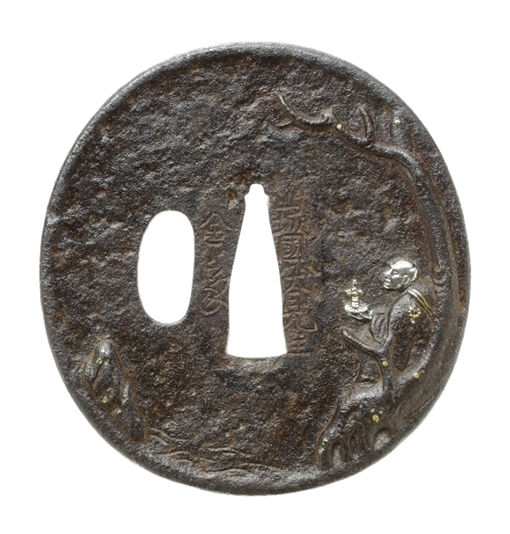
鍛え強い鋼を薄手の竪丸形に仕立て、耳を打ち返して空間を切り取り、地鉄は鍛えた鎚の痕跡が明瞭で、修行僧の闊歩する荒野を想わせる肌合い。羅漢の身体は同じ鉄を用いた共鉄象嵌、眼窩が窪んで厳しい表情を示す顔と仏舎利は銀の高彫象嵌、要所に金の点象嵌を加えている。裏面は金家に間々みられる京近郊と思しき山水風景図で、釣り人もまた共鉄象嵌。波は毛彫。ゆったりと連なる山並みは、その端が穏やかに霞み込んでおり、これも金家の特徴である。 羅漢の目線は、自らが前にささげている仏舎利を通して遥か遠くに結ばれているようだ。数十年の長きに亘って修行を重ねてもなお、師と仰ぐ釈迦は見えてこない。民衆から羅漢と呼ばれて敬愛されてはいても、釈迦と同じ観念世界には永遠に到達できないのではないだろうか、と苦悩する表情が窺いとれるのである。
NihontoWatchOffered by Choshuya
This piece has sold
Get an email when a new Kaneie piece hits the market.

As written by the shop
Iron-tsuba · Yamashiro
1 piece on the market now
Kaneie is celebrated as the founder of pictorial-style (eshi-fu) tsuba, active in Fushimi, Yamashiro Province[[c:1]] during the Momoyama period. His work represents a decisive break from the purely functional iron guards that preceded him, establishing the tsuba as a vehicle for sophisticated pictorial expression. In addition to standard plate forms such as mokko-gata, maru-gata, and nadekaku-gata, he devised highly original shapes — among them futatsu-mokko-gata and kobushi-gata — designing each work so that subject and plate form would mutually enhance one another[[c:2]]. His oeuvre reflects a deep engagement with Zen-inflected literary and religious themes, including Daruma and the parable of the monkey grasping at the moon's reflection.
Kaneie's plates are consistently forged of iron to an exceptionally fine standard[[c:3]]. He characteristically finished the ground with tsuchime-ji (hammered texture), imparting an understated elegance that serves as the tonal foundation for his compositions. His carving method is powerful and assured, combining takabori (high relief) with usuniku-bori (low relief) and incisive kebori (fine-line engraving), while iroe colored inlay and zogan in gold and silver are applied with deliberate restraint. This economy of precious metal heightens both the chromatic contrast and the pictorial refinement[[c:6]]. His compositions employ perspective to open broad spatial fields, placing emphasis on the layers of air that fill the pictorial space[[c:4]] and achieving an elevated, dignified tone throughout[[c:5]].
Kaneie's contribution lies in demonstrating that the iron tsuba could attain the status of a self-contained pictorial art[[c:7]]. His characteristic interplay of forceful relief carving, restrained metalwork, and contemplative subject matter established a standard against which later generations of pictorial guard makers would be measured. His works are held in the highest scholarly regard and remain essential reference points in the study of Japanese sword-fitting art[[c:8]].
Where Kaneie stands among comparable artisans: across all of nihontō, and within tradition, era, and period. The tiers (Foremost · Leading · Major · Notable) weigh official designations from the NBTHK and Japan's Agency for Cultural Affairs, together with historical honors of lasting repute such as the Sansaku and Meibutsu-chō.
Select a lens to see how it's measured.
Iron-tsuba · Yamashiro
7 pieces on the market now
Kaneie is celebrated as the founder of pictorial-style tsuba (e-fū tsuba), having introduced explicitly painterly subject matter into guard design during the Momoyama period. Working from Fushimi in Yamashiro Province, he pioneered an approach that moved beyond ornamental patterns to embrace landscapes, figures, and Zen themes as primary compositional elements. His innovations extended beyond subject matter to form itself: while producing guards in standard mokko-gata, nadekaku-gata, and maru-gata shapes, he also devised original silhouettes including double-mokko and the distinctive ken-gata (fist-shaped) form. Each work demonstrates careful integration between chosen motif and outline, with design and form considered together as a unified aesthetic conception. The collective technical vocabulary attributed to works in the Kaneie manner reflects an unsurpassed mastery of forged iron. Plates are invariably iron, worked with tsuchime hammering to create richly textured grounds that impart an elegant, refined character. The compositional method employs perspective with deliberate economy: broad spatial intervals are reserved, and particular emphasis is placed upon the layers of air that fill empty space, achieving an elevated, dignified tone throughout. Carving is executed through forceful iron takabori-zōgan (high-relief inlay using the same metal—a demanding technique termed tomogane suemon), while fine kebori engraving animates details such as waves and reeds.
Colored metals—gold, silver, shakudō—are restrained to the minimum necessary, deployed as sparse accents that heighten both chromatic effect and pictorial refinement. This disciplined restraint allows the intrinsic beauty of the iron itself and the viewer's contemplation of negative space to dominate the visual experience. Works attributed to the Kaneie school encompass a distinctive repertoire of themes drawn from Zen Buddhism, Chinese lore, and the natural world. Recurring subjects include Daruma shown in profile with piercing gaze, the "Monkey Trying to Grasp the Moon" (enkō takugetsu), solitary fishermen beneath crescent or full moons, Taikōbō at his suspended line, and the ascetic figures Shide and Chao Fu. Landscapes feature distant pagodas partially concealed by mountain ridges, withered trees, temple halls, and thatched boats drifting amid waves rendered in point-inlay. The nozarashi theme—three skulls and exposed bones laid bare upon an infinite empty ground—conveys the impermanence of all things (shogyō mujō) with stark severity. Across this body of work, one perceives a human spirit that reveres great nature and honors the kami and buddhas, expressing the infinite through perspectival depth and unhurried, composed atmosphere. Within the confines of small plates, boundless space is evoked, suffused with inexpressible stillness and lofty poetic resonance. Learn more →
| Smith | Era | Designated |
|---|---|---|
| Kaneie金家 | — | 40 |
| Tetsujin鉄人 | — | 0 |
| Tetsujin鉄人 | — | 0 |
| Kanesada金定 | — | 0 |
If, due to our fault, the item differs significantly from its proper condition, the item may be returned. Cooling-off is within one week of the item's arrival.