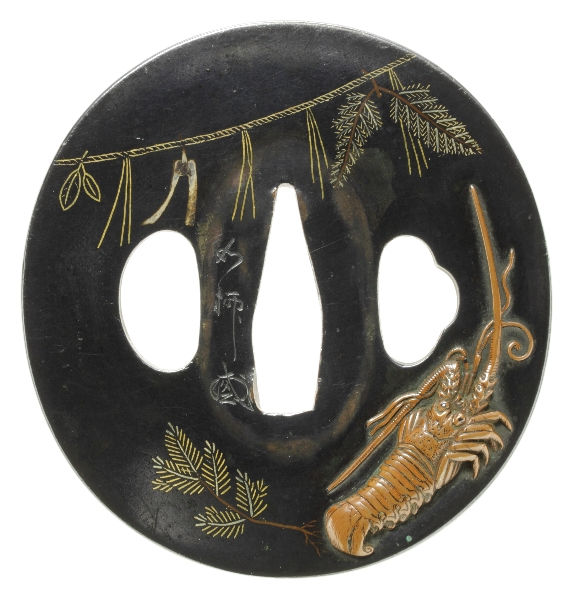
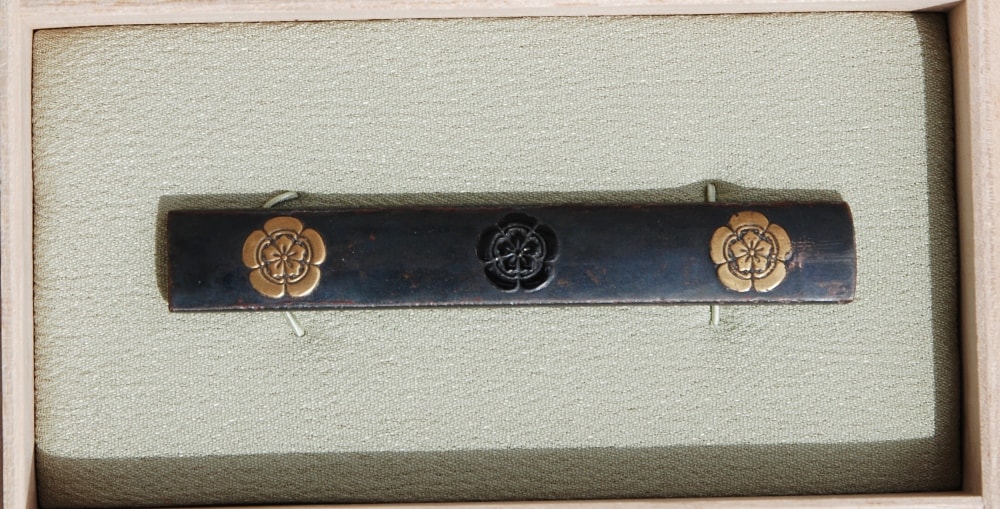
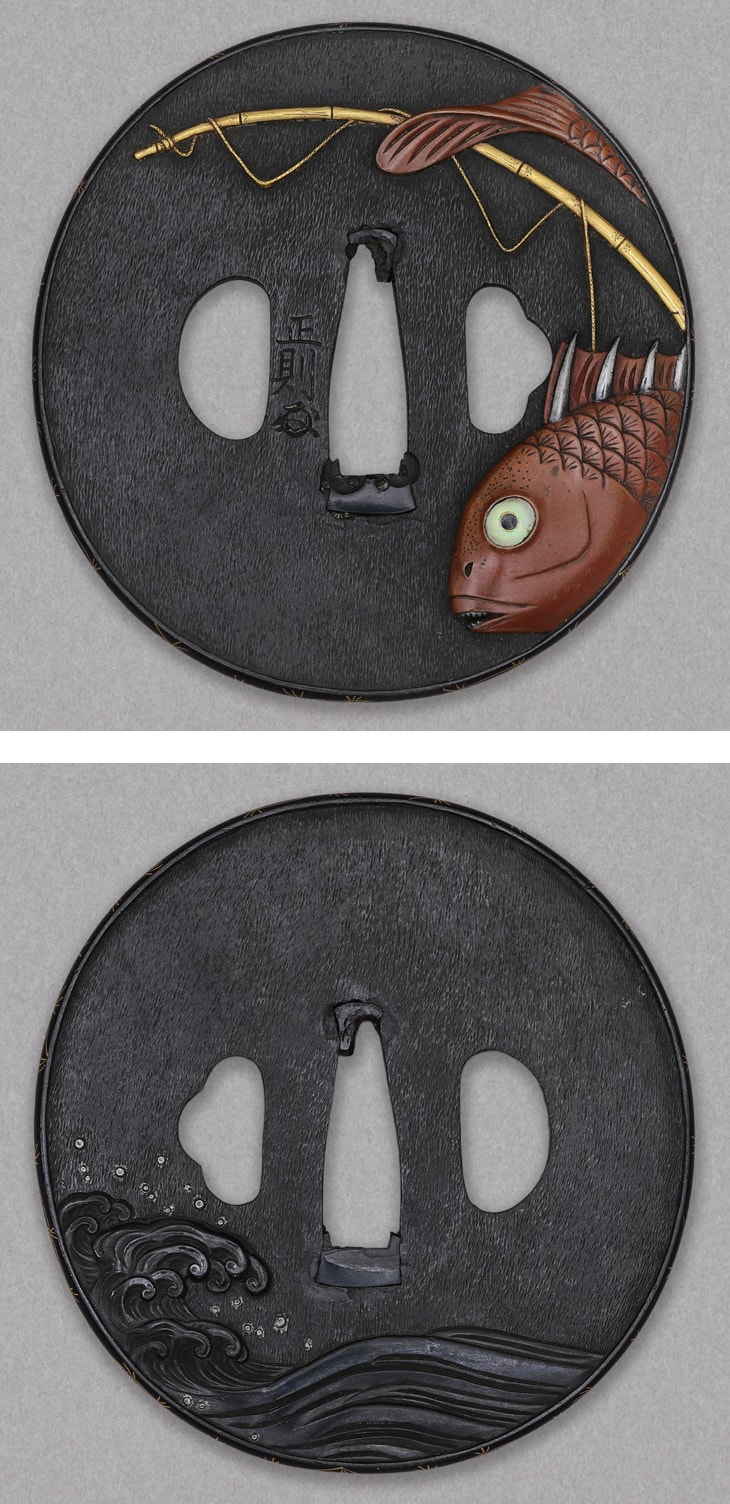
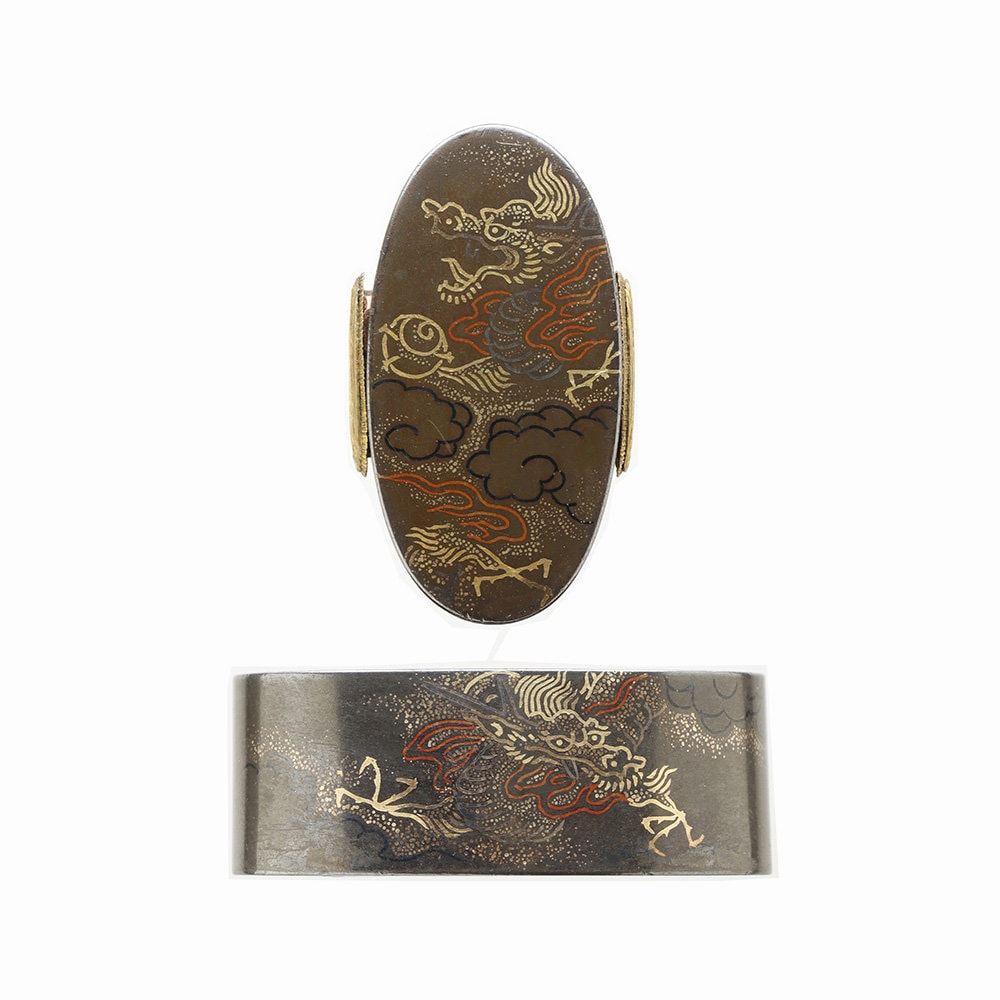
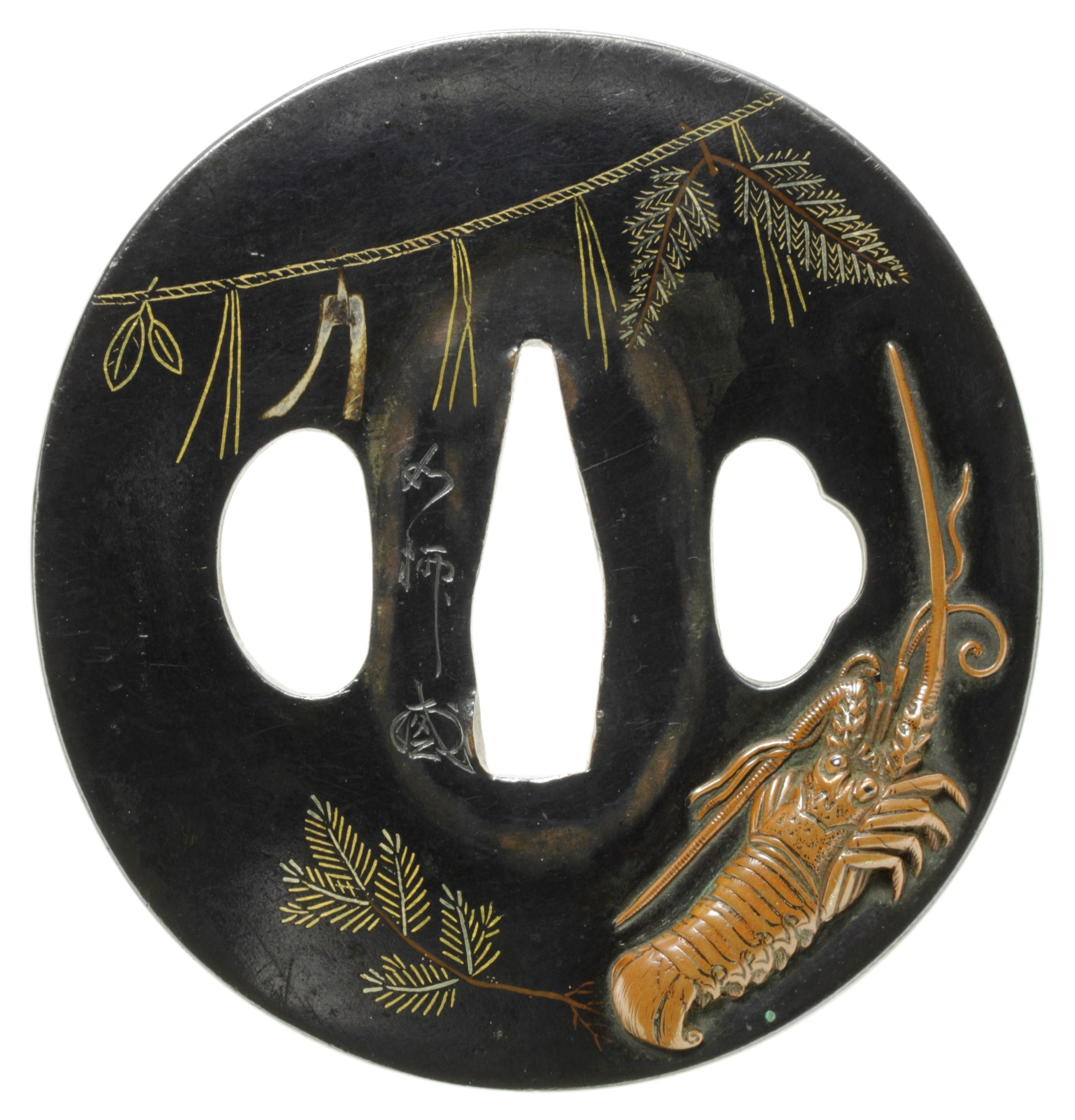
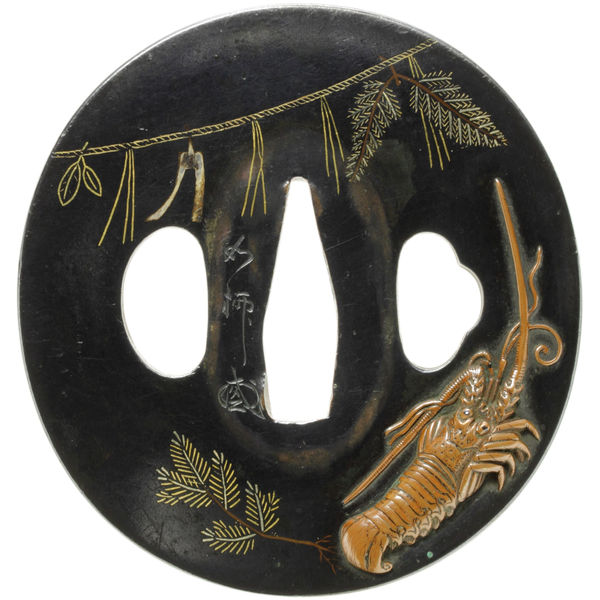
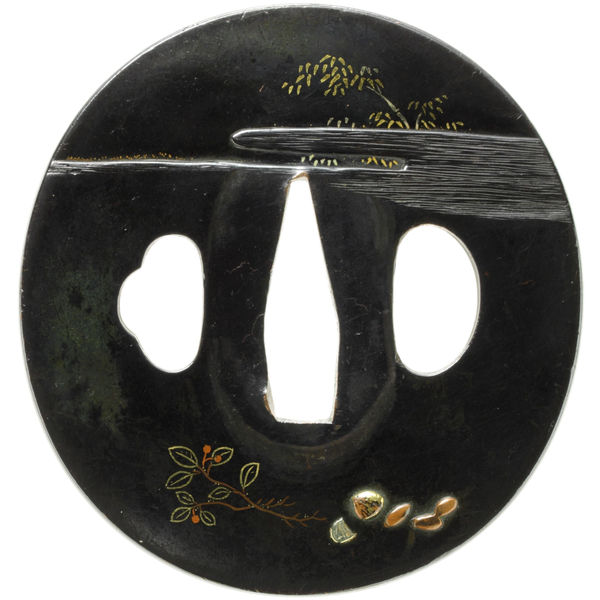
This is a tsuba by Joryu, a student of Murakami Jochiku, known for his intricate works. It features a New Year's decoration motif, with a highly detailed design on a polished shakudo ground. The craftsmanship includes high-relief carving, iroe (color inlay), and fine hair-like engraving to depict textures and movement.
 NihontoWatch
mei · Jochiku · Edo
Machibori
1 piece on the market now
Machibori
12 pieces on the market now
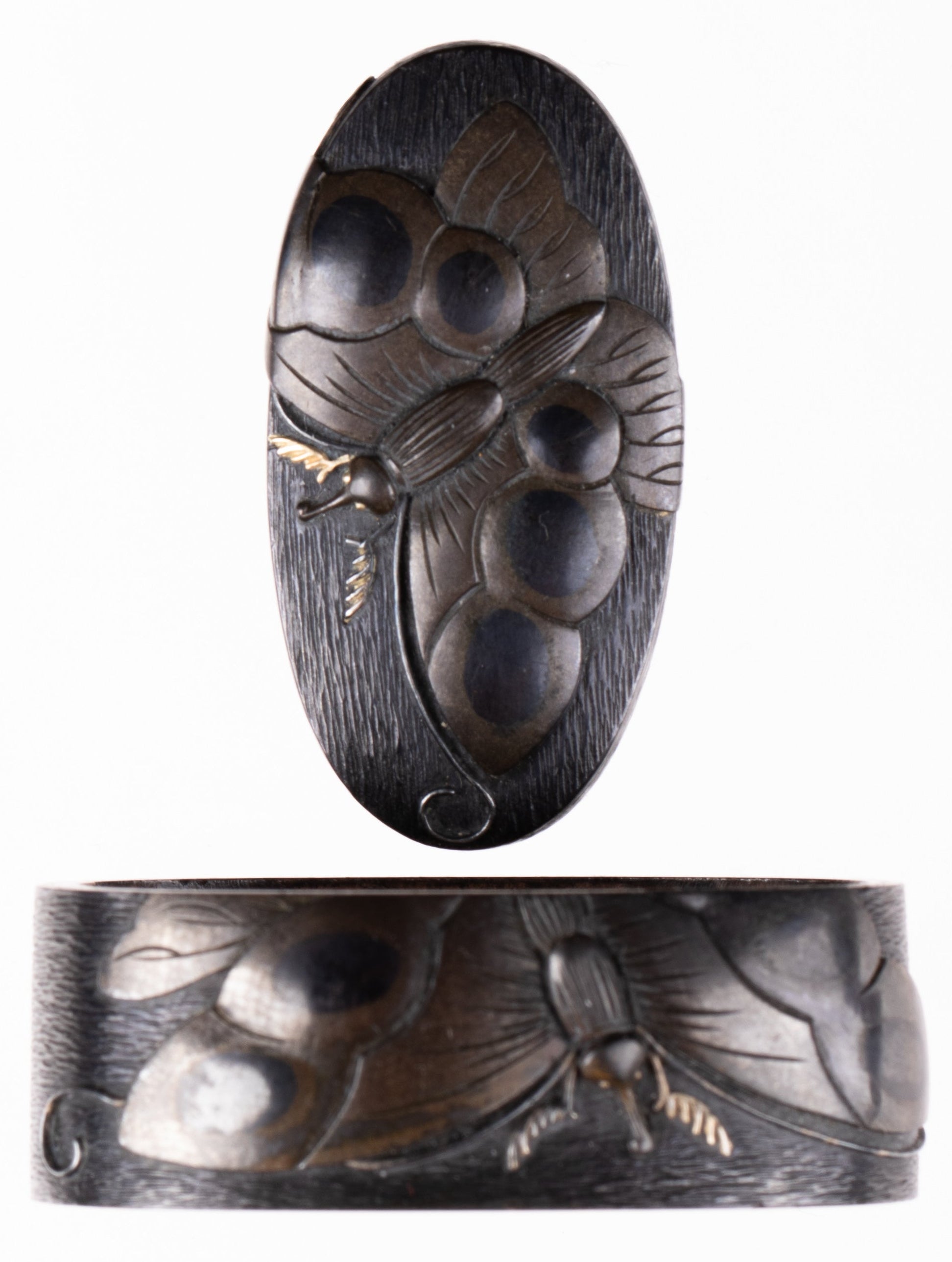
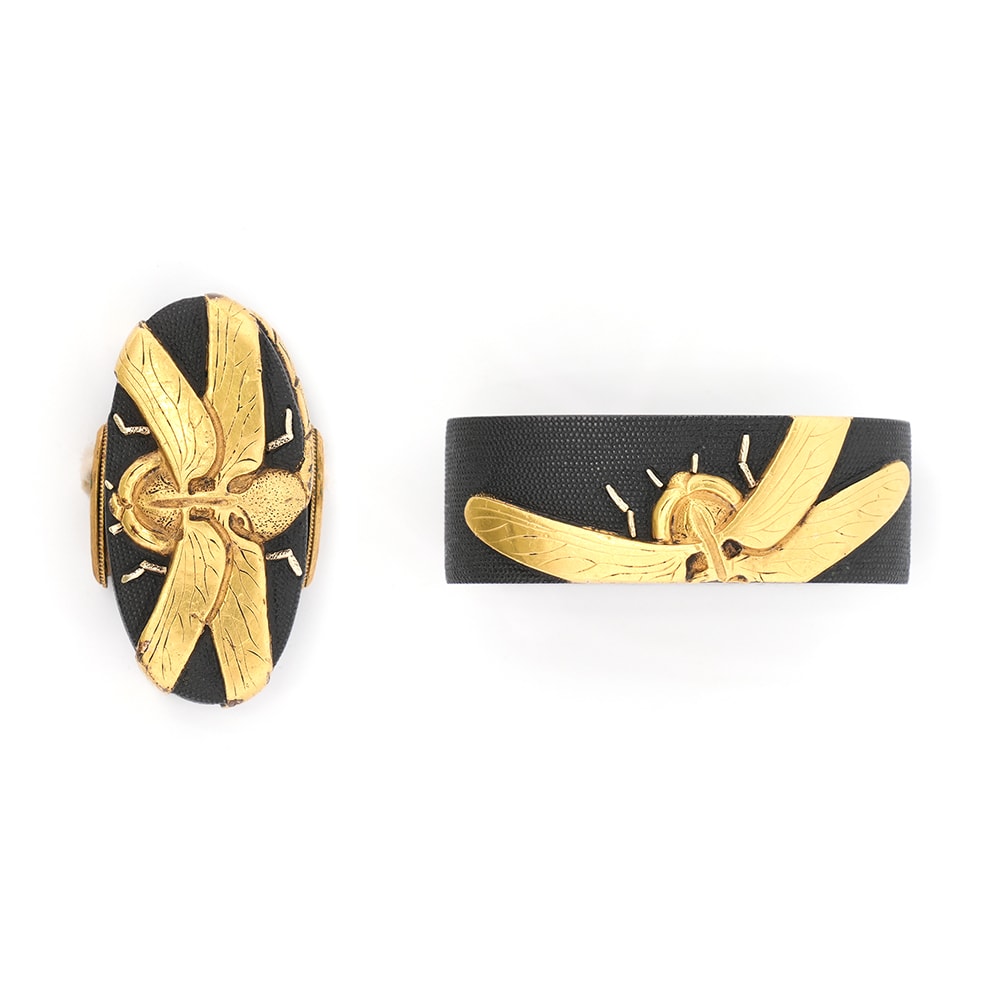
The Murakami school was established in Edo by Murakami Jochiku (村上如竹), who lived in the Shiba district and was active from the mid through late Edo period, around the Tenmei era (1781--1789). His personal name was initially Nakanori (仲矩), later also Mitsunori (光則); he took the art name Kanshodo (歓笙堂). The NBTHK setsumei consistently record that Jochiku "originally came from the trade of inlay work for stirrups" (abumi zogan), and subsequently turned to the profession of a kinko metalworker. One source further notes that he apparently established himself without seeking a particular master, suggesting a largely self-directed artistic formation. This background in stirrup inlay proved foundational to the distinctive inlay vocabulary that would define the school. Jochiku gathered a circle of followers, among whom the most prominent was Masanori (正則), traditionally regarded as his younger brother. While most members of the Jochiku group incorporated the character jo (如) in their art names, Masanori was a notable exception, and his signature was cut in kaisho (standard script) rather than the cursive forms favored by others in the circle. The collective style of the Murakami school is defined by mastery of suemon-zogan (applied-motif inlay) and hira-zogan (flat inlay), executed in bold, large-scale, design-like compositions. The school's preferred ground is the chirimen-ishime-ji[[c:1]] -- a distinctive crepe-textured stone-grain surface in shakudo that recurs across the majority of designated works.
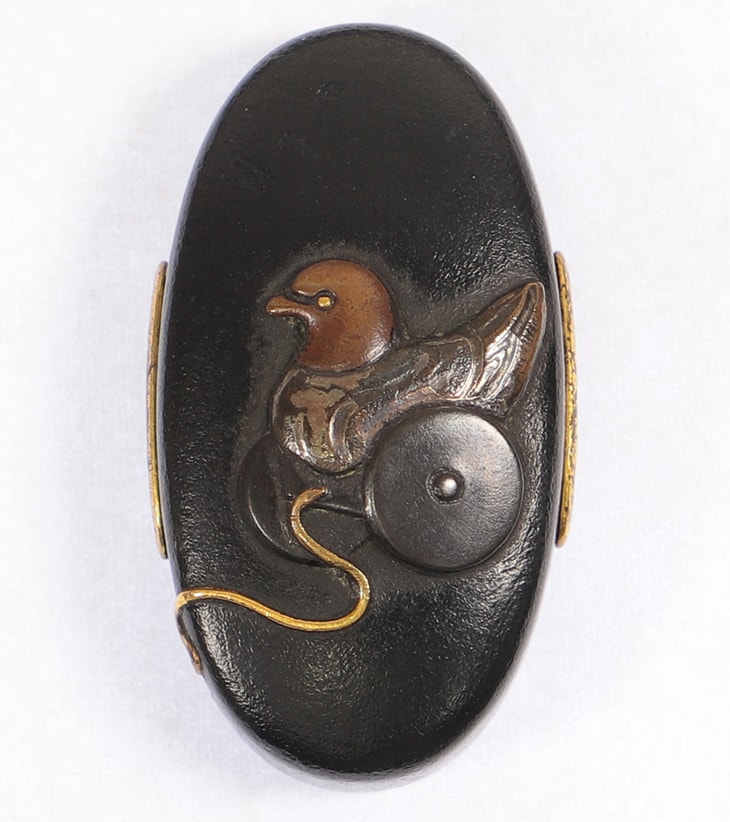
A smaller number of pieces employ nanako-ji, and the setsumei observe that all such works are notably painstaking in execution. Subject matter draws heavily from the natural world: fish and shellfish -- sea bream (tai), cuttlefish, squid, shark, and whitebait -- as well as insects such as butterflies, dragonflies, and cicadas, and animals including cats and tigers. These motifs are rendered in high-relief inlay (takaniku-zogan) with polychrome iroe in gold, silver, shibuichi, suaka, and shakudo. A defining innovation of the school is the insertion of non-metallic materials -- mother-of-pearl (aogai), coral, lacquer, and glass -- into portions of these compositions, "in a manner reminiscent of embedded elements in lacquerwork," thereby heightening the coloristic effect and pursuing visual variety. The treatment of eyes is a particular signature: shell inlaid within shakudo orbs, sometimes covered with glass, and in the celebrated tiger subjects, crystal (suisho) set to produce a piercing gaze. The rusu-moyo ("absence pattern") -- wherein the attributes of Ebisu or Daikoku are depicted without the figure itself, inviting the viewer to imagine the concealed protagonist -- constitutes a major thematic current, often embellished with the auspicious character kotobuki (寿) inlaid repeatedly around the rim. The Murakami school occupies a singular position within the Edo-period machibori tradition by virtue of its intensely individual character and its innovative fusion of metalworking and decorative-arts techniques. The setsumei repeatedly characterize Jochiku's manner as "extremely individualistic" and credit him with having "established an innovative new approach" through the combination of large-scale suemon-zogan with materials drawn from the lacquer and enamel crafts. " The school's designated corpus reveals an atelier that pursued a distinctly craft-oriented decorative beauty -- bridging metalwork, lacquer arts, and glass -- while maintaining the commanding boldness of design and technical precision that the NBTHK recognizes as Jochiku's enduring legacy. Learn more →
| Smith | Era | Designated |
|---|---|---|
| Jochiku如竹 | 1670 | 20 |
| Kazunobu一信 | — | 0 |
| Joryu如柳 | — | 0 |
| Josen如泉 | — | 0 |
| Jochu如 | — | 0 |
A Hozon-certified fitting of notably superior craftsmanship and condition, often with signature or workmanship of high reference value.
The NBTHK (Nihon Bijutsu Tōken Hozon Kyōkai, the Society for the Preservation of Japanese Art Swords) is a public-interest incorporated foundation founded in 1948 and supervised by Japan’s Agency for Cultural Affairs (Bunkachō); it is based at the Japanese Sword Museum in Tokyo. Its expert panels physically examine each submitted work (shinsa) and issue a certificate (kanteishō) ranking it by artistic and historical merit. NBTHK papers are the most widely recognized standard of authentication for Japanese swords and fittings.
NBTHK official siteIf, due to our fault, the item differs significantly from its proper condition, the item may be returned. Cooling-off is within one week of the item's arrival.
¥450,000
This is a tsuba by Joryu, a student of Murakami Jochiku, known for his intricate works. It features a New Year's decoration motif, with a highly detailed design on a polished shakudo ground. The craftsmanship includes high-relief carving, iroe (color inlay), and fine hair-like engraving to depict textures and movement.
NihontoWatchmei · Jochiku · Edo
Machibori
1 piece on the market now
Machibori
12 pieces on the market now
The Murakami school was established in Edo by Murakami Jochiku (村上如竹), who lived in the Shiba district and was active from the mid through late Edo period, around the Tenmei era (1781--1789). His personal name was initially Nakanori (仲矩), later also Mitsunori (光則); he took the art name Kanshodo (歓笙堂). The NBTHK setsumei consistently record that Jochiku "originally came from the trade of inlay work for stirrups" (abumi zogan), and subsequently turned to the profession of a kinko metalworker. One source further notes that he apparently established himself without seeking a particular master, suggesting a largely self-directed artistic formation. This background in stirrup inlay proved foundational to the distinctive inlay vocabulary that would define the school. Jochiku gathered a circle of followers, among whom the most prominent was Masanori (正則), traditionally regarded as his younger brother. While most members of the Jochiku group incorporated the character jo (如) in their art names, Masanori was a notable exception, and his signature was cut in kaisho (standard script) rather than the cursive forms favored by others in the circle. The collective style of the Murakami school is defined by mastery of suemon-zogan (applied-motif inlay) and hira-zogan (flat inlay), executed in bold, large-scale, design-like compositions. The school's preferred ground is the chirimen-ishime-ji[[c:1]] -- a distinctive crepe-textured stone-grain surface in shakudo that recurs across the majority of designated works.
A smaller number of pieces employ nanako-ji, and the setsumei observe that all such works are notably painstaking in execution. Subject matter draws heavily from the natural world: fish and shellfish -- sea bream (tai), cuttlefish, squid, shark, and whitebait -- as well as insects such as butterflies, dragonflies, and cicadas, and animals including cats and tigers. These motifs are rendered in high-relief inlay (takaniku-zogan) with polychrome iroe in gold, silver, shibuichi, suaka, and shakudo. A defining innovation of the school is the insertion of non-metallic materials -- mother-of-pearl (aogai), coral, lacquer, and glass -- into portions of these compositions, "in a manner reminiscent of embedded elements in lacquerwork," thereby heightening the coloristic effect and pursuing visual variety. The treatment of eyes is a particular signature: shell inlaid within shakudo orbs, sometimes covered with glass, and in the celebrated tiger subjects, crystal (suisho) set to produce a piercing gaze. The rusu-moyo ("absence pattern") -- wherein the attributes of Ebisu or Daikoku are depicted without the figure itself, inviting the viewer to imagine the concealed protagonist -- constitutes a major thematic current, often embellished with the auspicious character kotobuki (寿) inlaid repeatedly around the rim. The Murakami school occupies a singular position within the Edo-period machibori tradition by virtue of its intensely individual character and its innovative fusion of metalworking and decorative-arts techniques. The setsumei repeatedly characterize Jochiku's manner as "extremely individualistic" and credit him with having "established an innovative new approach" through the combination of large-scale suemon-zogan with materials drawn from the lacquer and enamel crafts. " The school's designated corpus reveals an atelier that pursued a distinctly craft-oriented decorative beauty -- bridging metalwork, lacquer arts, and glass -- while maintaining the commanding boldness of design and technical precision that the NBTHK recognizes as Jochiku's enduring legacy. Learn more →
| Smith | Era | Designated |
|---|---|---|
| Jochiku如竹 | 1670 | 20 |
| Kazunobu一信 | — | 0 |
| Joryu如柳 | — | 0 |
| Josen如泉 | — | 0 |
| Jochu如 | — | 0 |
A Hozon-certified fitting of notably superior craftsmanship and condition, often with signature or workmanship of high reference value.
The NBTHK (Nihon Bijutsu Tōken Hozon Kyōkai, the Society for the Preservation of Japanese Art Swords) is a public-interest incorporated foundation founded in 1948 and supervised by Japan’s Agency for Cultural Affairs (Bunkachō); it is based at the Japanese Sword Museum in Tokyo. Its expert panels physically examine each submitted work (shinsa) and issue a certificate (kanteishō) ranking it by artistic and historical merit. NBTHK papers are the most widely recognized standard of authentication for Japanese swords and fittings.
NBTHK official siteIf, due to our fault, the item differs significantly from its proper condition, the item may be returned. Cooling-off is within one week of the item's arrival.
¥450,000