 NihontoWatchNihontoWatch
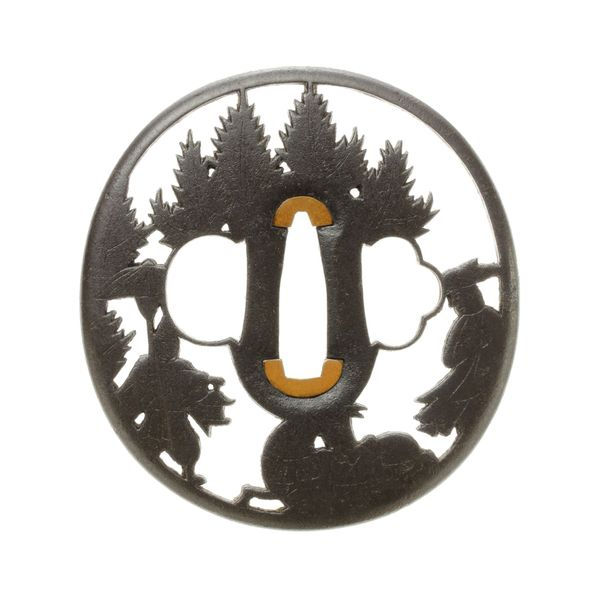
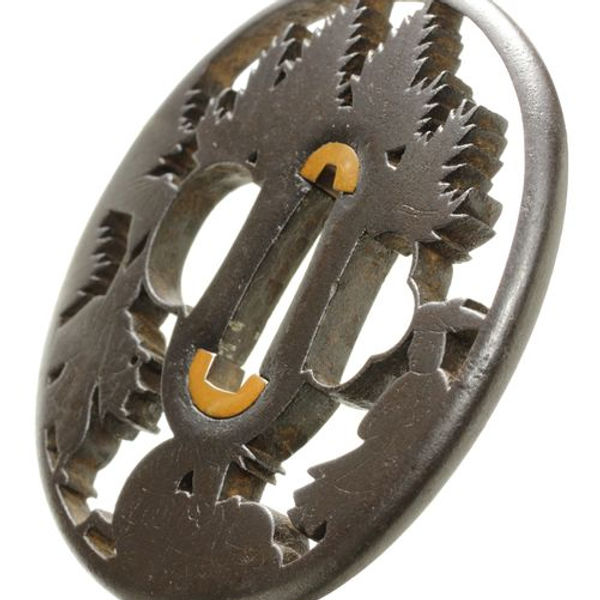
鬱蒼とした杉木立。手前に倒れ伏した馬と貴人。上手より歩み来る傘をさして灯火を持った人物。謡曲「蟻通」(*)に題を得た赤坂忠重の手になる透鐔である。鍛えよく、精良にして艶のある肉厚の鉄地は耳際でやや肉を落とし自然な柔らか味を醸し出す。鋸歯状に刻みだされた杉の木は先端鋭く、微細にして確かな描写の毛彫も味わい深い。赤坂鐔において人物を登場させて情景描写をする作は極めて少ない。赤坂歴代工のなかで、四代忠時以降最も優れた工人と評される忠重の貴重な一枚である。 (*)紀貫之は、和歌の神を祀る紀伊国玉津島明神に詣でる途中、突然の豪雨に見舞われる。乗っていた馬も倒れ、全く動かない。途方に暮れていると宮守が現れ、蟻通明神の社地を下馬せずに通ろうとした咎めであると言う。貫之が歌人であることを知ると宮守は、和歌を奉じて詫びると良いと勧める。貫之が「雨雲の立ち重なれる夜半なれば、蟻通しとも思うべきかは」と即興で歌を詠むと宮守は感心し、和歌の徳によって神は宥められ馬は再び立ち上がる。宮守は神楽を舞って貫之を寿ぎ、自分は蟻通明神であると告げて姿を消す。夜が明けると貫之は玉津島神社に向け旅立っていく。
NihontoWatchOffered by Choshuya
This piece has sold
59 on the market
Get an email when a new Akasaka Tadashige piece hits the market.

As written by the shop
Iron-tsuba · Musashi · around 1730-1816
Tayuemon Tadashige is a signing master of the Akasaka school, the makers of iron openwork tsuba who, the published sources record, moved from Kyoto to the Akasaka district of Edo at the beginning of the Edo period and flourished there until the end of the shogunate. The first three generations, Tadamasa, Tadamasa and Tadatora, the so-called old Akasaka, have no confirmed signed work. Signed pieces begin only with the fourth generation Tadatoki around the Genroku era, signing Bushu ju Akasaka Hikojuro Tadatoki saku, and the main line carried the name Tadatoki down to the ninth generation. Tadashige was a pupil of this Tadatoki line. Most entries say he entered under the fourth generation, one calls him a pupil of the fifth, and the latest reconciles the two: he entered in the fourth generation's old age, but his teacher in practice was the fifth. He was long-lived, with a signature dated at seventy-eight and a last work signed at eighty-four, and the sources praise him as "among the finest hands of the Akasaka tsuba makers from the fourth to the ninth generation"[[c:1]].
His guards keep the Akasaka construction the published sources describe for the school. The iron is at times laminated in the manner called sanmai-awase, the plate is modelled high at the centre, the connecting bars of the openwork widen near the rim to give stability, and the rim is usually a rounded maru-mimi. His technique is ji-sukashi openwork with kebori, on iron plates of a large and dignified size. The sources dwell on the steel: the forging is superb, the rust colour has a sheen, and on one daisho the colour of the patina is called clear.
What the sources single out in him is design. Novelty of composition is one of the points of Akasaka work, and Tadashige, they write, was especially strong in design, "enterprising enough to take in the pattern designs of Ogata Korin"[[c:2]]. His large openwork guard of old pines, called a representative work of his hand, sets two pine branches of different sizes in a three-tiered matsukaze design that the sources call "Tadashige's own invention, not seen even in Higo tsuba"[[c:3]]. A daisho pair signed at seventy-eight shows a plum tree giving off its faint scent under a blue moon in the depth of winter, and the sources find that it "well displays the character of Akasaka tsuba, whose forte is stylish openwork"[[c:4]].
His subjects draw on nature and on old stories, as the school's do. Beside the pines and the plum stand a tsuba of sacred deer with a torii, signed with the place name Kasugayama, a guard of paulownia framed in a window, and a round iron guard of the yellow hollyhock, whose full, soft modelling the sources read as showing the skill that makes him the white eyebrow of the Akasaka makers. On the larger guards the build is big and dignified and the cutting of the openwork is keen. The paulownia guard, which takes the Higo master Kanshiro as its model and adds a new freshness, is modelled with the flesh dropped away at the rim, and the sources note that this modelling "well shows Tadashige's particular character"[[c:5]].
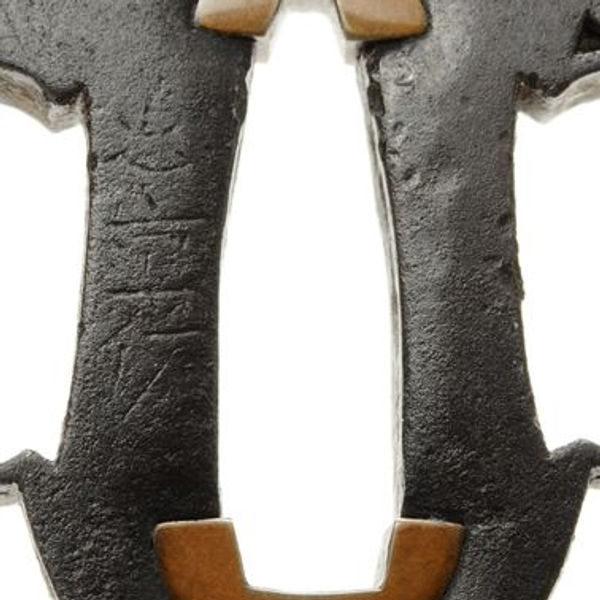
The signature itself carries a question the published sources address directly. The paulownia guard bears the age inscription of eighty-four, his last, and is judged "from the style of the signature a substitute work and substitute signature"[[c:6]] by his eldest son Tadayoshi. Even so the sources call it an outstanding work that shows his forte, so the late age-dated pieces stand at the edge between his own hand and his workshop.
For the collector Tadashige is represented by five tsuba at the Juyo level, all signed, with no higher designations and no recorded provenance. They include the old pines held as his representative work, the plum daisho and the age-dated pieces of his final years. A signed Tadashige of his large, inventive openwork appears only from time to time, so a documented example is a deliberate find for a collector of Edo iron tsuba.
Where Tadashige stands among comparable artisans: across all of nihontō, and within tradition, era, and period. The tiers (Foremost · Leading · Major · Notable) weigh official designations from the NBTHK and Japan's Agency for Cultural Affairs, together with historical honors of lasting repute such as the Sansaku and Meibutsu-chō.
Select a lens to see how it's measured.
Iron-tsuba · Edo
Phase: Akasaka赤坂· 1688–1860
59 pieces on the market now
| Smith | Era | Designated |
|---|---|---|
| Tadamasa忠正 | 1624-1657 | 5 |
| Tadashige忠重 | 1730-1816 | 5 |
| Tadatoki忠時 | 1704-1764 | 0 |
| Juchiku/Toshitake寿竹 | — | 0 |
| Tadanori忠則 | 1730-1780 | 0 |
A Hozon-certified fitting of notably superior craftsmanship and condition, often with signature or workmanship of high reference value.
The NBTHK (Nihon Bijutsu Tōken Hozon Kyōkai, the Society for the Preservation of Japanese Art Swords) is a public-interest incorporated foundation founded in 1948 and supervised by Japan’s Agency for Cultural Affairs (Bunkachō); it is based at the Japanese Sword Museum in Tokyo. Its expert panels physically examine each submitted work (shinsa) and issue a certificate (kanteishō) ranking it by artistic and historical merit. NBTHK papers are the most widely recognized standard of authentication for Japanese swords and fittings.
NBTHK official siteIf, due to our fault, the item differs significantly from its proper condition, the item may be returned. Cooling-off is within one week of the item's arrival.