 NihontoWatchNihontoWatch
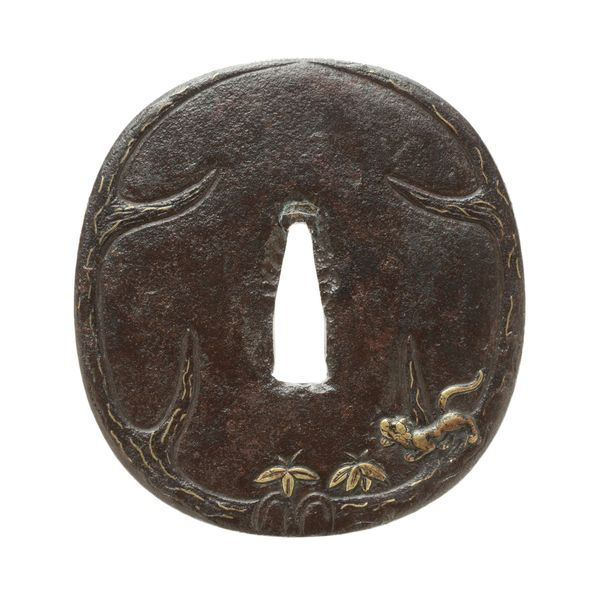
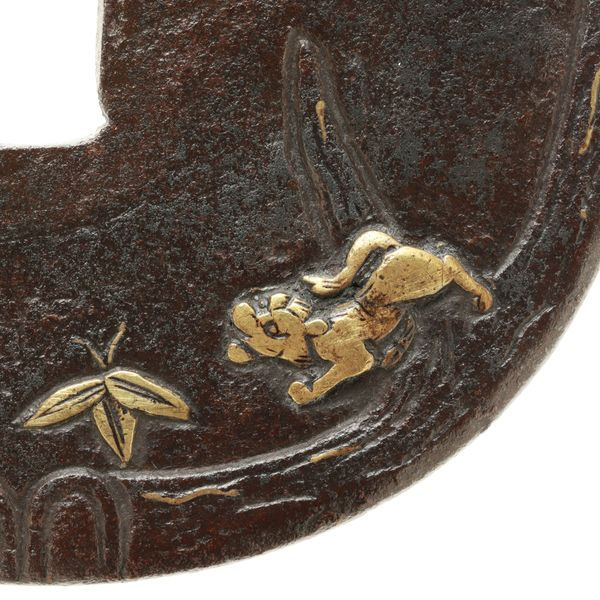
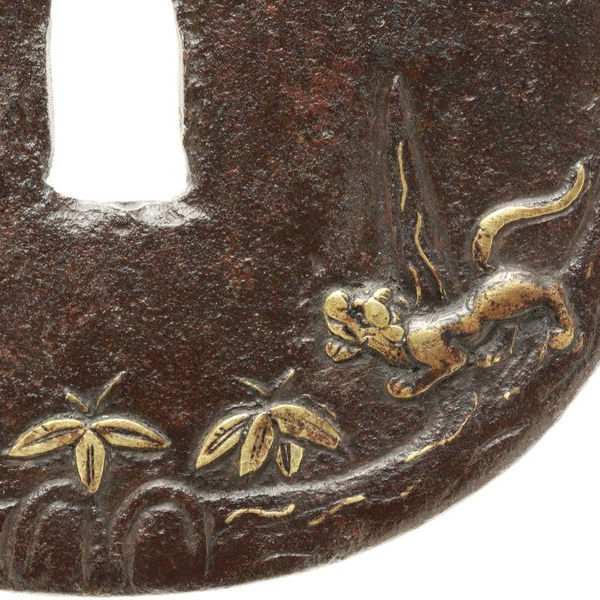
鹿角に蜂で俸禄。鹿角に蟻は禄有り。では鹿角に竹虎は何を意味するのであろう? 大振りで鍛えの良い鉄地は耳に向かってやや肉を落とした竪丸形。その耳に切り取られた鹿角を廻らし、それよりもはるかに小さな虎を真鍮象嵌している。角には毛彫りと真鍮の線象嵌が施され、切り口は写実的。判じ絵であろうか、何とも不思議な図である。鹿の角から連想するものを書き連ねていてはたと気がついた。敵の侵入を防ぐために鹿角のように枝の先端を尖らせて外側に向けた障害物を逆茂木という。その別名は鹿砦(ろくさい)、または逆虎落(さかもがり)。これは武運長久の願いが込められたものではないだろうか。虎があまりに小さく可愛らしいのが何とも味わい深く面白い。吉久は平安城式象嵌を得意とした江戸時代初期の鐔工。
NihontoWatchOffered by Choshuya
This piece has sold
Get an email when a new Heianjo-Zogan Yoshihisa piece hits the market.

Heianjo-Zogan Yoshihisa
late 17th century (d. c.1700)
Yamashiro
Signed
Tokuho (NBTHK)
As written by the shop
Iron-tsuba
1 piece on the market now
Iron-tsuba
22 pieces on the market now
Heianjo zogan tsuba constitute a technique-defined regional tradition rooted in Yamashiro Province, centered on the capital city of Kyoto. The NBTHK setsumei consistently describe the tradition as one that "draws upon the lineage of Onin tsuba,"[[c:1]] though the relationship is understood as broadly contemporaneous rather than strictly sequential; the earliest Heianjo inlay works are, in terms of period, close to Onin tsuba. The tradition flourished from the closing years of the Muromachi period through the Momoyama era and into the early Edo period. Connections to other iron-tsuba lineages such as Kamakura tsuba have also been contemplated. From within this milieu emerged Koike Yoshiro, who received the court title Izumi no Kami and took the name Naomasa; originally of Kyoto, he later relocated to Kaga Province and is said to have pioneered the tradition known as Kaga inlay (Kaga zogan). " The collective idiom of the tradition divides broadly into two technical approaches: suemon-zogan (flush raised inlay) and hira-zogan (flat inlay). A defining characteristic shared by both is the extensive use of brass (shinchu / 真鍮).
In terms of design, the suemon-zogan manner frequently employs crests and scrolling karakusa (唐草) arabesques developed in an ornamental, pattern-like fashion, while the hira-zogan manner often depicts grasses and flowers -- chrysanthemum, dianthus (nadeshiko), and bellflower (kikyo) motifs among them. As time progressed, the palette expanded beyond brass to include gold, silver, refined copper (suaka), shakudo, and yamagane, used in combination; pictorial designs were introduced, and some works mix suemon-zogan with hira-zogan or incorporate sukidashi-bori takabori (raised carving in scooped-out relief). The iron plates are typically of generous proportion, and the Koike Yoshiro sub-line is further distinguished by thin iron plates with successive crest openwork at the rim edge, dense karakusa hira-zogan across the ground enhanced with fine line engraving (kebori), and a subtle niku-otoshi ("set-down flesh") treatment at the rim. Across the NBTHK setsumei the tradition is repeatedly praised for an unmistakably Kyoto sensibility. "[[c:4]] The pictorial ambition of later masters such as Nagayoshi, whose sukidashi-takabori landscape compositions "successfully unfold the world of pictorial tsuba," demonstrates the breadth of the tradition beyond pure inlay ornament. Taken together, the Heianjo zogan corpus attests to a sustained metropolitan workshop culture in which brass inlay on iron plate was elevated -- through distinctive technique, refined design[[c:5]], and an abiding courtly elegance -- into one of the recognized pillars of the Kyoto tsuba canon. Learn more →
| Smith | Era | Designated |
|---|---|---|
| Shigemitsu重光 | — | 0 |
| Hidesada英貞 | — | 0 |
| Tadatsugu忠次 | — | 0 |
| Yoshihisa吉久 | — | 0 |
| Yoshinaga吉長 | — | 0 |
A Hozon-certified fitting of notably superior craftsmanship and condition, often with signature or workmanship of high reference value.
The NBTHK (Nihon Bijutsu Tōken Hozon Kyōkai, the Society for the Preservation of Japanese Art Swords) is a public-interest incorporated foundation founded in 1948 and supervised by Japan’s Agency for Cultural Affairs (Bunkachō); it is based at the Japanese Sword Museum in Tokyo. Its expert panels physically examine each submitted work (shinsa) and issue a certificate (kanteishō) ranking it by artistic and historical merit. NBTHK papers are the most widely recognized standard of authentication for Japanese swords and fittings.
NBTHK official siteIf, due to our fault, the item differs significantly from its proper condition, the item may be returned. Cooling-off is within one week of the item's arrival.