The Haitōrei edict of 1876 ended sword wearing and nearly ended the craft itself. Military demand and imperial patronage kept a remnant alive, and in 1906 Gassan Sadakazu and Miyamoto Kanenori were named Artists to the Imperial Household.
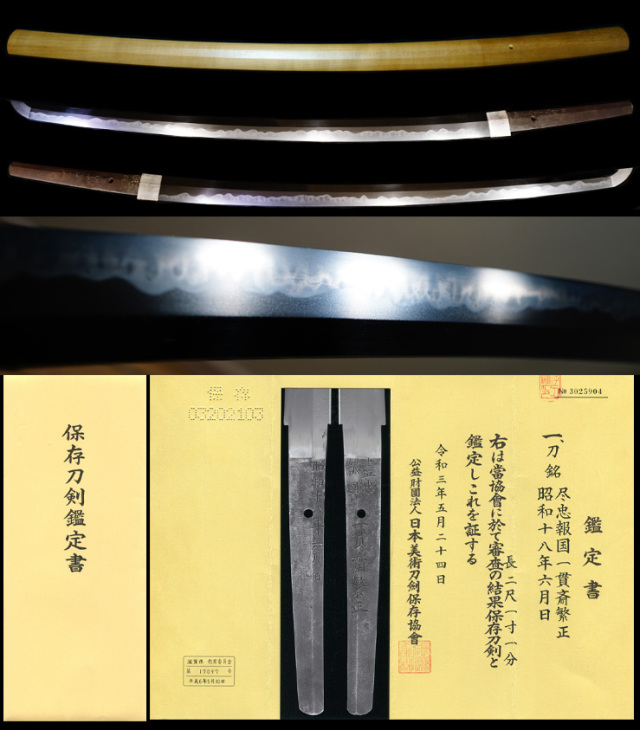
A work from during World War II, the nakago is inscribed with "Junchu Hokoku," meaning to serve with loyalty to repay one's country, making it a truly historical document; the fact that such a carefully crafted work could be ordered from Shigemasa, who was already Yokozuna-class at the time during the Showa war, leaves no doubt that this was a custom order from someone of commander rank. The workmanship is reminiscent of Fukuoka Ichimonji, with a dynamic and powerful gunome-midare, a refined skin texture of dense ko-itame with ji-nie, and the habuchi is frequently covered in sunagashi with kinsan running through it; the nie and nioi are deep, both the ji and ha are bright and clear, and the hataraki within the刃 is extraordinary and full of spirit, representing a magnificent achievement that can be called the pinnacle of Bizen style. Ikkansai Shigemasa, whose real name was Sakai Hiroshi, was born in Meiji 38 in Otowa-cho, Shizuoka City, as the third son of Sakai Yasujiro (the younger brother of the swordsmith Miyaguchi Masatoshi). In Taisho 10, he became a disciple of the master Kasama Shigetsugu. After nearly 15 years of training, Shigemasa received the character "Shige" from Kasama Shigetsugu. His first mei was Shigemasa (繁正). Later, he changed his mei to Shigemasa (繁政). From Showa 8, he forged swords at the Yasukuni Jinja Nihonto Tanrenkai and the Okura Nihonto Tanrenjo. In Showa 16, he became independent in Itabashi-ku, Tokyo. He received certification as an Army Jumei Tosho, and furthermore, in Showa 19, he also received certification as a Navy Jumei Tosho. After the war, he went by the name Ikkansai Shigemasa (繁政) and continued to forge swords energetically, being certified as Mukansa by the Nihon Bijutsu Token Hozon Kyokai. He passed away in Heisei 8 at the age of 91. He is a highly honored master smith who deeply carved his name into the history of Japanese swords both before and after the war.
Offered by Kusanagi
This piece has sold
Get an email when a new Kasama Ikkansai Shigemasa piece hits the market.


As written by the shop
Machine translation from the shop's Japanese · may contain errors ·
around 1926-1989
3 pieces on the market now
Meiji: survival after the edict
The Haitōrei edict of 1876 ended sword wearing and nearly ended the craft itself. Military demand and imperial patronage kept a remnant alive, and in 1906 Gassan Sadakazu and Miyamoto Kanenori were named Artists to the Imperial Household.
Certifies a genuine blade worth preserving: a signature confirmed correct, or, if unsigned, an era, province, and school that the NBTHK can reliably identify.
The NBTHK (Nihon Bijutsu Tōken Hozon Kyōkai, the Society for the Preservation of Japanese Art Swords) is a public-interest incorporated foundation founded in 1948 and supervised by Japan’s Agency for Cultural Affairs (Bunkachō); it is based at the Japanese Sword Museum in Tokyo. Its expert panels physically examine each submitted work (shinsa) and issue a certificate (kanteishō) ranking it by artistic and historical merit. NBTHK papers are the most widely recognized standard of authentication for Japanese swords and fittings.
NBTHK official sitePlease notify us of your intention to return, by email or fax, no later than the day after the item's arrival. Return shipping, insurance, and refund transfer fees are the customer's responsibility.