Hizen swords were a domain enterprise: the Nabeshima sent Tadayoshi to study under Umetada Myōju around 1596, then built a licensed school around him. Nine generations carried its famously consistent konuka-hada work into the Meiji era.
 NihontoWatchNihontoWatch
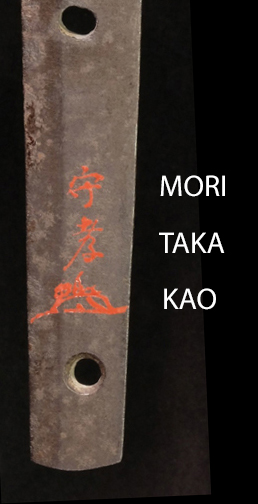
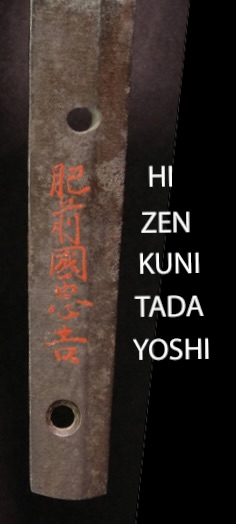
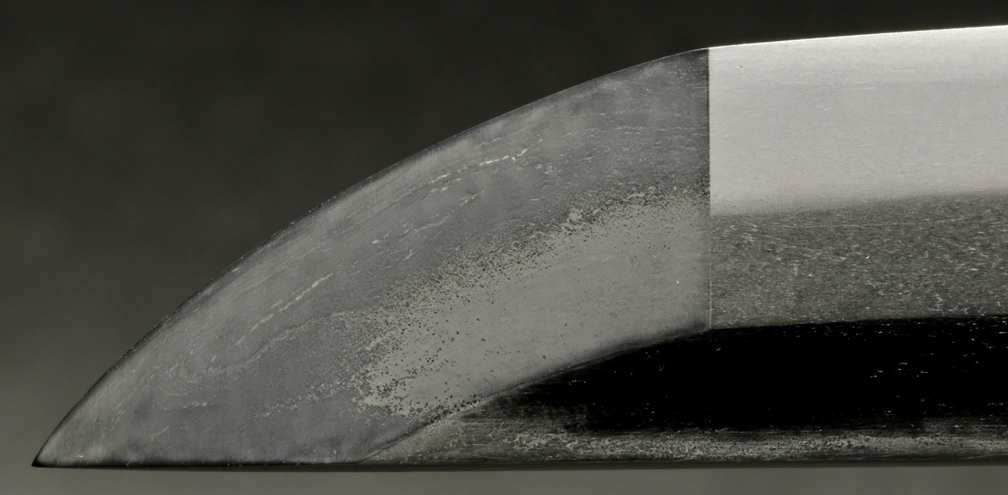
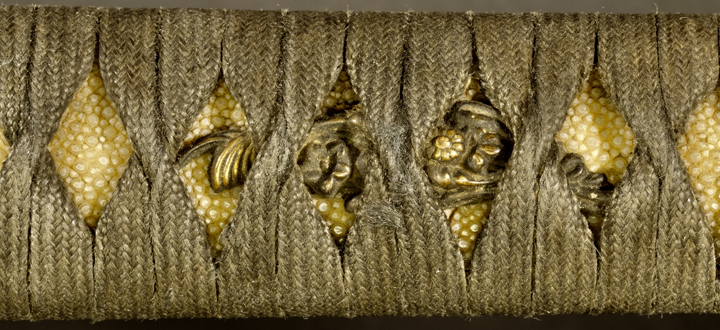
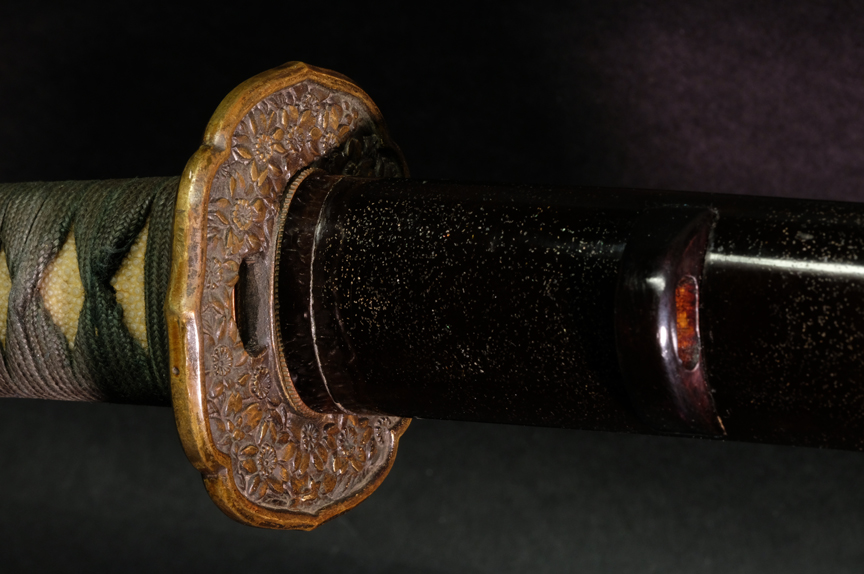
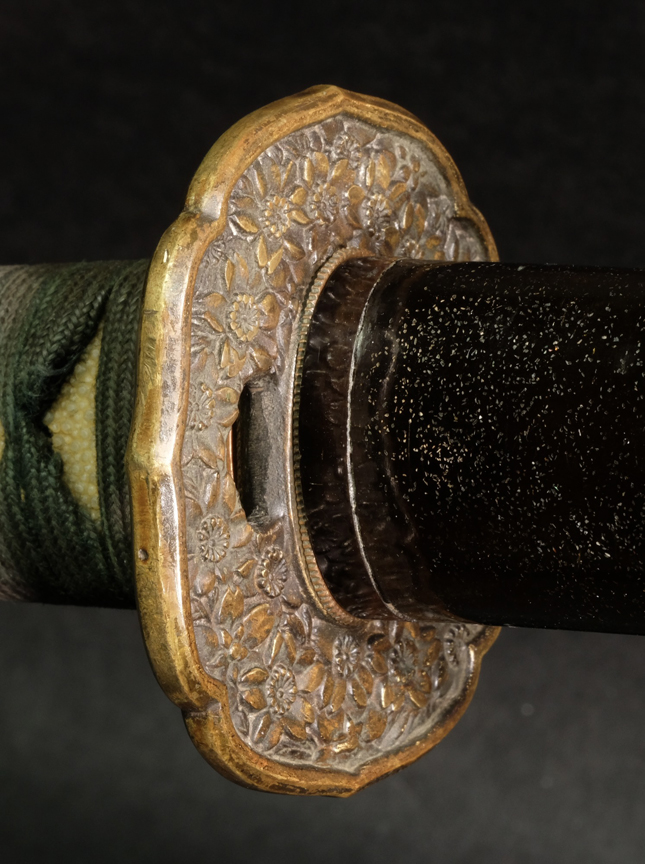
HACHIDAI (8TH GEN.) CHUJOSAKU (RANKING BY FUJISHIRO) NTHK PAPERED KOSHIRAE The Hizen Tadayoshi school of sword smith’s needs no introduction and are highly prized worldwide. It all began with the Shodai Tadayoshi who was born in 1572 and known as Hashimoto Shinsaemonjo. Shodai Tadayoshi at age 25 became an apprentice to Umetada Myoju in Kyoto, who is known as the founder of the Shinto Sword. The “Tada” character was given to him by Umetada. After a three-year apprenticeship Tadayoshi returned to his home in Hizen Province, where he set up the Hizen Tadayoshi Kaji. The Hizen Tadayoshi Kaji extended through nine mainline generations, ending with the death of the 9th generation Hizen Tadayoshi in 1880. This Wakizashi is attributed by the NTHK to the Hachidai or eighth generation Hizen Tadayoshi. Hachidai Tadayoshi was born in 1801 and known as Hashimoto Shunichiro. He was the son of Rokudai (6th gen) Tadayoshi’s daughter. He was adopted by the Nanadai (7th gen) who had no children, to continue a legitimate blood heir ship. The 6th and 7th generations both died when the Hachidai Tadayoshi was around sixteen years old, and apparently deshi Tadayuki not only ran the school but mentored the Hachidai Tadayoshi until he was old enough to manage the school on his own. Hachidai Tadayoshi and Tadayuki maintained a close relationship until the death of Tadayuki in1844. Hachidai Tadayoshi was also known to have produced guns and cannons at the request of the Daimyo Nabeshima Naomasa. Hachidai Tadayoshi, at the Daimyo Nabeshima Naomasa’s request performed a sword making demonstration in 1851. He was one of only two Tadayoshi smith’s to ever demonstrate the art of sword forging to such a high-ranking samurai as the Daimyo. Not only were the works of the Hachidai Tadayoshi recognized and revered by the Daimyo during his lifetime, but his reputation as an exemplary sword smith continues today. Roger Robertshaw, author of the book “The School of Tadayoshi”, is one of the foremost authorities and collectors of the Hizen Tadayoshi School. Without his diligence most of this information would be unavailable to non-Japanese readers. In his book “The School of Tadayoshi”, Mr. Robertshaw states, “One of the favorite swords in my collection is by the Hachidai (8th gen) Tadayoshi. Such a sword attests to the enduring quality of even such a late generation smith, as this talented artist undoubtedly was”. From Markus Sesko’s, Swordsmiths of Japan: TADAYOSHI (忠吉), 8th gen., Ansei (安政, 1854-1860), Hizen – “Hizen no Kuni Tadayoshi” (肥前国忠吉), “Hizen no Kuni Shinzaemon no Jō Fujiwara Tadayoshi” (肥前国新左衛門尉藤原忠吉), “Hizen no Kuni Hashimoto Shin- zaemon Fujiwara Tadayoshi” (肥前国橋本新左衛門藤原忠吉), real name Hashimoto Shinzaemon (橋本新左衛門), he changed his first name later to Kuranosuke (内蔵允) and Shun ́ichirō (舜一郎), second son of Furukawa Yohei Michihiro (古川与兵衛道弘), he was adopted by the 7th gen. Tadayoshi as his successor, he did not receive any honorary title and died on the 26th day of the fifth month Ansei six (1859) at the age of 59, we know date signatures from the eighth year of Tenpō (天保, 1837) to his year of death Ansei six (1859), jō-saku. This sword was shortened at some point where the mei was lost. One can only speculate, but it is most likely that it was shortened by the swordsmith Moritaka. The nakago has had a shumei applied. Shumei, being an attribution done in red lacquer. The shumei states, Hizen no Kuni Tadayoshi on the omote. On the Ura, it is signed Moritaka with Kao also in shumei. Again, as Moritaka put his name and kao on the sword along with the attribution, the probability is high that he performed the shortening of the nakago and replaced the mei with shumei. Placing his name was his way of legitimizing the work. The sword comes in Koshirae. The koshirae is nothing fancy but it is intact and fits tight. It looks to have had some minor repairs to the saya. The polish is brand new, as sword was polished just prior to shinsa. It was papered and attributed to the 8th generation Tadayoshi by the NTHK at the San Francisco Token kai in August of 2022. It takes several months to receive the papers. If someone purchases this blade before the papers are received, they will be forwarded to the new owner ASAP.
Offered by Yakiba
The listing mentions papers from the NTHK that aren’t in our records yet. Current NBTHK and NTHK shinsa papers are the independent check we rely on, so it’s worth asking the dealer for a clear photo of the certificate. — Hoshi
4 on the market









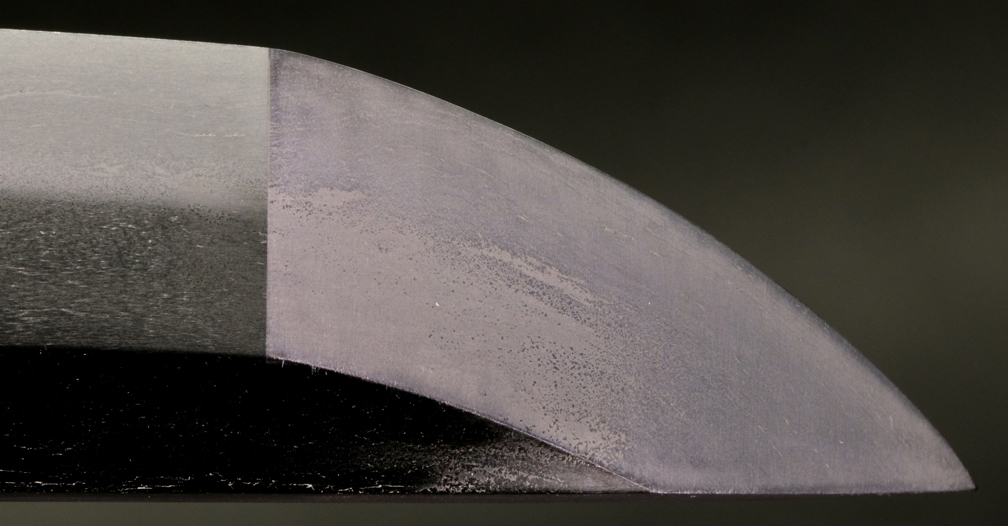
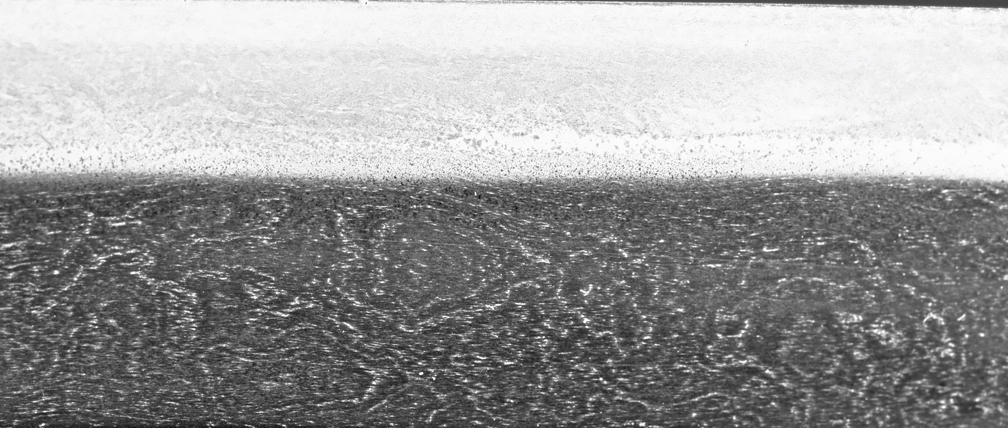
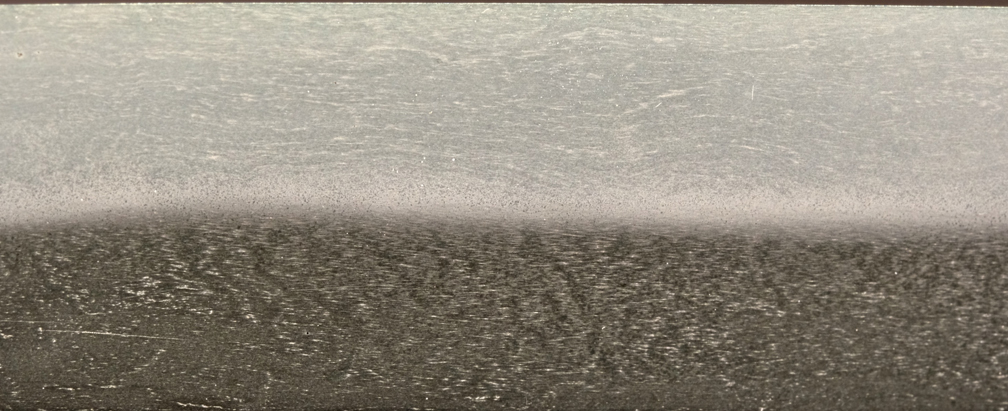
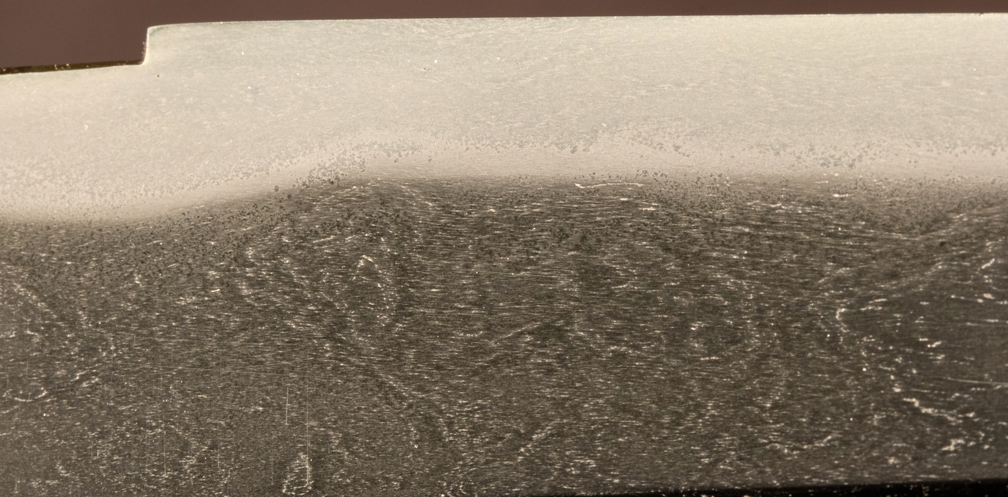


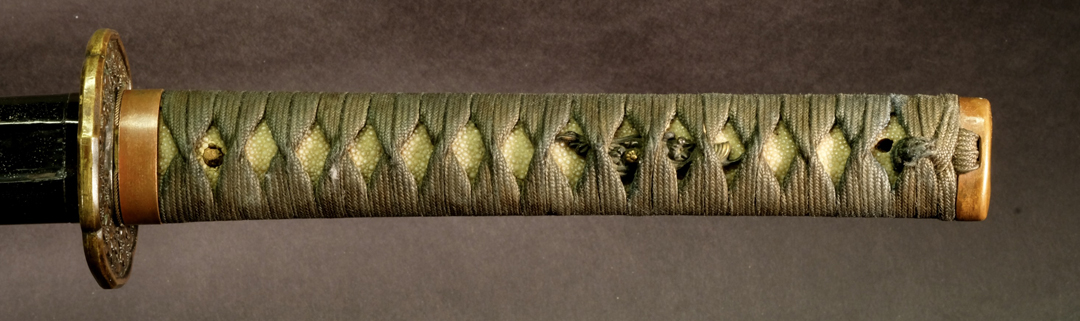
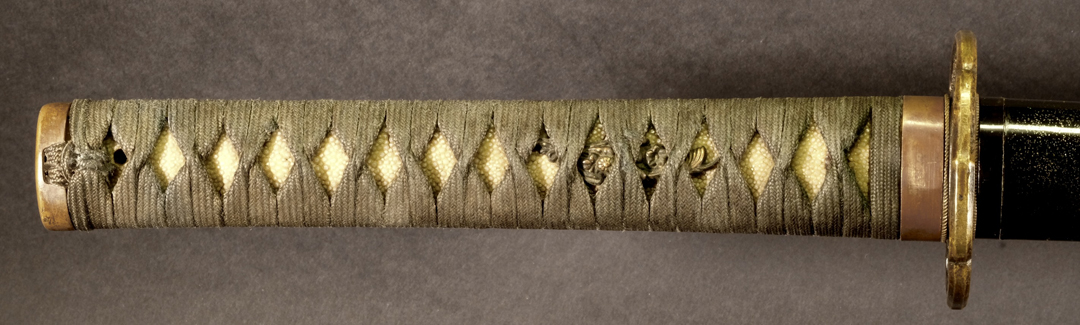
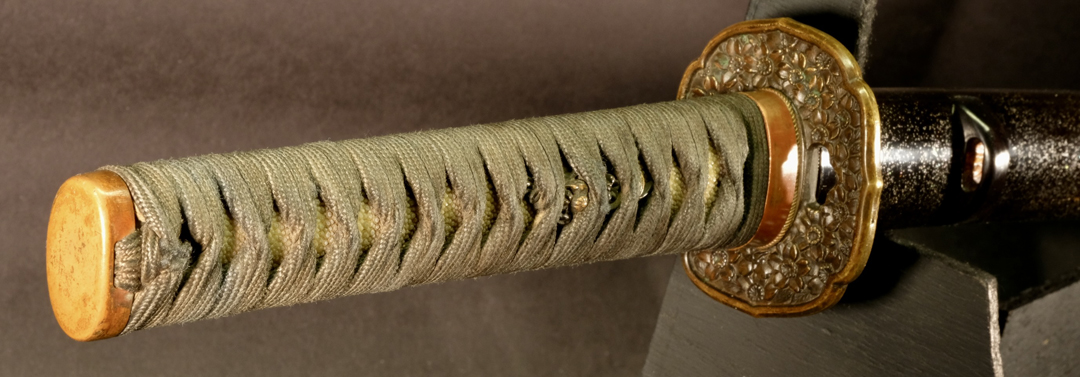
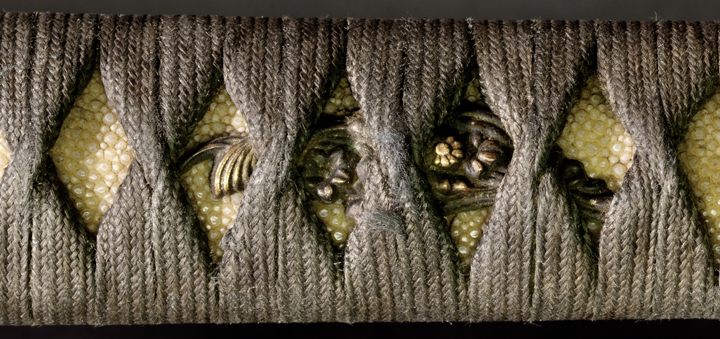
Shinto · Hizen · around 1830-1844
Fujishiro Chu-jo saku · Tōken Taikan top 76%
4 pieces on the market now
Shinto · Hizen
105 pieces on the market now
The Hizen school began with a single domain commission. In Keicho 1 (1596) the Nabeshima of Hizen ordered Hashimoto Shinzaemon, the smith who would sign Tadayoshi, up to Kyoto with the carver Munenaga; there he entered the gate of Umetada Myoju and studied forging while Munenaga learned the chisel. The two returned to the province in Keicho 3 (1598), and Tadayoshi settled in the castle town below Saga, where under the domain's patronage the line grew into the dominant sword-making house of Kyushu. His own work runs from Keicho 5 (1600) to his death in Kan'ei 9 (1632); in Genna 10 (1624) he received the court title Musashi Daijo, changed his name to Tadahiro, and shifted his clan name from Minamoto to Fujiwara, so that the late Musashi Daijo blades are the founder under a second name. From him the house became a true generational institution: his son the second-generation Omi Daijo Tadahiro carried it forward as its most prolific hand, the third-generation Mutsu no Kami Tadayoshi returned its highest finish, and a Tosa no Kami branch took the founder's signature when he set it aside. Around this main line grew a circle of disciples and collateral hands, the waki-Hizen or Soba-Hizen smiths, several of them, like Yoshiie and Hironori, working as daisaku substitute makers whose own signed pieces are therefore scarce. The school's signature is its steel. Over a ko-itame forged so tightly it shows no slackness, fine ji-nie gathers in minute particles until the surface takes on the rice-bran konuka-hada (also written komenuka-hada) that no other school produces, fine chikei entering throughout and the ji notably clear and bright.
The orthodox temper laid upon it is a chu-suguha or hiro-suguha, sometimes tinged with a shallow notare and ko-gunome, the nioiguchi deep with finely clustered ko-nie and tightened to a bright clarity, the boshi running straight to a quiet ko-maru. The founder aimed this suguha toward the Rai school yet departed from it, his nioiguchi tighter and his forging carrying more vigor; the third generation refined it to what the published sources call the strongest and most precise hand of the first three generations. Against that calm register the house also worked a showier one, the Hizen choji-midare mixing gunome, long ashi, kinsuji and sunagashi, a manner the published sources already find more often in the founder's late Musashi Daijo work than in his Tadayoshi years, and one the second generation made his own. The branches pushed further from the suguha standard: Tadakuni of the Ogi domain ran sunagashi more conspicuously than any other Hizen hand and reached toward old Ichimonji in his o-choji; Masahiro and Yukihiro favored a flamboyant long-ashi choji over the calm main line; and the Iyo no Jo Munetsugu line worked apart in the Soshu-den, building a midareba on notare with a pointed togariba and a jihada that tends to stand and tone slightly blackish. A collector seeks Hizen-to first for that steel, and reads it the same way the appraiser does: a bright suguha lying over a clear, tight konuka-hada identifies the school before the signature is consulted, and the quiet ko-maru boshi on the ura-signed tang confirms the main-line practice. Generation and branch are then told within that frame, the third generation's powerful sugata recalling not his father but his grandfather, the waki-Hizen hands set apart by their irregular temper, their sujikai file marks and a sashi-ura signature, the Munetsugu line by its Soshu togari. The main line, made in real numbers across so long a span, reaches the market more readily than any Kamakura master, so a papered example is within reach of a patient collector, while the founder's own work and the finest konuka-suguha of the third generation come to open hands only from time to time. Provenance runs back through the house the school served, blades recorded to Nabeshima Katsushige and Nabeshima Naomoto and passing onward to the Owari Tokugawa, the Satake and the Imperial families; documentary inscriptions sharpen the picture further, a Myoju soemei attesting the founder's discipleship, Umetada carving adding flowers to brocade on his late blades, and the gold-inlaid cutting tests of Yamano Kanjuro and Yamano Ka'emon, rare on Hizen work, naming the edge as well as the hand. Learn more →
| Smith | Era | Designated |
|---|---|---|
| Tadayoshi忠吉 | 1596-1632 | 155 |
| Tadayoshi忠吉 | 1660-1686 | 61 |
| Tadahiro忠廣 | 1633-1693 | 133 |
| Masahiro正廣 | 1624-1655 | 30 |
| Tadakuni忠國 | 1648-1652 | 32 |
Hizen: a domain enterprise
Hizen swords were a domain enterprise: the Nabeshima sent Tadayoshi to study under Umetada Myōju around 1596, then built a licensed school around him. Nine generations carried its famously consistent konuka-hada work into the Meiji era.
The NTHK’s principal certificate, issued for a blade of considerable quality. It confirms a genuine signature, or, for an unsigned (mumei) work, records the judges’ attribution to a smith or school. The paper carries a detailed worksheet with a numerical point score.
The NTHK (Nihon Tōken Hozon Kai, the Society for the Preservation of the Japanese Sword) is the oldest of Japan’s sword-appraisal bodies, founded in 1910, decades before the NBTHK. After the death of its long-serving head it divided into two successor societies, the NTHK and the NTHK-NPO, both of which continue to hold shinsa. NTHK blade certificates are known for a detailed worksheet that records a numerical point score alongside the judges’ written opinion (fitting papers carry the judges’ opinion without a point score), and the society is especially respected for its attribution of unsigned (mumei) work.
All swords sold for $5000 USD or less are considered final! Swords above the $5000 range may be returned for any reason within 48 hrs. Buyer will receive a full refund minus shipping/handling, insurance and or any fees incurred in shipping or sale.
$3,950