Edo was the sword’s age of connoisseurship: the Hon’ami appraisers, the shogunal register of famous blades of 1719, and a thriving literature turned the sword into an object of study even as it ceased to be drawn in war.
 NihontoWatchNihontoWatch
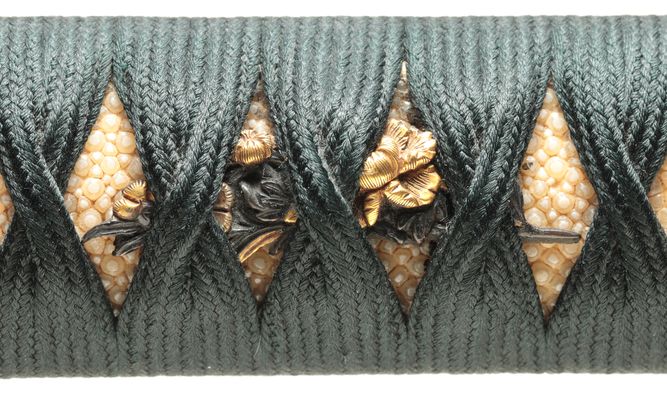
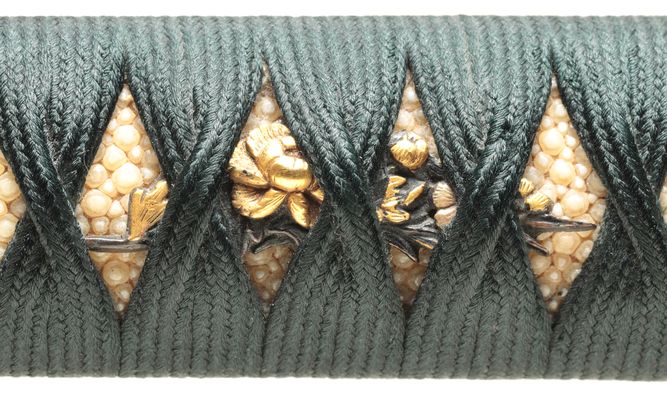
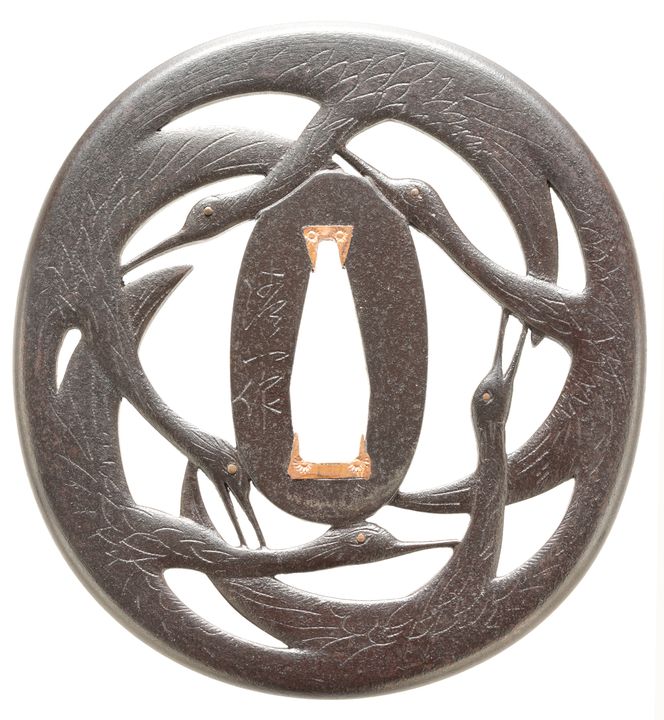
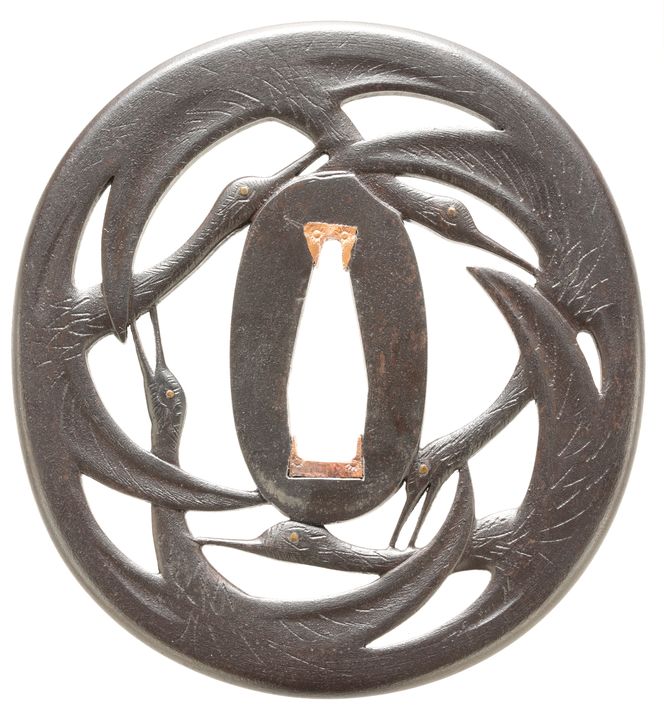
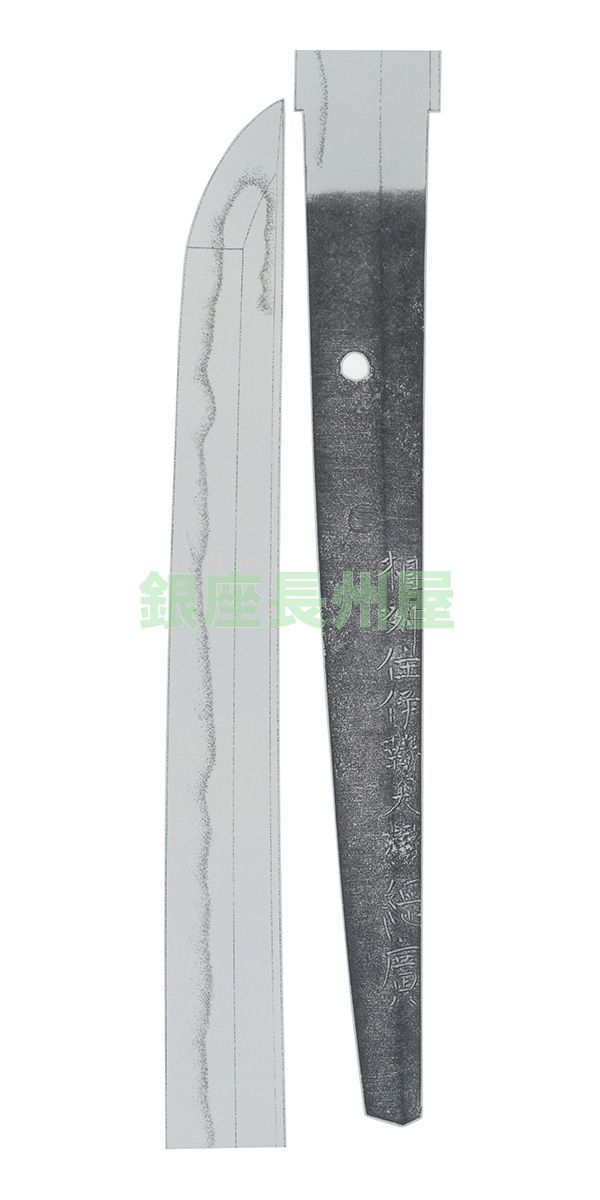
相州正宗の末裔と伝える綱広家は、戦国期に関東の覇者北条氏に仕え、慶長九年には三代宗右衛門が奥州津軽家に招かれて駐鎚している。五代弥右衛門は江戸の長曽祢虎徹、大和守安定、法城寺正弘などと同時期に、祖先が受け継いできた鎌倉扇ヶ谷の鍛冶場にて鎚を揮い、彼らに近似した沸出来の互の目乱を焼いた作を以て武士の需めに応え、殊に評価が高く万治三年に伊勢大掾を受領している(注)。 寛文初年頃の作と鑑られるこの刀は、僅かに区送りながらも身幅広く重ね厚く鎬筋が強く張り、中鋒に仕立てられた頑健な造り込み。地鉄は広めの鎬地を細かな柾に、平地を小板目肌に錬り鍛え、地沸が厚く付き、地景が縦横に働いて活力が漲り、一際明るく冴え冴えとしている。刃文は浅い湾れに二つ三つと連れた互の目を焼いて虎徹の瓢箪刃を想わせる。焼刃は小沸が深く匂口明るく、太い沸足が盛んに入り、細かな金線が処々に光り、砂流しが掛かり、焼の深い帽子は良く沸付いて小丸に深く返る。物打辺りの棟がわずかに焼かれ、また、茎も柄木の厚みへの配慮から薄手に仕立てられるなど、武用への備えも充分に考慮された、まさに江戸武士好みの手強い一刀となっている。 黒石目地塗鞘に鉄地舞鶴図の鐔を掛けた、しっかりとした打刀拵が付帯している。 注...『新刀鍛冶綱領』に「新刀綱廣中にては此伊勢大掾と銘ずるものに最も佳作多し」とある。
NihontoWatchOffered by Choshuya
This piece has sold
Get an email when a new Sue-Soshu Tsunahiro piece hits the market.










Soshu-den · Sagami · around 1592-1605
Fujishiro Jo saku · Tōken Taikan top 37%
1 piece on the market now
Where Tsunahiro stands among comparable artisans: across all of nihontō, and within tradition, era, and period. The tiers (Foremost · Leading · Major · Notable) weigh official designations from the NBTHK and Japan's Agency for Cultural Affairs, together with historical honors of lasting repute such as the Sansaku and Meibutsu-chō.
Select a lens to see how it's measured.
Years he was demonstrably active, proven by signed-and-dated blades
Soshu-den · Sagami
Phase: Sue-Sōshū末相州· 1356–1868
21 pieces on the market now
When the great Kamakura masters had passed and the country slid into the wars of the late Muromachi, a residual Soshu-den held on in Sagami under a new patron. The Later Hojo, ruling from Odawara castle, kept smiths at hand, and it was from this orbit that the leading name of the window emerged: Tsunahiro, transmitted as a retained smith of the Odawara Hojo who took the character tsuna from Hojo Ujitsuna. The first generation's earliest dated works fall in the Tenbun era, and the line runs forward in the conventional reckoning through Tensho, Keicho, Kan'ei, and Manji, the third generation drawn west to Tsugaru by Tamenobu to forge daisho before returning home. Around him stood a wider Sagami population working the same idiom: Hirotsugu of Kamakura, whose strongest hands cluster near the Meio and Tenbun years; Hiromasa and Soso, names carried across several indistinct generations; Masahiro, reaching back toward Joji; and the Odawara group of Yasuharu, Yasukuni, and Fusamune, the last praised above all for his carving. These smiths inherited the manner of the Nanbokucho apex at a remove of generations rather than by direct descent from the mainline of Masamune and Sadamune. The signature of the phase is the open declaration of the full temper. The forging stays itame mixed with mokume, the grain inclined to stand (hadadachi-gokoro), with ji-nie and chikei; over it the smiths ran a notare-and-gunome ground that climbs the upper half into hitatsura, tobiyaki and muneyaki firing across ji and mune, sunagashi and kinsuji threading the ha. This is the hitatsura and o-midare learned from Hiromitsu and Akihiro, but pushed toward display: the Hirotsugu katana of the 61st Juyo runs its temper so high it reaches the shinogi, mixing choji, togariba, and yahazu-gata into a demonstrative yakidaka pattern.
The contrast with the classic apex is precise and the appraisers mark it. Where Masamune raised nie to its deepest refinement over a bright, clear steel, the Sue-Soshu ji tends to shirake, a whitish cast standing in for that clarity, and the nioiguchi inclines to shizumi, a sunken or subdued quality rather than depth. The 238th Jubi record states the point plainly for the first-generation Tsunahiro: the ji and ha carry abundant nie, yet the very shape of the hamon departs from that of Hiromitsu and Akihiro. The temper is broader and busier across the surface, but it lacks the quiet command and the leaping interior activity of the original. To kantei the window is to separate this demonstrative late temper from the classic Soshu-den it imitates: a standing itame with shirake, a wide hitatsura worked with yahazu and crescent tobiyaki, a nioiguchi that sinks rather than deepens, and signatures reading Soshu-ju with full given names rather than the o-suriage mumei of the great forebears. The named hands carry the distinctions, Fusamune through his dense, precise horimono of kurikara and bonji, Tsunahiro through his crescent tobiyaki and high monouchi fire, Hirotsugu through a hitatsura vigorous enough to recall Hasebe. Provenance keeps these blades close to power: several are recorded in Honma's inventory of the Imperial collection, one bearing the ownership inscription of Akimoto Yoshihide of Kozuke, another the Hachiman Daibosatsu invocation of a Sengoku warrior, the Tsunahiro commission tied by its dated nakago to the Tsugaru house. Learn more →
| Smith | Era | Designated |
|---|---|---|
| Fusamune總宗 | 1504-1521 | 5 |
| Tsunahiro綱廣 | 1532-1555 | 14 |
| Hiromasa廣正 | 1444-1456 | 4 |
| Hirotsugu廣次 | 1492-1501 | 4 |
| Tsunaie綱家 | 1532-1555 | 3 |
The Edo period (1615 to 1868)
Edo was the sword’s age of connoisseurship: the Hon’ami appraisers, the shogunal register of famous blades of 1719, and a thriving literature turned the sword into an object of study even as it ceased to be drawn in war.
A Hozon-certified blade judged to show notably superior workmanship and a better state of preservation. The bar is higher: re-tempered blades and most unsigned Muromachi/Edo works are excluded.
The NBTHK (Nihon Bijutsu Tōken Hozon Kyōkai, the Society for the Preservation of Japanese Art Swords) is a public-interest incorporated foundation founded in 1948 and supervised by Japan’s Agency for Cultural Affairs (Bunkachō); it is based at the Japanese Sword Museum in Tokyo. Its expert panels physically examine each submitted work (shinsa) and issue a certificate (kanteishō) ranking it by artistic and historical merit. NBTHK papers are the most widely recognized standard of authentication for Japanese swords and fittings.
NBTHK official siteIf, due to our fault, the item differs significantly from its proper condition, the item may be returned. Cooling-off is within one week of the item's arrival.