After the Ōnin War broke the Ashikaga order, a century of Sengoku warfare armed nearly every province in Japan. The era rewards a discriminating eye: routine work exists in quantity, and beside it stand custom blades of the first rank.
 NihontoWatchNihontoWatch
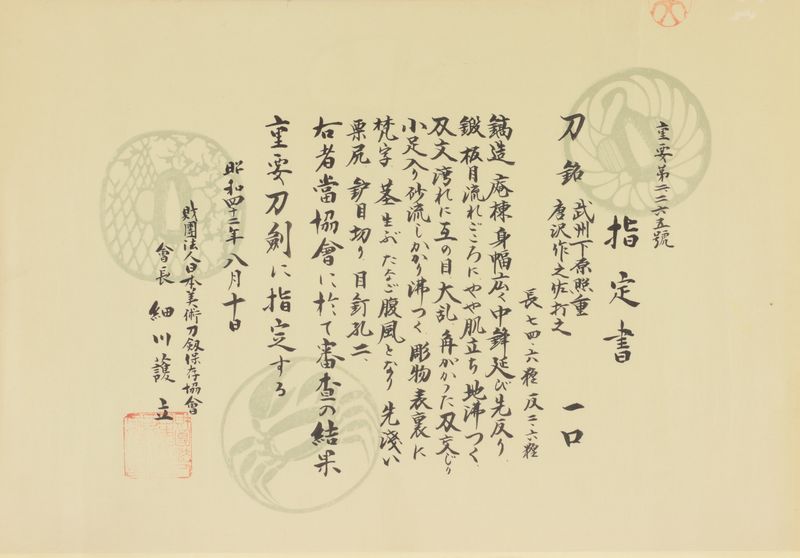
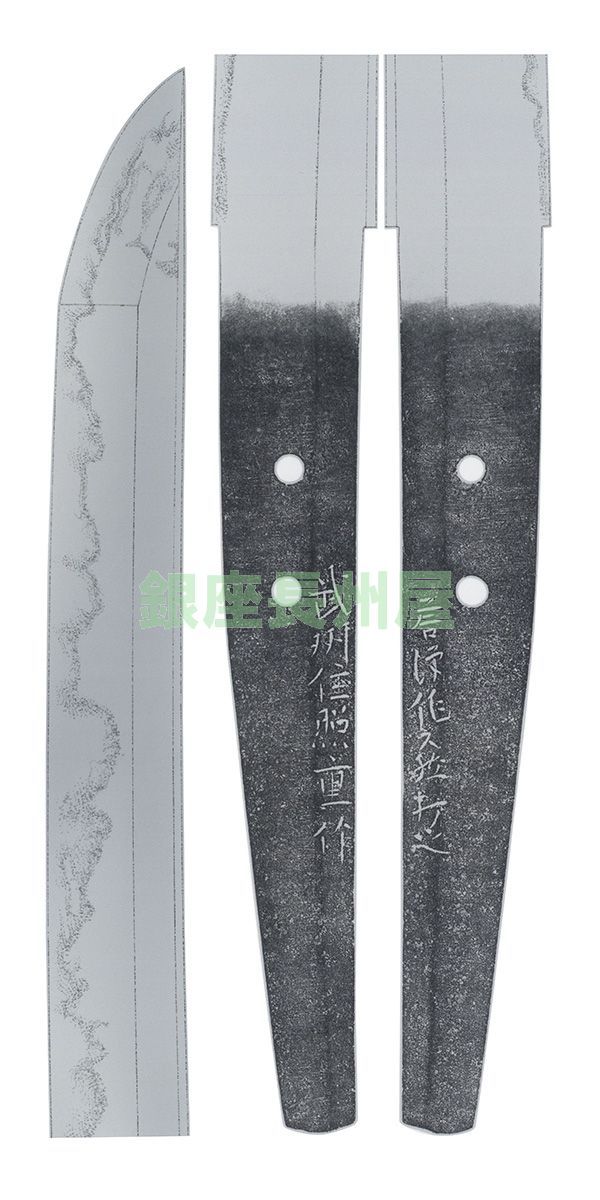
Tensho era(A.D.1573-1591, Momoyama period) Moto-haba(Width at ha-machi) approx. 3.51cm Saki-haba(Width at Kissaki) approx. 2.6cm 武蔵国多摩郡横河郷(注1)の住人照(てる)重(しげ)は、北条氏康の二男滝山城主陸奥守氏照より照の一字を賜り、永禄二年頃(注2)より初銘の周重を照重に切り改めている。 「唐澤作之佐打之」の所持銘のあるこの刀は、氏照による天正十三年の八王子城築城以前、天正年間前期(注3)の作刀と鑑せられ、身幅が極めて広く反り深く、中鋒の延びた堂々の造り込み。板目に杢目を多く配した地鉄は、如輪杢(じょりんもく)となって刃中にも円形の杢肌が現れ、地沸が厚く付いて鍛着は緻密。下半湾れに小丁子が交じり、上半は大きく深く乱れた互の目となって矢(や)筈(はず)刃が入り乱れ、刃中には足が長く入って砂流(すなが)しが絡み、刃縁明るく沸付いて地刃躍動し、同工同派中の冠刀として過言なき傑作(注4)。注文主の唐澤(からさわ)作之佐(さくのすけ)の唐澤は、上州吾妻郡(注5)の地衆に多く、吾妻郡東村の唐澤縫殿介幸周は天正三年北条氏直から加勢依頼の書状を受けており、またその北方の高山村の中山城は、天正年間には北条氏の配下となり、唐澤半右衛門が中山十八人衆の一人として北条方で活躍している。作之佐もこの地方の出身であり、北条氏の要請を受けて滝山城下に馳せ参じた武将の一人であったと思われ、この刀を手にしての、往時の奮迅の戦い振りが想起される。
NihontoWatchOffered by Choshuya
This piece has sold
Get an email when a new Shitahara Terushige piece hits the market.









Shinto · Musashi · around 1558-1570
Fujishiro Jo saku · Tōken Taikan top 49%
1 piece on the market now
Where Terushige stands among comparable artisans: across all of nihontō, and within tradition, era, and period. The tiers (Foremost · Leading · Major · Notable) weigh official designations from the NBTHK and Japan's Agency for Cultural Affairs, together with historical honors of lasting repute such as the Sansaku and Meibutsu-chō.
Select a lens to see how it's measured.
Shinto · Musashi
7 pieces on the market now
The Shitahara group (下原) worked at Hachiōji in Bushū, the old province of Musashi, from the end of the Muromachi period and carried its forge on into the Edo period. The setsumei place the lineage among the swordmakers of Musashi in the kotō age and name Terushige, Yasushige, Hiroshige, and Chikashige as its leading hands, with the meikan recording Terushige across three generations: a shodai in Kyōroku, a nidai in Eiroku, and a sandai in Tenshō. " That same blade was made to order, in this case from Hagiwara Kaminao of Kōshū, marking the group as a working provincial forge serving its region. In the forging the setsumei return repeatedly to an itame-hada freely mixed with mokume that stands up rather than lying flat, the grain described as hada-datsu, often running to nagare near the edge and taking on an ayasugi-like, whorled or vortex-like cast in the jigane. The temper is a moderately undulating notare into which gunome enter, frequently in regular paired sequences, with pointed togariba, a chōji-like feeling at times, and ko-nie clinging along a nioiguchi that can settle into a subdued shizumi tone; sunagashi and ashi appear within the ha, and the bōshi tends to run midare-komi and turn back in maru. One katana sets gunome, ō-midare and angular elements into a notare, its bōshi sweeping off in hakikake.
The setsumei read this hand as a synthesis drawing on late Sōshū and the Muramasa line together with late Mino tendencies, which together account for the standing grain and the paired gunome. For kantei the markers are consistent: the risen mokume with its ayasugi turn, the regularly paired gunome, and a build suited to the uchigatana of the closing Muromachi years, often with pronounced sakizori and an extended chū-kissaki. Carving recurs, including bō-hi, bonji, gomabashi, and a deeply cut kurikara-ryū whose coiling tail the NBTHK singles out as characteristic. Named and dated pieces anchor the group: the Yamamoto Genjirō Terushige naginata, uncommon as a double-edged ryōba form, and a Terushige katana appraised between Eiroku and Tenshō that the register calls the hakubi of the school. The setsumei note that Shitahara work survives in number into the shintō period while outstanding examples remain few, which sets these designated blades apart within the lineage. Learn more →
| Smith | Era | Designated |
|---|---|---|
| Terushige照重 | 1558-1570 | 2 |
| Terushige照重 | 1596-1615 | 1 |
| Yasushige康重 | 1558-1570 | 1 |
| Morishige盛重 | 1661-1673 | 0 |
| Yasushige康重 | 1661-1704 | 0 |
The Muromachi period (1392 to 1573)
After the Ōnin War broke the Ashikaga order, a century of Sengoku warfare armed nearly every province in Japan. The era rewards a discriminating eye: routine work exists in quantity, and beside it stand custom blades of the first rank.
A blade of top-grade workmanship and condition, formally judged to rank with a nationally recognized Important Art Object (Jūyō Bijutsuhin). Awarded only at the NBTHK’s competitive annual examination.
Of Japan’s roughly 2.5 million registered swords, only 12,348 (about 1 in 202) have ever attained Jūyō.
The NBTHK (Nihon Bijutsu Tōken Hozon Kyōkai, the Society for the Preservation of Japanese Art Swords) is a public-interest incorporated foundation founded in 1948 and supervised by Japan’s Agency for Cultural Affairs (Bunkachō); it is based at the Japanese Sword Museum in Tokyo. Its expert panels physically examine each submitted work (shinsa) and issue a certificate (kanteishō) ranking it by artistic and historical merit. NBTHK papers are the most widely recognized standard of authentication for Japanese swords and fittings.
NBTHK official siteIf, due to our fault, the item differs significantly from its proper condition, the item may be returned. Cooling-off is within one week of the item's arrival.