 NihontoWatchNihontoWatch
Watanabe Issei learned metalworking techniques consisting of elaborate and precise takabori expression from the master craftsman Hayashi Masamitsu of the Aizu Shoami school, after which he went to Edo to learn the latest techniques and sensibilities from Funada Ikkin, a high disciple of Goto Ichijo, and became independent in his hometown of Aizu Wakayama. This tsuba takes the Shakkyo-zu tsuba produced by Ichijo as a model, and while it uses the same theme, same dimensions, and same tetsu-ji takabori, it is a work with a concise composition, possessing a quality as if one were looking at the honka by Ichijo. The mountain range and the stone bridge extending into the far distance are depicted as if shrouded in mist. In contrast to the lion gazing into the distance on the bridge, the ura side features only a single peony flower in full bloom, making its vividness stand out.
NihontoWatchOffered by Choshuya

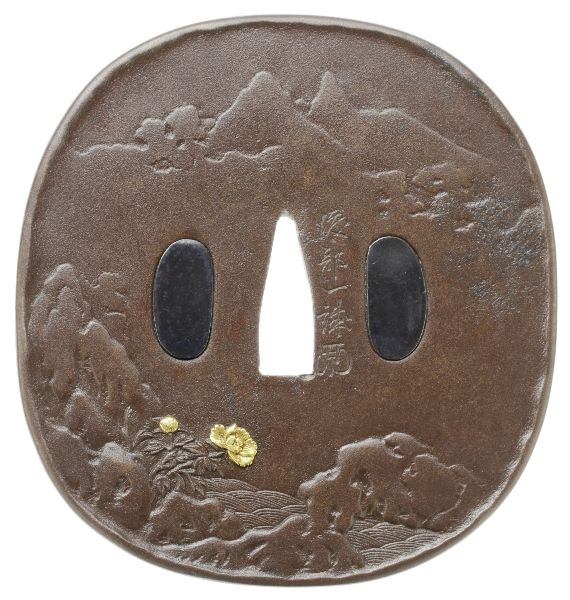
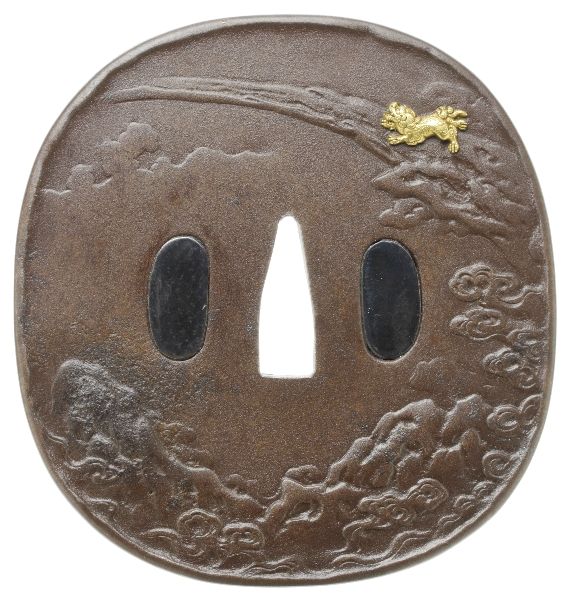
Machine translation from the shop's Japanese · may contain errors ·
A Hozon-certified fitting of notably superior craftsmanship and condition, often with signature or workmanship of high reference value.
The NBTHK (Nihon Bijutsu Tōken Hozon Kyōkai, the Society for the Preservation of Japanese Art Swords) is a public-interest incorporated foundation founded in 1948 and supervised by Japan’s Agency for Cultural Affairs (Bunkachō); it is based at the Japanese Sword Museum in Tokyo. Its expert panels physically examine each submitted work (shinsa) and issue a certificate (kanteishō) ranking it by artistic and historical merit. NBTHK papers are the most widely recognized standard of authentication for Japanese swords and fittings.
NBTHK official siteIf, due to our fault, the item differs significantly from its proper condition, the item may be returned. Cooling-off is within one week of the item's arrival.
¥450,000