Power sat in Kamakura, but taste was still made in Kyōto. The Awataguchi school’s pear-skin steel became a byword for perfection, and the Rai line supplied dignified tachi to the court, senior warriors, and the great temples alike.
 NihontoWatchNihontoWatch
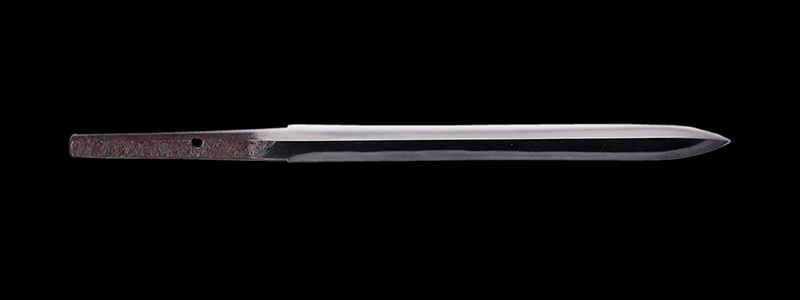
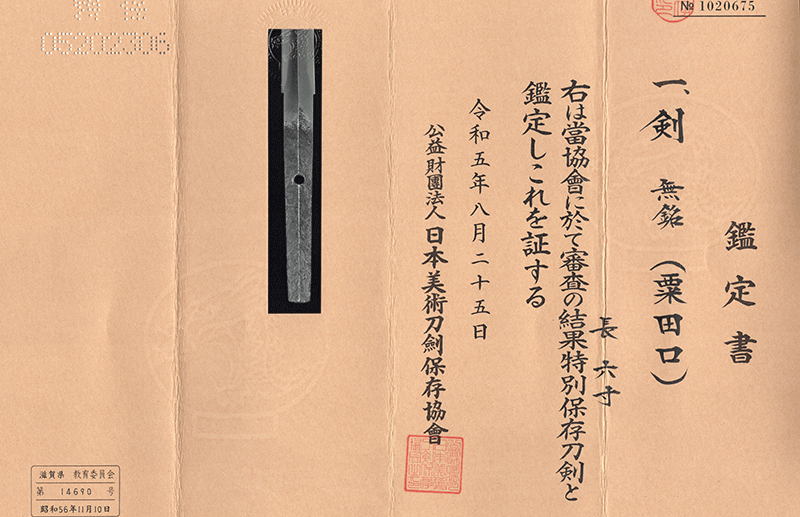
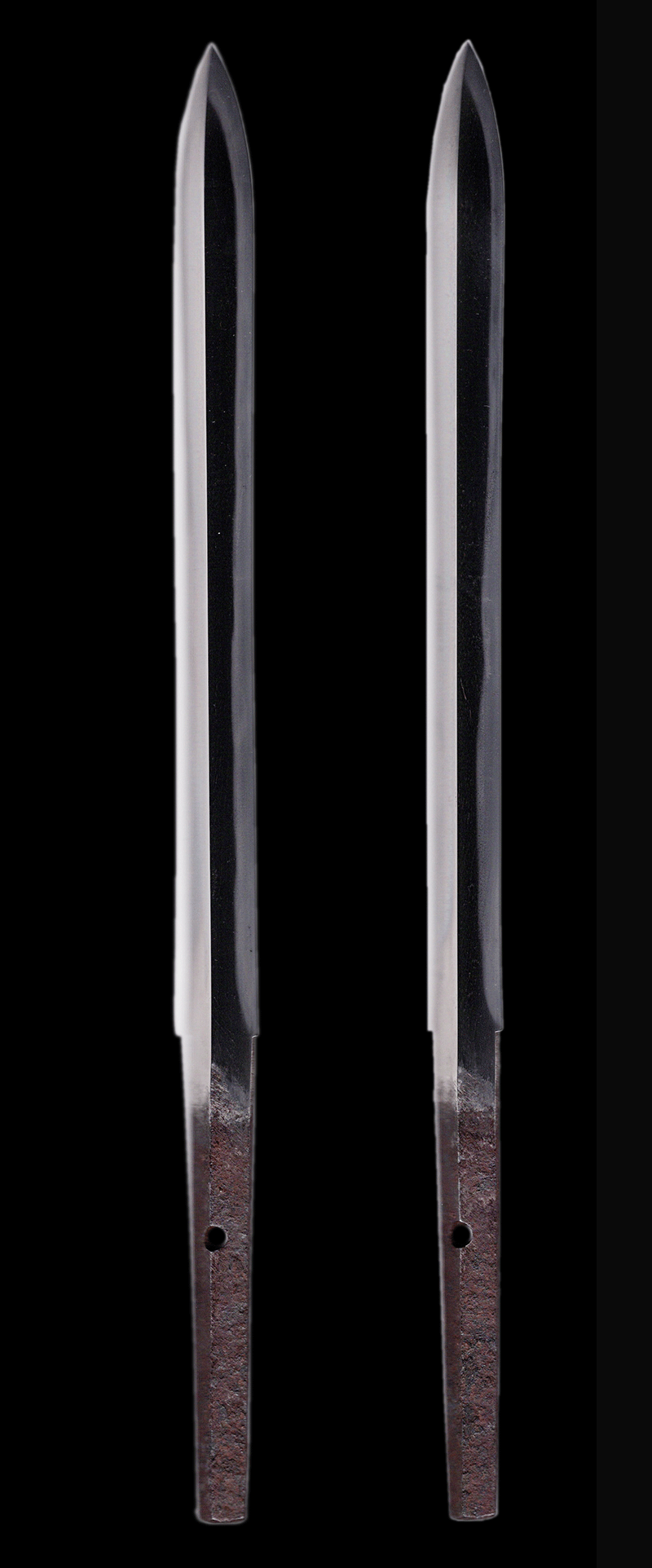
鎌倉時代に山城国で活躍し、史上随一の短刀の名手として名高い藤四郎吉光などを輩出した粟田口に極められた剣の特別保存刀剣指定作品。 粟田口一派は鎌倉時代に山城国で活躍し、国友を筆頭に6兄弟や国吉、吉光などが代表工として知られている。特に藤四郎吉光は新藤五国光と並んで短刀の名手として、江戸時代には正宗・江と共に「天下三作」と称され、三者の筆頭として挙げられ最も珍重された天下の名工である。数多くの作品が名物として大大名の所蔵するところとなり、4点が国の国宝に、9点が重要文化財に指定されている。 本作は粟田口極めの剣の作品である。粟田口物の剣では国吉とその子、または弟子と伝える吉光に作例が認められ、代表作としては国宝、白山吉光などが高名である。極めどころは日本美術刀剣保存協会の説明によると地鉄がよく詰んで潤いがあり、匂口が明るいなどの特徴を捉えてのことと説明されたが、本作の特筆すべき点はむしろ8mmという豊かな体配にあると思われ、過去に某神社の指定品や、重要文化財指定の光忠の剣などを拝見したが、特に光忠の作例に同様の非常に重ねの厚い、刃肉豊かについた名品を慧眼した。名品の持つ格調高さに非常に感動した記憶が鮮明に残されているが、本作も同作に繋がる優れた作域を示した優品である。
NihontoWatchOffered by Iida Koendo
This piece has sold
3 on the market
Get an email when new Awataguchi School work hits the market.

As written by the shop
Yamashiro-den · Yamashiro
3 pieces on the market now
The steel is the first thing one learns to read in Awataguchi work: a ko-itame kneaded so tight that the surface takes on the pear-skin sheen the texts name nashiji-hada, the ji-nie dusted over it fine and even, slender chikei threading through, the whole carrying a moist luster (潤い) and a clarity that recurs in notice after notice. This is the steel of the early Yamashiro tradition at its summit. The forge stood at the foot of the Awataguchi slope in Kyoto, on the highway running toward Omi, and a community of smiths already worked there by the early Kamakura period; the tale collection Uji Shui Monogatari attests their presence, so this is a house with a documented place in the literature of its own century. The school is conventionally founded on the six brothers, Kunitomo the eldest, then Hisakuni, Kuniyasu, Kunikiyo, Arikuni and Kunitsuna, sons of the founder Kunika (also given as Kuniie). Kunitomo, Hisakuni and Kuniyasu were summoned as goban-kaji to forge on rotation at the cloistered court of the Retired Emperor Go-Toba, and Hisakuni is even transmitted as a teacher to the sovereign; that imperial patronage is the reason a slender tachi with so quiet a temper carries the authority it does. What binds the house across four generations is restraint married to refinement. Over the nashiji-hada the brothers set a calm suguha leaning into a shallow notare, mixed with ko-midare, ko-gunome and ko-choji, the nioiguchi tight and bright, ko-ashi and yo entering, kinsuji and sunagashi running within the ha; the boshi turns in a refined ko-maru that very often sweeps with hakikake. This is the opposite pole from the clove-flower flamboyance of contemporary Bizen, an edge whose interest lies in the activity within rather than the height of the pattern. Within that shared vocabulary the members are told apart by habit. Kunitomo and Kuniyasu hold to the compressed ko-midare of the founding generation, their nioiguchi clouding into urumi; Kuniyasu's linked ko-gunome picks him out alone within the school.
Kunitsuna is the divergence, a robust o-itame standing prominently over thick ji-nie, with conspicuously strong ha-nie that leans toward the Sagami manner about to be born. The later course runs through Norikuni, the bridge generation, into the tanto age of Kuniyoshi and Yoshimitsu, where the temper settles into bright suguha in fine ko-nie. Kuniyoshi's tell is the nijuba, the doubled (at times trebled) line along the ha; Yoshimitsu's is the linear kuisagari dropping of nie into the ji beneath the boshi, his suguha a narrow hoso-suguha under a bright nioiguchi. For the collector the school divides into work that can be studied and work that can be owned. Its summit, Toshiro Yoshimitsu, crowns the close of the line; paired with Shintogo Kunimitsu of Sagami as a master of the tanto and a virtuoso of suguha, and ranked in the Edo period with Masamune and Go among the Three Great Works under Heaven, he is a smith met in the great collections rather than possessed, his signed tanto the standard against which every attribution is measured. His teacher Kuniyoshi, whose nashiji-hada the texts name outright, is by Awataguchi measure not wholly beyond reach, his o-suriage mumei katana anchored on the doubled line. The house also seeded the eastern tradition: Kunitsuna's transmitted descent runs on to Shintogo Kunimitsu, the de facto founder of Soshu, whose own refined nashiji steel passes for Awataguchi until the chikei and kinsuji betray it, and from whose quiet nie-laden suguha Yukimitsu, Masamune and Norishige drew the nie-midare of the mature tradition. The refined nie-suguha the brothers fixed was likewise the wellspring the Rai masters drew from, the two hands sitting so close in the eye that gold-inlaid Rai attributions appear on blades grouped with Hisakuni. To kantei an Awataguchi blade is to read the pear-skin steel first, then the quiet nie-laden suguha, then the swept boshi, and to know which brother or pupil the habits name; to acquire one, of any generation, is among the scarcest encounters early Yamashiro affords. Learn more →
| Smith | Era | Designated |
|---|---|---|
| Yoshimitsu吉光 | 1259-1260 | 49 |
| Kuniyoshi國吉 | 1275-1278 | 50 |
| Hisakuni久國 | 1190-1199 | 21 |
| Kunitsuna國綱 | 1240-1264 | 14 |
| Kuniyasu國安 | 1199-1201 | 23 |
Yamashiro in the Kamakura period
Power sat in Kamakura, but taste was still made in Kyōto. The Awataguchi school’s pear-skin steel became a byword for perfection, and the Rai line supplied dignified tachi to the court, senior warriors, and the great temples alike.
A Hozon-certified blade judged to show notably superior workmanship and a better state of preservation. The bar is higher: re-tempered blades and most unsigned Muromachi/Edo works are excluded.
The NBTHK (Nihon Bijutsu Tōken Hozon Kyōkai, the Society for the Preservation of Japanese Art Swords) is a public-interest incorporated foundation founded in 1948 and supervised by Japan’s Agency for Cultural Affairs (Bunkachō); it is based at the Japanese Sword Museum in Tokyo. Its expert panels physically examine each submitted work (shinsa) and issue a certificate (kanteishō) ranking it by artistic and historical merit. NBTHK papers are the most widely recognized standard of authentication for Japanese swords and fittings.
NBTHK official siteFor returns at the customer's convenience, please notify us within two days of the item's arrival. Items that have been altered cannot be accepted. Return shipping is at the customer's expense. Costs other than the item price (bank transfer fees, cash-on-delivery fees, etc.) cannot be refunded. Items delivered overseas cannot be returned or refunded.