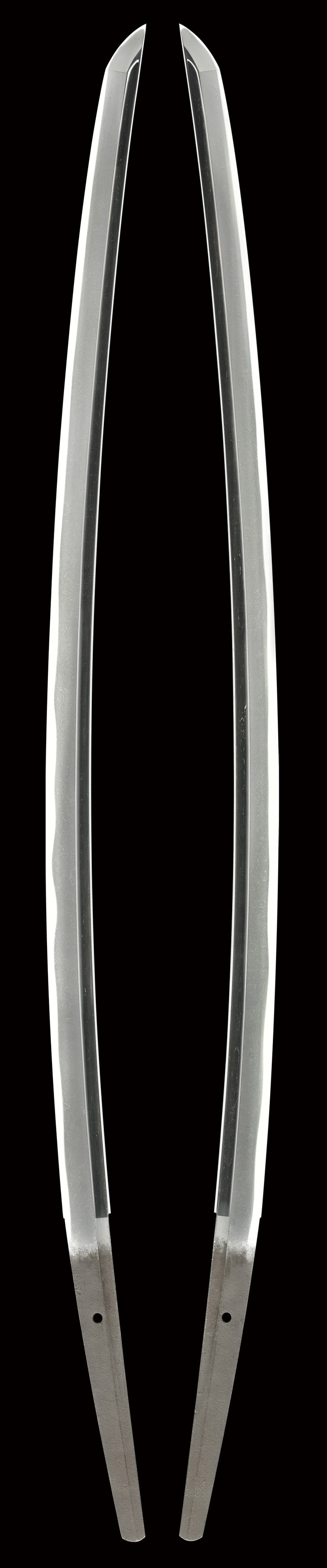
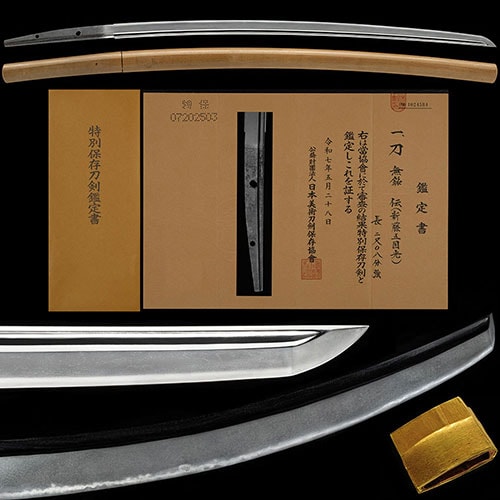
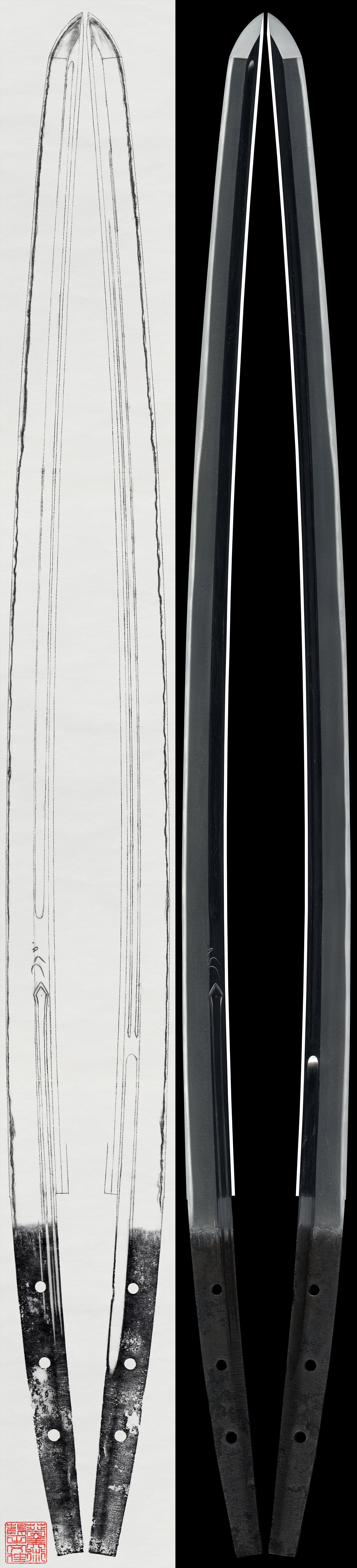
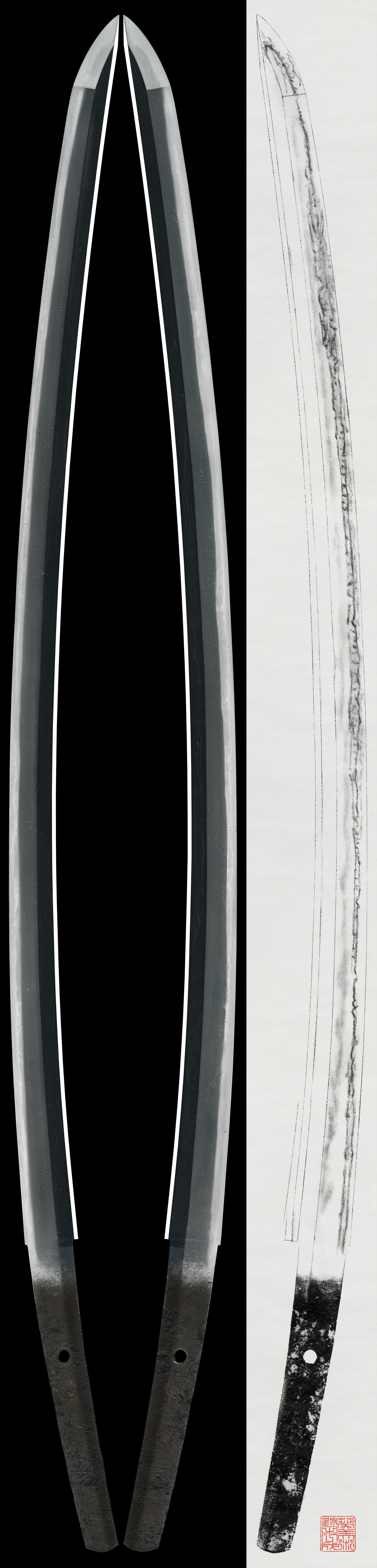
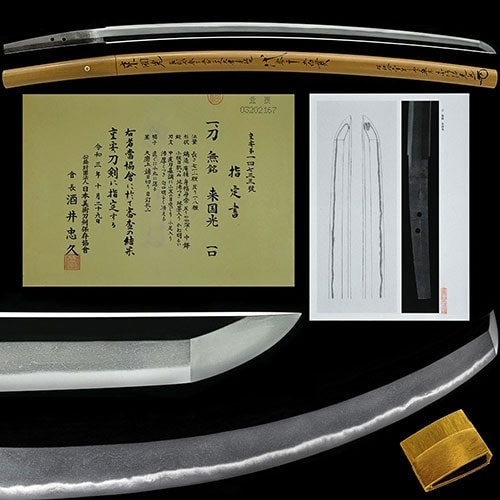
Kunitsuna worked in early Kyōto as the youngest of the six brothers, the eldest being Kunitomo, and he styled himself Tōroku Sakon. The published sources transmit that he later went down to , summoned by the Hōjō, and there, together with Kunimune and Sukezane of , became one of the smiths who opened the way for the tradition. They also concede how little of his hand survives: genuine signed works that can be accepted with confidence are recorded as extremely few, the celebrated Kunitsuna standing as the representative piece. He worked under the name 国綱, and a long survives signed in full 鎌倉住藤六左近国綱 and dated 建長五年八月日, the only dated trace of the years.
The published sources draw a sharp line between him and the rest of the school. work is generally an earnest, classical elegance, but his shape, his forging and his temper are called distinctive: a with high that does not droop toward the tip, a forging in which the stands large and prominent over thickly laid , and a wide, varied temper in which the is conspicuously strong. The way both and are vigorously animated, the sources say, is precisely the hallmark of his art. This is the recognition core: where his brothers refine, Kunitsuna pushes the forward, and the steel leans toward the bold manner that was about to be born.
Over that runs a base in shallow , mixed with , and , with thick and , the deep and the interior of the thickly covered in ; run frequently, hangs, and in places the shows with and . The is the tight steel carried thick with and , often standing into , with a rising from the togidame that connects into a -like , an aspect the sources note as often seen in his work. The is where the older profile had to be corrected: it is not simply a calm . On the it runs straight into a with a slight and the point sweeps a little , and on the it sweeps straight in toward a tendency; elsewhere it enters with a pointed turn. That swept, -broken point is as much his tell as the standing grain.
The published sources are explicit that he has two faces. There are pieces in the orthodox manner, and there are works of a different cast, robust in form with a standing . The belongs to the second, robust group; many of the surviving signed belong to the first, where the forging tightens to a finer , the temper a calmer base, the whole quieter and more obviously of the court tradition. For the eye the two faces share the engine: the conspicuous , the busy and , the , and the swept . The subdued, sunken on the quieter parts him from bright ; the openly strong and the standing grain part him from the orthodox of his brothers.
The is the heart of his fame and the reason a smith of so few blades is known to every collector. Its later transmission reads as a history of power, passing through the great houses and into the Imperial collection, where it survives as an Imperial heirloom and one of the Five Great Swords, shown to almost no one. The published record names, beside it, a once held by the Viscount Nishitakatsuji family and an Important Art Object once owned by the Aizu Matsudaira house, and counts among the Important Cultural Properties attributed to him the preserved at Hie Shrine. The and kinpun attributions on several of the shortened , cut by Kōson and his line, show how seriously the house took a Kunitsuna ascription.
For the collector this is among the rarest of the names. Fujishiro grades him Sai-jō , and his finest signed work descends through houses of the first rank: the Tosa Yamanouchi family held one , and the Sendai Date family received another from Konoe Motohiro and kept it as a treasured heirloom. A handful fall in the and tiers, with a small body of Important Cultural Properties, while the masterpiece itself can never leave the Imperial collection. A signed Kunitsuna in private hands is therefore one of the scarcest things a student of the early sword can hope to meet, and the very scarcity is part of why his descent, by tradition the bridge that ran on to Kunimitsu and the line, carries the weight that it does.