Shinto, Tosa. Early Edo. Wazamono.
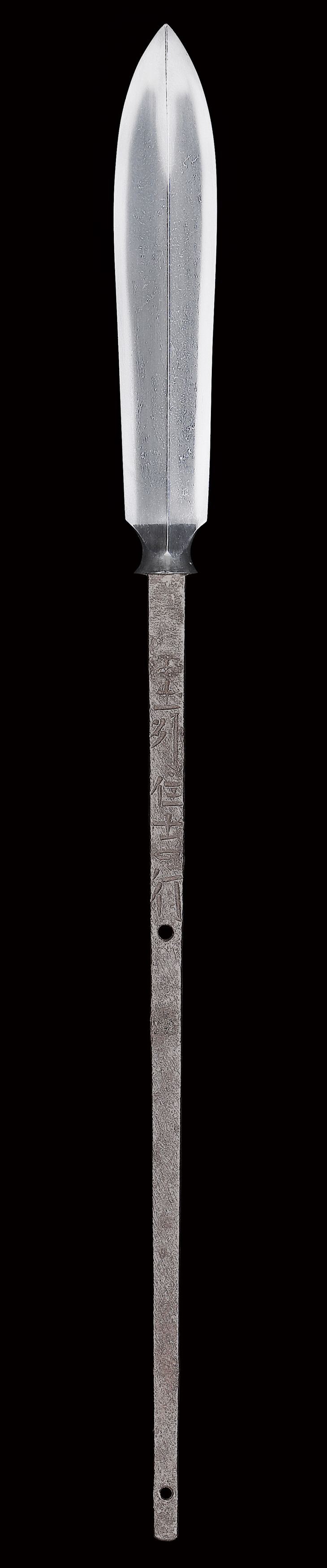
Ryoshinogi-zukuri, marukubi. Kitae: itame-hada, somewhat sunken, flowing and standing out in places, ji-nie attaches well, jitetsu is good. Hamon: suguha style, habuchi has ko-nie and is somewhat sunken and tight, fine hotsure and nijuba appear. Boshi: suguha style, the tip has slight hakikake and a long kaeri. Nakago is ubu, tip is kurijiri, yasurime is kiri. Period polish. In shirasaya.
Yoshiyuki was born in Mutsu no Kuni Soma Nakamura (present-day Soma City, Nakamura, Fukushima Prefecture), was named Morishita Heisuke, and was the second son of Harima no Kami Yoshinari; his older brother was Ueno no Kami Yoshikuni. Later, he moved to Osaka Sumiyoshi with his father and brother and entered the school of Mishina Yamato no Kami Yoshimichi. He first received the title "Mutsu no Daijo" and later "Mutsu no Kami," was adopted into the Yamaoka family, and changed his name to Yamaoka Heisuke. Around Genroku, he was invited as a smith for the Tosa Kochi Han and moved to Tanezaki-cho, east of Kochi Castle; he served the fourth Daimyo Yamauchi Toyomasa and, after being very active as a domain smith, it is said he finally returned to Osaka and passed away.
His active period was from Kanbun to Genroku; his style specialized in the gunome choji of his master's style, and like his master, there are cases where he mixed in the kobushigata choji of the Kawachi no Kami Kunisuke style; he also produced suguha and, in his early period, sudareba styles.
Mei are signed as "Yoshiyuki," "Mutsu no Daijo Yoshiyuki," "Mutsu no Kami Yoshiyuki," "Sesshu Ju Yoshiyuki," "Doshu Ju Yoshiyuki," and so on.
This work is a yari by Yoshiyuki, ryoshinogi-zukuri, dimensions slightly under 3 sun 8 bu; the suguha style blade has a habuchi with ko-nie that is somewhat sunken and tight, with fine hotsure and nijuba appearing.
Although it is a somewhat small size, the habuchi has fine hataraki, there are no major kizu, and it is in a shirasaya with a kuchigane attached to the koiguchi part.
Mutsu no Kami Yoshiyuki, whose sharpness that famous Sakamoto Ryoma fell in love with, has become increasingly popular in recent years, but authentic works rarely appear, so do not miss it.
Signed (100% of this smith's designated works are signed)
Measurements
Nagasa11.4cmMotohaba2.21cm
Details from Samurai Nippon
Stock no.
Q-551
Mei
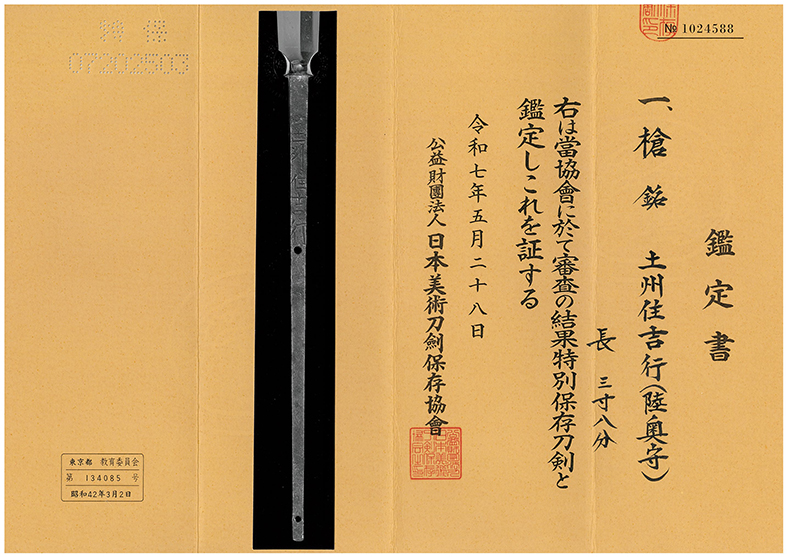
土州住吉行(陸奥守)
Nakago
20.7
Sori
なし
穴
2(内1忍)
As written by the shop
Description from Samurai Nippon
Machine translation from the shop's Japanese · may contain errors ·
Shinto, Tosa. Early Edo. Wazamono.
Ryoshinogi-zukuri, marukubi. Kitae: itame-hada, somewhat sunken, flowing and standing out in places, ji-nie attaches well, jitetsu is good. Hamon: suguha style, habuchi has ko-nie and is somewhat sunken and tight, fine hotsure and nijuba appear. Boshi: suguha style, the tip has slight hakikake and a long kaeri. Nakago is ubu, tip is kurijiri, yasurime is kiri. Period polish. In shirasaya.
Yoshiyuki was born in Mutsu no Kuni Soma Nakamura (present-day Soma City, Nakamura, Fukushima Prefecture), was named Morishita Heisuke, and was the second son of Harima no Kami Yoshinari; his older brother was Ueno no Kami Yoshikuni. Later, he moved to Osaka Sumiyoshi with his father and brother and entered the school of Mishina Yamato no Kami Yoshimichi. He first received the title "Mutsu no Daijo" and later "Mutsu no Kami," was adopted into the Yamaoka family, and changed his name to Yamaoka Heisuke. Around Genroku, he was invited as a smith for the Tosa Kochi Han and moved to Tanezaki-cho, east of Kochi Castle; he served the fourth Daimyo Yamauchi Toyomasa and, after being very active as a domain smith, it is said he finally returned to Osaka and passed away.
His active period was from Kanbun to Genroku; his style specialized in the gunome choji of his master's style, and like his master, there are cases where he mixed in the kobushigata choji of the Kawachi no Kami Kunisuke style; he also produced suguha and, in his early period, sudareba styles.
Mei are signed as "Yoshiyuki," "Mutsu no Daijo Yoshiyuki," "Mutsu no Kami Yoshiyuki," "Sesshu Ju Yoshiyuki," "Doshu Ju Yoshiyuki," and so on.
This work is a yari by Yoshiyuki, ryoshinogi-zukuri, dimensions slightly under 3 sun 8 bu; the suguha style blade has a habuchi with ko-nie that is somewhat sunken and tight, with fine hotsure and nijuba appearing.
Although it is a somewhat small size, the habuchi has fine hataraki, there are no major kizu, and it is in a shirasaya with a kuchigane attached to the koiguchi part.
Mutsu no Kami Yoshiyuki, whose sharpness that famous Sakamoto Ryoma fell in love with, has become increasingly popular in recent years, but authentic works rarely appear, so do not miss it.
About the maker
Yoshiyuki
吉行
Tosa · around 1661-1673
Tōken Taikan top 60%
2 pieces on the market now
›
Historical importance
Where Yoshiyuki stands among comparable artisans: across all of nihontō, and within tradition, era, and period. The tiers (Foremost · Leading · Major · Notable) weigh official designations from the NBTHK and Japan's Agency for Cultural Affairs, together with historical honors of lasting repute such as the Sansaku and Meibutsu-chō.
For two and a half centuries of peace the sword was the warrior’s legal badge rather than his weapon. Each great city developed its own manner, Edo’s tested strength against Ōsaka’s polished brilliance, until demand thinned in the era’s last decades.
A Hozon-certified blade judged to show notably superior workmanship and a better state of preservation. The bar is higher: re-tempered blades and most unsigned Muromachi/Edo works are excluded.
About the NBTHK›
The NBTHK (Nihon Bijutsu Tōken Hozon Kyōkai, the Society for the Preservation of Japanese Art Swords) is a public-interest incorporated foundation founded in 1948 and supervised by Japan’s Agency for Cultural Affairs (Bunkachō); it is based at the Japanese Sword Museum in Tokyo. Its expert panels physically examine each submitted work (shinsa) and issue a certificate (kanteishō) ranking it by artistic and historical merit. NBTHK papers are the most widely recognized standard of authentication for Japanese swords and fittings.
For one-of-a-kind items such as swords, sword fittings and antiques, other customers may be waiting for the item, so please contact us about a return within 3 days of its arrival and ship it back within 8 days. Refunds are made on the day the returned item arrives.
 NihontoWatch