Mino was founded, tradition holds, by immigrants: Kaneuji of the Yamato Tegai line settled at Shizu to work in the new Sōshū manner, so persuasively that later appraisers judged his best blades the closest of any to Masamune.
 NihontoWatchNihontoWatch
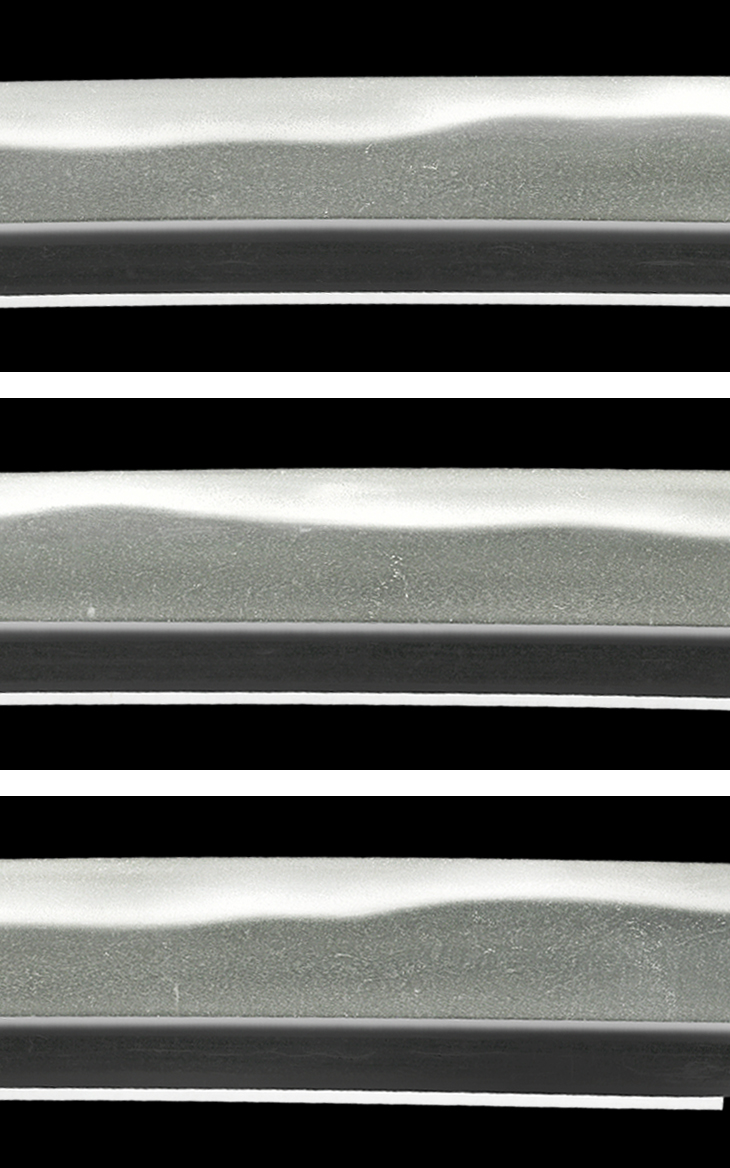
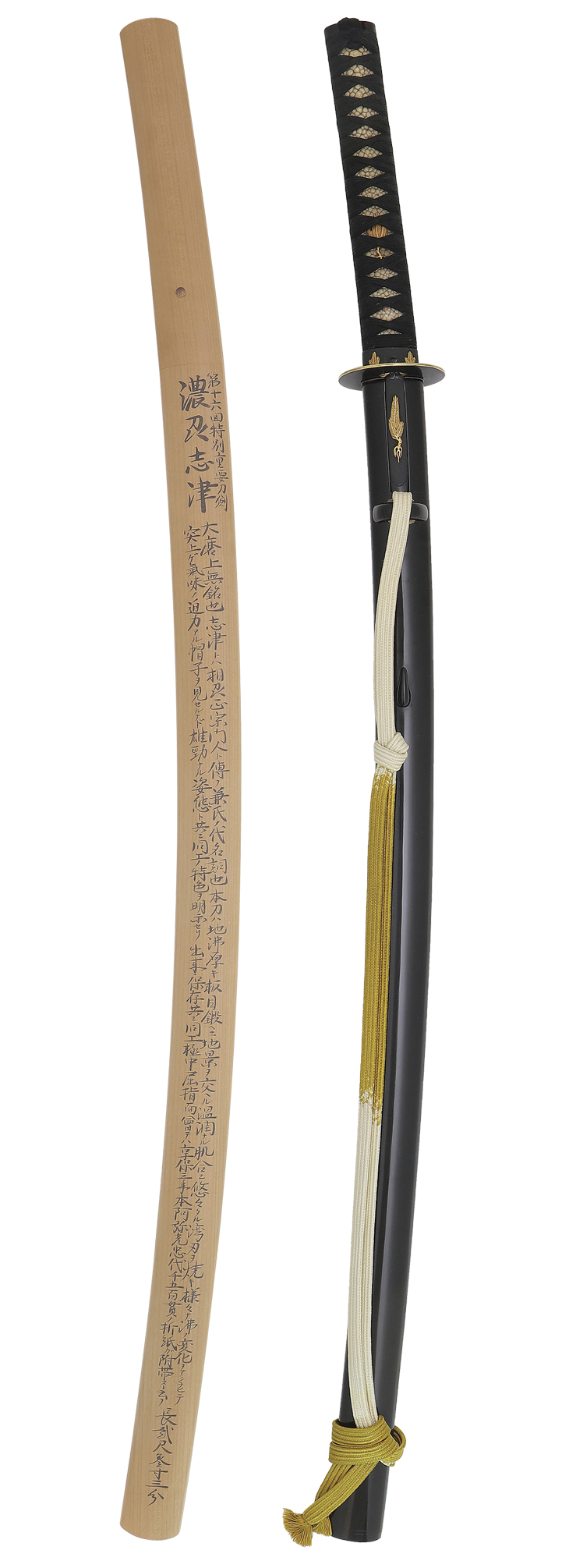
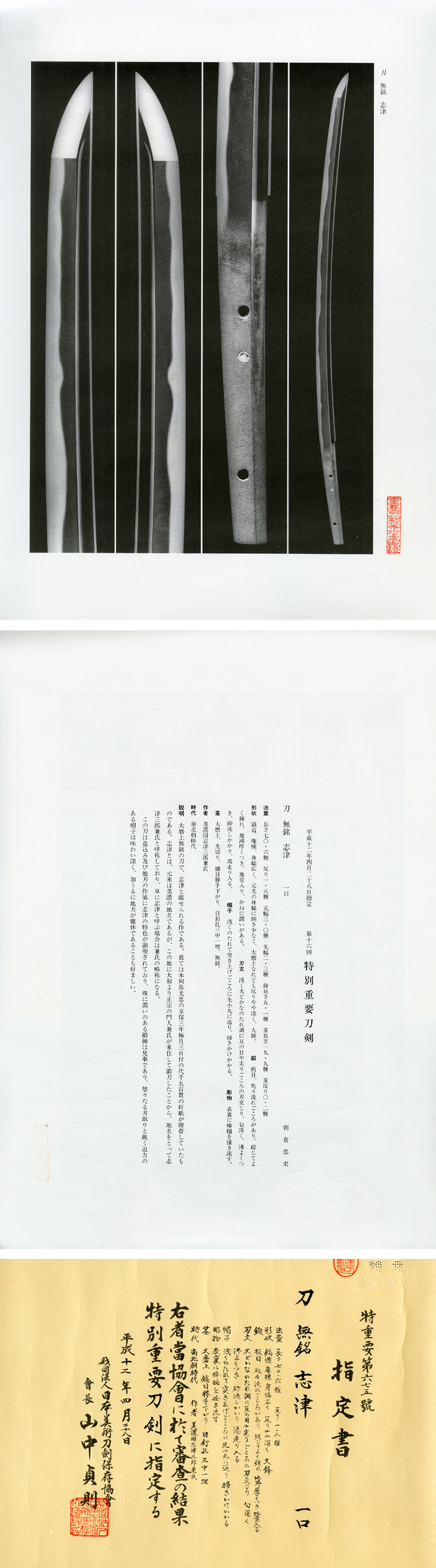
古刀・美濃 南北朝期 最上作 拵え付き 探山先生鞘書き有り 鎬造り、鎬高め庵棟低め、大切っ先でやや鋭角となる。 表裏共に棒樋を茎途中で掻き流す。 鍛え、板目、杢目、流れ肌を交えて良く錬られ、鉄に潤いがあり、地沸厚く付き、地景繁く入り、地鉄精良。 刃文、湾れ調で互の目、小互の目、尖り風の刃を交え、刃縁良く沸付いて匂い深く明るく冴え、筋状の湯走り掛かり、刃中互の目足、小足、葉入り、金筋、砂流し掛かる。 帽子、湾れ込んで沸付き、先突き上げて尖り心に掃きかけ返る。 茎大磨り上げ、先切り、鑢勝手下がり。 銅に金着せ二重ハバキ。 時代最上研磨。 白鞘入り。 上打ち刀拵え(全長98 柄23.5 江戸期 鞘 黒の呂鞘 小柄笄、銘:吉岡因幡介 赤銅魚子地高彫金色絵、根引き松図 下げ緒、卯の花に辛子色 柄 親鮫に黒柄巻き 縁、赤銅魚子地高彫金色絵 頭、角黒塗り 目貫、金無垢地容彫、根引き松図 鍔 赤銅研磨地無文、金覆輪 櫃穴縁金覆輪)付き。 志津兼氏の特別重要刀剣、『正宗十哲』、美濃鍛冶の最高峰、正宗に迫る沸の変化を存分に示した同工出色の出来映え、嘗ては、享保三年本阿弥光忠の代千五百貫の折紙付き、非の打ち所がない志津です。 志津三郎兼氏は、元来大和国手掻派出身で、大和在住時は、『包氏』と銘したが、後に美濃国志津(現岐阜県海津市南濃町志津)の地へ移住した際に『兼氏』に改銘したと伝えられます。また志津は、前述したように、元来は美濃の地名ですが、無銘極めで単に志津と呼ぶ場合は、兼氏の略称になります。 兼氏の師伝に付いては、古来より相州正宗門として、『正宗十哲』の一人に数えられており、現存品の作風からすると、十哲の中で最も正宗の影響を受けていることが分かります。 正宗との相違点は、鍛えに板目が流れるなどの柾心がある点、互の目が連れる刃、尖り風の刃が交じる点、帽子に丸みがあって、先が大丸風で返りが短く、時には先が焼き詰め風となる点などが挙げられます。 御物一口、重要文化財四口、重要美術品三口を数えますが、在銘確実な作は僅か数振りで、御物である『浮田志津』、重要文化財『稲葉志津』は、生ぶ無銘の短刀、重要文化財で徳川家康の指し料であった『分部志津』も、大磨り上げ無銘であるように、志津と言えば、大半が無銘極めとなります。 本作は、大磨り上げ無銘ながら、『志津』と極められた名品中の名品、昭和三十六年(一九六一)、第六回の重要刀剣で、平成十二年(二〇〇〇)、第十六回の特別重要刀剣指定品です。 特別重要刀剣とは、日刀保の審査基準によると、『重要刀剣の中で、更に一段と出来が傑出し、保存状態が優れ、国認定の重要美術品の上位に相当すると判断されるもの、若しくは国指定の重要文化財に相当する価値があると考えられるもの。』としています。 審査は二年に一度、令和八年までで、二十九回の審査が行われましたが、合格率は概ね10%程度、但しこの数字は、毎回10%は合格するという意味ではなく、厳しい年では、6~7%の場合もあります。とにかくどれも狭き門を潜り抜けた選ばれし名刀です。 本作は、寸法二尺三寸三分、大切っ先やや鋭角となり、元先身幅、重ねのがっしりとした堂々たるスタイルで、地刃共に無類の健全さを誇る素晴らしい状態です。 板目、杢目、流れ肌を交えて良く錬られた精良な地鉄は潤いがあり、湾れ調の刃は、互の目、小互の目、尖り風の刃を交え、刃縁良く沸付いて匂い深く明るく冴え、筋状の湯走り掛かり、刃中互の目足、小足、葉入り、金筋、砂流しが掛かっています。帽子も湾れ込んで沸付き、先突き上げて尖り心に掃きかけ返るなど、普段の志津と言うより、正宗風を意識した出来と言えるでしょう。 探山先生鞘書きには、『焼きに様々な沸の変化をあしらい、迫力のある帽子、雄勁(堂々として力強いこと)なる姿態は、同工の特色を明示している。出来、保存状態共に同工極め中の屈指也。かつては、享保三年本阿弥光忠の代千五百貫の折紙が附帯と伝う。帽子など、沸の変化の妙を現し、正宗に触発されたる同工の特色を明示する優品也。』とあり、図譜には、『この刀は、造り込み及び地刃の作風に志津の特色が顕現されており、殊に潤いのある鍛錬は見事であり、悠々たる刃取りと鋭く迫力のある帽子は味わい深く、加うるに地刃が健体であることも好ましい。』とあります。 鑑定が厳格で代付けも厳しいため、最高権威と呼ばれる本阿弥本家十三代光忠の極め、且つ千五百貫という破格の代付けからも分かるように、本作は、前述した重要文化財名物『稲葉志津』や『分部志津』に比肩するものと考えて良いでしょう。 また付属の外装も大変素晴らしい江戸期の作、赤銅魚子地の小柄笄は、吉岡因幡介在銘品、その他の金具類も赤銅でピシッと揃えてあり、目貫は金無垢です。 一度ご覧頂ければ分かります。これは物凄い志津、姿も格好良い、非の打ち所がないとはこのこと、近年稀にみる名刀の登場です。
NihontoWatchOffered by Samurai Nippon
This piece has sold
16 on the market
Get an email when a new Shizu Kaneuji piece hits the market.

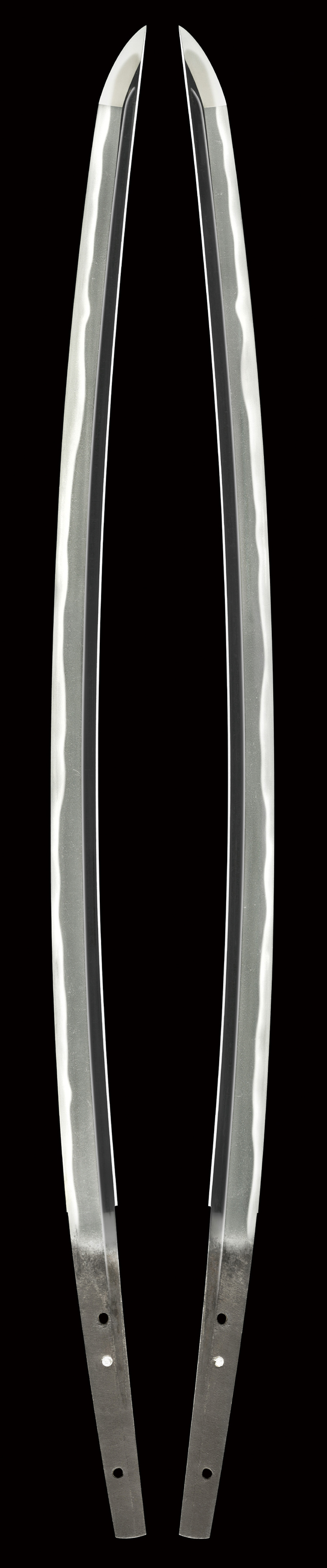
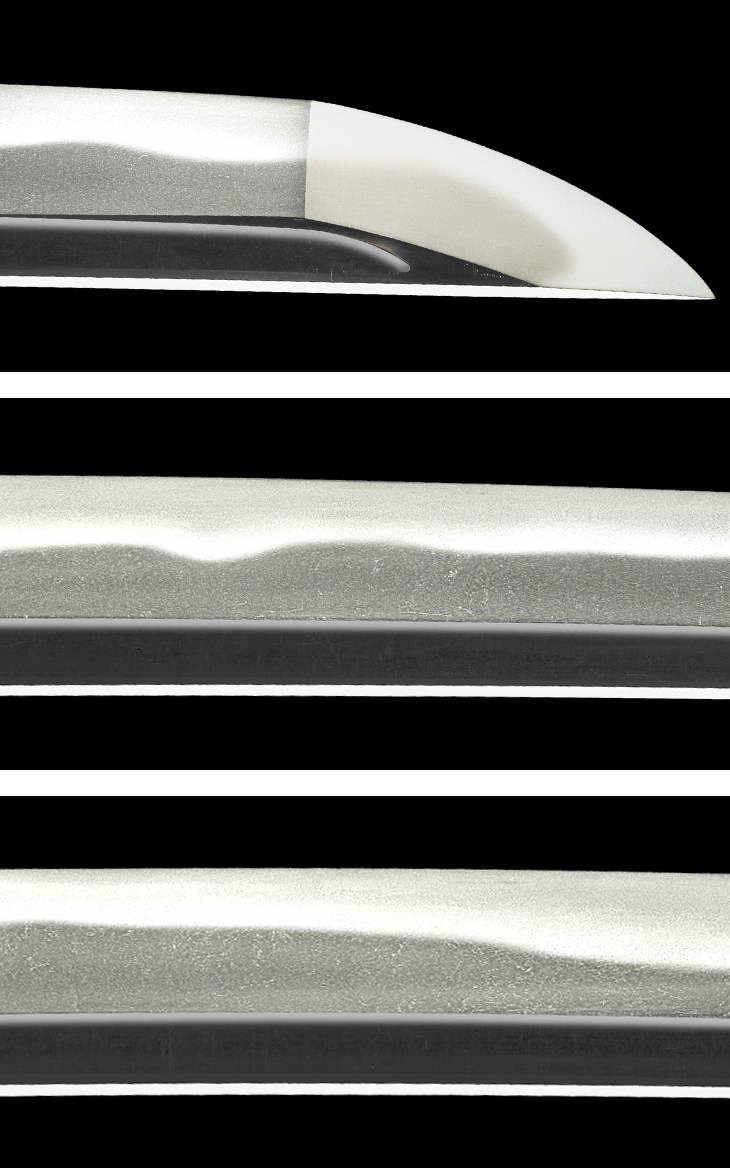
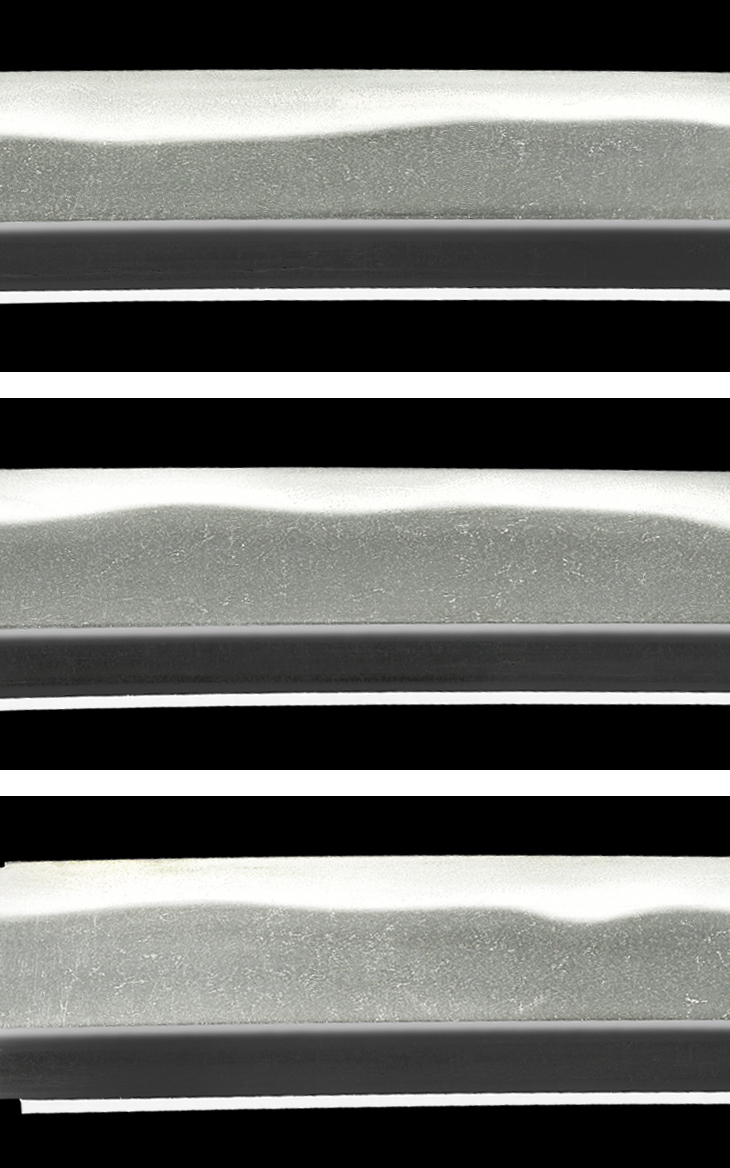
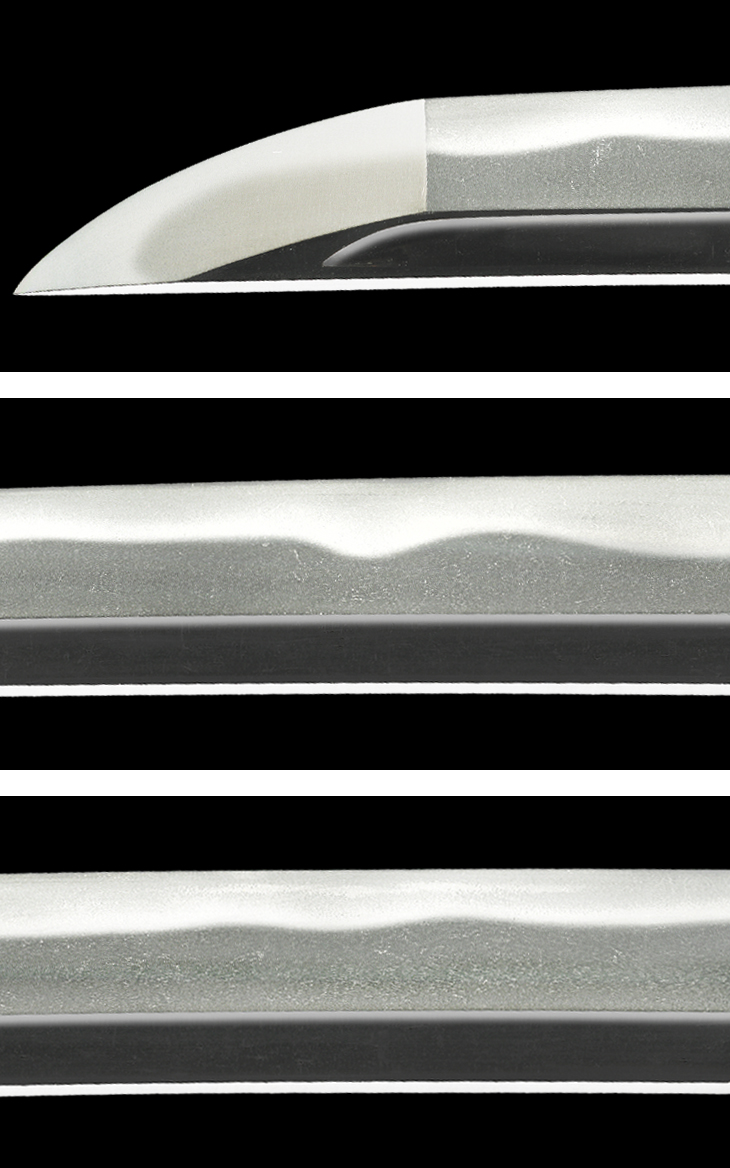
As written by the shop
Shizu (Mino) · Mino · around 1319-1321
Fujishiro Sai-jo saku · Tōken Taikan top 2%
Shizu is in origin a place name in Mino: because Masamune's pupil Kaneuji came to live and forge there, the name passed from village to man, and in the appraisal tradition a blade attributed simply Shizu means Kaneuji[[c:1]]. He began in Yamato as a Tegai smith signing 包氏, entered the gate of Soshu Masamune, and at Shizu changed the writing to 兼氏. Counted from old among the Masamune Juttetsu, he is, in the sentence his designation texts repeat, the one whose manner stands closest to Masamune[[c:2]]. No dated work survives; the sources fix his period from the Kanno 1 (1350) date of his reputed pupil Kanetsugu, the very end of Kamakura into early Nanbokucho. One gold-inlaid katana goes further: in settling there he created the foundation of the Mino smiths[[c:3]].
The kantei against the master is stated in one clause: what differs from Masamune is that masame mixes into the kitae and the gunome run linked within the ha[[c:4]]. His itame flows and leans toward masame far more often than in Masamune, Sadamune, Norishige or Yukimitsu, the Tegai hand surviving inside finished Soshu work. The pointed teeth are a second tell, togari-ba mixing into his gunome across much of the corpus where on the Soshu homeland smiths they are an occasional accident. Where Masamune's midare never shows the same form twice, Kaneuji lets two or three gunome of one shape run linked in series, and the texts call the linked ko-gunome his habit of hand[[c:5]]. The boshi sweeps with hakikake and turns back gently round, the calm round return named among his traits.
The manner itself is grand Nanbokucho work. The katana run wide with little taper, shallow in sori, the kissaki extended or grown to o-kissaki. The jigane is itame mixed with mokume and flowing hada, the ji-nie thick, minute on the finest pieces, with fine chikei entering incessantly. Over it he tempers a notare base with gunome, ko-gunome and togari-ba, the nioiguchi deep, the nie thick and bright with rough nie in places; kinsuji, sunagashi, yubashiri and tobiyaki work through ha and ji, and the boshi runs midare-komi or notare into ko-maru or o-maru with hakikake. Yamato shows through this Soshu surface at the edge, in hotsure, kuichigai-ba, nijuba and uchinoke. The first Tokubetsu Juyo text settled a first-glance Soshu masterpiece on exactly these points, reading the flowing itame, pointed gunome and swept, yakizume-like boshi as a Yamato air[[c:6]]; another finds the Yamato temperament[[c:7]] in the masa-leaning kitae and shallow return; a recurring formula resolves the whole: Yamato-den with Soshu-den added[[c:8]].
Signed works are exceedingly rare, the record repeating it in nearly the same words across decades[[c:9]]: eight signed records stand against one hundred thirty-six titled mumei, the kiwame sustained by gold-inlaid and red-lacquer attribution inscriptions and by Hon'ami origami: the Edo kinzogan of Sugawara Naganori, a Hon'ami Kochu origami of Kyoho 3 (1718) at 1,500 kan, the tanto whose gold-inlaid name Hanagatami is attributed to Hon'ami Koetsu. The rare signed pieces form a register of their own, maru-mune tachi, some carved with futasuji-hi whose tips sit slightly low, and ubu tanto with uchizori, short for their era; the sources turn the point into a trait: builds that never become especially long are rather characteristic of Kaneuji. Within the mumei corpus two poles stand apart. At the bold extreme the yaki rises and falls strongly, tobiyaki and long yubashiri scatter, and the boshi fills with fire: one Tokubetsu Juyo katana is called a blade of particular daring among Shizu attributions[[c:10]]; another, of Enbun-Joji build with a flame-form boshi burning down the mune, is named the very finest of the smith's attributions[[c:11]]; a third, gold-inlaid, is so daring that the text takes the Kaneuji kinzogan as confirmed by the work itself. At the calm extreme the temper sits low and even, a shallow notare with ko-gunome; one signed Jubi tachi in suguha-cho stands apart even from his other signed blades. At least two Kaneuji are thought to have worked in Nanbokucho; Honma records that on the whole the large mei belong to the first generation, the small to the second and after, the first generation's signature angular and large in its cutting[[c:12]].
The appraisal tradition keeps a lattice of distinct targets around him. A Shizu attribution in the broad sense, the so-called O-Shizu, can reach past the first Kaneuji to the second and third generations and the direct pupils; blades of the direct line are marked as not descending to what is called Naoe Shizu[[c:13]]. Naoe Shizu is the school after the move to Naoe in the same province, its jigane showing, against the master's, the feeling of less ji-nie with chikei growing fewer[[c:14]]; one katana published at Juyo session 15 as Naoe Shizu was raised at Tokubetsu Juyo session 7 as den Shizu. The boundary runs upward as well. The katana that opened his Tokubetsu Juyo record had carried a Hon'ami Koyu origami to Sadamune and a sayagaki to Masamune; the NBTHK settled it as Shizu on the flowing itame, pointed gunome and swept boshi, calling it the finest deki among Shizu works[[c:15]]. What he founded ran forward: the Mino tradition the sources credit him with beginning, and, two and a half centuries on, the Keicho revival of Soshu-den that Horikawa Kunihiro built above all on the model of Shizu.
Fujishiro rates him Sai-jo saku. He has no National Treasures; six blades are Important Cultural Properties, patrimony outside the market, among them three signed tachi and the meibutsu Inaba Shizu, the tanto his texts cite as the yardstick for his short blades. Nine works are prewar Juyo Bijutsuhin; nineteen Tokubetsu Juyo and one hundred twenty-seven Juyo make one hundred forty-six blades in those two tiers, of one hundred sixty-one designated works on record. Thirty-two blades carry recorded provenance, a roll running through Tokugawa Ieyasu and Hidetada, Maeda Toshitsune, Kuroda Nagamasa, the Date, Satake Yoshinobu, the Hosokawa marquis house, the Naito of Nobeoka, the Owari Tokugawa and the Choshu Mori; the Kuroda Shizu, a Tokubetsu Juyo blade, carries the sayagaki of Hirai Chiba. One tanto, given by Ii Naomasa to Kimata Seizaburo Morikatsu after the Wakamiko standoff with the Hojo in Tensho 10 (1582), descended in the Kimata, first house of elders of the Hikone Ii. Of recorded whereabouts today, holders include Futarasan Jinja, the Tokugawa Art Museum and the Sano Art Museum. What a private collector may realistically encounter is the Tokubetsu Juyo and Juyo tier; those blades are held closely, and one comes to market only rarely. When it does, the nakago is almost always bare, the attribution reading simply Shizu, in this tradition the name of one man.
Where Kaneuji stands among comparable artisans: across all of nihontō, and within tradition, era, and period. The tiers (Foremost · Leading · Major · Notable) weigh official designations from the NBTHK and Japan's Agency for Cultural Affairs, together with historical honors of lasting repute such as the Sansaku and Meibutsu-chō.
Select a lens to see how it's measured.
Mino-den · Mino
16 pieces on the market now
The Shizu tradition originated in Mino Province during the late Kamakura period when Kaneuji—originally of the Yamato Tegai school—relocated from his studies under Masamune of Sagami to the village of Shizu in Tagai District. Taking the place-name as his appellation, he became known as Shizu Saburō Kaneuji, and established a lineage that would become one of the most celebrated branches among the so-called Masamune Jittetsu (Ten Great Disciples of Masamune). While Kaneuji himself is often considered the paramount master of this group, the designation "Shizu" came to be applied broadly to unsigned works displaying the characteristic manner of this school, encompassing not only Kaneuji but also his contemporaries and successors working within the same stylistic orbit. A related category, Yamato Shizu, refers either to Kaneuji's early production before settling in Mino—when his work retained stronger Yamato Tegai characteristics—or to smiths of the Kanetsugu lineage who remained in Yamato rather than migrating to Mino. The collective hallmarks of Shizu workmanship reveal a distinctive synthesis of Sōshū-den brilliance and Yamato structural sensibilities. The forging typically displays flowing itame-hada mixed with mokume, frequently tending toward hada-dachi (standing grain), with areas where masame inclinations appear along the edge. A defining feature is the dense application of fine ji-nie, often described as thickly adhering, accompanied by abundant chikei that enter repeatedly to produce a notably clear and bright appearance. The hamon favors shallow notare as a foundation, mixed with gunome, ko-gunome, and pointed elements (togariba), forming compositions that range from gentle undulations to boldly disturbed patterns.
The temper is richly nie-based, with vigorous sunagashi streaming through the pattern, frequent kinsuji, and in many examples a temper built on notare (notare-ba). Characteristic activities include hotsure along the habuchi, occasional nijūba (double-temper) effects that recall Yamato influence, and in some works the presence of linked gunome sequences. The bōshi commonly enters in midare-komi or notare-komi, turning back with pointed or rounded forms, and frequently displays hakikake at the tip. Among the upper tier of Sōshū-den productions, works attributed to the Shizu lineage are particularly valued for the way their gleaming ha-nie activities create patterns that are both vigorous and refined. The thick ji-nie and prominent chikei in the forging, combined with the bright, clear nioiguchi in the temper, result in blades that are described as saeru—possessing a luminous clarity that distinguishes superior examples. While the style stands closest to Masamune among his disciples, the Shizu manner retains its own individuality: the blending of Yamato characteristics into the Sōshū tradition produces a distinctive temperament in both ji and ha that connoisseurs recognize at a glance. Many extant examples survive only as greatly shortened (ō-suriage) and unsigned (mumei) blades, yet the workmanship in such pieces typically remains sound and well-preserved (kenzen), testifying to the fundamental excellence of forging and tempering that defines this celebrated school. Learn more →
| Smith | Era | Designated |
|---|---|---|
| Kaneuji兼氏 | 1319-1321 | 161 |
| Naoshizu直鎭 | 1532-1555 | 0 |
Mino in the Nanbokuchō period
Mino was founded, tradition holds, by immigrants: Kaneuji of the Yamato Tegai line settled at Shizu to work in the new Sōshū manner, so persuasively that later appraisers judged his best blades the closest of any to Masamune.
The NBTHK’s highest grade, reserved for the rare Jūyō blades of exceptional artistry, condition, and historical value, judged on par with a nationally designated Important Cultural Property (Jūyō Bunkazai).
Only 1,211 swords have ever reached Tokubetsu Jūyō, about 1 in 2,064 registered blades.
The NBTHK (Nihon Bijutsu Tōken Hozon Kyōkai, the Society for the Preservation of Japanese Art Swords) is a public-interest incorporated foundation founded in 1948 and supervised by Japan’s Agency for Cultural Affairs (Bunkachō); it is based at the Japanese Sword Museum in Tokyo. Its expert panels physically examine each submitted work (shinsa) and issue a certificate (kanteishō) ranking it by artistic and historical merit. NBTHK papers are the most widely recognized standard of authentication for Japanese swords and fittings.
NBTHK official siteFor one-of-a-kind items such as swords, sword fittings and antiques, other customers may be waiting for the item, so please contact us about a return within 3 days of its arrival and ship it back within 8 days. Refunds are made on the day the returned item arrives.