 NihontoWatchNihontoWatch
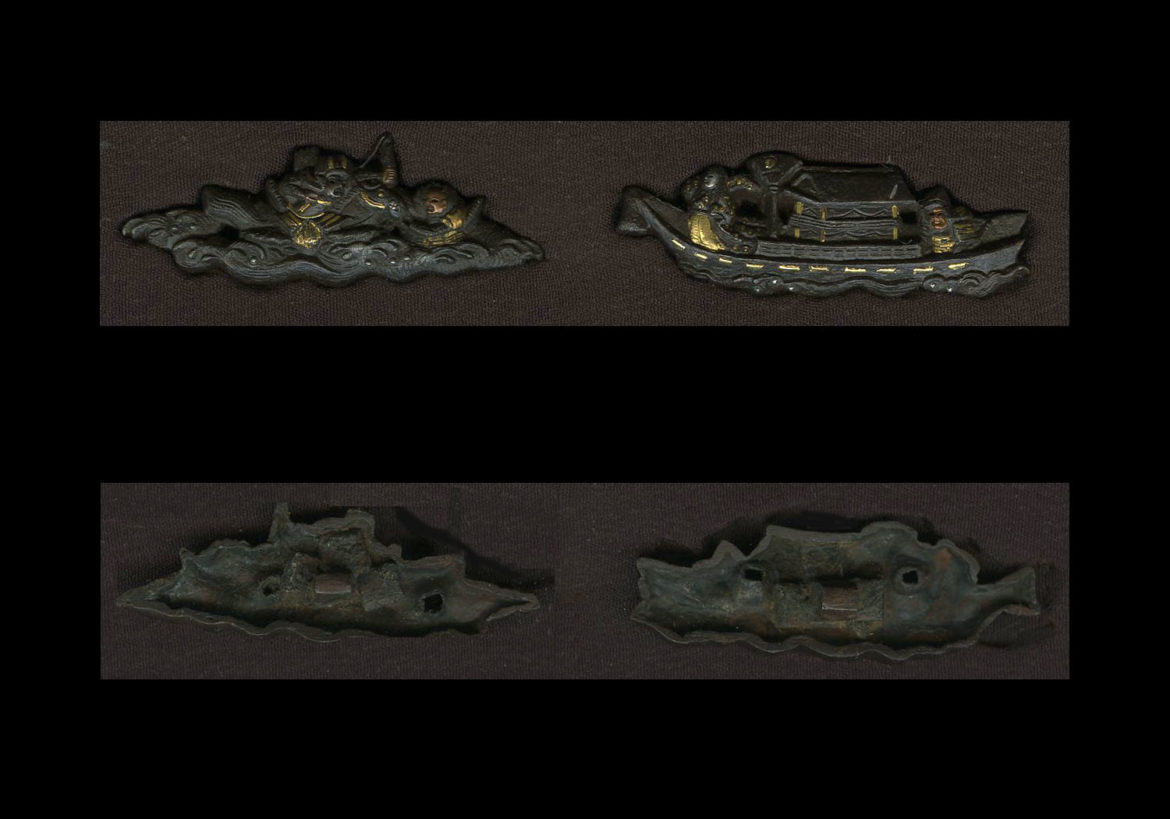
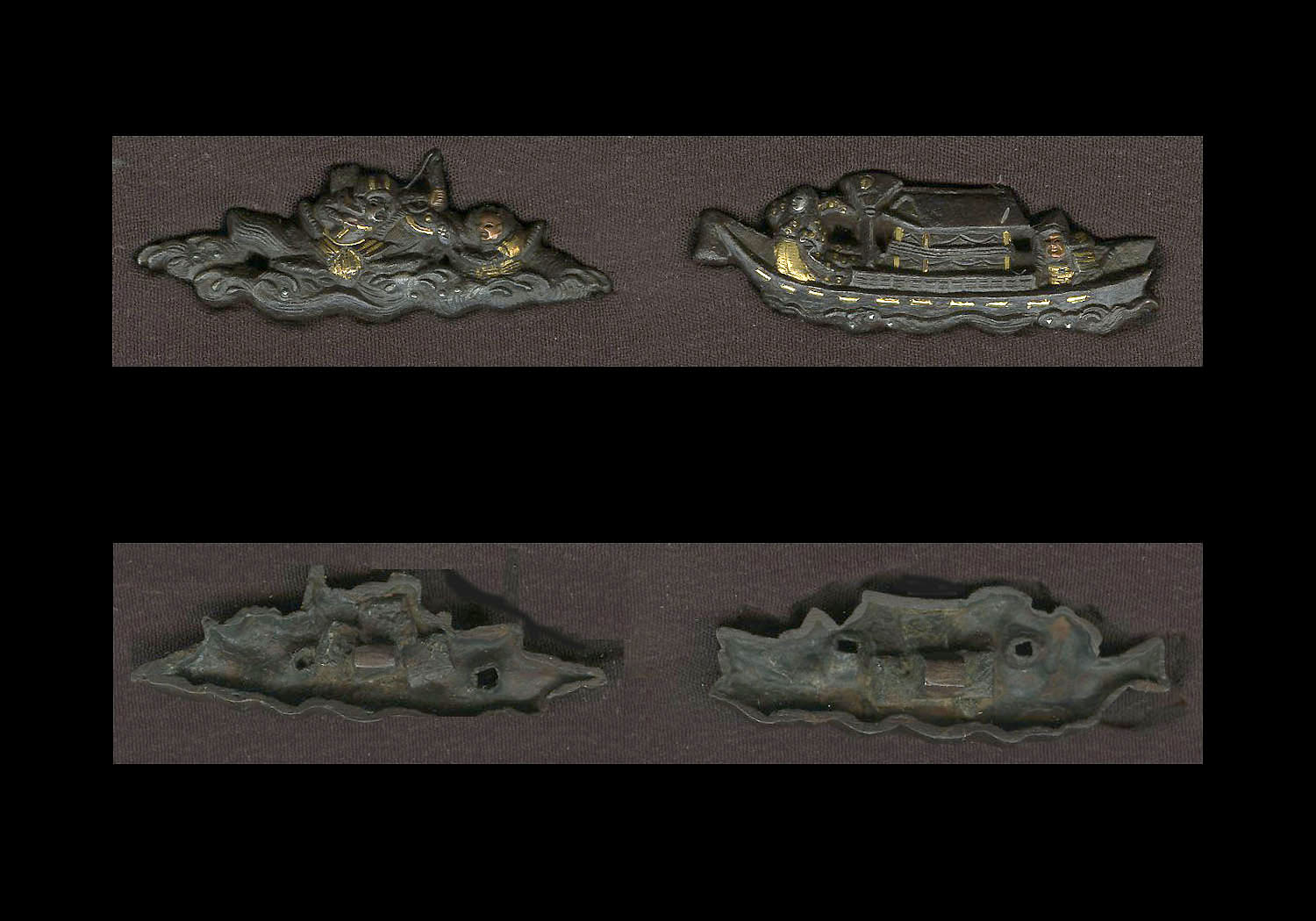
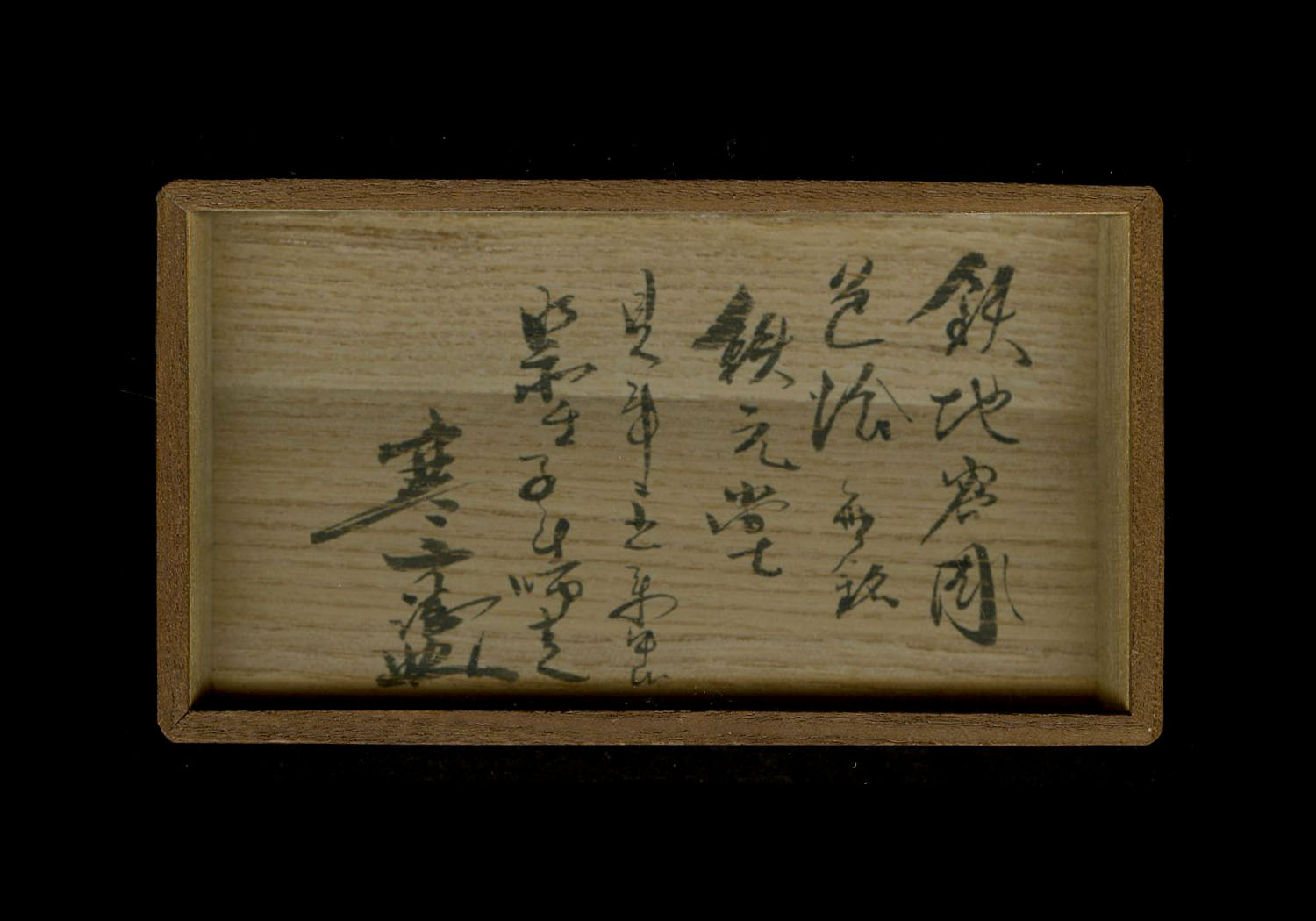
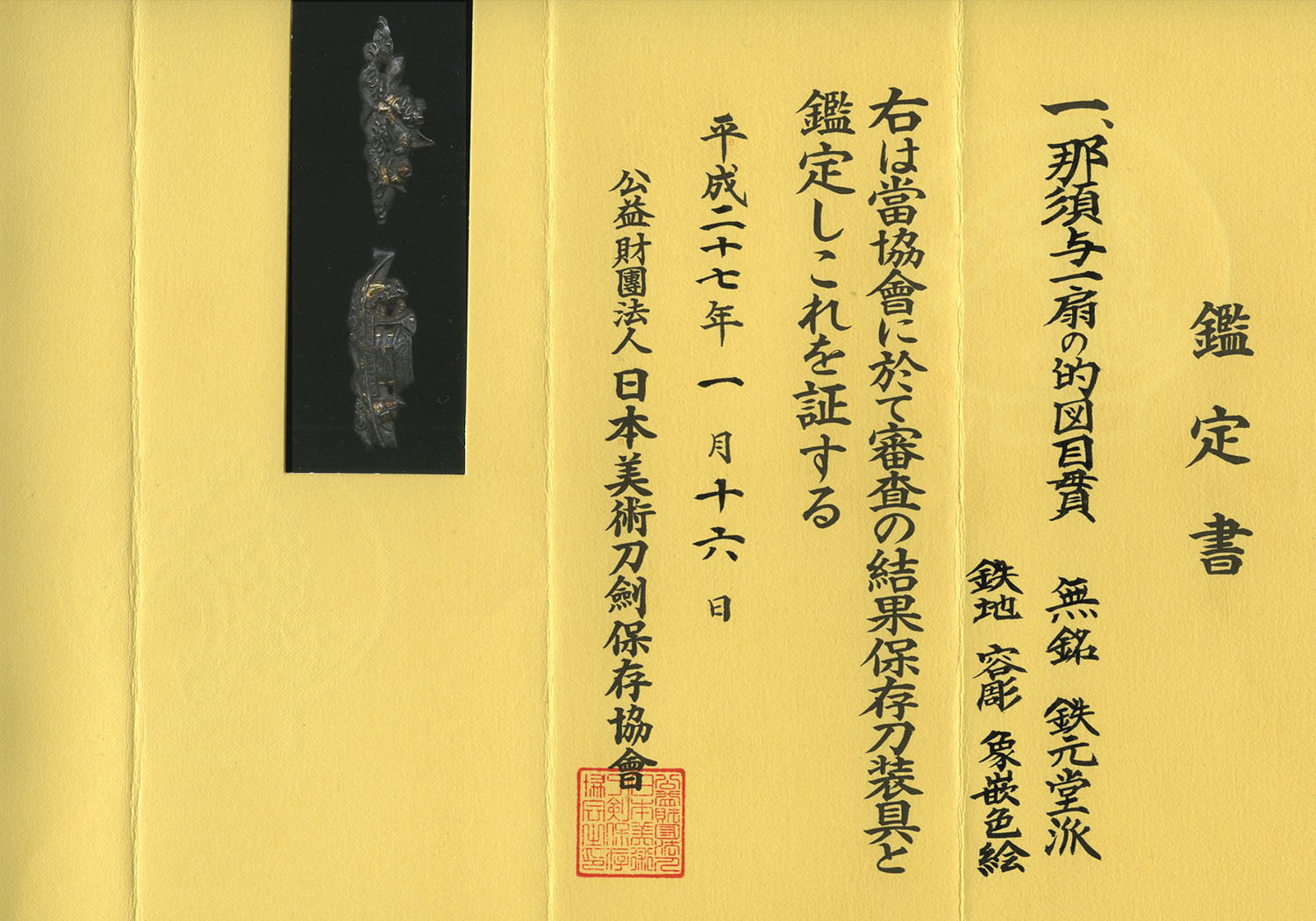
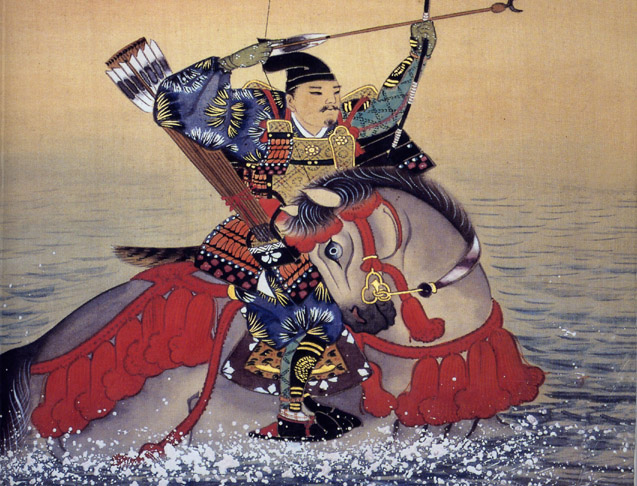
I present here a finely detailed pair of iron menuki of the Tetsugendô school. They are delicately and beautifully carved and depict a famous scene from the Gempei war of the late 1100’s between the Taira and the Minamoto. They measure 1 7/8 inches or 4.7 cm and are highlighted with gold, silver, shakudo, and copper. They show Nasu no Yoichi wading into the waves to accept a challenge of bowmanship as described below: Nasu no Yoichi, as depicted in a hanging scroll in the Watanabe Museum, Tottori Nasu no Yoichi (那須与) (c. 1169 – c. 1232) was a Samurai who fought alongside the Minamoto clan in the Genpei War. He is particularly famous for his actions at the Battle of Yashima in 1184. According to the Heike Monogatari, the enemy Taira placed a fan atop a pole on one of their ships, daring the Minamoto warriors to shoot it off. Sitting atop his mount in the waves, his target atop the ship rocking as well, Nasu nevertheless shot it down with only one shot. These menuki are in excellent condition with no rust and the faces of the warriors are quite well preserved with almost no rubbing. They come in a custom made fitted wooden box with a hakogaki by Kanzan Sato, the former head of the NBTHK. They also come with NBTHK Hozon papers attesting to their quality, condition, and attribution.
Certificate reading — 無銘(鉄元堂派)
NihontoWatchOffered by Nihonto.com
15 on the market

Tetsugendo School
Edo
Unsigned
Hozon (NBTHK)
Machibori · Yamashiro
15 pieces on the market now
The Tetsugendo (鉄元堂) lineage emerged in Kyoto during the mid-Edo period, founded by Okamoto Genbei Toshiyuki, who trained under Tetsuya Denbei Kuniharu[[c:1]]. Known by his working name Naoshige (尚茂), the founder later adopted the art name Shoraku (正楽) after taking Buddhist tonsure, and died in An'ei 9 (1780). The lineage passed to a second generation, Naofusa (尚房), whose works also survive. Together with Ichinomiya Nagatsune and Otsuki Mitsuoki, the first-generation Shoraku was celebrated as one of the "Three Outstanding Metalworkers of Kyoto" (Kyoto kinko no sanketsu). The broader circle of Kyoto kinko working in related idioms includes Hosono Sozaemon Masamori, a metalworker resident at Nijo whose dated works span from Genroku 3 (1690) to Kyoho 3 (1718), and Yamazaki Ichiga (also called Nizaemon), whose first generation studied under Goto Shujo and whose line continued through several generations. The hallmark of the Tetsugendo school is its commanding mastery of iron. Shoraku worked chiefly in iron and earned a reputation as an artist who "handled iron with exceptional freedom" and "tolerated no rival" in that material. His characteristic method builds compositions upon a polished iron ground (tetsu migaki-ji) or a finely struck ishime-ji surface, developing figures through sukidashi-bori that transitions seamlessly into fully developed takabori (high relief), imparting depth and a heightened sense of volume.
At key points across the iron plate, inlays of gold, silver, shakudo, shibuichi, suaka, and brass are applied with meticulous zogan iroe -- a combination "often regarded as a difficult undertaking" on iron, and one that the NBTHK repeatedly describes as achievable only by Tetsugendo. Subjects are overwhelmingly figural and grounded in direct observation: scenes of figures caught in a sudden evening shower (yudachi) rank among his greatest specialties and "many examples of this same subject are known"; exotic depictions of Tatar (Dattan) figures with Western dogs recur across tsuba and other fittings; and literary themes such as Kisho (Returning Woodcutter), Genjouraku (a gagaku court dance), Fujin and the Great Buddha, and Nanbanjin (Southern Barbarians) are rendered with rich naturalistic observation and a muscular vigor the setsumei call his "true mettle" (shinkotcho). Hosono Masamori, working on shibuichi and shakudo grounds rather than iron, developed a parallel pictorial world through exhaustive kebori and katakiribori combined with hira-zogan of various colored metals, producing panoramic townscape and agrarian scenes of extraordinary descriptive density. " The Tetsugendo lineage occupies a distinctive place in the tosogu canon as the foremost Kyoto school specializing in iron. The first-generation Shoraku's tsuba consistently demonstrate what the NBTHK describes as "a level of finish achievable only by Tetsugendo," from the subdued, moist richness of his iron plates through to the polychrome inlay work executed down to the smallest details. His yudachi compositions -- capturing the clamor and confusion of an evening squall across matched daisho sets of tsuba, fuchi-kashira, and other fittings -- are "very much his own domain," while his Tatar-figure tsuba, including a dated example from Tenmei 2 (1782), are valued both artistically and as documentary evidence for research into the first- and second-generation question. The menuki depicting Kusazuri-hiki on an imo-tsugi-ji ground of gold and shakudo reveal Shoraku's capacity to work outside iron with deliberate archaism, evoking the manner of Goto Yujo. Learn more →
| Smith | Era | Designated |
|---|---|---|
| Shoraku正楽 | — | 15 |
| Bokusen牧川 | — | 0 |
| Shigekuni重国 | — | 0 |
| Yoshioki佳興 | — | 0 |
| Naofusa直房 | — | 0 |
Certifies a genuine fitting worth preserving: a correct signature, or, if unsigned, an identifiable era and school, with recognized artistic and craft value.
The NBTHK (Nihon Bijutsu Tōken Hozon Kyōkai, the Society for the Preservation of Japanese Art Swords) is a public-interest incorporated foundation founded in 1948 and supervised by Japan’s Agency for Cultural Affairs (Bunkachō); it is based at the Japanese Sword Museum in Tokyo. Its expert panels physically examine each submitted work (shinsa) and issue a certificate (kanteishō) ranking it by artistic and historical merit. NBTHK papers are the most widely recognized standard of authentication for Japanese swords and fittings.
NBTHK official siteThree-day inspection period and seven-day return period; buyer notifies by email within three days of receipt, no reason needed; full refund once item returned undamaged and unaltered.
$1,250