Edo was the sword’s age of connoisseurship: the Hon’ami appraisers, the shogunal register of famous blades of 1719, and a thriving literature turned the sword into an object of study even as it ceased to be drawn in war.
 NihontoWatchNihontoWatch
刃渡り二尺五寸八分、身幅約三十二ミリ、刃文は実用本位に直ぐ調、刃区付近は焼き落とし、折れず曲らず良く切れる剣豪用におすすめする御刀 在銘 大和大掾藤原正則 銘、出来、共に良く保存保証可 正則について 大和大掾藤原正則は新刀期の越前鍛冶を代表する刀工であり、その斬れ味から良業物に列位。 祖は山城三条吉則といわれ、本国は丹後の国宮津、後に徳川家康の次男の結城秀康が藩主となった越前(福井県)に移住する。 越前国が結城秀康六十七万石の城下となると、正則や近江国の下坂康継をはじめとする諸刀工が各地から同国へ移住して越前鍛冶は大いに繁栄する。 折れず曲らず良く切れる御刀をお探しの方におすすめする一振り。 (保証) 銘良く、刃切れなどの重大な欠点がないので日刀保の保存やNPO保存会の正真鑑定書が取れると思います。 現状では上記の保存・正真鑑定を保証はしておりませんが、代金に+5万円で保証可能でございます。保証は銘がある刀を安心してお取引したい方向けです。 保証販売の場合ですが例えば万が一、証書が取得できなければ代金+5万円で返品返金致したします。 尚、錆や傷、刀装具の欠品など変化がないお渡しした状態に限ります。 また保証は下記2機構で保証期間は落札した日から半年(審査に出した日)とさせていただきますので、その間に必ず審査の方お手数ではございますがお手続きしてください。 日本美術刀剣保存協会 NPO保存会 (鑑定書発行代行) 保存、特別保存鑑定書(協会)、正真鑑定書(NPO法人保存会)など必要な方は鑑定費用(実費)と代行費用1万円、鑑定書発行まで数カ月のお時間頂きますが、受付可能でございます。 商品の状態 *僅かな刃こぼれ(研磨で修復可)有るも刃切れ・刃絡み・曲がり・撓え・膨れ・匂い切れ・駆け出しなどはございません。 *時代による、汚れ、細かな擦れ傷,劣化等はご了承ください。写真を参考にしてください。
NihontoWatchMasanori正則
Offered by Yazawa Shokai
This piece has sold
Get an email when a new Masanori piece hits the market.

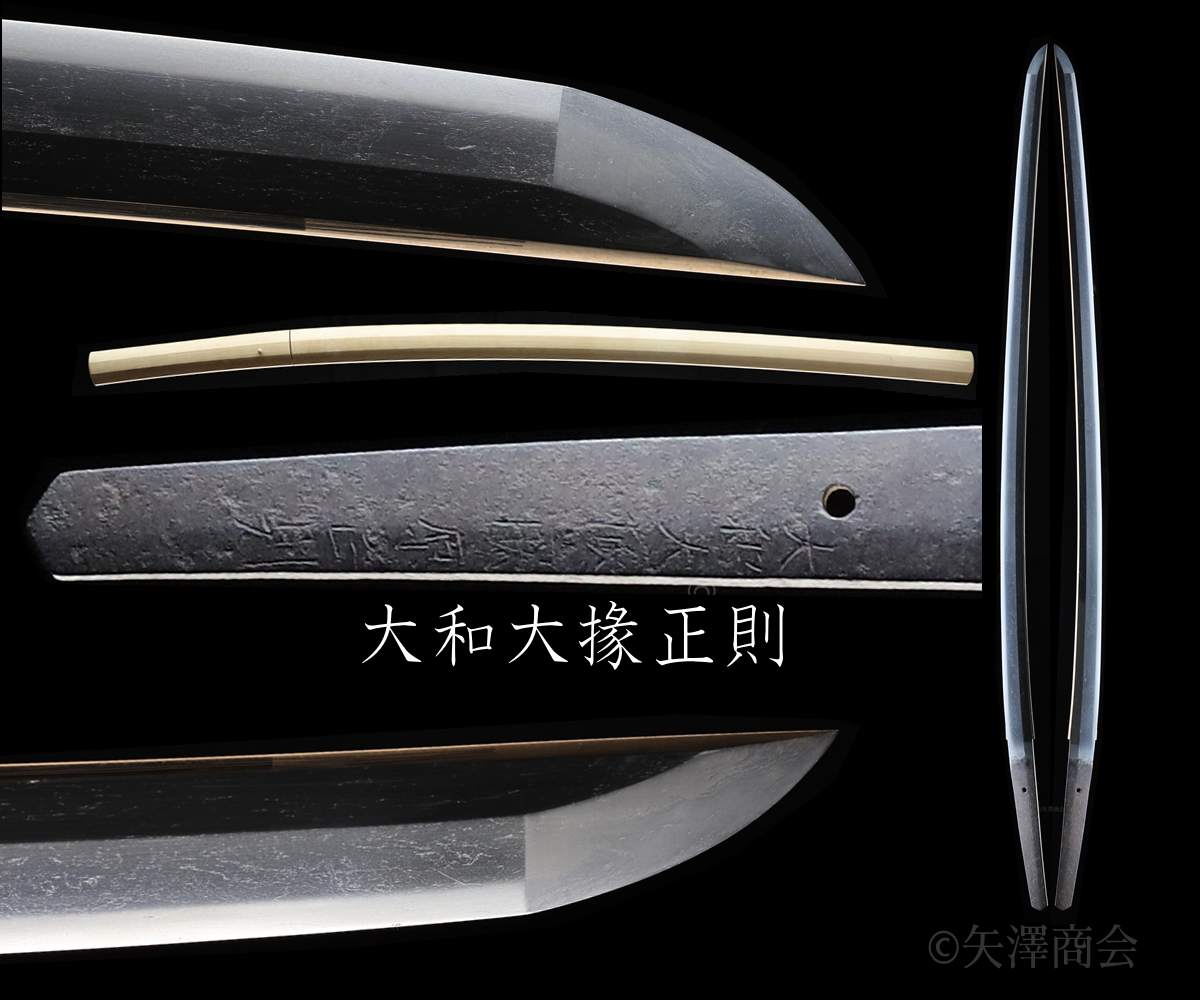



As written by the shop
(Translation unavailable)
Echizen Shinto (Fukui, Echizen); signing Yamato Daijo Fujiwara Masanori · Echizen · around 1596-1615
2 pieces on the market now
Masanori signed his work in full as Yamato Daijo Fujiwara Masanori[[c:1]], and the earliest of his dated blades carries the year Keicho 13 (1608), with later pieces reaching Genna 2 (1616), Kan'ei 1 (1624) and Keian 4 (1651). That span sets him squarely in the first generation of Echizen smiths working at Fukui in the opening decades of the Edo period, active alongside the first and second generations of Echizen Yasutsugu. The published sources transmit, as one view only, that he descended from Sanjo Yoshinori of Yamashiro, that his native province was Miyazu in Tango, and that he afterward moved to Fukui in Echizen. They place him in the immediate orbit of Yasutsugu, perhaps as a pupil, and add that even where that cannot be shown it is difficult to deny that he came under that smith's influence[[c:2]]. The name continued through several more generations after him, but it is this first Masanori, with his long signature and his ubu nakago, whose hand the four designated blades record.
His everyday manner is read first off the jigane. Over an itame that flows and stands a little (板目 on all four blades, hada-dachi on three, with flowing grain entering on two) he lays ji-nie, and on the larger katana chikei (地景) appears; the steel is sometimes blackish. The hamon that runs above it is a midareba built from gunome, large gunome, pointed togariba and yahazu-like (矢筈) heads, with ko-nie attaching, the boshi running midare-komi to a small round turnback. What the published sources return to, however, is not any single feature of the line but the character of the nioiguchi: it tends to sink, somewhat subdued, and they sum the whole up by saying that his is a subdued-nioiguchi blade generally close to the Seki smiths, 「匂口の沈んだ刃で, 一般に関物に近い」. That sinking quality, paired with the flowing standing jigane, is the closest thing he has to a constant tell across the busier work.
Not every blade is busy. On one of the naginata the hand quiets entirely: the kitae is a fine ko-itame with only a slight tendency to stand, ji-nie appearing, and the hamon settles into a suguha (直刃) with ashi and ko-nie, the boshi straight to a ko-maru. The published sources name this suguha alongside the midareba as the other thing he often produces, and they judge the piece refined in its forging, with the ji and ha well ordered throughout, 「地鉄が精美で地刃の出来がよく整った」. It is the disciplined counterpart to the flowing midare manner, and it shows that his Echizen training carried a calmer register as readily as the showier one.
The ceiling of his work lies elsewhere again. His seventh-session designated katana, the oldest of the four on record, is the height of his ambition: a wide blade running to a large point, cut on the omote in single-bevel construction (片切刃) and on the ura in shinogi-zukuri, modeled after the so-called Kiriba-Sadamune (切刃貞宗). Above a standing itame with frequent muneyaki runs a paired so-mon in a large midare (双文大乱) mixed with gunome, ashi and yo entering freely, sunagashi running through, and the ura passing into full tempering (皆焼), the boshi thrusting up with hakikake and nie. A sankoken (三鈷剣) is carved on the omote. Of this blade the published sources write that the workmanship is excellent, very nearly reaching the first-generation Yasutsugu, and that among Masanori's own works there is none to set beside it, 「殆んど初代康継に迫るものがあり, 同作中これに比すべきものがない」. The katakiriba construction is itself a recurring trait of his record rather than a one-off, appearing on a naginata as well, but it is on this katana that the Sadamune model is named and the ambition fully realized.
What distinguishes Masanori within the crowded field of Echizen Shinto is best drawn from his own grounded features rather than by contrast with his neighbors. The flowing, standing itame and the sinking nioiguchi are the marks the published sources tie to his closeness to the Seki tradition, and they are what hold his everyday work together; against them, the katakiriba blades and the Sadamune-modeled showpiece are the reach toward an older and grander manner. The judges note on the twenty-third-session naginata that his own characteristic features show densely in the ji and ha of that piece, 「地刃に正則の特色が濃く」, and on the same blade that the carving is splendid besides. He is, in the school's reckoning, a smith whose typical work sits close to Seki yet who could, on his best day, turn out a katana that approached the founder of his own province's Shinto tradition.
Masanori's designated record stands at four Juyo blades, two katana and two naginata, every one signed in full and on an ubu nakago; his record reaches the Juyo tier and no higher, and none of the four carries a recorded line of provenance or a named owner. The seventh-session katana, the Sadamune-modeled piece the published sources rank without equal in his output, is the work by which he is best known, and the two naginata, one quiet in suguha and one densely his own, round out a small but coherent body. For the collector this is a smith whose work surfaces only occasionally and whose finest blade is a landmark when it appears; the signed Echizen katana and naginata of his hand are not beyond reach in the way a designated cultural property would be, but they come to market rarely, and a piece in which his subdued nioiguchi and flowing standing jigane are clearly present rewards patience more than it does pursuit.
Where Masanori stands among comparable artisans: across all of nihontō, and within tradition, era, and period. The tiers (Foremost · Leading · Major · Notable) weigh official designations from the NBTHK and Japan's Agency for Cultural Affairs, together with historical honors of lasting repute such as the Sansaku and Meibutsu-chō.
Select a lens to see how it's measured.
The Edo period (1615 to 1868)
Edo was the sword’s age of connoisseurship: the Hon’ami appraisers, the shogunal register of famous blades of 1719, and a thriving literature turned the sword into an object of study even as it ceased to be drawn in war.