 NihontoWatchNihontoWatch
A masterpiece featuring bamboo and sparrows carved with skillful engraving techniques into a dark iron ground with excellent iron quality.
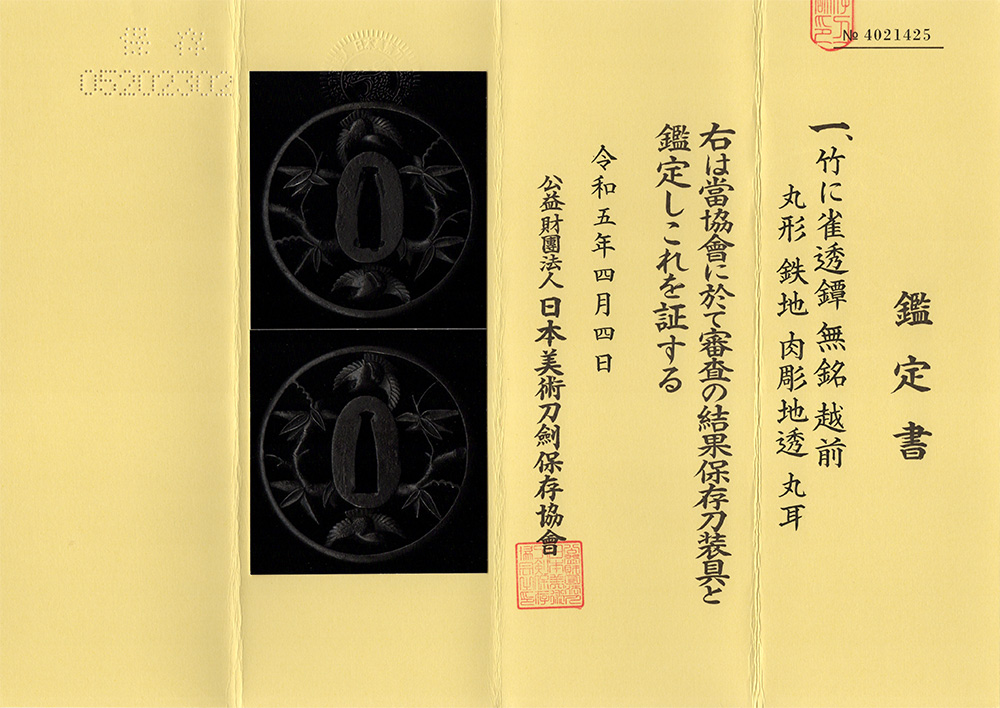
Certificate reading — 無銘(越前)
NihontoWatchOffered by Toushin
3 on the market

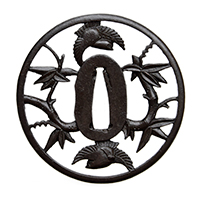
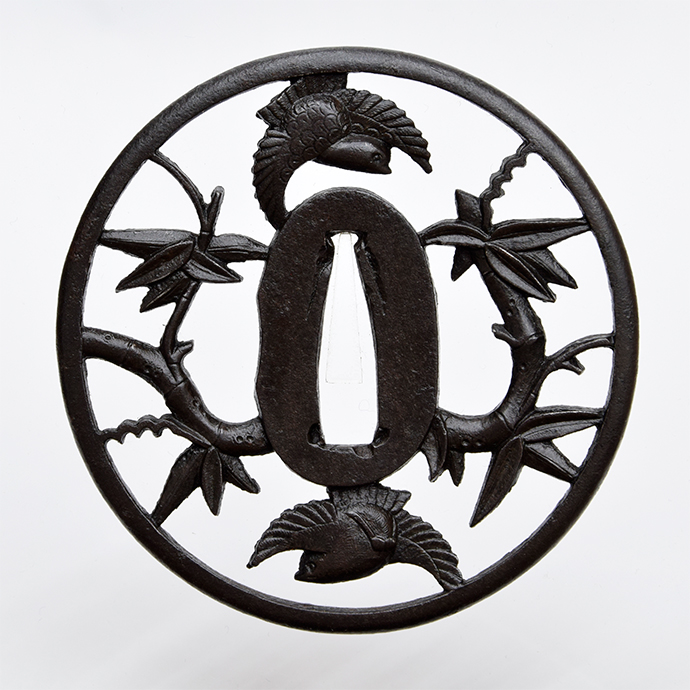
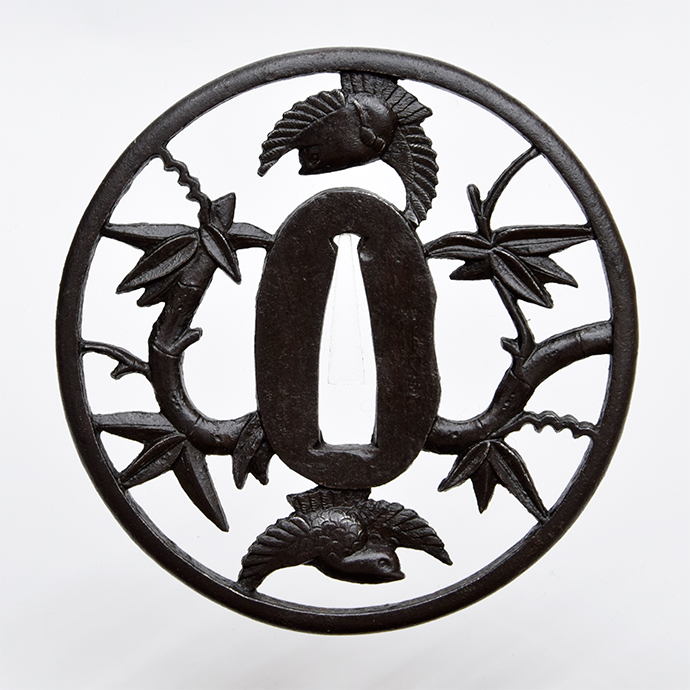
Echizen Rai
Shōwa
Echizen
Unsigned
Hozon (NBTHK)
As written by the shop
Machine translation from the shop's Japanese · may contain errors ·
Yamashiro-den · Echizen · around 1336-1392
3 pieces on the market now
Echizen Rai is the attribution given to unsigned blades judged to be the work of the Rai line transplanted to Echizen. The published sources trace the name to Rai Kuniyasu (来国安), said to have been born in Yamashiro and by one tradition a grandson of Rai Kunisue (来国末), who later moved to Echizen and is regarded as the founder of the Chiyotsuru line; the sword-reference works place him around the Joji era (1362 to 1368). The attribution therefore belongs to the Nanbokucho period, when the Kyoto Rai manner was carried into the northern provinces.
The one designated example on record is a katana, o-suriage and mumei, designated Juyo Token at the 66th session in 2020. Its shape, with a wide mihaba, little taper from base to tip, a somewhat shallow sori and an extended chu-kissaki, places it in the Nanbokucho period. The jigane is itame well mixed with mokume, standing overall, with ji-nie and fine chikei. The temper is a chu-suguha mixed with ko-gunome near the monouchi, with ko-ashi and yo, a slight hint of Kyo-saka-ashi, strong nie in places, hotsure along the habuchi, and kinsuji and sunagashi running well; a bo-hi is carved on both sides.
The published sources read the blade in two layers. The suguha with ko-gunome, the ashi and yo, the hint of Kyo-saka-ashi and the kinsuji and sunagashi show the features of the Rai school in both ji and ha. Against these stands the steel: 「地鉄が総じて肌立ち, かな色が黒みがかって淡く白ける処に北国風が感じられ, ここに越前来の極めが首肯される」 (the jigane stands out overall and its colour is somewhat blackish with a faint whitish cast, which gives a northern-province feeling, and here the attribution to Echizen Rai is persuasive). They add that the variety in the surface pattern is conspicuous and that 「特に刃中と刃縁の豊富な働きが見事であり, 優れた出来映えである」 (the abundant activity within the edge and along the habuchi is especially splendid, an excellent piece of work).
Beyond this blade, some thirty further unsigned works attributed to Echizen Rai are recorded in the koto research data, all placed in the Nanbokucho period; nearly all are katana, with a few wakizashi and one naginata-naoshi.
Where Echizen stands among comparable artisans: across all of nihontō, and within tradition, era, and period. The tiers (Foremost · Leading · Major · Notable) weigh official designations from the NBTHK and Japan's Agency for Cultural Affairs, together with historical honors of lasting repute such as the Sansaku and Meibutsu-chō.
Select a lens to see how it's measured.
Yamashiro-den · Echizen
5 pieces on the market now
| Smith | Era | Designated |
|---|---|---|
| Echizen越前 | 1336-1392 | 1 |
Certifies a genuine fitting worth preserving: a correct signature, or, if unsigned, an identifiable era and school, with recognized artistic and craft value.
The NBTHK (Nihon Bijutsu Tōken Hozon Kyōkai, the Society for the Preservation of Japanese Art Swords) is a public-interest incorporated foundation founded in 1948 and supervised by Japan’s Agency for Cultural Affairs (Bunkachō); it is based at the Japanese Sword Museum in Tokyo. Its expert panels physically examine each submitted work (shinsa) and issue a certificate (kanteishō) ranking it by artistic and historical merit. NBTHK papers are the most widely recognized standard of authentication for Japanese swords and fittings.
NBTHK official siteAs a rule we do not accept returns, except when we have sent a different item from the one ordered or when there is a significant discrepancy between the description and the item. If you wish to return an item, please contact us within 3 days of its arrival and then send it back.
¥165,000