NihontoWatch MonNihontoWatch
Market
Encyclopedia
Kantei
NihontoWatch MonNihontoWatch
Market
Encyclopedia
Kantei

Description

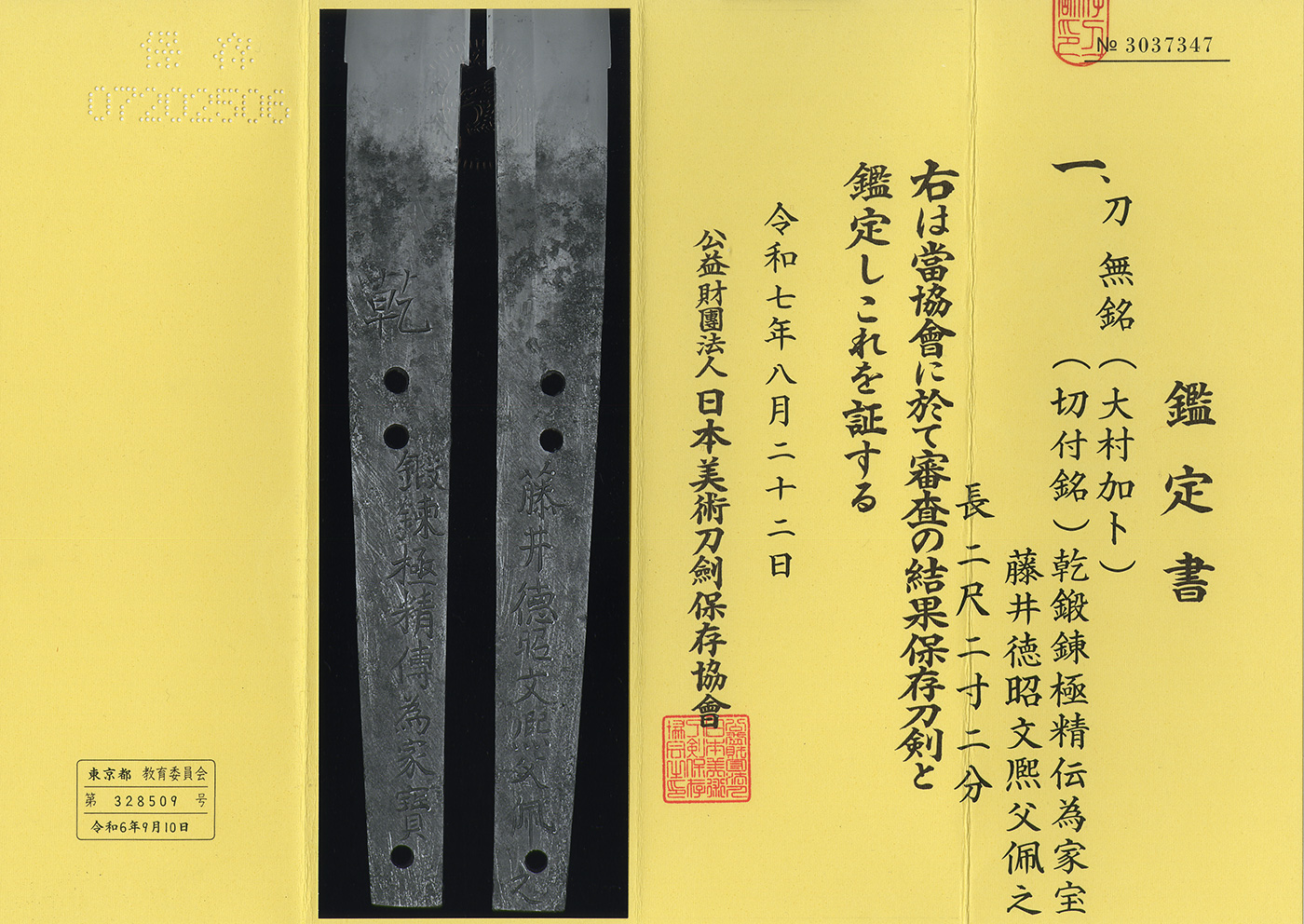
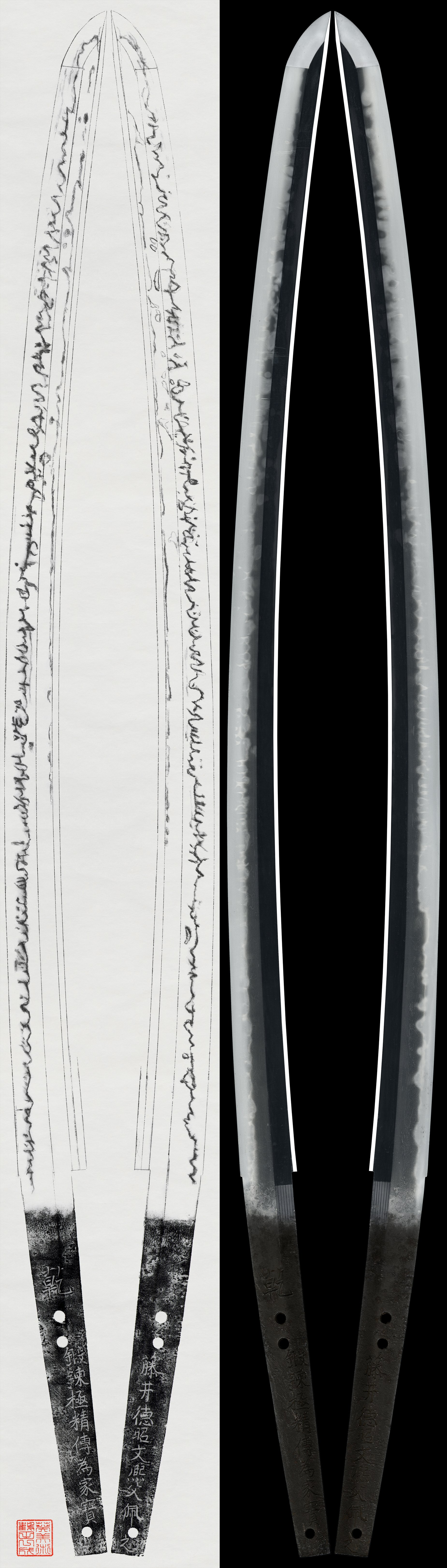
This is a katana attributed to Omura Kaboku, a swordsmith who served the Echigo domain. The blade is mumei (unsigned) and has been shortened. It features a vigorous choji midare hamon and is accompanied by an NBTHK Hozon Token certificate.

NihontoWatch MonNihontoWatch
MarketEncyclopediaKantei
Swords›Omura Kaboku›Kaboku›Katana: Mumei (attributed to Omura Kaboku) - Ken Tanren Gokusei Den Tame Kaho Fujii Noriaki Bunki Chichi Kore wo Haku (NBTHK Hozon Token)
katanaHozon
Omura Kaboku

Katana: Mumei (attributed to Omura Kaboku) - Ken Tanren Gokusei Den Tame Kaho Fujii Noriaki Bunki Chichi Kore wo Haku (NBTHK Hozon Token)

mumei · Shoho (1644-1648) · nagasa 67.2cm · sori 2.1cm

SOLD
Omura Kaboku (加卜) · Shoho (1644-1648)View artist page →
KatanaHozon
Could you name the smith from the blade alone? Today’s kantei →
Omura Kaboku — 1 of 6
Omura Kaboku — 2 of 6
Omura Kaboku — 3 of 6
Omura Kaboku — 4 of 6
Omura Kaboku — 5 of 6
Omura Kaboku — 6 of 6
1 / 6
1 / 6
Omura Kaboku — 1 of 6Omura Kaboku — 2 of 6Omura Kaboku — 3 of 6Omura Kaboku — 4 of 6Omura Kaboku — 5 of 6Omura Kaboku — 6 of 6
Omura Kaboku (加卜) · Shoho (1644-1648)View artist page →
KatanaHozon
Could you name the smith from the blade alone? Today’s kantei →
Measurements & details
Smith
Omura Kaboku
Type
Katana
School
Omura Kaboku
Period
Around 1644–1684(Shoho–Jokyo)
Signature
Unsigned(100% of this smith's designated works are signed)
Measurements
Nagasa 67.2cmSori 2.1cmMotohaba 3.23cmSakihaba 2.15cmKasane 0.68cmWeight 840g
Description

This is a katana attributed to Omura Kaboku, a swordsmith who served the Echigo domain. The blade is mumei (unsigned) and has been shortened. It features a vigorous choji midare hamon and is accompanied by an NBTHK Hozon Token certificate.

About the maker

Kaboku

加卜

Omura Kaboku (Echigo / Mito shinto) · Hitachi · around 1644-1684

Fujishiro Jo saku · Tōken Taikan top 21%

›

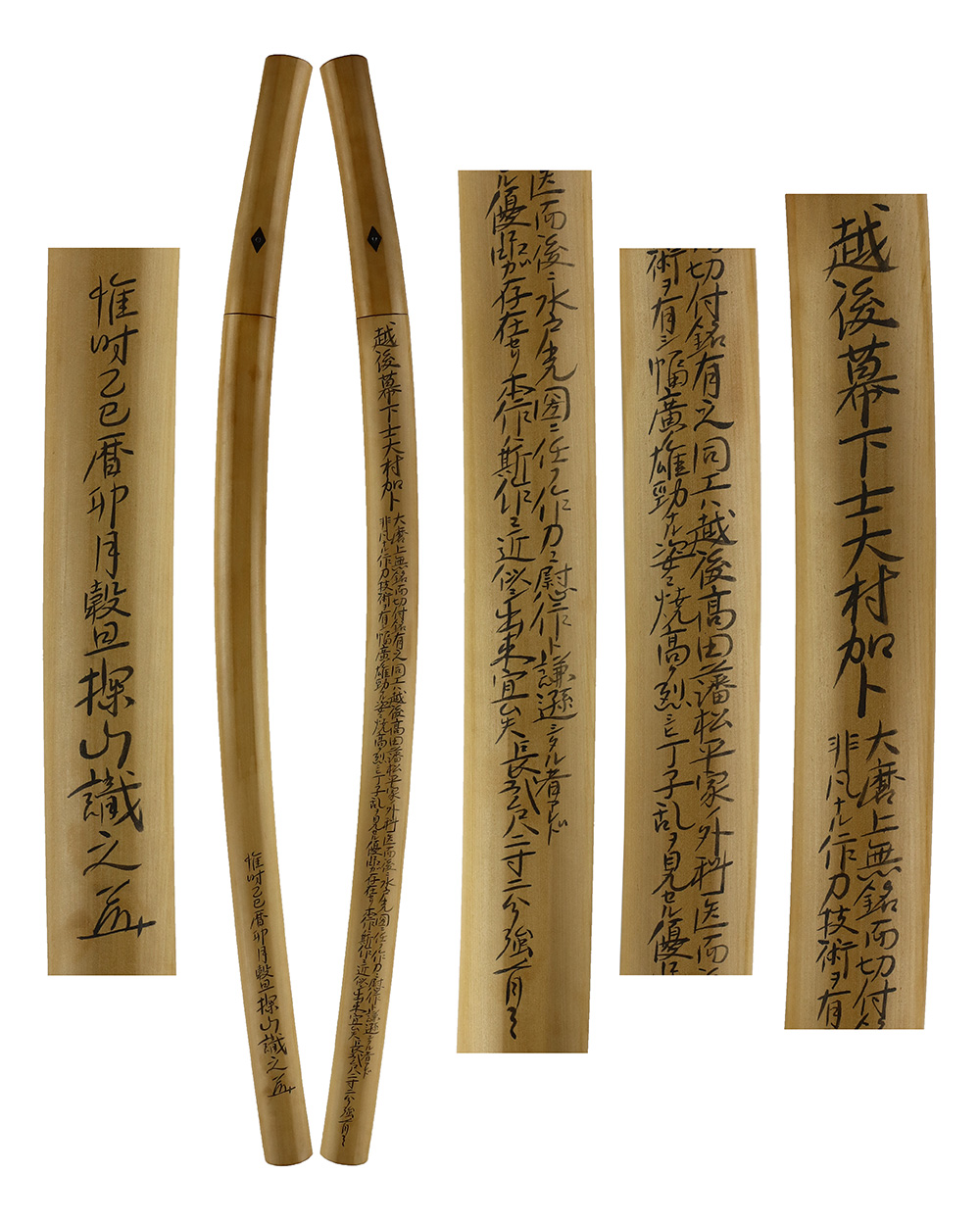
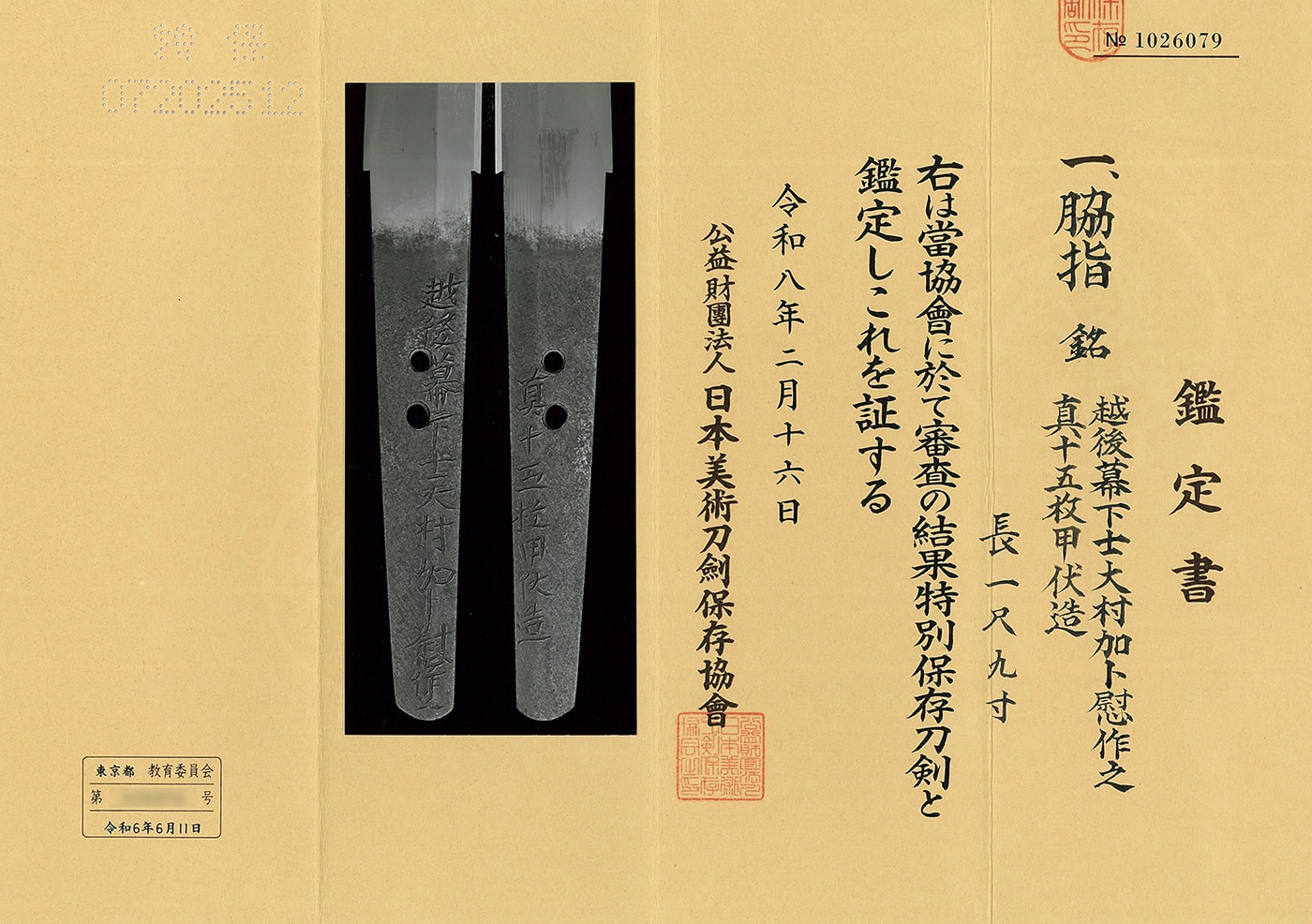
On a katana now in Osaka, dated the eighth month of Shōhō 2 (1645), Ōmura Kaboku cut not only his signature but a small manifesto: the construction, "true fifteen-plate kabuse"[[c:1]], the proud disclaimer "I am no smith"[[c:2]], and a line that the blade was forged to be heard of nine hundred years hence. The man behind that inscription was Ōmori Jibuzaemon, a physician born at Anzai on the outskirts of Sunpu in Suruga, who took up the forge as an avocation alongside his medical practice. By his own account in the Tōken Hihō, his treatise on swords, he began forging in the third month of Shōhō 1 (1644) and over the forty-one years to Jōkyō 1 (1684) made about a hundred blades. He served Matsudaira Mitsunaga, lord of Takada in Echigo, by virtue of his medicine; after that house was dispossessed he became a rōnin, went up to Edo, and entered the attendance of Tokugawa Mitsukuni of the Mito domain. His teacher is not clearly known, and his small signed corpus is prized by the published sources as much for the documentary value of its long inscriptions as for the blades themselves.

Kaboku worked in two distinct manners, and the gunome that runs through both is the thread that ties his hand together. The first is a brilliant Bizen tradition. Over an itame mixed with mokume, densely forged and carrying a standing midare-utsuri, he tempers a large chōji mixed with gunome, into which ashi and yō enter frequently; the nioi is deep and the nioiguchi clear, and the bōshi runs slightly midare-komi before turning in ko-maru. The published sources liken this work to the splendid chōji of the Ishidō current, calling it "the fine Ishidō-style chōji workmanship"[[c:3]], and judge his masterpieces to lie among these Bizen-tradition pieces. His other manner is Sōshū. There the temper is a broad suguha or a notare-based large gunome-midare worked deep in nie, with thick ashi, hotsure and yubashiri, and kinsuji and sunagashi coursing freely through the edge.

The jigane shifts with the manner, and reading it is the surest way into his work. In the Bizen mode the forging is a dense itame with mokume, the grain tightly closed beneath the bright midare-utsuri that rises in the old Bizen jigane. In the Sōshū mode the same itame stands a little more openly, here mixed with moku and flowing nagare-hada, and carries fine ji-nie together with a chikei that enters well though subdued; on the latest of the surviving blades the steel color is described as somewhat blackish, a strong, clearly textured jigane. His shapes are those of an early-Edo shintō katana: shinogi-zukuri with iori-mune, a thick kasane and a somewhat high shinogi, the sori shallow and the chū-kissaki extended. The published sources praise the proportions of the sixty-second-session blade as "robust and stalwart"[[c:4]], an ordinary width carried with abundant nikuoki.

The surviving Jūyō blades let his two registers be set against one another. The eleventh-session katana is the Bizen voice at its clearest, its large chōji and gunome over a bright utsuri judged probably his finest, the published sources calling it "likely his crowning achievement"[[c:5]]. The nineteenth and twenty-third pieces lean to Sōshū, the one a wide suguha with gunome and sunagashi, the other a notare-based large gunome-midare in deep nie. The sixty-second-session katana, designated in 2016 and the most fully described of the four, is the strongest statement of that manner: a broad suguha base mixed with gunome, chōji-like elements and shallow notare in a companion arrangement, kinsuji and sunagashi frequent, and the bōshi tempered so deeply that it becomes ichimai-like with tobiyaki on the reverse. The published sources read it as a work "plainly made with a keen awareness of Gō Yoshihiro"[[c:6]], and note that he also left a broad suguha in the manner of Shinkai. Across his nakago he cut unusually full long inscriptions, recording the kabuse plate count on nearly every blade and styling himself at times Yasuhide, which is why his dated, self-named pieces are treated as valuable source material.

What distinguishes Kaboku is the breadth of an amateur who answered to no school line and ranged freely between Bizen and Sōshū. His Bizen chōji sets him among the Ishidō-influenced smiths of the early shintō without binding him to them, while his Sōshū work, looking past his own century to Gō, gives him an ichimai-tempered bōshi and a thick nie activity that few of his contemporaries pursued so deliberately. The published sources name Bandō Tarō Toden among his disciples, but his line did not carry far; he is remembered less as the head of a tradition than as a singular figure, a doctor of letters who forged a hundred blades and wrote a book about it, and whose surviving swords are read off their own long signatures rather than off any documented descent.

For the collector Kaboku is a rare and particular name rather than a famous one. He has no National Treasures and no Important Cultural Properties; his record runs through the Jūyō rank, with four blades on official record, all of them katana and all signed. None carries a documented daimyō provenance in the surviving papers, and current holders are largely unrecorded, the blades having passed into private hands in Shizuoka, Tottori and Osaka among others. His total output was small to begin with, about a hundred swords across a working life that was never his principal occupation, and the designated pieces are held rather than traded; a signed Ōmura Kaboku comes to the open market only seldom. A privately held example is a notable thing for a collector to encounter, valued the more for the long inscriptions in which a seventeenth-century physician set down, in his own hand and his own words, exactly how and why he made the blade.

Historical importance

Where Kaboku stands among comparable artisans: across all of nihontō, and within tradition, era, and period. The tiers (Foremost · Leading · Major · Notable) weigh official designations from the NBTHK and Japan's Agency for Cultural Affairs, together with historical honors of lasting repute such as the Sansaku and Meibutsu-chō.

随一
Foremost
屈指
Leading
有数
Major
著名
Notable

Select a lens to see how it's measured.

Designation record
5 designated works
Jūyō
5
Kaboku — full profileOmura Kaboku (Echigo / Mito shinto) school

Study this maker →

About the school

Omura Kaboku

大村加卜

Shinto · Hitachi

›

Born at Anzai on the outskirts of Sunpu in Suruga Province, the smith who signed himself Omura Kaboku (大村加卜) came to swordmaking by an unusual road. His personal name was Omori Jibuzaemon, and his primary calling was medicine; the setsumei describe him as a physician, even a surgeon, who entered the service of Matsudaira Mitsunaga, lord of the Takada Domain in Echigo, on the strength of his medical practice. After that house was dispossessed by kaieki he became a rōnin, went up to Edo, and later took service with Tokugawa Mitsukuni of the Mito Domain. By his own account in Tōken Hihō ("Secret Treasures of Swords"), he began forging in the third month of Shōhō 1 (1644) and produced one hundred blades over the forty-one years until Jōkyō 1 (1684). His teacher is not clearly recorded, and the inscriptions show he at times styled himself Yasuhide. Kaboku worked in two principal modes, and the blades bear this out. One is a flamboyant Bizen manner: itame-hada mixed with mokume, densely forged with prominent midare-utsuri, carrying large chōji mixed with gunome, with ashi and yō entering frequently and a clear nioiguchi. The other is a Sōshū-inflected mode of broad suguha foundation mixed in a companion manner with gunome, chōji-like elements, and shallow notare, into which thick nie adheres and a deep nioiguchi forms, with hotsure, yubashiri, kinsuji, and sunagashi coursing through; the bōshi there can temper deeply toward an ichimai character before turning back in ko-maru.

On one such work the NBTHK read a keen awareness of Go Yoshihiro. The jigane tends to itame with mokume and flowing nagare-hada, the grain standing slightly, with ji-nie and chikei and at times a somewhat blackish steel. To recognize the hand, look also to the nakago: ubu, ha-agari kurijiri, large ō-sujikai file marks, and a long thick-chisel signature carried high on the shinogi-suji, frequently paired on the ura with an inscription describing the forging. Those forging inscriptions are themselves a kantei point. The phrase shin jūgo-mai kabuse (true fifteen-plate kabuse construction), or its ten-plate variant, appears on the great majority of his works, and the declaration yo kaji ni arazu ("I am not a swordsmith") records his stance as a scholar who forged. Among named pieces, one katana carries the gold-inlaid kinzōgan "Ōigawa," likely added by a later owner who likened its suguha to the Kyoto river, and a Yasuhide-signed blade dated Shōhō 2 (1645) serves as source material fixing an early work. The setsumei name Bandō Tarō Toden among his disciples. His Bizen-tradition pieces are held to be his masterworks, one called probably his crowning achievement, and the line stands as the rare instance of a physician who set his learning to the anvil at Mito. Learn more →

1 recorded smiths5 designated works
Leading smiths
SmithEraDesignated
Kaboku加卜1644-16845
Explore the Omura Kaboku school →

Historical context

The Edo period (1615 to 1868)

›

Under the Tokugawa peace the daishō became a regulated uniform, and demand gathered in the castle towns, above all Edo itself. The craft split two ways: brilliant display work for connoisseurs, and tested blades whose cutting results were sometimes inlaid in gold.

The Edo period (1615 to 1868) →

NBTHK Certificate
Hozon Tōken保存刀剣
Sword Worthy of Preservation
›

Certifies a genuine blade worth preserving: a signature confirmed correct, or, if unsigned, an era, province, and school that the NBTHK can reliably identify.

About the NBTHK›

The NBTHK (Nihon Bijutsu Tōken Hozon Kyōkai, the Society for the Preservation of Japanese Art Swords) is a public-interest incorporated foundation founded in 1948 and supervised by Japan’s Agency for Cultural Affairs (Bunkachō); it is based at the Japanese Sword Museum in Tokyo. Its expert panels physically examine each submitted work (shinsa) and issue a certificate (kanteishō) ranking it by artistic and historical merit. NBTHK papers are the most widely recognized standard of authentication for Japanese swords and fittings.

NBTHK official site→
Seller
A
Aoi Art
🇯🇵Ships from Japan
›
✓Verified dealeraoijapan.com
✓Ships worldwide✓English supportWire transferPayPalCredit card
Return policy

If you wish to return an item, please notify us within 3 days of receipt. After this period we cannot accept cancellations. Please ship the return to us within 5 business days. Cancellation is conditional on the item being kept in the same condition as at the time of sale, so please handle it with care.

View all of Aoi Art’s listings→View this item on the dealer’s site→

Previously sold by Omura Kaboku

View all →
Samurai Shokai
Tokuho
Wakizashi - Tokuho - by Omura Kaboku - Omura Kaboku - True Jūgōmai Kōbuse-zukuriWakizashi - Tokuho - by Omura Kaboku - Omura Kaboku - True Jūgōmai Kōbuse-zukuri
Sold

Wakizashi

ByOmura Kaboku
SOLD
Choshuya
Wakizashi - by Omura Kaboku - Omura Kaboku - True Fifteen-Plate Kobuse-zukuriWakizashi - by Omura Kaboku - Omura Kaboku - True Fifteen-Plate Kobuse-zukuri
Sold

Wakizashi

ByOmura Kaboku
SOLD
Ikeda Art
Tokubetsu Kichō
Wakizashi - Tokubetsu Kichō - by Omura Kaboku - Omura KabokuWakizashi - Tokubetsu Kichō - by Omura Kaboku - Omura Kaboku
Sold

Wakizashi

ByOmura Kaboku
SOLD

Swords

  • Katana
  • Wakizashi
  • Tantō
  • Tachi
  • Naginata
  • Yari
  • Japanese Swords
  • Samurai Swords

Fittings

  • Tsuba
  • Fuchi-Kashira
  • Kozuka
  • Menuki
  • Sword Guards (Tsuba)

Armor

  • Kabuto
  • Samurai Armor
  • All Samurai Armor

By Certification

  • Tokujū
  • Jūyō
  • Tokuho
  • Hozon

Resources

  • Dealer Directory
  • Artist Directory
  • The Daily Kantei
  • Glossary
  • Browse All
Nihontowatch© 2026
TermsPrivacyCookiesAbout
Sold

Description

This is a katana attributed to Omura Kaboku, a swordsmith who served the Echigo domain. The blade is mumei (unsigned) and has been shortened. It features a vigorous choji midare hamon and is accompanied by an NBTHK Hozon Token certificate.

NihontoWatch MonNihontoWatch
MarketEncyclopediaKantei
Swords›Omura Kaboku›Kaboku›Katana: Mumei (attributed to Omura Kaboku) - Ken Tanren Gokusei Den Tame Kaho Fujii Noriaki Bunki Chichi Kore wo Haku (NBTHK Hozon Token)
katanaHozon
Omura Kaboku

Katana: Mumei (attributed to Omura Kaboku) - Ken Tanren Gokusei Den Tame Kaho Fujii Noriaki Bunki Chichi Kore wo Haku (NBTHK Hozon Token)

mumei · Shoho (1644-1648) · nagasa 67.2cm · sori 2.1cm

SOLD
Omura Kaboku (加卜) · Shoho (1644-1648)View artist page →
KatanaHozon
Could you name the smith from the blade alone? Today’s kantei →
Omura Kaboku — 1 of 6
Omura Kaboku — 2 of 6
Omura Kaboku — 3 of 6
Omura Kaboku — 4 of 6
Omura Kaboku — 5 of 6
Omura Kaboku — 6 of 6
1 / 6
1 / 6
Omura Kaboku — 1 of 6Omura Kaboku — 2 of 6Omura Kaboku — 3 of 6Omura Kaboku — 4 of 6Omura Kaboku — 5 of 6Omura Kaboku — 6 of 6
Omura Kaboku (加卜) · Shoho (1644-1648)View artist page →
KatanaHozon
Could you name the smith from the blade alone? Today’s kantei →
Measurements & details
Smith
Omura Kaboku
Type
Katana
School
Omura Kaboku
Period
Around 1644–1684(Shoho–Jokyo)
Signature
Unsigned(100% of this smith's designated works are signed)
Measurements
Nagasa 67.2cmSori 2.1cmMotohaba 3.23cmSakihaba 2.15cmKasane 0.68cmWeight 840g
Description

This is a katana attributed to Omura Kaboku, a swordsmith who served the Echigo domain. The blade is mumei (unsigned) and has been shortened. It features a vigorous choji midare hamon and is accompanied by an NBTHK Hozon Token certificate.

About the maker

Kaboku

加卜

Omura Kaboku (Echigo / Mito shinto) · Hitachi · around 1644-1684

Fujishiro Jo saku · Tōken Taikan top 21%

›

On a katana now in Osaka, dated the eighth month of Shōhō 2 (1645), Ōmura Kaboku cut not only his signature but a small manifesto: the construction, "true fifteen-plate kabuse"[[c:1]], the proud disclaimer "I am no smith"[[c:2]], and a line that the blade was forged to be heard of nine hundred years hence. The man behind that inscription was Ōmori Jibuzaemon, a physician born at Anzai on the outskirts of Sunpu in Suruga, who took up the forge as an avocation alongside his medical practice. By his own account in the Tōken Hihō, his treatise on swords, he began forging in the third month of Shōhō 1 (1644) and over the forty-one years to Jōkyō 1 (1684) made about a hundred blades. He served Matsudaira Mitsunaga, lord of Takada in Echigo, by virtue of his medicine; after that house was dispossessed he became a rōnin, went up to Edo, and entered the attendance of Tokugawa Mitsukuni of the Mito domain. His teacher is not clearly known, and his small signed corpus is prized by the published sources as much for the documentary value of its long inscriptions as for the blades themselves.

Kaboku worked in two distinct manners, and the gunome that runs through both is the thread that ties his hand together. The first is a brilliant Bizen tradition. Over an itame mixed with mokume, densely forged and carrying a standing midare-utsuri, he tempers a large chōji mixed with gunome, into which ashi and yō enter frequently; the nioi is deep and the nioiguchi clear, and the bōshi runs slightly midare-komi before turning in ko-maru. The published sources liken this work to the splendid chōji of the Ishidō current, calling it "the fine Ishidō-style chōji workmanship"[[c:3]], and judge his masterpieces to lie among these Bizen-tradition pieces. His other manner is Sōshū. There the temper is a broad suguha or a notare-based large gunome-midare worked deep in nie, with thick ashi, hotsure and yubashiri, and kinsuji and sunagashi coursing freely through the edge.

The jigane shifts with the manner, and reading it is the surest way into his work. In the Bizen mode the forging is a dense itame with mokume, the grain tightly closed beneath the bright midare-utsuri that rises in the old Bizen jigane. In the Sōshū mode the same itame stands a little more openly, here mixed with moku and flowing nagare-hada, and carries fine ji-nie together with a chikei that enters well though subdued; on the latest of the surviving blades the steel color is described as somewhat blackish, a strong, clearly textured jigane. His shapes are those of an early-Edo shintō katana: shinogi-zukuri with iori-mune, a thick kasane and a somewhat high shinogi, the sori shallow and the chū-kissaki extended. The published sources praise the proportions of the sixty-second-session blade as "robust and stalwart"[[c:4]], an ordinary width carried with abundant nikuoki.

The surviving Jūyō blades let his two registers be set against one another. The eleventh-session katana is the Bizen voice at its clearest, its large chōji and gunome over a bright utsuri judged probably his finest, the published sources calling it "likely his crowning achievement"[[c:5]]. The nineteenth and twenty-third pieces lean to Sōshū, the one a wide suguha with gunome and sunagashi, the other a notare-based large gunome-midare in deep nie. The sixty-second-session katana, designated in 2016 and the most fully described of the four, is the strongest statement of that manner: a broad suguha base mixed with gunome, chōji-like elements and shallow notare in a companion arrangement, kinsuji and sunagashi frequent, and the bōshi tempered so deeply that it becomes ichimai-like with tobiyaki on the reverse. The published sources read it as a work "plainly made with a keen awareness of Gō Yoshihiro"[[c:6]], and note that he also left a broad suguha in the manner of Shinkai. Across his nakago he cut unusually full long inscriptions, recording the kabuse plate count on nearly every blade and styling himself at times Yasuhide, which is why his dated, self-named pieces are treated as valuable source material.

What distinguishes Kaboku is the breadth of an amateur who answered to no school line and ranged freely between Bizen and Sōshū. His Bizen chōji sets him among the Ishidō-influenced smiths of the early shintō without binding him to them, while his Sōshū work, looking past his own century to Gō, gives him an ichimai-tempered bōshi and a thick nie activity that few of his contemporaries pursued so deliberately. The published sources name Bandō Tarō Toden among his disciples, but his line did not carry far; he is remembered less as the head of a tradition than as a singular figure, a doctor of letters who forged a hundred blades and wrote a book about it, and whose surviving swords are read off their own long signatures rather than off any documented descent.

For the collector Kaboku is a rare and particular name rather than a famous one. He has no National Treasures and no Important Cultural Properties; his record runs through the Jūyō rank, with four blades on official record, all of them katana and all signed. None carries a documented daimyō provenance in the surviving papers, and current holders are largely unrecorded, the blades having passed into private hands in Shizuoka, Tottori and Osaka among others. His total output was small to begin with, about a hundred swords across a working life that was never his principal occupation, and the designated pieces are held rather than traded; a signed Ōmura Kaboku comes to the open market only seldom. A privately held example is a notable thing for a collector to encounter, valued the more for the long inscriptions in which a seventeenth-century physician set down, in his own hand and his own words, exactly how and why he made the blade.

Historical importance

Where Kaboku stands among comparable artisans: across all of nihontō, and within tradition, era, and period. The tiers (Foremost · Leading · Major · Notable) weigh official designations from the NBTHK and Japan's Agency for Cultural Affairs, together with historical honors of lasting repute such as the Sansaku and Meibutsu-chō.

随一
Foremost
屈指
Leading
有数
Major
著名
Notable

Select a lens to see how it's measured.

Designation record
5 designated works
Jūyō
5
Kaboku — full profileOmura Kaboku (Echigo / Mito shinto) school

Study this maker →

About the school

Omura Kaboku

大村加卜

Shinto · Hitachi

›

Born at Anzai on the outskirts of Sunpu in Suruga Province, the smith who signed himself Omura Kaboku (大村加卜) came to swordmaking by an unusual road. His personal name was Omori Jibuzaemon, and his primary calling was medicine; the setsumei describe him as a physician, even a surgeon, who entered the service of Matsudaira Mitsunaga, lord of the Takada Domain in Echigo, on the strength of his medical practice. After that house was dispossessed by kaieki he became a rōnin, went up to Edo, and later took service with Tokugawa Mitsukuni of the Mito Domain. By his own account in Tōken Hihō ("Secret Treasures of Swords"), he began forging in the third month of Shōhō 1 (1644) and produced one hundred blades over the forty-one years until Jōkyō 1 (1684). His teacher is not clearly recorded, and the inscriptions show he at times styled himself Yasuhide. Kaboku worked in two principal modes, and the blades bear this out. One is a flamboyant Bizen manner: itame-hada mixed with mokume, densely forged with prominent midare-utsuri, carrying large chōji mixed with gunome, with ashi and yō entering frequently and a clear nioiguchi. The other is a Sōshū-inflected mode of broad suguha foundation mixed in a companion manner with gunome, chōji-like elements, and shallow notare, into which thick nie adheres and a deep nioiguchi forms, with hotsure, yubashiri, kinsuji, and sunagashi coursing through; the bōshi there can temper deeply toward an ichimai character before turning back in ko-maru.

On one such work the NBTHK read a keen awareness of Go Yoshihiro. The jigane tends to itame with mokume and flowing nagare-hada, the grain standing slightly, with ji-nie and chikei and at times a somewhat blackish steel. To recognize the hand, look also to the nakago: ubu, ha-agari kurijiri, large ō-sujikai file marks, and a long thick-chisel signature carried high on the shinogi-suji, frequently paired on the ura with an inscription describing the forging. Those forging inscriptions are themselves a kantei point. The phrase shin jūgo-mai kabuse (true fifteen-plate kabuse construction), or its ten-plate variant, appears on the great majority of his works, and the declaration yo kaji ni arazu ("I am not a swordsmith") records his stance as a scholar who forged. Among named pieces, one katana carries the gold-inlaid kinzōgan "Ōigawa," likely added by a later owner who likened its suguha to the Kyoto river, and a Yasuhide-signed blade dated Shōhō 2 (1645) serves as source material fixing an early work. The setsumei name Bandō Tarō Toden among his disciples. His Bizen-tradition pieces are held to be his masterworks, one called probably his crowning achievement, and the line stands as the rare instance of a physician who set his learning to the anvil at Mito. Learn more →

1 recorded smiths5 designated works
Leading smiths
SmithEraDesignated
Kaboku加卜1644-16845
Explore the Omura Kaboku school →

Historical context

The Edo period (1615 to 1868)

›

Under the Tokugawa peace the daishō became a regulated uniform, and demand gathered in the castle towns, above all Edo itself. The craft split two ways: brilliant display work for connoisseurs, and tested blades whose cutting results were sometimes inlaid in gold.

The Edo period (1615 to 1868) →

NBTHK Certificate
Hozon Tōken保存刀剣
Sword Worthy of Preservation
›

Certifies a genuine blade worth preserving: a signature confirmed correct, or, if unsigned, an era, province, and school that the NBTHK can reliably identify.

About the NBTHK›

The NBTHK (Nihon Bijutsu Tōken Hozon Kyōkai, the Society for the Preservation of Japanese Art Swords) is a public-interest incorporated foundation founded in 1948 and supervised by Japan’s Agency for Cultural Affairs (Bunkachō); it is based at the Japanese Sword Museum in Tokyo. Its expert panels physically examine each submitted work (shinsa) and issue a certificate (kanteishō) ranking it by artistic and historical merit. NBTHK papers are the most widely recognized standard of authentication for Japanese swords and fittings.

NBTHK official site→
Seller
A
Aoi Art
🇯🇵Ships from Japan
›
✓Verified dealeraoijapan.com
✓Ships worldwide✓English supportWire transferPayPalCredit card
Return policy

If you wish to return an item, please notify us within 3 days of receipt. After this period we cannot accept cancellations. Please ship the return to us within 5 business days. Cancellation is conditional on the item being kept in the same condition as at the time of sale, so please handle it with care.

View all of Aoi Art’s listings→View this item on the dealer’s site→

Previously sold by Omura Kaboku

View all →
Samurai Shokai
Tokuho
Wakizashi - Tokuho - by Omura Kaboku - Omura Kaboku - True Jūgōmai Kōbuse-zukuriWakizashi - Tokuho - by Omura Kaboku - Omura Kaboku - True Jūgōmai Kōbuse-zukuri
Sold

Wakizashi

ByOmura Kaboku
SOLD
Choshuya
Wakizashi - by Omura Kaboku - Omura Kaboku - True Fifteen-Plate Kobuse-zukuriWakizashi - by Omura Kaboku - Omura Kaboku - True Fifteen-Plate Kobuse-zukuri
Sold

Wakizashi

ByOmura Kaboku
SOLD
Ikeda Art
Tokubetsu Kichō
Wakizashi - Tokubetsu Kichō - by Omura Kaboku - Omura KabokuWakizashi - Tokubetsu Kichō - by Omura Kaboku - Omura Kaboku
Sold

Wakizashi

ByOmura Kaboku
SOLD

Swords

  • Katana
  • Wakizashi
  • Tantō
  • Tachi
  • Naginata
  • Yari
  • Japanese Swords
  • Samurai Swords

Fittings

  • Tsuba
  • Fuchi-Kashira
  • Kozuka
  • Menuki
  • Sword Guards (Tsuba)

Armor

  • Kabuto
  • Samurai Armor
  • All Samurai Armor

By Certification

  • Tokujū
  • Jūyō
  • Tokuho
  • Hozon

Resources

  • Dealer Directory
  • Artist Directory
  • The Daily Kantei
  • Glossary
  • Browse All
Nihontowatch© 2026
TermsPrivacyCookiesAbout
Sold
NihontoWatch MonNihontoWatch
Market
Encyclopedia
Kantei
NihontoWatch MonNihontoWatch
Market
Encyclopedia
Kantei