Around 1800 Suishinshi Masahide argued in his writings that the craft must return to the old masters’ methods: the fukkotō revival. His greatest successor Naotane worked convincingly in Bizen and Sōshū manners that had been dead for centuries.
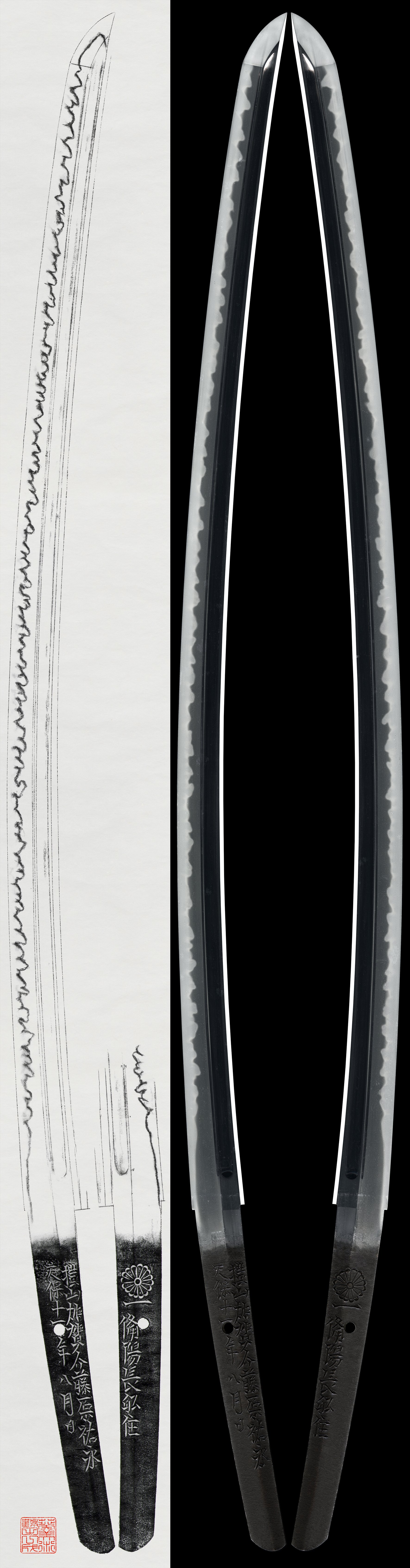
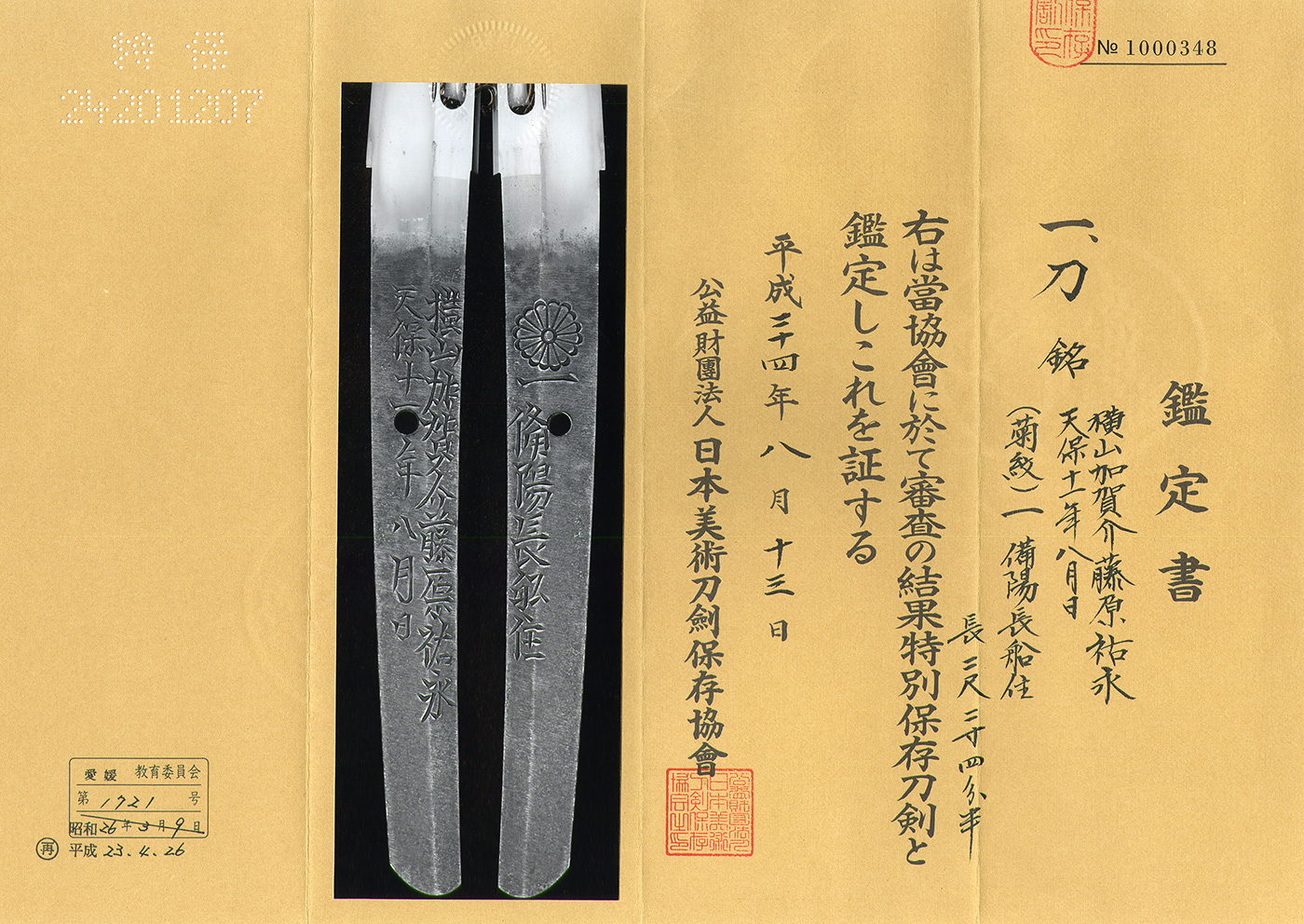
Ordering Number: AS26182Katana in Shirasaya with Koshirae (NBTHK Tokubetsu Hozon Token).Signature: Yokoyama Kaganosuke Fujiwara Sukenaga,August 1840.(Kikumon) Ichibiyo Osafune.横山加賀介藤原祐永天保十一年八月日(菊紋)一備陽長船Shinshinto: Jyo Saku: Bizen.(We divide 4 sections for each sword as Saijyo Saku, Jyojyo Saku, Jyo Saku and Regular Saku).This work is ranked as Jyojyo Saku for Yokoyama Kaganosuke Fujiwara Sukenaga.Habaki: Gold-plated double Habaki.Blade Length: 68.1 cm (26.81 in).Curvature: 2.4 cm (0.94 in).Mekugi Hole: 1.Width at Base (Motohaba): 3.09 cm (1.22 in).Width at Yokote: 2.01 cm (0.79 in).Thickness of rim (Kasane): 0.68 cm (0.27 in).Sword Weight: 650 g.Era: Edo period, Tenpo 11 (1840).Shape: A katana with standard width and thickness.It has a deep curvature and an extended kissaki.Bo-hi and soe-hi grooves are carved on both sides.Jigane: Well-forged ko-itame hada forming a refined and beautiful surface.Hamon: Nie-deki.Starting with suguha from the hamachi, it changes into gunome-midare, creating the beautiful hamon characteristic of the Yokoyama school.The boshi turns back in a rounded form.Features: This distinctive Yokoyama-style hamon could hardly be replicated outside the Yokoyama school.Even modern swordsmiths find it difficult to produce without flaws.Among their works, swords forged during the Tenpo era are especially well made, featuring well-balanced gunome-choji midare.During the Tenpo era of the Edo period, Japanese swords sold very well.This was due to the rise of the Sonnō Jōi movement, as fears of renewed conflict increased the demand for swords.Swordsmiths undoubtedly made every effort to produce works of the highest possible quality.This applied not only to Sukenaga but also to nearly all famous swordsmiths of the time.Therefore, when examining works by renowned smiths made during the Tenpo period, one can clearly see their superior workmanship.This piece is also accompanied by an excellent koshirae.Koshirae:Tsuba: Round shakudo tsuba with openwork carvings
Offered by Aoi Art
This piece has sold
24 on the market
Get an email when new Yokoyama School work hits the market.


Bizen-den · Bizen
24 pieces on the market now
| Smith | Era | Designated |
|---|---|---|
| Sukenobu祐信 | 1830-1844 | 0 |
| Suketaka祐高 | 1865-1868 | 0 |
| Sukeharu祐春 | 1864-1865 | 0 |
| Sukehiro祐廣 | 1854-1860 | 0 |
| Sukekane祐包 | 1868-1912 | 0 |
The Shinshintō revival
Around 1800 Suishinshi Masahide argued in his writings that the craft must return to the old masters’ methods: the fukkotō revival. His greatest successor Naotane worked convincingly in Bizen and Sōshū manners that had been dead for centuries.
A Hozon-certified blade judged to show notably superior workmanship and a better state of preservation. The bar is higher: re-tempered blades and most unsigned Muromachi/Edo works are excluded.
The NBTHK (Nihon Bijutsu Tōken Hozon Kyōkai, the Society for the Preservation of Japanese Art Swords) is a public-interest incorporated foundation founded in 1948 and supervised by Japan’s Agency for Cultural Affairs (Bunkachō); it is based at the Japanese Sword Museum in Tokyo. Its expert panels physically examine each submitted work (shinsa) and issue a certificate (kanteishō) ranking it by artistic and historical merit. NBTHK papers are the most widely recognized standard of authentication for Japanese swords and fittings.
NBTHK official siteIf you wish to return an item, please notify us within 3 days of receipt. After this period we cannot accept cancellations. Please ship the return to us within 5 business days. Cancellation is conditional on the item being kept in the same condition as at the time of sale, so please handle it with care.