Nobutaka is a swordsmith who represents Owari Shinto along with Masatsune and Ujifusa, and based on the meiburi, this smith is the 8th generation Owari Nobutaka. His first mei was "Nobunao," and he signed "Oyo Ju Nobunao." His name was Jinroku, later changed to Jinnoshin. He was a monjin of the 6th generation Nobutaka, but in Tenmei 3, after the death of his master, he studied under Yamato no Kami Motohira of Satsuma, and further went to Osaka to enter the mon of Ozaki Gengoemon Suketaka to study. Because the 7th generation Nobutaka was young, he was in charge of his technical instruction. For that merit, he was permitted the name "Shimizu Jinnoshin Nobutaka" and became the 8th generation. He inherited the sakufu of Ozaki Suketaka, aimed for the toranba of Tsuda Echizen no Kami Sukehiro, and resembles Suishinshi Masahide.
Because the Nobutaka family of Seki Kaji-cho died out, he lived in Nagoya Yoshida-cho and succeeded the master's house. In Kansei 2, 5th month, he received a three-man fuchi as a kakae-kaji for one generation from the Owari Tokugawa family. In Kansei 3, 2nd month, he changed his name to "Jinnoshin." In the same 7th year, 10th month, 27th day, he was ordered to perform miscellaneous duties and received two ryo of gold annually. In the same 8th year, 11th month, 18th day, he was granted an additional four-man fuchi. He retired on Bunka 10, 1st month, 29th day, and died on Tenpo 8, 9th month, 8th day. A wakizashi that is a copy of the "Oni no Hocho" signed "Shimizu Jinnoshin Nobutaka Kansei 9 nen 2 gatsu hi Utsushi Oni no Hocho Masakatsu Kono no" is famous.
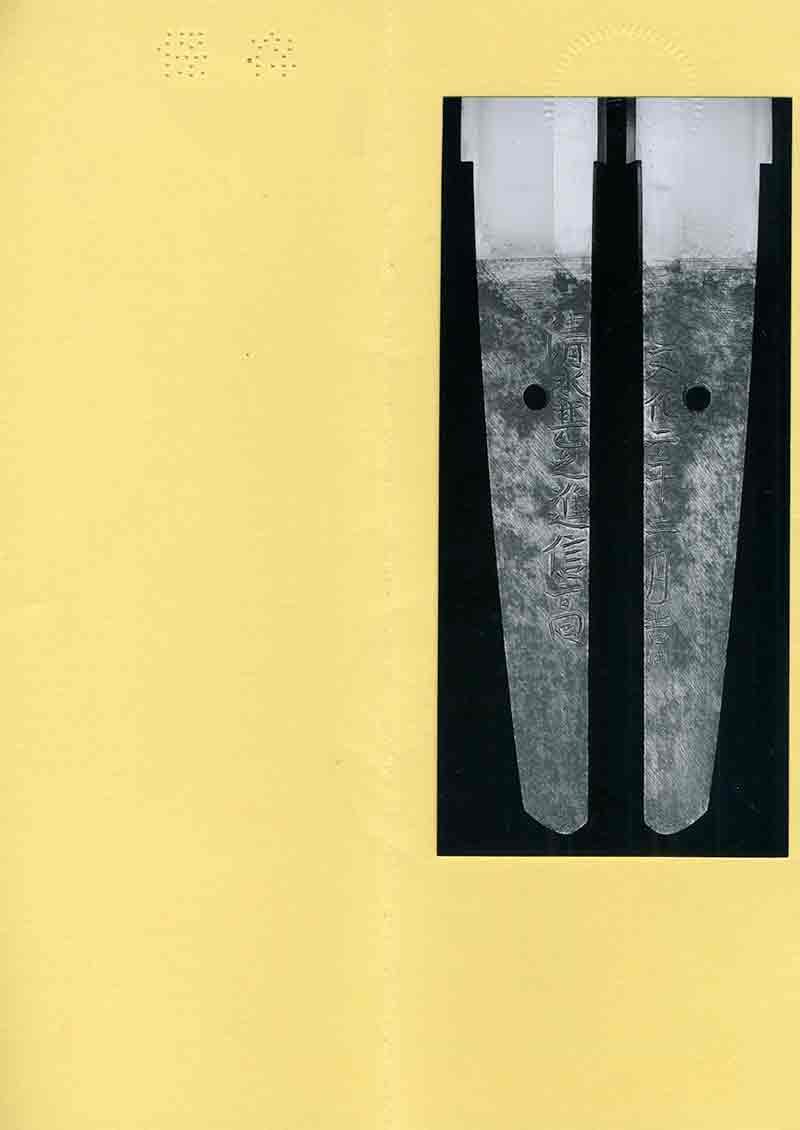
From the early Shinshinto period through Tenmei, Kansei, Kyowa, and the early years of Bunka, tosho all over the country actively produced the toranba of Osaka Shinto. This wakizashi is also a well-made work to the extent that many people, if appraising it, would see it as Suishinshi Masahide. The jiba is healthy, and not only is the deki excellent, but the preservation state of the nakago is also good, and the meiburi of Shimizu Jinnoshin is precious, not making one feel the passage of over 200 years of time.
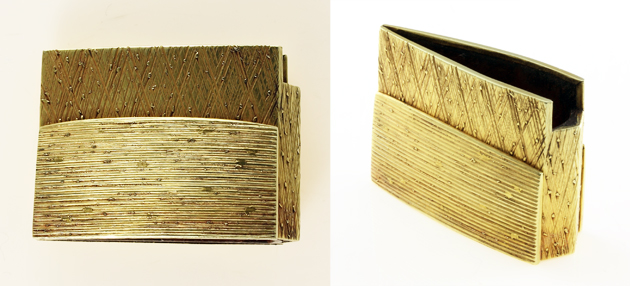
This work was handed down in the house of a retainer of the Owari Tokugawa family, and the habaki is a period Owari habaki where the kamigai is kiri and the shimogai has higaki yasuri; perhaps because the gold content is high, the gold rust has good character, and the underlying suaka is also a red hiiro-gane. The shirasaya is old, and it is thought that it was originally a tomo-tsuka.
Although not to a concerning degree, there are fine hike.
There is a small kizu below the yokote on the sashi-omote.
Machine translation from the shop's Japanese · may contain errors ·
Nobutaka is a swordsmith who represents Owari Shinto along with Masatsune and Ujifusa, and based on the meiburi, this smith is the 8th generation Owari Nobutaka. His first mei was "Nobunao," and he signed "Oyo Ju Nobunao." His name was Jinroku, later changed to Jinnoshin. He was a monjin of the 6th generation Nobutaka, but in Tenmei 3, after the death of his master, he studied under Yamato no Kami Motohira of Satsuma, and further went to Osaka to enter the mon of Ozaki Gengoemon Suketaka to study. Because the 7th generation Nobutaka was young, he was in charge of his technical instruction. For that merit, he was permitted the name "Shimizu Jinnoshin Nobutaka" and became the 8th generation. He inherited the sakufu of Ozaki Suketaka, aimed for the toranba of Tsuda Echizen no Kami Sukehiro, and resembles Suishinshi Masahide.
Because the Nobutaka family of Seki Kaji-cho died out, he lived in Nagoya Yoshida-cho and succeeded the master's house. In Kansei 2, 5th month, he received a three-man fuchi as a kakae-kaji for one generation from the Owari Tokugawa family. In Kansei 3, 2nd month, he changed his name to "Jinnoshin." In the same 7th year, 10th month, 27th day, he was ordered to perform miscellaneous duties and received two ryo of gold annually. In the same 8th year, 11th month, 18th day, he was granted an additional four-man fuchi. He retired on Bunka 10, 1st month, 29th day, and died on Tenpo 8, 9th month, 8th day. A wakizashi that is a copy of the "Oni no Hocho" signed "Shimizu Jinnoshin Nobutaka Kansei 9 nen 2 gatsu hi Utsushi Oni no Hocho Masakatsu Kono no" is famous.
From the early Shinshinto period through Tenmei, Kansei, Kyowa, and the early years of Bunka, tosho all over the country actively produced the toranba of Osaka Shinto. This wakizashi is also a well-made work to the extent that many people, if appraising it, would see it as Suishinshi Masahide. The jiba is healthy, and not only is the deki excellent, but the preservation state of the nakago is also good, and the meiburi of Shimizu Jinnoshin is precious, not making one feel the passage of over 200 years of time.
This work was handed down in the house of a retainer of the Owari Tokugawa family, and the habaki is a period Owari habaki where the kamigai is kiri and the shimogai has higaki yasuri; perhaps because the gold content is high, the gold rust has good character, and the underlying suaka is also a red hiiro-gane. The shirasaya is old, and it is thought that it was originally a tomo-tsuka.
Although not to a concerning degree, there are fine hike.
There is a small kizu below the yokote on the sashi-omote.
For two and a half centuries of peace the sword was the warrior’s legal badge rather than his weapon. Each great city developed its own manner, Edo’s tested strength against Ōsaka’s polished brilliance, until demand thinned in the era’s last decades.
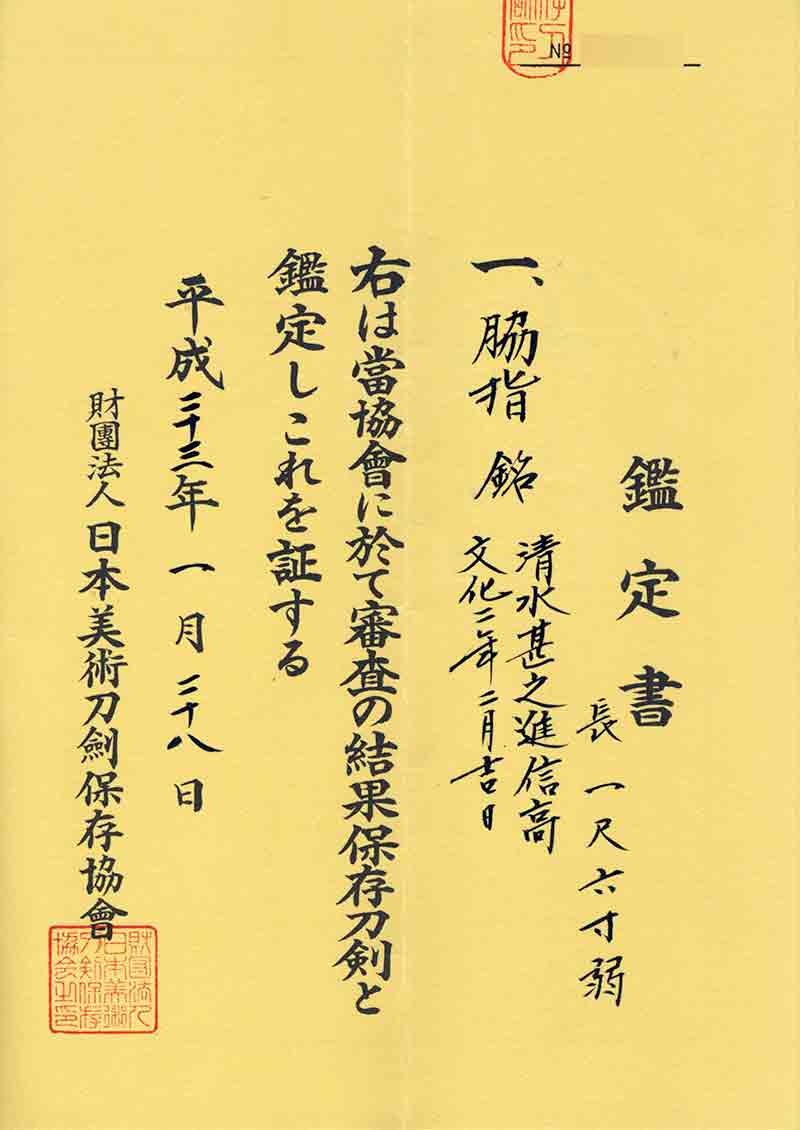
Certifies a genuine blade worth preserving: a signature confirmed correct, or, if unsigned, an era, province, and school that the NBTHK can reliably identify.
About the NBTHK›
The NBTHK (Nihon Bijutsu Tōken Hozon Kyōkai, the Society for the Preservation of Japanese Art Swords) is a public-interest incorporated foundation founded in 1948 and supervised by Japan’s Agency for Cultural Affairs (Bunkachō); it is based at the Japanese Sword Museum in Tokyo. Its expert panels physically examine each submitted work (shinsa) and issue a certificate (kanteishō) ranking it by artistic and historical merit. NBTHK papers are the most widely recognized standard of authentication for Japanese swords and fittings.
Please exercise cooling-off within 8 days of the item's arrival.
(1) We cannot accept items that have been altered or worked on in any way (e.g. test cutting, polishing or other work, display at viewing meetings, photography, taking oshigata rubbings, use for appreciation, copying of books).
(2) Return shipping is at the customer's expense.
(3) Costs other than the item price (bank transfer fees, cash-on-delivery fees, installment fees, etc.) cannot be refunded.
(4) For cash-on-delivery and similar payments, the refund is made after the payment has reached us.
(5) We cannot accept a return when a trade-in item is involved.
(6) Items delivered overseas cannot be returned or refunded (because of the time involved and, for swords, the surrender of the registration certificate and other circumstances).



 NihontoWatch