 NihontoWatchNihontoWatch
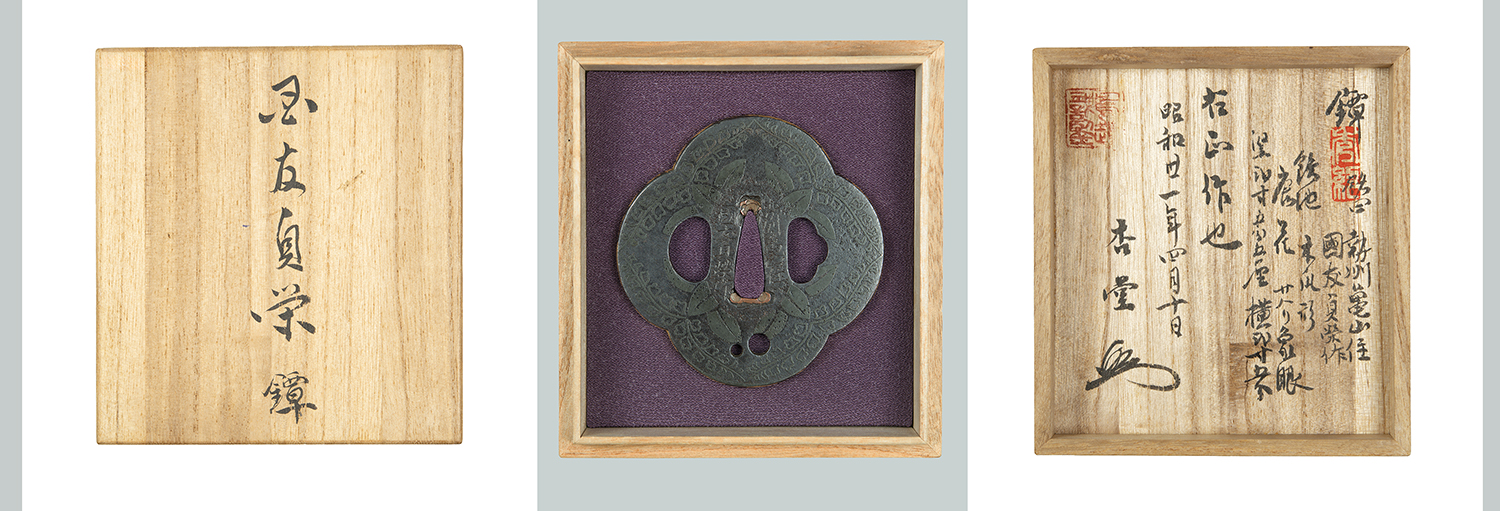
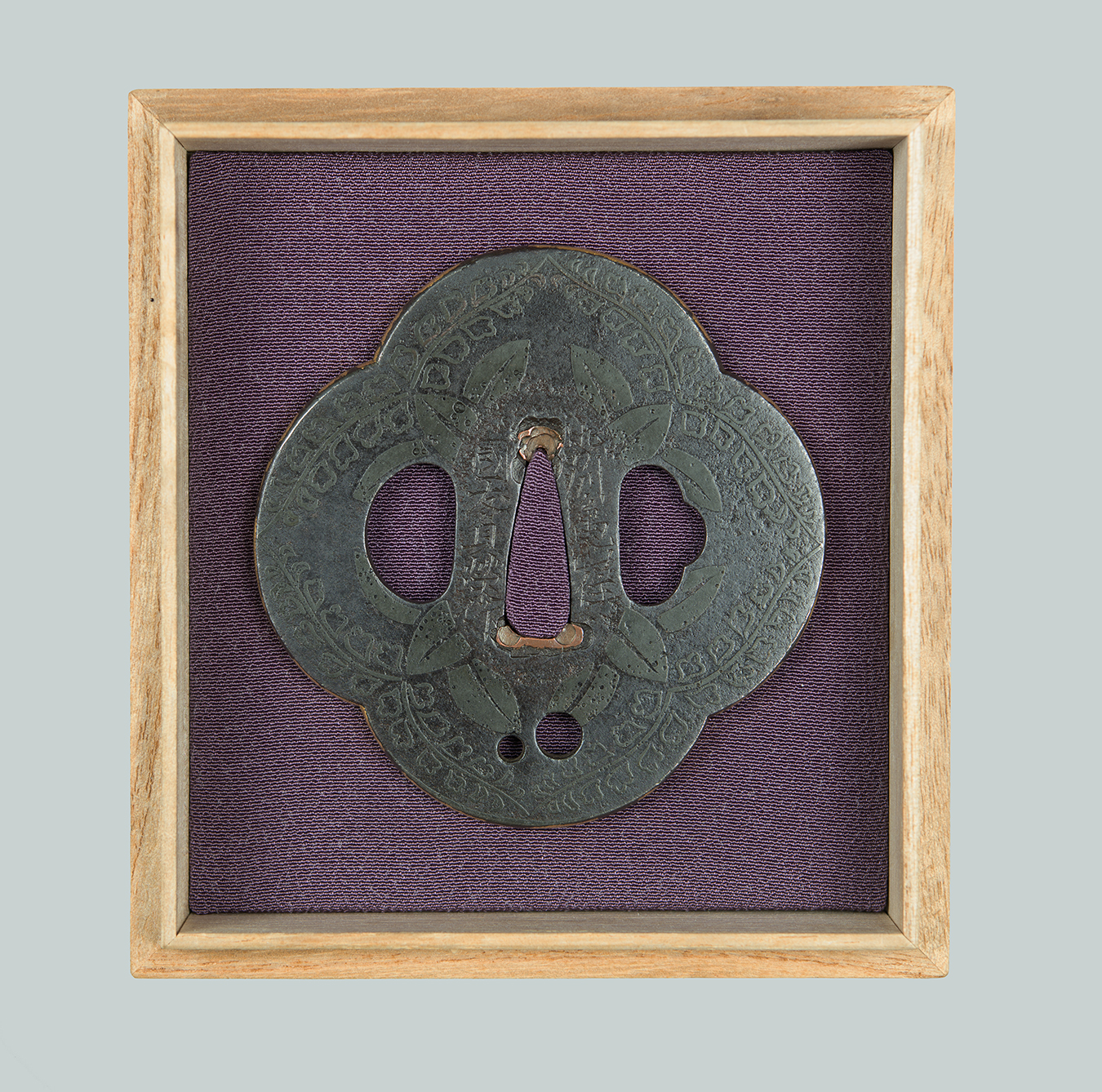
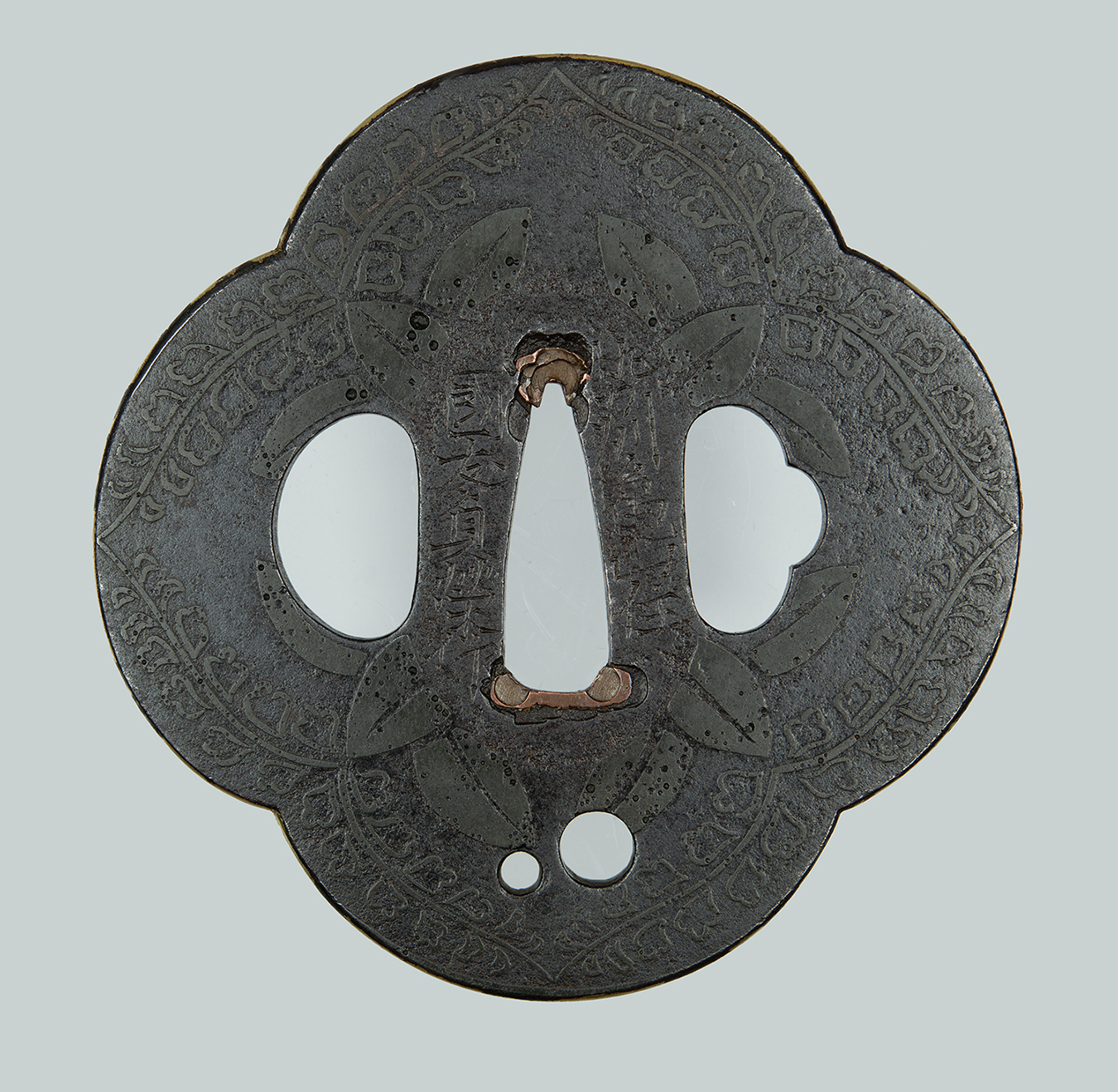
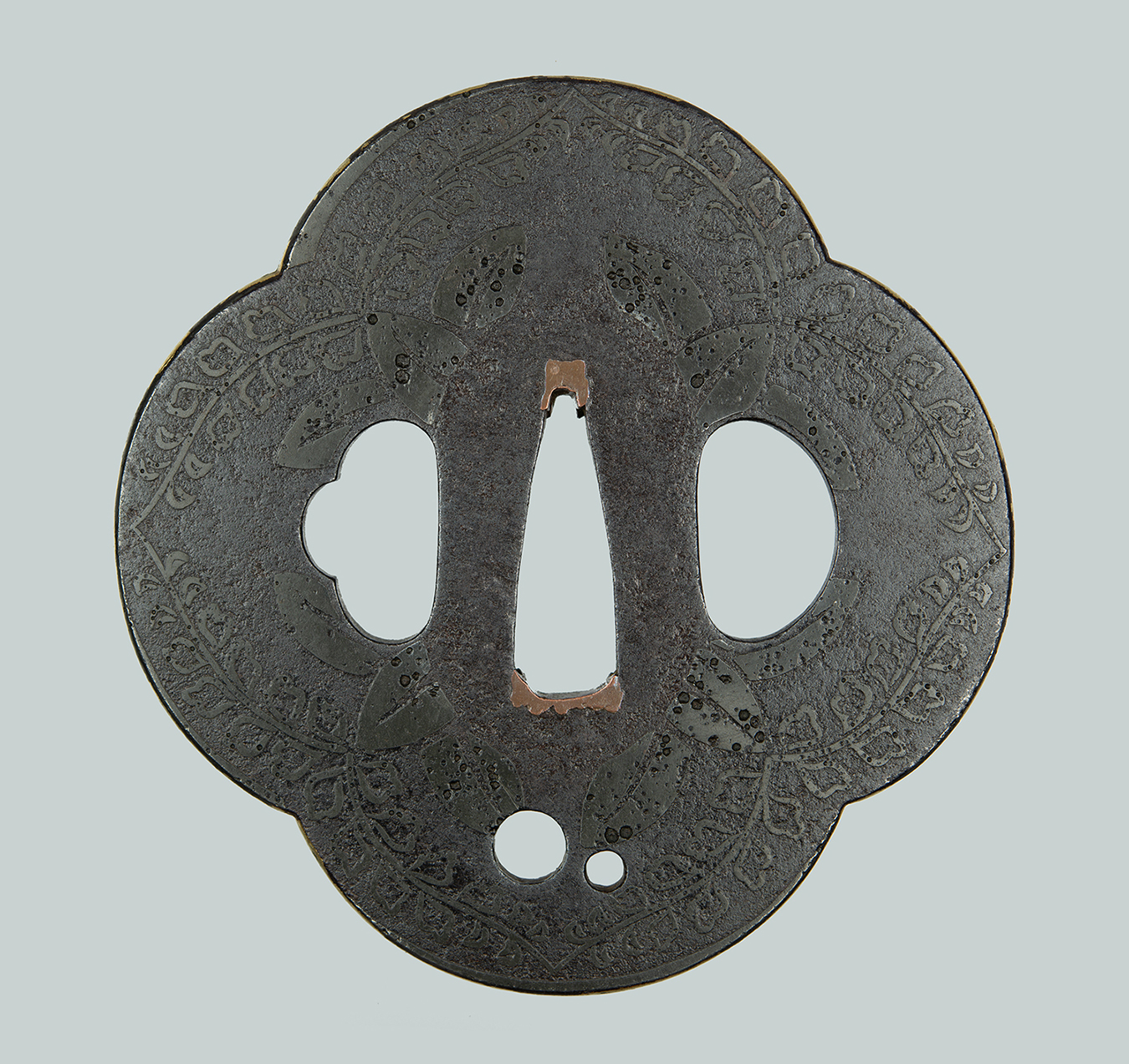
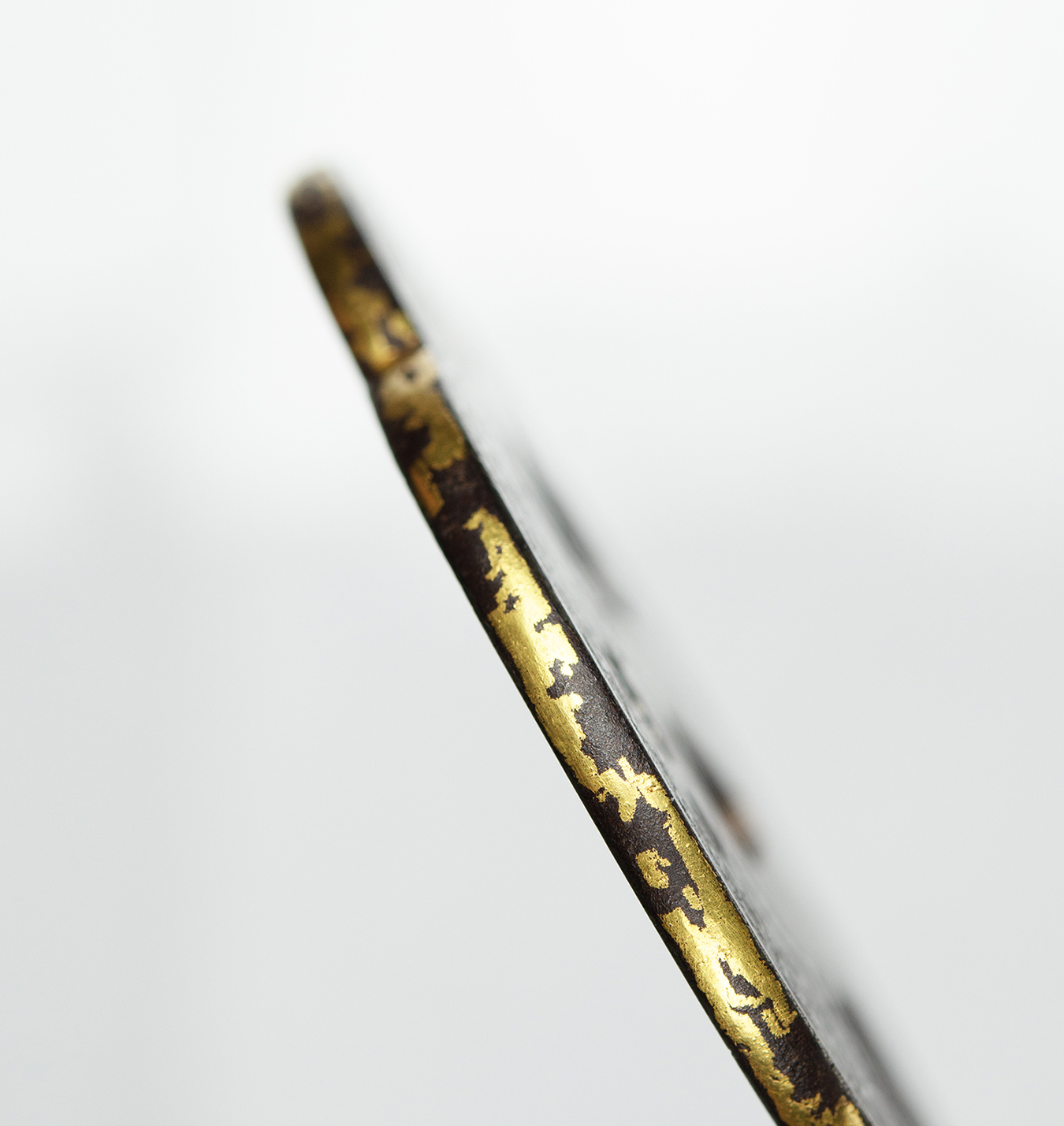
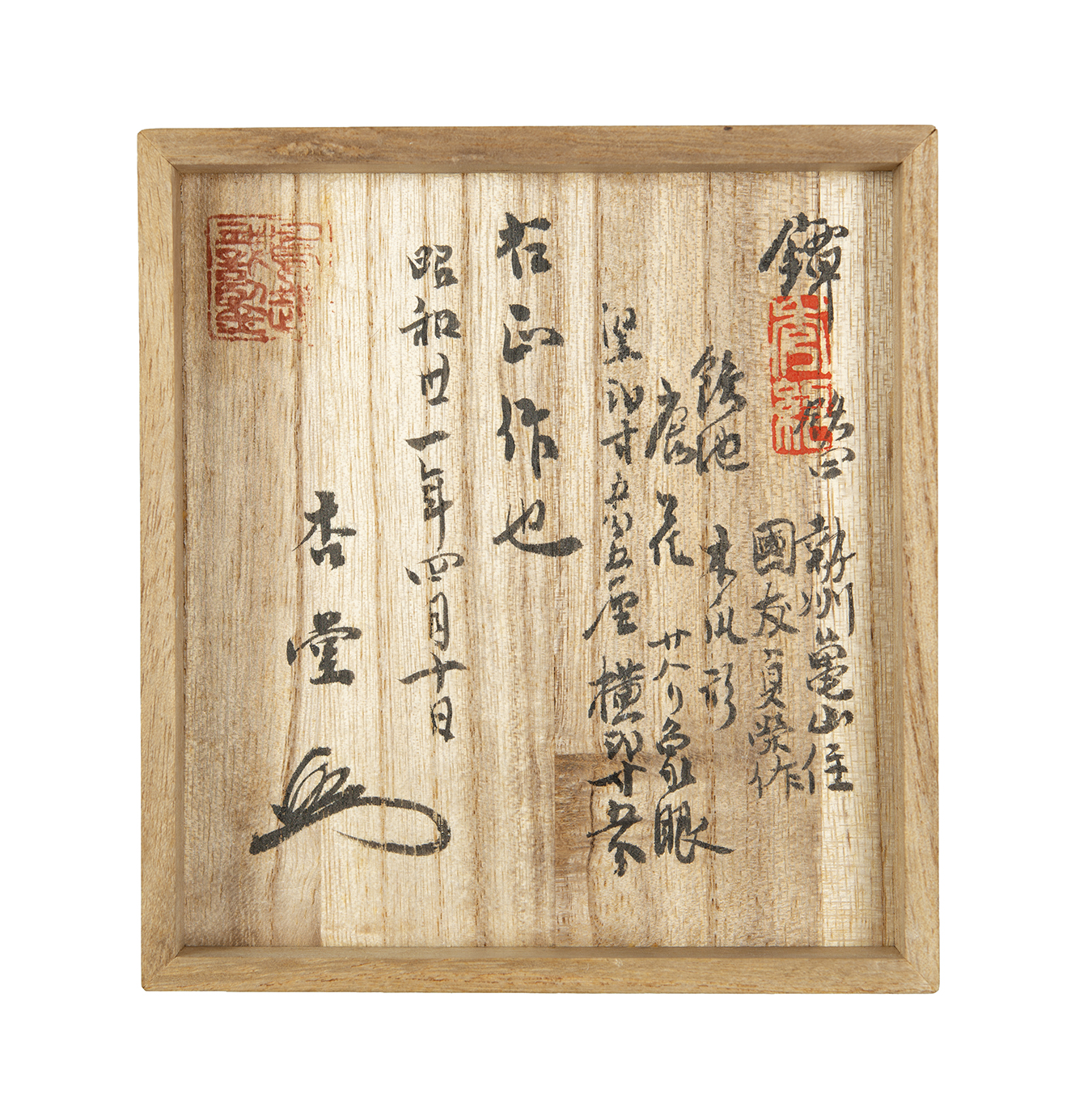
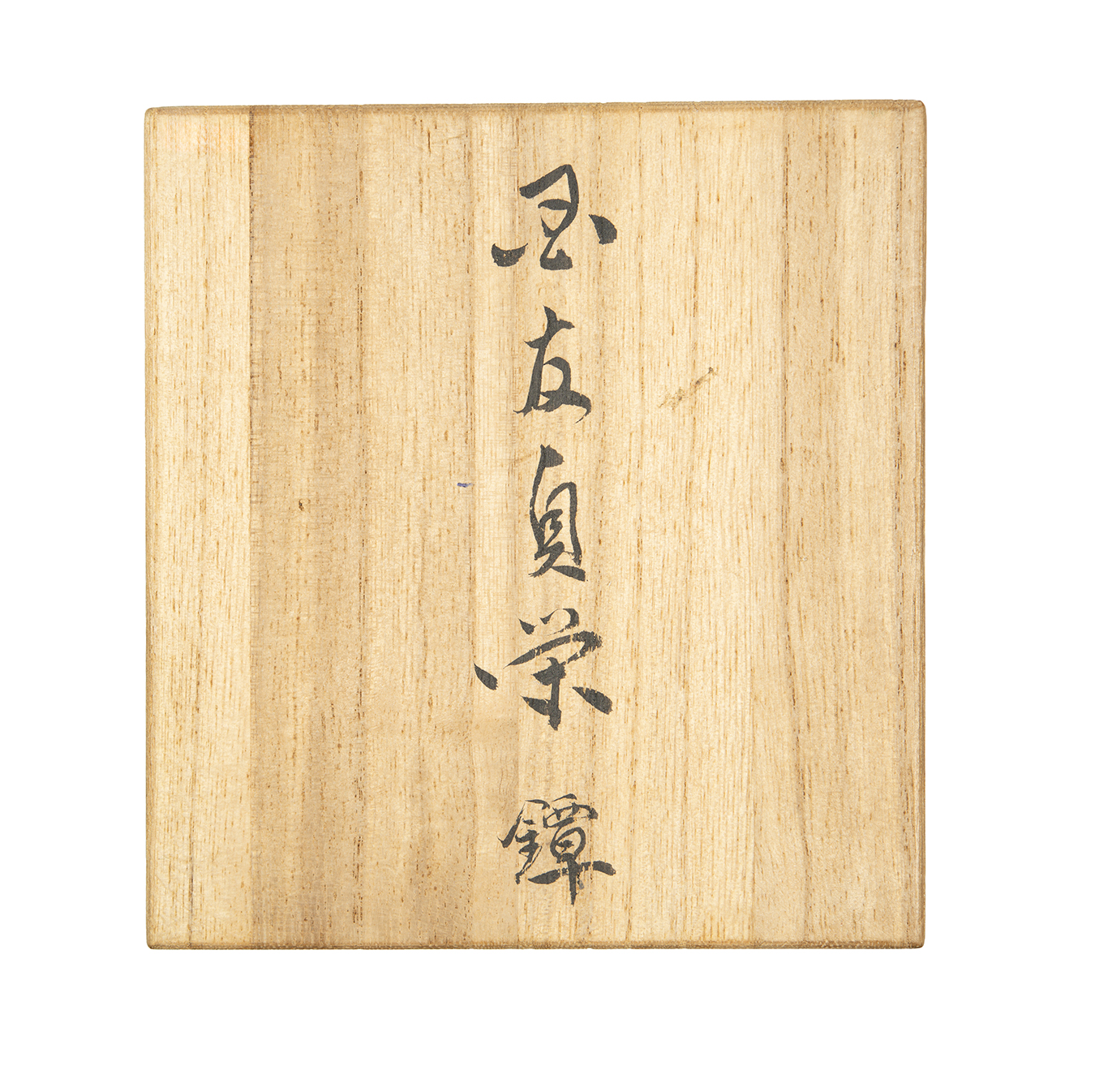
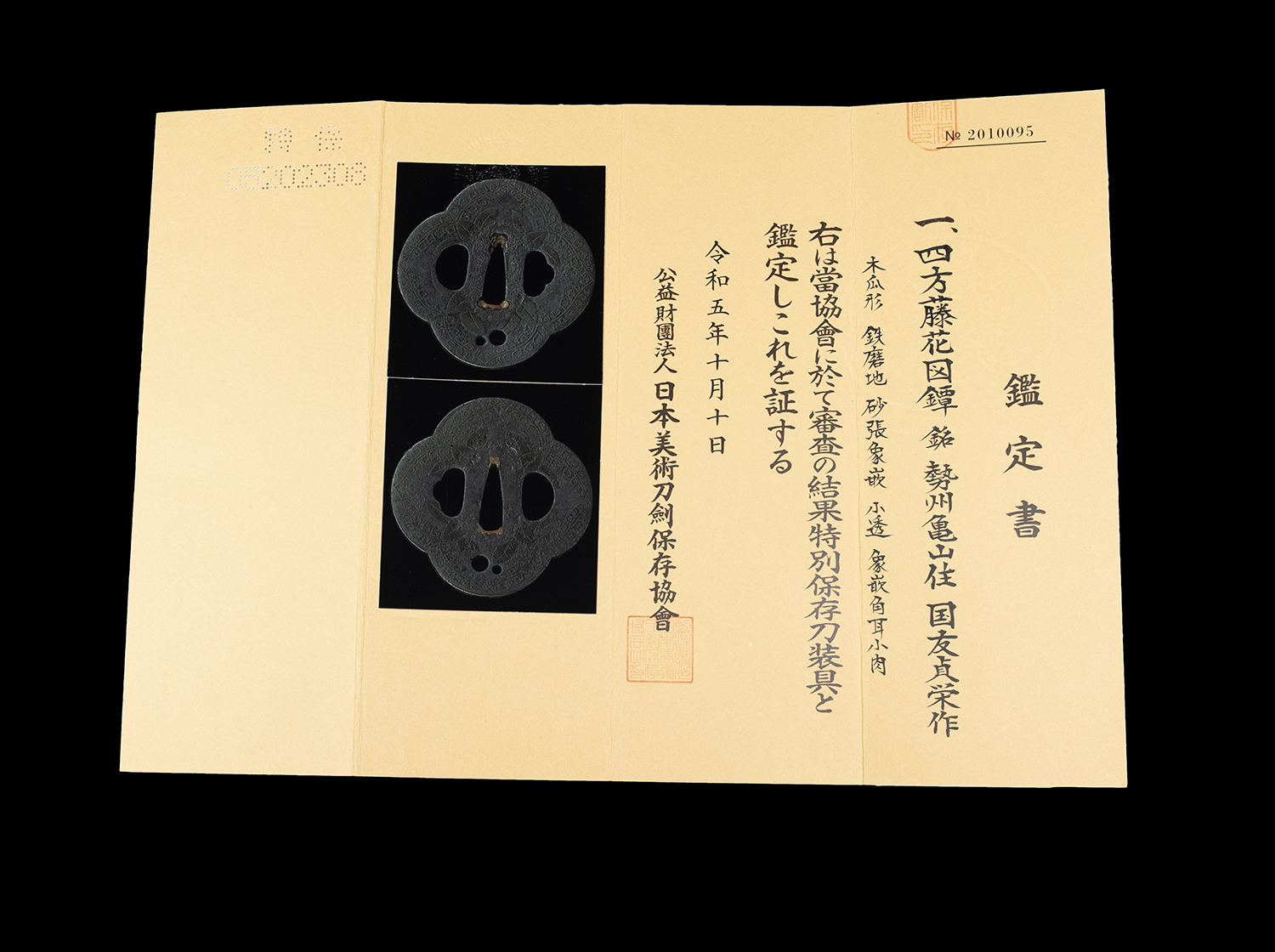
Seishu Kameyama Ju Kunitomo Teiei Saku NBTHK Tokubestu Hozon Hakogaki by Dr. Torigoye A marvelous sahari inlay Hazama tsuba by Teiei. Fully signed, "Seishu Kameyama (no) Ju Kunitomo Teie". The floral motif here is an exacting one with abundant detail and the mimi features gold zogan work that is in wonderful condition. This is accompanied by Dr. Torigoye’s hakogaki from Showa 41 (1966). The kao that Dr.Torigoye used here is the one he reserved for first class items, using one small up stroke on the left of the Kao, rather than two. It is also accompanied by an NBTHK Tokubetsu Hozon paper. This work dates to around 1702-1718, based on Teiei's few dated works. Needless to say, Teiei is a famous maker, ranked at the Yuko 優工 Level by Wakayama and examples are seldom available on the market. Hazama Tsuba: The following info is from "Tsuba, An Aesthetic Study ", by Kazutaro Torigoye and Robert Haynes. Toward consistency in future study, pronunciations used here (Kunitomo Teiei and Kunitomo Masataka) are from Wakayama's Kinko Jiten. The Hazama tsuba is one of the most sought after styles. The reason for this popularity is the use of sahari inlay in the decoration. Sahari is an alloy of several metals that is very hard. It is a wonder that any school would wish to sue such a hard metal for its inlay. There is another name for Hazama tsuba: the Kameyama school. In the period from Hoei to Kyoho (1704-36) at Kameyama, in the province of Ise, the Kunitomo family made this style of tsuba. The original members of this family were from Kunitomo village in the province of Omi, just east of Lake Biwa. In the Momoyama age they had been gunsmiths. The later descendants moved to Ise Province. The sahari style of inlay had been used by this family for generations in the decoration of gun barrels; it was not a decoration original to tsuba. The Kunitomo family adapted the technique from the decoration of guns to that of tsuba. Not all the member of the family specialized in sahari inlay. Some, such as Kunitomo Nakaaki, Masanaka, Masayuki, and Shigesada, worked in other styles of decoration. The two artists who are best known for the sahari style of inlaid tsuba are Teiei and Masataka. These two artists made the superior examples for which this school is so famous. Characteristics of Sahari Inlay Tsuba: Shape: round, goishi gata, (shape of a go piece), and most other shapes. Plate Metal: iron, of about the same hardness and quality as would be used in the making of gun barrels. Soft metals such as shakudo, brass and copper were also used. Edge: round or kakumimi koniku. Hitsuana: common Edo age shape. Thickness: average Edo age thickness. Inlay: sahari, but also gold, silver and copper were used as additional inlay. Sukashi: openwork is very rare, the majority of the decoration is on flat plate. The most important aspects of the tsuba of this school are the well-tempered iron and the excellent inlay. The plate may be made of soft metal, but these pieces do not have the proper feeling that the sahari inlay obtains when the plate is of iron, the kawarigane tsuba of this school are purely decorative and below the quality of those of iron plate. Because it was necessary for the plate to be polished, much of the hammered surface was removed, but the good quality of the iron is still apparent. The most common designs are radish, noshi, daffodil, kanji, yoshi no gawa, (flower on water), seaweed, and devil mask. There are two styles used to represent the above designs. In one, large amount of sahari inlay are used covering a majority of the web area. The second style uses less inlay, with designs of fine lines covering only a portion of the web area. The signature will be of the following types: Teiei, or Masataka, rarely Hazama. Seishu Kameyama (no) Ju Kunitomo Masataka Joshu Yodo ni oite Kunitomo Teiei Saku Seishu Sakura ni oite Kunitomo Teiei Seishu Kameyama (no) Ju Kunitomo Teiei, dated Genroku 15 (1702) in August. Also, with the same signature, Kyoho 2 (1718). Teiei and Masataka seem to be brothers, or perhaps father and son. The signature Hazama should be considered as that of Masataka. The reasons for the use of this signature are not clear. It might have been a former name of the Kunitomo family before they resided in Kunitomo. They may have come originally from Hazama. This would seem to be the best explanation. Hazama means a narrow place between the mountains. It would seem that the early signature was either Hazama or Masataka, and in later life the signature becomes longer and the dates were added. The relationship of these artists is rather uncertain at the present time. Sahari Inlay: This inlay is made from a combination of copper, tin, zinc, and lead. The mixture is then made into the shape of a stick, otherwise it could not be used as an inlay material. The stick is ground to powder and the powder is placed in the crevices on the plate that have been engraved to form the design. Then the powder is melted by fire. After the alloy has melted, and filled the areas of the design, the excess is filed from the plate and the surface is polished smooth to the face of the plate. In the old days the melting was done over a charcoal fire. Today several methods are used in the application of sahari inlay. Some artists prefer to melt the stick of alloy directly on to the plate, others still use the powder method. Because the alloy fills the area of the design unevenly, and air pockets are left in the metal from the melting process, the resulting inlay has a corroded appearance, but this is natural to the alloy and its method in melting. If it does not have this appearance it is not true sahari inlay. The color of the inlay may vary due to the differences in the percentage of the metals used in its mixture. The most common color is a lean color, but it may be lighter or darker than the basic tone.
Offered by Nihontocraft
2 on the market

Kinko · Ise
2 pieces on the market now
Where Sadahide stands among comparable artisans: across all of nihontō, and within tradition, era, and period. The tiers (Foremost · Leading · Major · Notable) weigh official designations from the NBTHK and Japan's Agency for Cultural Affairs, together with historical honors of lasting repute such as the Sansaku and Meibutsu-chō.
Select a lens to see how it's measured.
Kinko · Ise
8 pieces on the market now
The Hazama school (Hazama-ha 間派), also known as the Kameyama tsuba makers, emerged in the castle town of Kameyama in Ise Province from around the Genroku era (1688-1704). The school's founders were members of the Kunitomo (国友) family, originally matchlock gunsmiths (teppou kaji) who had lived in Omi Province. "[[c:2]] Works bear either the single-character signature "間" (Ma) or personal names such as Kunitomo Sadaei and Masaei (正栄), linking the school's named artisans to a shared workshop tradition rooted in the military metalworking crafts of the Kunitomo lineage. The Hazama school's defining contribution is sahari-zougan (佐波理象嵌), an inlay technique employing sahari, a distinctive alloy of copper, tin, and lead.
"[[c:4]] Techniques attested across the corpus include suemon-zougan (applied inlay), takabori takanikubori (high-relief carving) in shakudou, hira-zougan (flat inlay), and the yakite kusarashi (fired and corroded) surface treatment. "[[c:5]] The Hazama school occupies a singular position within the broader kinko tradition as the only lineage to have applied sahari inlay to tsuba production. " The school's origin as firearms craftsmen who transferred their metalworking mastery to a peaceful art form, and their creation of a decorative vocabulary without parallel elsewhere in tsuba production, secure their place as one of the most distinctive regional schools of the mid-Edo period. Learn more →
| Smith | Era | Designated |
|---|---|---|
| Masahide正秀 | — | 3 |
| Sadahide貞秀 | — | 3 |
| Masataka正孝 | — | 0 |
A Hozon-certified fitting of notably superior craftsmanship and condition, often with signature or workmanship of high reference value.
The NBTHK (Nihon Bijutsu Tōken Hozon Kyōkai, the Society for the Preservation of Japanese Art Swords) is a public-interest incorporated foundation founded in 1948 and supervised by Japan’s Agency for Cultural Affairs (Bunkachō); it is based at the Japanese Sword Museum in Tokyo. Its expert panels physically examine each submitted work (shinsa) and issue a certificate (kanteishō) ranking it by artistic and historical merit. NBTHK papers are the most widely recognized standard of authentication for Japanese swords and fittings.
NBTHK official site3 day inspection period on all sales. Items can be returned for any reason for a full refund, less return shipping cost. Returned items must be in the same condition as when purchased.
$4,850
Certificate reading — 銘 勢州亀山住 国友貞栄作