 NihontoWatchNihontoWatch
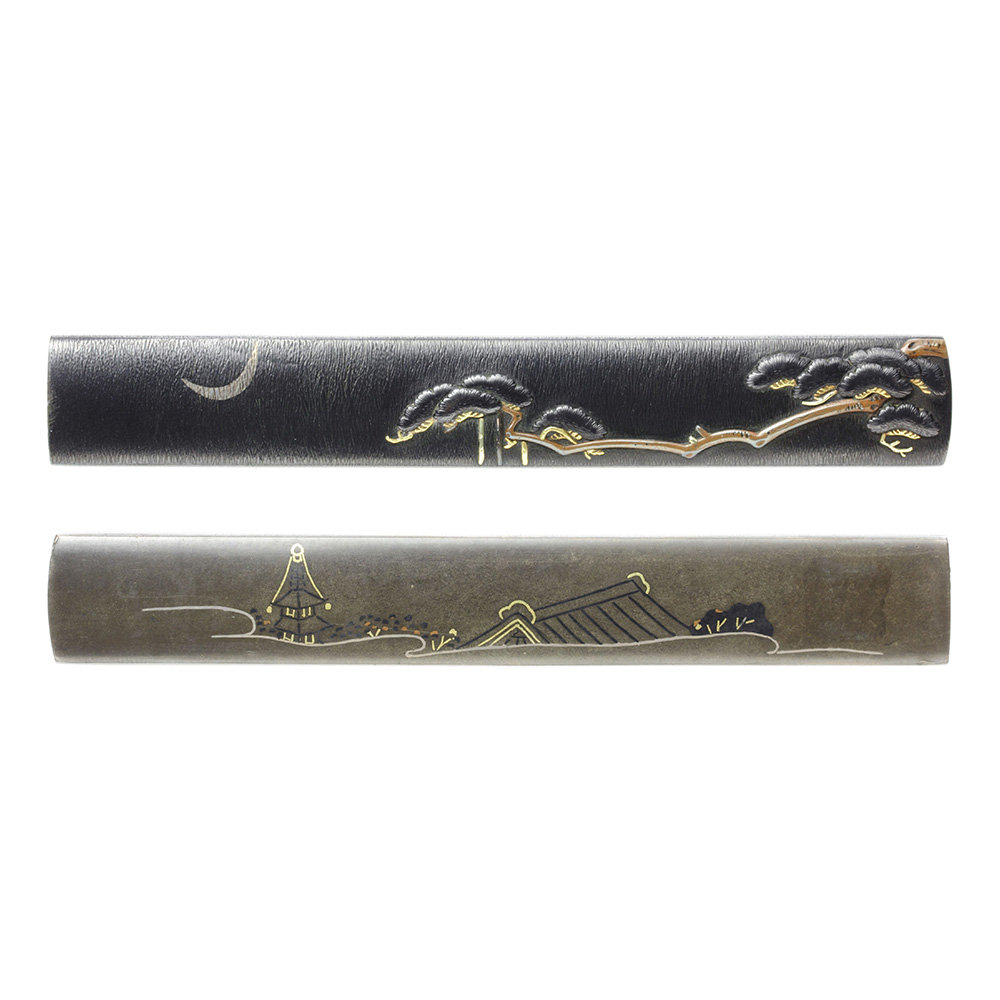
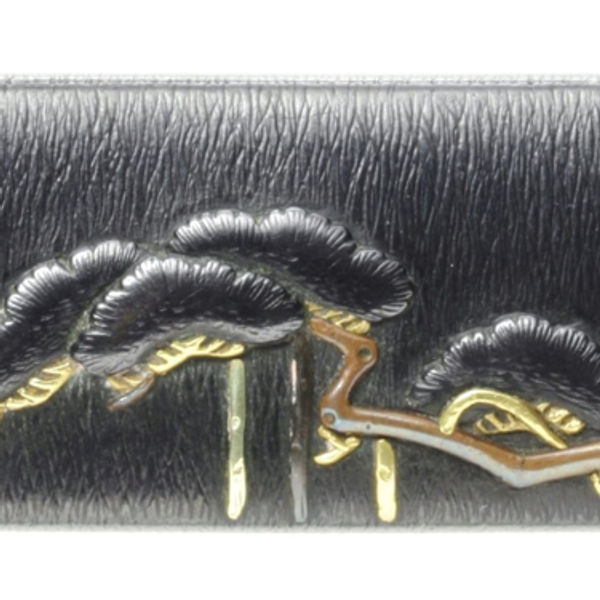
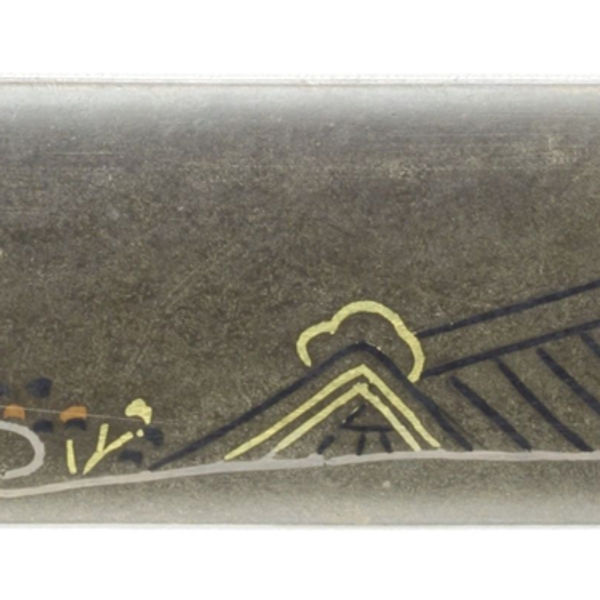
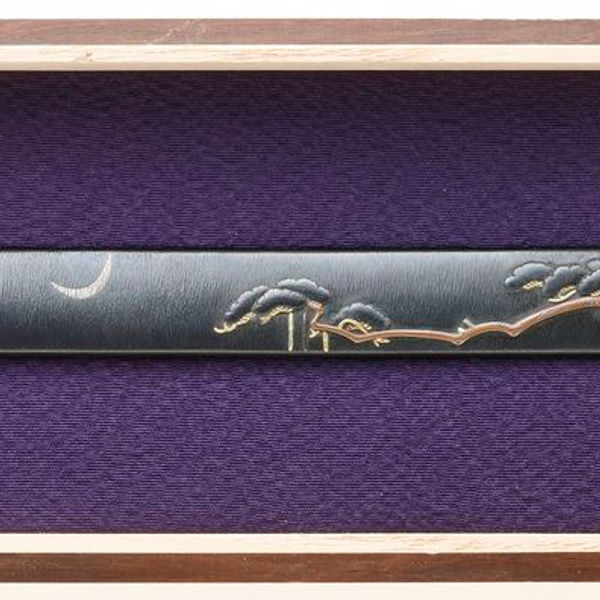
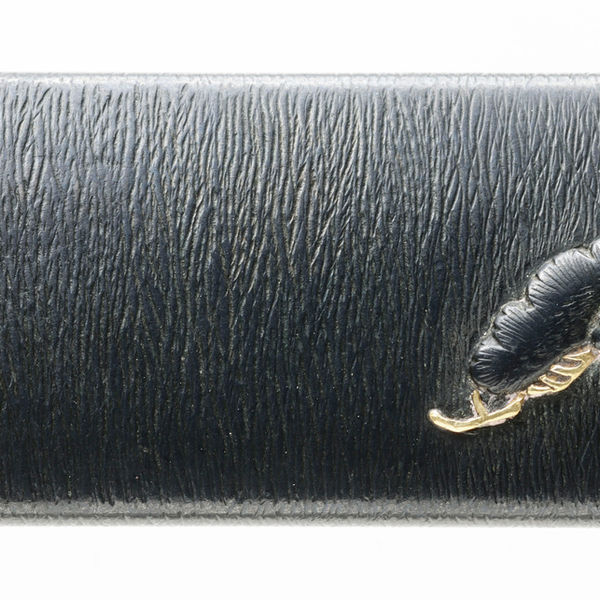
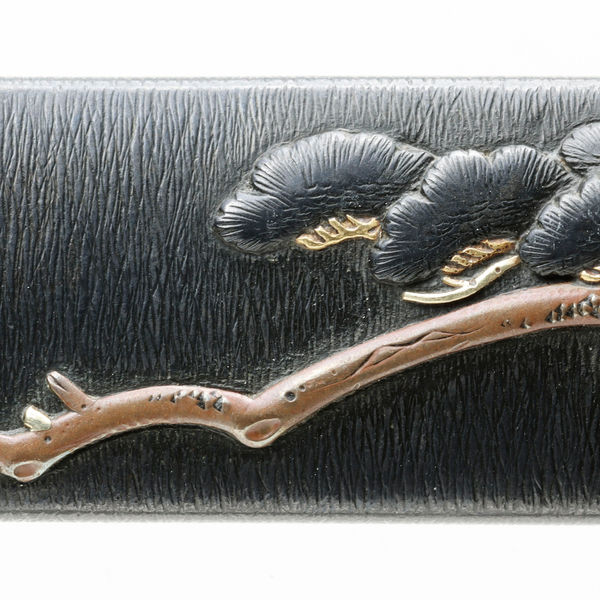
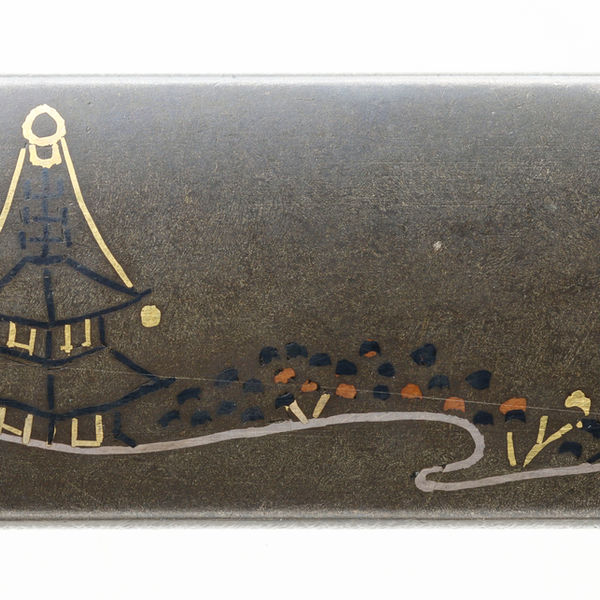
地を這う老松は、京都大原野 西山 善(よし)峯(みね)寺(でら)の遊龍の松が遍く知られている。この小柄は、裏面に寺の佇まいを添え描いて総体を美しい絵画として仕上げた作。繊細で洒落た平(ひら)象嵌(ぞうがん)で知られる加賀象嵌の特質が良く示されている。赤銅地を縦鑢に仕上げて暗夜を表現し、松の枝はくっきりとした高彫の素銅地に微細な点刻、松葉も高彫に細やかな毛彫で描き出している。裏板は深みのある朧(おぼろ)銀(ぎん)地で、金銀赤銅平象嵌による線画の表現。 (加賀)
NihontoWatchOffered by Choshuya
This piece has sold
16 on the market
Get an email when new Kaga-kinko School work hits the market.

Kaga-kinko School
Edo
Kaga
Unsigned
Hozon (NBTHK)
As written by the shop
Kinko · Kaga
16 pieces on the market now
The Kaga metalworking tradition (加賀金工) encompasses the broader community of artisans who practiced their craft under the patronage of the Maeda lords of Kaga Province, centered on Kanazawa. '" Craftsmen's families such as Kuwamura, Tsuji, Katsuki, and Koichi are said to have migrated from Kyoto to Kaga around the Kan'ei and Joo eras, where they prospered. " Named masters include Suzuki Kahei Yoshinori[[c:1]], whose signed tsuba adorns a koshirae transmitted as the possession of Maeda Yoshiyasu, fourteenth lord of the house, and Yamao Haruri (山尾春理), whose signed fuchi demonstrate the tradition's continuation into the Bakumatsu period. The collective idiom of Kaga metalwork is defined by its mastery of hira-zogan — flat inlay deploying a rich palette of colored metals against polished grounds. " The technique is said to have originated when the flat-inlay methods of stirrup-makers (abumi-shi, 鐙工) were adapted for tsuba and sword fittings. Particular refinement is achieved through manipulation of gold alloy proportions: one tsuba uses "several kinds of gold — created by altering the proportions of the alloy — imparting an even deeper tonal richness," while another distinguishes three tonal gradations within gold alone.
Alongside hira-zogan, kebori (毛彫, hairline engraving) is a constant companion technique, and the corpus extends to takabori with kin-gin iroe on shakudo nanako-ji grounds. Motifs range from literary subjects — Genji monogatari scenes rendered on bamboo blinds, folding screens, and fan panels — to naturalistic compositions of autumn grasses, massed butterflies, dianthus with brushwood fences, and heraldic programs such as the Hakutaku (白澤) guardian creature of Maeda family tradition. Works on suaka ground are noted as "comparatively rare," presenting "an archaic flavor," while polished shakudo grounds yield jet-black fields against which colored metals achieve maximum brilliance. The Kaga tradition occupies a singular position in the tosogu canon as the premier regional school of flat inlay. " Several designated works are identified as presentation pieces conceived for the highest levels of daimyo patronage. Learn more →
| Smith | Era | Designated |
|---|---|---|
| Ujitada氏忠 | — | 0 |
| Kiyonaga清永 | — | 0 |
| Katsuhisa克久 | — | 0 |
| Genroku源六 | — | 0 |
| Katsuhisa克久 | — | 0 |
Certifies a genuine fitting worth preserving: a correct signature, or, if unsigned, an identifiable era and school, with recognized artistic and craft value.
The NBTHK (Nihon Bijutsu Tōken Hozon Kyōkai, the Society for the Preservation of Japanese Art Swords) is a public-interest incorporated foundation founded in 1948 and supervised by Japan’s Agency for Cultural Affairs (Bunkachō); it is based at the Japanese Sword Museum in Tokyo. Its expert panels physically examine each submitted work (shinsa) and issue a certificate (kanteishō) ranking it by artistic and historical merit. NBTHK papers are the most widely recognized standard of authentication for Japanese swords and fittings.
NBTHK official siteIf, due to our fault, the item differs significantly from its proper condition, the item may be returned. Cooling-off is within one week of the item's arrival.