Power sat in Kamakura, but taste was still made in Kyōto. The Awataguchi school’s pear-skin steel became a byword for perfection, and the Rai line supplied dignified tachi to the court, senior warriors, and the great temples alike.
 NihontoWatchNihontoWatch
Kyoto, since the relocation of the capital to Heian-kyo in Enryaku 13 (794), has been the center of politics, economy, and culture in Japan, a place where the cutting-edge technology of the time was born and gathered, producing many master craftsmen. In this region, schools of swordsmiths such as the Sanjo school and Gojo school existed from the late Heian period, and the Awataguchi school from the early Kamakura period. Among the schools of Yamashiro Province, a lineage bearing the name "Rai" appeared from the mid-Kamakura period, with a style distinct from the Awataguchi school. With Kuniyuki as the de facto founder, this Kunitoshi is handed down as the son of Kuniyuki and was called Magotaro. Regarding the works of Rai Kunitoshi, there are Niji Kunitoshi and three-character mei of Rai Kunitoshi; whether the two are the same person or different individuals has been a subject of debate since the late Muromachi period and has not reached a settled theory even today. The style of Niji Kunitoshi consists of a grand tachi sugata reminiscent of his father Kuniyuki, with an ikubi kissaki and a hamon primarily composed of flamboyant choji. In contrast, Rai Kunitoshi has a slenderer build compared to Niji Kunitoshi, with a ko-kissaki and a style that gives an elegant and gentle impression, being suguha or sugu-cho mixed with small-patterned gunome. Due to these differences in style, and the fact that "while most works of Niji Kunitoshi are tachi and only one tanto has been handed down to the present, the three-character mei Kunitoshi has relatively many tanto," the theory that they are different people is discussed. Among the works of this smith, there exists an Important Cultural Property in the collection of the Tokugawa Art Museum inscribed with the date "Rai Kunitoshi / Showa 22 nen 10 gatsu 23 nichi □□ sai 75 (1315)". There is also a tachi in the collection of the National Museum inscribed "Kunitoshi / Koan 1 nen 12 gatsu hi (1278)"; if one estimates the birth year to be around Ninji 1 (1240) from the aforementioned three-character mei Kunitoshi, the tachi with the Koan date corresponds to a work from around age thirty-eight. If one considers that differences in the swordsmith mei and style arose from changes over the years of the same smith, the same-person theory is also supported, including the point that Kunitoshi lived a long life. Starting with Kuniyuki, the founder of the school, the direct descendants Kunitoshi, Kunimitsu, and Kunitsugu are all famous and ranked as Saijo-saku; among them, many works by this smith are designated as National Treasures, Important Cultural Properties, and Important Art Objects. With the National Treasure "Atsuta no Rai Kunitoshi" owned by Atsuta Jingu and the "Aizen Kunitoshi" passed down through the Toyotomi and Tokugawa families, many have been fascinated by this smith's works since ancient times, and with excellent cutting ability, he is also ranked as O-wazamono, being a master smith widely known to the present day. The taihai of this work has a nagasa of 2 shaku 4 sun 3 bun. Although it is o-suriage, the mihaba is firm, there is a difference between the moto and saki width, the kasane is ordinary, the shinogi-suji stands out sharply, the sori is well-applied, and it is a graceful, old-style sword sugata with a ko-kissaki characteristic of the Rai school. The jitetsu is a well-tightened itame hada with ji-nie, a well-refined hada appears throughout, and nie-utsuri stands out, resulting in an exquisite kitae. The hamon is overall small-patterned, sugu-cho mixed with togari-ba, ko-gunome, and ko-choji, with a yakiba rich in subtle variations continuing to the yokote, and the nioiguchi has ko-nie, appearing soft, bright, and very clear. The ha-machi has hotsure in places, with ashi and yo entering, and is full of hataraki. The boshi is small and midare, returning to a saki ko-maru. A kin-zogan by Honami Koson remains on the nakago. This sword is an outstanding piece by the anciently renowned Rai Kunitoshi. The characteristics of this smith are well manifested, and the yakiba in particular shows the small-patterned variations typical of old works seen in various smiths of the same period as this smith, which is a truly captivating highlight. Shirasaya, kin-paku niju habaki, Tokubetsu Hozon Token Kanteisho.
Offered by World Seiyudo
This piece has sold
Get an email when a new Rai Kunitoshi piece hits the market.

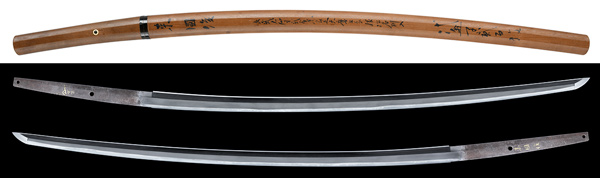

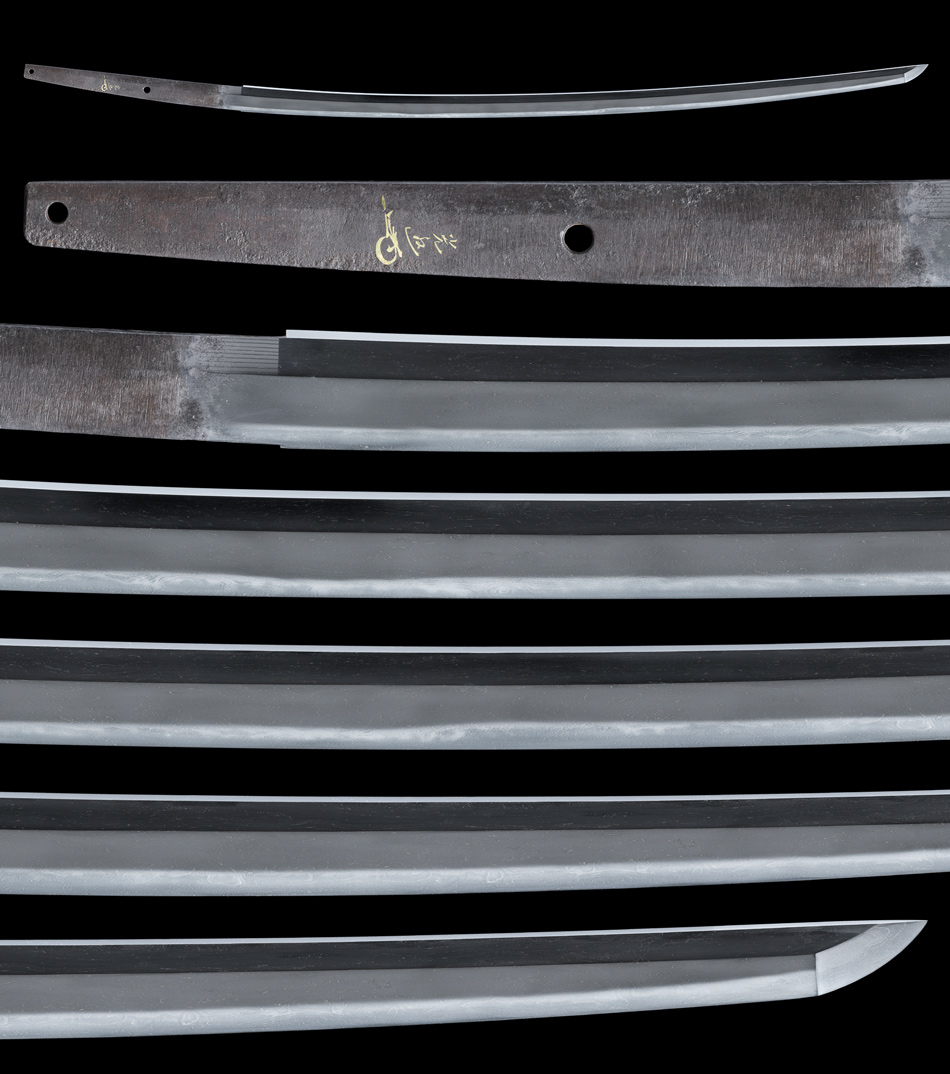
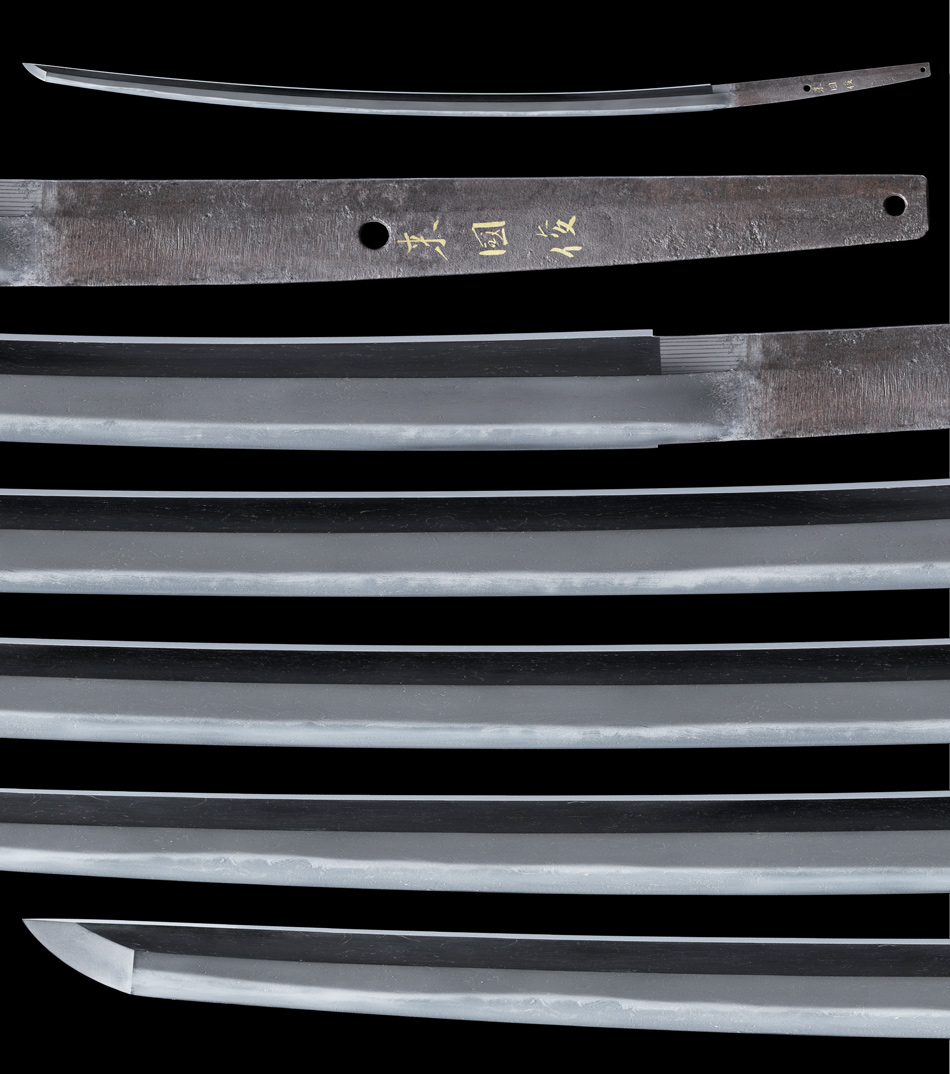
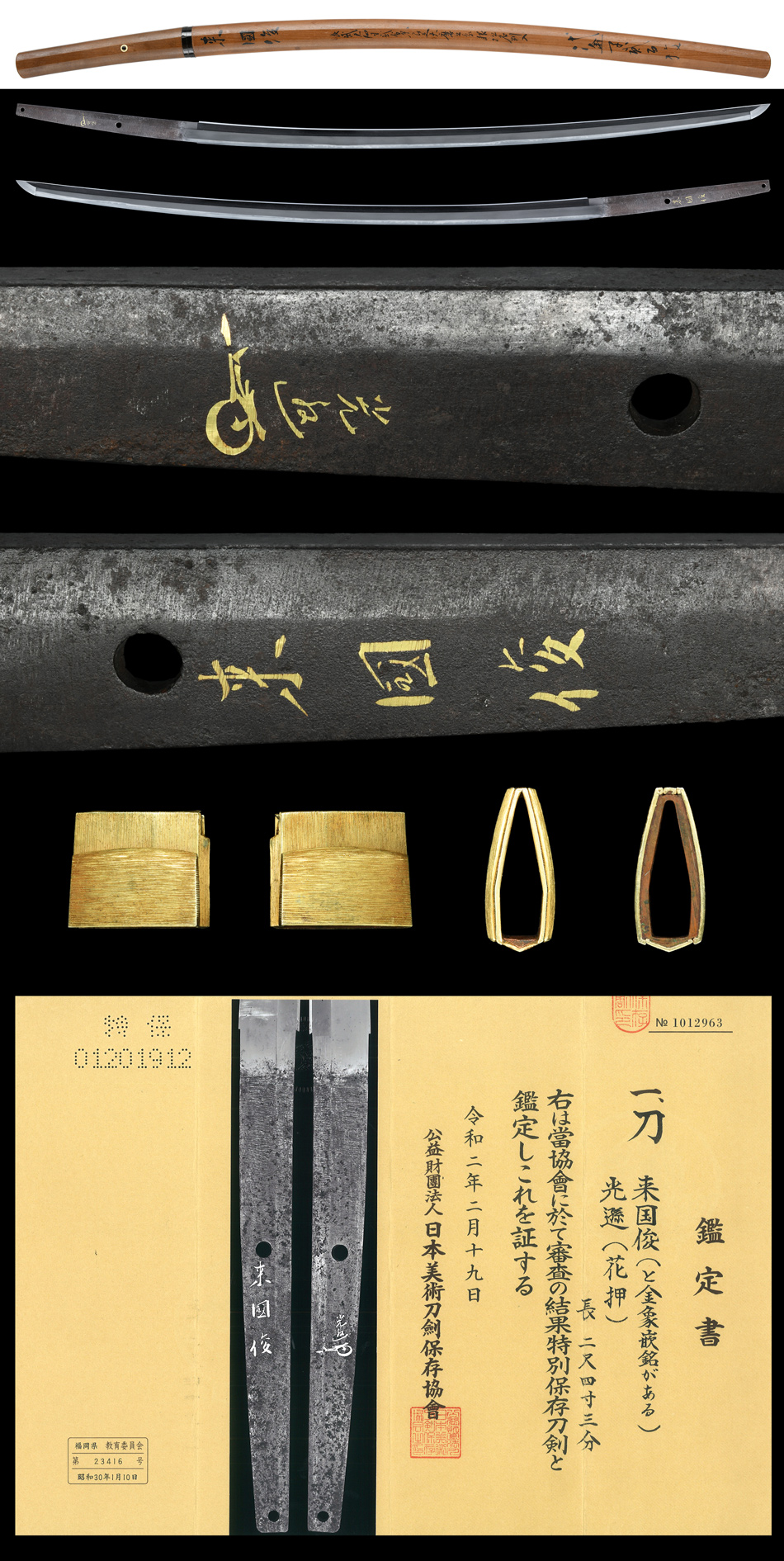
Machine translation from the shop's Japanese · may contain errors ·
Rai (Yamashiro) · Yamashiro · around 1288-1319
Fujishiro Sai-jo saku · Tōken Taikan top 1%
3 pieces on the market now
The published sources open Rai Kunitoshi's record with a single settled fact: he was "the first smith of the Rai line to crown his name with the character Rai, and all who followed took the practice from him"[[c:1]]. Traditionally the son of Rai Kuniyuki, he worked in Kyoto at the close of the Kamakura period. Dated blades open in the Shoo and Einin eras, fall silent for a time, then resume in Showa and continue through Bunpo, Gen'o and Genko. A National Treasure tachi of the Tokugawa Reimeikai, signed Rai Magotaro saku and dated Shoo 5 (1292), belongs to the first of these eras; the published sources record that Rai Magotaro is generally held to be Rai Kunitoshi, that this is the only blade signed in that form, and that its stately shape and calm Kyoto suguha allow the received view to stand[[c:2]]. A tachi of Showa 4 (1315) in the Tokugawa Art Museum bears the age inscription seventy-five (七十五歳), and a work of Genko 1 (1321), cut at eighty-two, stands near the end of his production. This run of dated pieces is the backbone of the late Kamakura Rai chronology.
His hand is the Rai mainline at its most refined. The tachi are slender or of standard width with a pronounced taper, the curvature koshi-zori, turning to a rounded wa-zori on shortened blades, and the point small or medium. On this body he burns a chu-suguha or hoso-suguha in ko-nie with ko-choji and ko-gunome mixed in; ashi and yo enter well, at times slanting toward the nakago in the Kyoto manner the published sources call kyo-sakaashi. Nijuba appears in places, fine kinsuji and sunagashi run through the ha, and the nioiguchi is tight and bright; the boshi turns in a calm ko-maru, the tip lightly swept. The judgment the published sources attach to the whole is consistent: "a refined and calm manner that is Kyoto work through and through"[[c:3]].
The jigane carries as much of the attribution as the hamon: a tightly knit ko-itame with thick, often dust-fine ji-nie, fine chikei, and a nie-utsuri standing clearly over it; one Juyo appraisal adds that "the refinement of the jigane in particular deserves special mention"[[c:4]]. Here and there the larger, softer patches the texts call Rai-hada (来肌) intrude, and on tanto the hada may flow toward masame in places, both accepted as marks of the school rather than flaws. The packed ko-itame, the fine nie over it and the standing utsuri are what the appraisals return to whenever an unsigned blade is settled on his name.
Nearly half of his published record is tanto: the sources state again and again that where the two-character Kunitoshi left a single example, the meibutsu Aizen Kunitoshi, Rai Kunitoshi left many. These are hira-zukuri and mitsu-mune, of standard width or slightly elongated, with the quiet uchi-zori of the late Kamakura period; the suguha may take a shallow notare, the kaeri of the ko-maru boshi often runs down long, and the hamachi is frequently hardened in. Carving is habitual, a katana-hi with a slender koshi-bi or suken set beside it, or bonji over gomabashi, the added side groove being a practice "peculiar to Rai work"[[c:5]]. Honma's inventory sums up the balance of his output: tachi and tanto are both plentiful, and he is a master of whom one cannot say whether the tachi or the tanto is his greater strength[[c:6]]. Suguha rules him, yet a small choji group stands at the opposite limit. Its representative is a National Treasure tachi, and a kodachi raised at the 27th Tokubetsu Juyo session, slender, high in koshi-zori, mixing large-lobed choji with the nie thick in the ha, is called "the most flamboyant range of work in his oeuvre"[[c:7]], "just evoking Niji Kunitoshi"[[c:8]]. That evocation is the heart of the school's classic question, whether the two-character Kunitoshi and the three-character Rai Kunitoshi are one smith or two. The combined dated works run from Koan 1 (1278) to Genko 1 (1321), some forty years and no strain for a single career, and counted back from the age inscription of seventy-five, the lone dated Niji blade falls at age thirty-eight. In recent years, the sources write, re-examination of the workmanship and the signature forms has brought the same-smith view toward acceptance, prompting a rethink of the two-smith position, and the choji blades above are read as key material on his side of the divide. The signatures hold further scholarship: the Gen'o pieces turn cursive enough that the notes weigh his old age against a second generation; rare works add the Minamoto surname, and Honma's inventory of the Imperial collection, recording a tachi signed Rai Minamoto Kunitoshi and dated Gen'o 3, proposes as a question for further study that the Minamoto works may be by a different smith of the same name, their workmanship otherwise no different; and on a Genko 2 folded-signature katana once worn by Shimazu Narinobu, the character kuni is cut in the manner of his pupil Rai Kunitsugu, read as one of the rare cases of the pupil signing in the master's name, the third such example known.
The contrast with Niji Kunitoshi is the standing formula of his appraisals: against a grand body with ikubi point and a flamboyant choji-dominated midare, the three-character works set a slender or standard build, a suguha or suguha with small-patterned midare, and a gentle effect overall, so the two hands can be told apart even while the one-smith question stays open. His other neighbors lie within the school. His calmest, largest tanto are read first toward Rai Kunimitsu before the dignity of the work, "a grade higher"[[c:9]], settles the attribution on Kunitoshi. His pupils Rai Kunimitsu and Rai Kunitsugu carried the school through the end of Kamakura, and the line between master and pupils is fine enough that the meibutsu Yuki Rai Kunitoshi, a tanto recorded in the Meibutsucho, is itself said at first sight to suggest Kunimitsu and Kunitsugu.
For a master of this rank he is unusually approachable. Fujishiro grades him Sai-jo saku; five of his blades are National Treasures and eight more are Important Cultural Properties, with twenty-one Tokubetsu Juyo and one hundred thirty-seven Juyo beneath them, one hundred fifty-eight blades across those two tiers. Signed work is abundant, one hundred thirty-two signed against forty-nine unsigned here, which is why his chronology can be written at all. Those thirteen blades are held as patrimony and will never trade, among them the Rai Magotaro tachi, the kodachi of Futarasan Shrine at Nikko and the tanto of Atsuta Jingu dated Showa 5 (1316); the Tokugawa Art Museum holds the age-75 tachi, and other works rest with the Tokyo National Museum, the Nezu Museum, the Sano Art Museum and the Kurokawa Institute. Forty-six blades carry recorded provenance: Toyotomi Hideyoshi, the shogun Tokugawa Iemitsu, the Owari and Kishu Tokugawa, the Maeda, the Uesugi, the Shimazu of Kagoshima and the Sanada of Matsushiro. Yet thirty-two works are recorded in private hands and many more sit in the tradeable Juyo tiers, so a suguha tanto or tachi by Rai Kunitoshi, late Kamakura Yamashiro work in its purest form, remains a goal a serious collector can actually reach; the choji blades and the dated pieces stand effectively beyond the market.
Where Kunitoshi stands among comparable artisans: across all of nihontō, and within tradition, era, and period. The tiers (Foremost · Leading · Major · Notable) weigh official designations from the NBTHK and Japan's Agency for Cultural Affairs, together with historical honors of lasting repute such as the Sansaku and Meibutsu-chō.
Select a lens to see how it's measured.
Years he was demonstrably active, proven by signed-and-dated blades
Yamashiro-den · Yamashiro
30 pieces on the market now
A calm, lustrous steel is the first thing the connoisseur's eye is meant to settle on with the Rai school: a finely forged ko-itame (小板目) worked until it is dense and refined, over which the ji-nie lies thickly in minute particles, fine chikei (地景) enter, and a nie-utsuri rises in the ji. This bright, refined jihada, the surface the trade reads as Rai-hada when its softer, looser patches intrude, is the constant beneath every manner the house produced. The school took shape in Kyoto in the mid-Kamakura period around the workshop of Rai Kuniyuki (來國行), the de facto founder of the line, whose chronology is reckoned from the Koan 1 (1278) tachi of his transmitted son. From Kuniyuki the Yamashiro-den tradition of late Kamakura was built, carried by Niji Kunitoshi, the two-character 國俊, traditionally his son and the nearest of the house to his hand; by the three-character Rai Kunitoshi, the first to crown his name with the character Rai, a practice all who followed took from him; and onward through Rai Kunimitsu (來國光), Rai Kunitsugu (來國次) and the lesser names Kunizane, Tomokuni, Kunihide and Mitsukane into the early Nanbokucho period. Whether the two Kunitoshi are one smith or two remains the classic open question of the school, argued from a span of dated work running about forty years from Koan 1 to Genko 1 (1321). What unites the house is a temper of restraint and activity at once, its life carried in the nie rather than in the height of the pattern. Against Kuniyuki's wide, suguha-toned ha and against the refined chu- or hoso-suguha of the three-character line, the smiths mix ko-choji, ko-gunome and small midare; ashi and yo enter densely, often as the Kyoto-style kyo-sakaashi (京逆足) that slants back toward the nakago, the opposite of the Bizen direction; the nioiguchi runs deep and bright, ko-nie attaches thickly, and kinsuji and sunagashi move through the body of the ha. The boshi is the school's most misjudged trait: a ko-maru drawn out by hakikake, the brushed nie of the point continuing the work of the ji below, often falling into midare-komi with a pointing tip. Muneyaki along the back recurs often enough that the records name it a habit of the Rai hand, and carving in the groove, suken or gomabashi with an added side hi, is a practice the texts call peculiar to Rai work. The strength of the nie within the ha, the utsuri rising as a nie-utsuri, and the kyo-sakaashi are precisely the marks that part Niji Kunitoshi's choji-dominant midare, which the old books said resembles the Bizen Ichimonji, from the Ichimonji itself.
Where the early masters keep this calm Kyoto register, the late line bends toward Soshu-den: Kunitsugu, counted among the Ten Brilliant Pupils of Masamune and named Kamakura-Rai, shows the strongest nie of ji and ha in the whole school, a notare mixed with gunome the earlier Rai never had. For a collector the house style is the recognition tool. An unsigned, o-suriage katana settles to Rai when the packed ko-itame, the fine nie over it, the standing utsuri and the kyo-sakaashi read together; the named smith is then fixed by degree. Niji Kunitoshi and the three-character Kunitoshi, both graded Sai-jo saku by Fujishiro, anchor the canon, the latter unusually approachable because his signed work is abundant and roughly half of it tanto, late Yamashiro work in its purest form. Kunimitsu, the most prolific and most versatile of the house, gives the impression of surpassing his father in force; Kunitsugu, graded Jo-jo saku, is the Soshu-facing edge whose signed tachi are scarce. Mitsukane, the Chudo Rai who withdrew to forge on Mt. Hiei, stands apart as the strong pole, his ji-nie laid thicker than Kunitoshi's or Kunimitsu's and likened upward to Awataguchi Yoshimitsu; the smaller Kunizane, Tomokuni and Kunihide carry the jigane a step into the Nanbokucho. The provenance roll is of the first rank, with blades worn by Ieyasu and held beside the Honjo Masamune, meibutsu such as the Aizen Kunitoshi, the Torikai Kunitsugu and the Midare-Mitsukane, and descent through the Owari and Kishu Tokugawa, the Maeda, Uesugi and Shimazu houses. Much sits locked as National Treasure and patrimony, yet the Juyo tier of the major names, and the whole record of the minor hands, remains a goal a serious collector can actually reach. Learn more →
| Smith | Era | Designated |
|---|---|---|
| Kunitoshi國俊 | 1278-1288 | 99 |
| Kuniyuki國行 | 1259-1260 | 126 |
| Kunimitsu國光 | 1326-1351 | 262 |
| Kunitsugu國次 | 1311-1327 | 65 |
| Kunitoshi國俊 | 1288-1319 | 193 |
Yamashiro in the Kamakura period
Power sat in Kamakura, but taste was still made in Kyōto. The Awataguchi school’s pear-skin steel became a byword for perfection, and the Rai line supplied dignified tachi to the court, senior warriors, and the great temples alike.
A Hozon-certified blade judged to show notably superior workmanship and a better state of preservation. The bar is higher: re-tempered blades and most unsigned Muromachi/Edo works are excluded.
The NBTHK (Nihon Bijutsu Tōken Hozon Kyōkai, the Society for the Preservation of Japanese Art Swords) is a public-interest incorporated foundation founded in 1948 and supervised by Japan’s Agency for Cultural Affairs (Bunkachō); it is based at the Japanese Sword Museum in Tokyo. Its expert panels physically examine each submitted work (shinsa) and issue a certificate (kanteishō) ranking it by artistic and historical merit. NBTHK papers are the most widely recognized standard of authentication for Japanese swords and fittings.
NBTHK official siteNo cooling-off period or returns; refund only if the purchased sword is proven fake, capped at purchase price (excludes commission sales, accessories, auction items).