The twentieth century nearly killed the craft twice: wartime distortion, then the occupation ban. The NBTHK’s founding in 1948 and licensed forging from 1953 rebuilt the sword as an art, crowned by Living National Treasures and the mukansa rank.
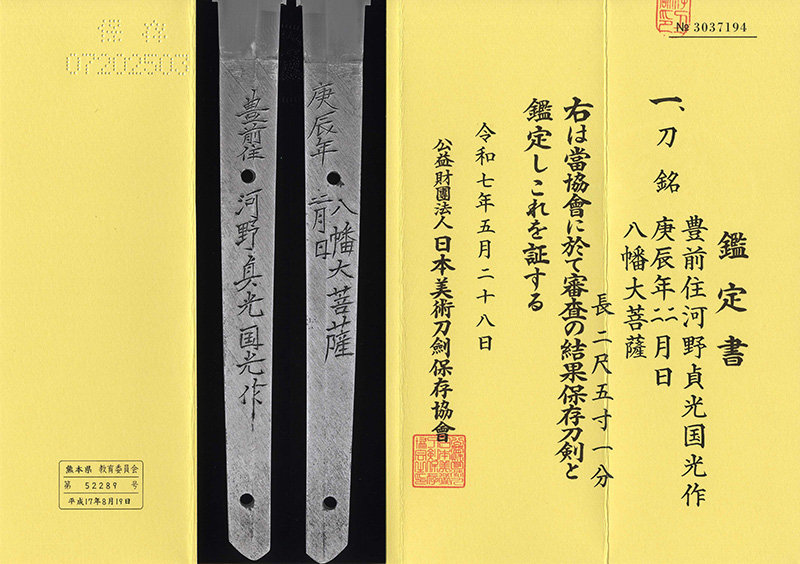
The real name of the swordsmith Kono Sadamitsu is Kono Hiroshi, born in Showa 25, residing in Shimohonjo, Saigawa-machi, Miyako-gun, Fukuoka Prefecture. Initially, he studied swordmaking under his biological father, the first generation swordsmith Kunimitsu (Sa Kunimitsu) (Buzen Ju Kono Kunimitsu), and for that reason, Sadamitsu initially called himself (Sa Kunimitsu the second generation). Later, in Showa 50, he became a student of the late Living National Treasure swordsmith Gassan Teiichi and trained in swordmaking, toshin bori, and other skills. His high level of skill was recognized by the late swordsmith Gassan Teiichi, and he was granted the character "Sada" by his master; thereafter, he signed as "Sadamitsu". A swordsmith devoted to research, he pursued the original function and functional beauty of the nihonto—that it does not break, does not bend, and cuts well—and is called the modern-day Kotetsu, being the preeminent modern swordsmith in terms of sharpness; he has an established reputation for the beauty and excellent sharpness of his works, receiving high praise from martial artists. Since the passing of the swordsmith Sadamitsu, his popularity has increased even further. He received many awards, such as the Doryoku-sho at the Shinsaku Meito Ten. *While this work is formally a gassaku with his father, the swordsmith Kunimitsu, it is in substance a work by the swordsmith Sadamitsu.
Kono Sadamitsu河野貞光
Offered by E-sword
This piece has sold
Get an email when a new Kono Sadamitsu piece hits the market.


Machine translation from the shop's Japanese · may contain errors ·
Buzen · around 1950-2013
2 pieces on the market now
Shōwa to the present: destruction and revival
The twentieth century nearly killed the craft twice: wartime distortion, then the occupation ban. The NBTHK’s founding in 1948 and licensed forging from 1953 rebuilt the sword as an art, crowned by Living National Treasures and the mukansa rank.
Certifies a genuine blade worth preserving: a signature confirmed correct, or, if unsigned, an era, province, and school that the NBTHK can reliably identify.
The NBTHK (Nihon Bijutsu Tōken Hozon Kyōkai, the Society for the Preservation of Japanese Art Swords) is a public-interest incorporated foundation founded in 1948 and supervised by Japan’s Agency for Cultural Affairs (Bunkachō); it is based at the Japanese Sword Museum in Tokyo. Its expert panels physically examine each submitted work (shinsa) and issue a certificate (kanteishō) ranking it by artistic and historical merit. NBTHK papers are the most widely recognized standard of authentication for Japanese swords and fittings.
NBTHK official siteCooling-off (returns or exchanges) is accepted within 3 days of the item's arrival. Return shipping and refund transfer fees are the customer's responsibility. Fees other than the item price (transfer fees, credit card fees, etc.) cannot be refunded. Returns and refunds are not available for overseas destinations.