The Shintō era was largely invented in Kyōto: Umetada Myōju’s workshop trained the movement, Horikawa Kunihiro raised a generation, and the Hon’ami appraisers, who held no forge, governed the meaning of famous blades.
 NihontoWatchNihontoWatch
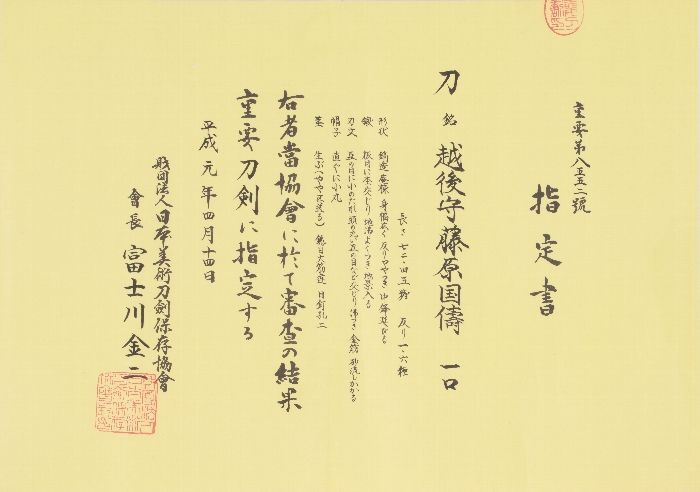
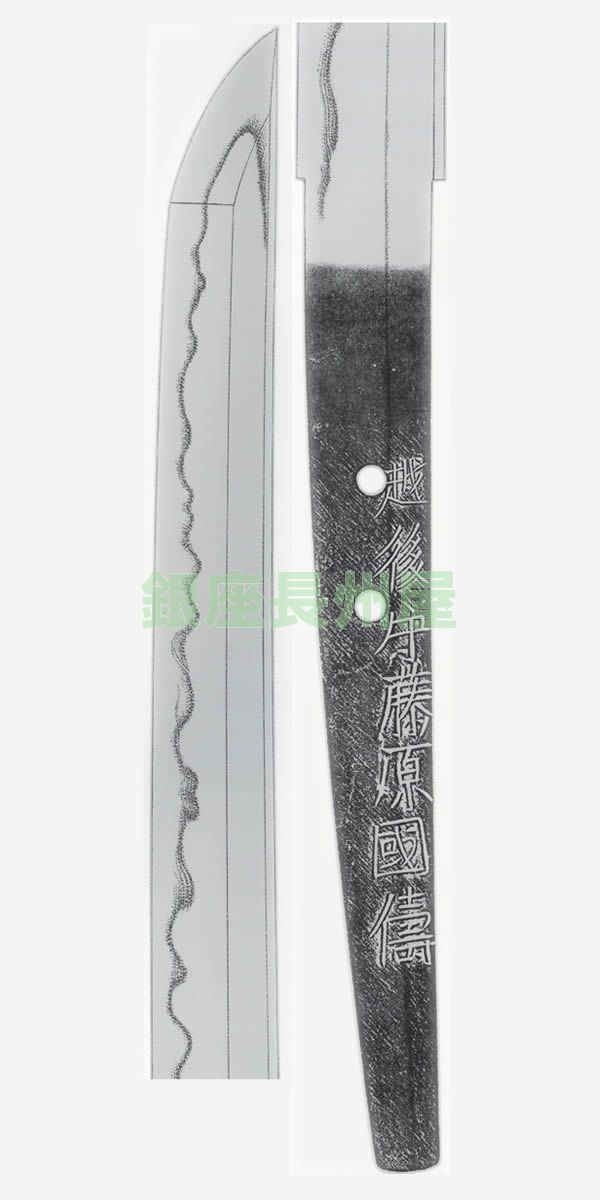
A katana by Echigo no Kami Kunitomo (Note 1), a monjin said to be the nephew of Horikawa Kunihiro. This is a cherished blade formerly owned by Mr. Ise Torahiko, who was known as a collector of the Kunihiro school. Born into a former hatamoto family, Mr. Ise served as the head of the film department of the Sumo Association and learned sword appreciation under the guidance of Dr. Sato Kanzan and Dr. Honma Kunzan, who were both sumo enthusiasts. Captivated by Kunihiro's great humanity—transcendently devoting himself to the path of sword forging he believed in and training many excellent disciples—and his powerful, unartful style, Mr. Ise collected works of high scholarly value and superior quality, including Kunihiro's Yamanbagiri katana (Juyo Bunkazai) and works by monjin such as Kuniyasu, Kunimichi, and Kunitomo. The katana by Kunitomo in the title is a blade that fascinated Mr. Ise. It has a wide mihaba, thick kasane, somewhat high sori, and a relaxed, powerful sugata. The jitetsu is itame mixed with moku and masagoke, the hadame stands out, and thick chikei enter, making the jihada overflow with vitality; tobiyaki enter, and it is covered in pure white nie particles, full of elasticity and a sense of moisture, additionally possessing the texture described as zanguri (Note 2), which is the unartful technical flavor unique to Horikawa-mono. The hamon is gunome with ko-notare, including angular ha, togari-gokoro ha, and double gunome arranged with a slight sakagakari; nie like fine masago attaches thickly, fine kinsan and sunagashi are present, nie-ashi enter, and the inside of the ha is strongly nie-duki with extremely high brightness. The boshi has deep yaki with nie, is hakikake, and returns in komaru with a long kaeri. The large-sized mei characters, carved with strong chisel pressure using a thick chisel into the deep rust-colored nakago, clearly show Kunitomo's individuality where the characters become larger toward the end. The style is characteristic of Kunitomo, reminiscent of Izumi no Kami Kanesada in the near sense and Shizu Kaneuji in the distant sense. This is a masterpiece that allows one to feel the great humanity of Kunitomo, who assisted Kunihiro, guided juniors such as Kunisada and Kunisuke, and contributed to the creation of Shinto. Note 1... There is a gassaku with Kunihiro (owned by Wakayama Toshogu; Juyo Bunkazai). Note 2... A state where itame-hada is mixed with mokume and masame, and despite the forging not being coarse, the hada appears to stand out due to the active presence of chikei, is expressed as zanguri. There is a study (Mr. Ito Sanpei's "Zanguri-ko") suggesting the etymology comes from a soft, plump texture or a natural, flavorful appearance (Kyoto dialect), or a sense of charm felt because it is broad/rough (tea utensil appreciation terminology), but the meaning seems to differ regarding sword jitetsu.
NihontoWatchOffered by Choshuya
This piece has sold
64 on the market
Get an email when new Horikawa School work hits the market.









Machine translation from the shop's Japanese · may contain errors ·
Shinto · Yamashiro
64 pieces on the market now
At Ichijo Horikawa in Kyoto, from Keicho 4 (1599), Horikawa Kunihiro gathered the pupils whose work the published sources name with his own as the opening of the shinto age. Kunihiro himself reached forging late and by a roundabout road. Born Tanaka and serving as a warrior under the Ito of Obi castle in Hyuga, he wandered the provinces after that house fell, forging where he stopped, his earliest dated blade cut in Hyuga in Tensho 4 (1576); his itinerant Tensho-uchi looked to late Soshu and late Seki, often run toward a hitatsura-like effect over devotional carving. The settlement in Kyoto changed that. There his stated aim, the sources write, lay in the revival of the Soshu-den tradition, the leaning strongest toward Shizu, and around that ideal he trained the men who carried his manner forward: Dewa no Kami Kunimichi, Kuniyasu, Osumi no Jo Masahiro, Echigo no Kami Kunitomo, the elder Kunisada and Kunisuke, with later and minor hands reaching Settsu, Echizen and Edo. Many of them, born like the master at Obi, followed him from Hyuga to the capital. The shared vocabulary is read first in the steel. The school forges an itame mixed with mokume that stands up, the grain raised into the loose, granular surface the commentaries name outright, the zanguri hada particular to Horikawa work, with ji-nie lying thick and chikei entering; on many blades a mizukage rises obliquely from the machi. Over that ground the prime manner is the Keicho-shinto sugata, wide with little taper and an extended chu-kissaki or o-kissaki, the build likened to a Nanbokucho odachi cut down, tempered in a notare and gunome with thick nie, sunagashi and long kinsuji, the nioiguchi often sinking into shizumi. Within that frame the pupils diverge sharply.
Kunimichi runs the flamboyant Shizu copy fully out and turns his boshi pointed in the Mishina manner, the Sanpin boshi the school otherwise does not show. Masahiro keeps the same Soshu-den worked at lower temperature, his temper calm and his mokume conspicuous; Kuniyasu and Kunitsugu stand closest of all to the master and signed for him. Kunitomo turns alone toward late Seki, his gunome round-headed and his chisel the finest in the group, and the elder Kunisada and Kunisuke carry the zanguri steel south into Osaka, the latter keeping the Ishido clove he was born to. Hiroyuki holds suguha over a blackish steel that recalls old Yamato, and the two Echizen Kunikiyo forge a dark, dense hokkoku-gane under a calm chu-suguha. A collector seeks Horikawa because the school stands at a hinge: Kunihiro is read as the first hand of the new-sword age, and the line he taught runs forward into the Osaka tradition through Kunisada and Kunisuke and into Echizen through Kunikiyo. To kantei the work, read the steel first, the standing zanguri surface and the oblique mizukage, then the sinking nioiguchi and the Soshu-revival notare with its sunagashi and kinsuji; the individual hand declares itself in the departures, Kunimichi's pointed boshi, Kunitomo's Seki gunome and compact tang, Kuniyasu's reversed file marks and two-character mei, Hiroyuki's kiri-yasuri. The founder and his closest pupils sit at the top of the line, Kunihiro signing almost everything he made, the large kata-ochi two-character mei beside his long residence signatures; because Kuniyasu, Masahiro, Kunitsugu and Hiromi worked as his daisaku, a share of the blades signed Kunihiro are in fact theirs. Provenance runs through the houses of the founder's own story and of the country, the Hyuga Ito he had served, the Shimazu of Kagoshima, the Imperial Family and Toyotomi Hideyori, with the tachi Kunihiro dedicated to the Hataeda Hachimangu still in the shrine's keeping. A signed Horikawa blade reaches a private collection only from time to time, carrying on its nakago the hand with which the new sword begins. Learn more →
| Smith | Era | Designated |
|---|---|---|
| Kunihiro國廣 | 1573-1613 | 147 |
| Kunimichi國路 | 1615-1624 | 75 |
| Kunisada國貞 | 1624-1646 | 87 |
| Kunitomo國儔 | 1596-1615 | 27 |
| Masahiro正弘 | 1596-1615 | 16 |
Kyōto: the revival workshop
The Shintō era was largely invented in Kyōto: Umetada Myōju’s workshop trained the movement, Horikawa Kunihiro raised a generation, and the Hon’ami appraisers, who held no forge, governed the meaning of famous blades.
A blade of top-grade workmanship and condition, formally judged to rank with a nationally recognized Important Art Object (Jūyō Bijutsuhin). Awarded only at the NBTHK’s competitive annual examination.
Of Japan’s roughly 2.5 million registered swords, only 12,348 (about 1 in 202) have ever attained Jūyō.
The NBTHK (Nihon Bijutsu Tōken Hozon Kyōkai, the Society for the Preservation of Japanese Art Swords) is a public-interest incorporated foundation founded in 1948 and supervised by Japan’s Agency for Cultural Affairs (Bunkachō); it is based at the Japanese Sword Museum in Tokyo. Its expert panels physically examine each submitted work (shinsa) and issue a certificate (kanteishō) ranking it by artistic and historical merit. NBTHK papers are the most widely recognized standard of authentication for Japanese swords and fittings.
NBTHK official siteIf, due to our fault, the item differs significantly from its proper condition, the item may be returned. Cooling-off is within one week of the item's arrival.