The swordsmith Shinkai lived in Hizen-cho, Higashimatsuura-gun, Saga Prefecture (present-day Karatsu City), and his real name was Inoue Gen.
He was a descendant of the Hizen swordsmith lineage that continued from the Edo period, and his teacher was his father, the swordsmith Hakuryushi Tadataka (Inoue Tadataka), who was hailed as a "Great Wazamono of the Showa era."
Although he also signed with the mei "Hizen no Kuni Tadatoshi," works signed with the mei "Shinkai" are known as some of the finest wazamono of modern times, boasting outstanding sharpness.
He received numerous awards such as Nyusen, and left behind masterful works that copied the famous Hizen smiths Mutsu no Kami Tadayoshi and Inoue Shinkai.
Due to his small output (limited number of productions), opportunities for his work to appear on the market are extremely rare.
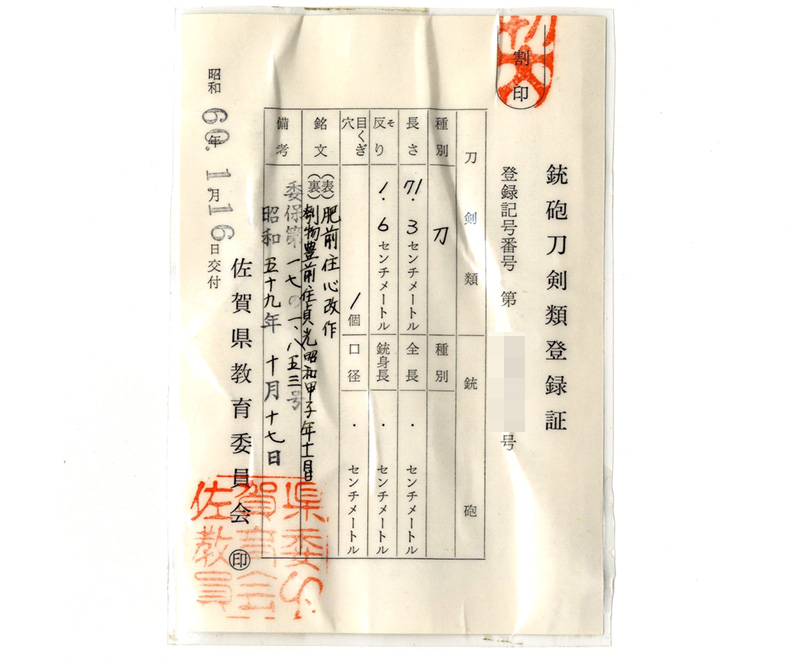
The nakago records that the horimono is the work of the swordsmith Kono Sadamitsu, who also has an established reputation for toshin-bori, making this an even more unusual and precious work.
*Swordsmith Kono Sadamitsu
The real name of the swordsmith Kono Sadamitsu was Kono Hiroshi, born in Showa 25, and he lived in Shimohonjo, Saigawa-machi, Miyako-machi, Fukuoka Prefecture.
At first, he studied sword making under his biological father, the first generation swordsmith Kunimitsu (Sa Kunimitsu) (Buzen-ju Kono Kunimitsu), and for that reason, the swordsmith Sadamitsu initially called himself (Sa Kunimitsu the second generation).
Later, in Showa 50, he became a student of the late Living National Treasure swordsmith Gassan Sadaichi and trained in sword making and toshin-bori.
His high level of skill was recognized by the late Gassan Sadaichi, and he was granted the character "Sada" by his teacher, after which he signed as "Sadamitsu."
He was a swordsmith devoted to research, pursuing the original function and functional beauty of the Japanese sword—that it does not break, does not bend, and cuts well—and he was hailed as the foremost among modern swordsmiths for sharpness, called the Kotetsu of today, with a reputation for the beauty and excellent cutting ability of his works, receiving high praise from martial artists.
Since the death of the swordsmith Sadamitsu, his popularity has increased even further.
He received numerous awards such as the Doryoku-sho at the Shinsaku Meito Ten.
Machine translation from the shop's Japanese · may contain errors ·
The swordsmith Shinkai lived in Hizen-cho, Higashimatsuura-gun, Saga Prefecture (present-day Karatsu City), and his real name was Inoue Gen.
He was a descendant of the Hizen swordsmith lineage that continued from the Edo period, and his teacher was his father, the swordsmith Hakuryushi Tadataka (Inoue Tadataka), who was hailed as a "Great Wazamono of the Showa era."
Although he also signed with the mei "Hizen no Kuni Tadatoshi," works signed with the mei "Shinkai" are known as some of the finest wazamono of modern times, boasting outstanding sharpness.
He received numerous awards such as Nyusen, and left behind masterful works that copied the famous Hizen smiths Mutsu no Kami Tadayoshi and Inoue Shinkai.
Due to his small output (limited number of productions), opportunities for his work to appear on the market are extremely rare.
The nakago records that the horimono is the work of the swordsmith Kono Sadamitsu, who also has an established reputation for toshin-bori, making this an even more unusual and precious work.
*Swordsmith Kono Sadamitsu
The real name of the swordsmith Kono Sadamitsu was Kono Hiroshi, born in Showa 25, and he lived in Shimohonjo, Saigawa-machi, Miyako-machi, Fukuoka Prefecture.
At first, he studied sword making under his biological father, the first generation swordsmith Kunimitsu (Sa Kunimitsu) (Buzen-ju Kono Kunimitsu), and for that reason, the swordsmith Sadamitsu initially called himself (Sa Kunimitsu the second generation).
Later, in Showa 50, he became a student of the late Living National Treasure swordsmith Gassan Sadaichi and trained in sword making and toshin-bori.
His high level of skill was recognized by the late Gassan Sadaichi, and he was granted the character "Sada" by his teacher, after which he signed as "Sadamitsu."
He was a swordsmith devoted to research, pursuing the original function and functional beauty of the Japanese sword—that it does not break, does not bend, and cuts well—and he was hailed as the foremost among modern swordsmiths for sharpness, called the Kotetsu of today, with a reputation for the beauty and excellent cutting ability of his works, receiving high praise from martial artists.
Since the death of the swordsmith Sadamitsu, his popularity has increased even further.
He received numerous awards such as the Doryoku-sho at the Shinsaku Meito Ten.
The twentieth century nearly killed the craft twice: wartime distortion, then the occupation ban. The NBTHK’s founding in 1948 and licensed forging from 1953 rebuilt the sword as an art, crowned by Living National Treasures and the mukansa rank.
We could not find an authenticity certificate on the seller’s listing. Japanese swords and fittings are normally papered by the NBTHK (or the NTHK). Without one, the attribution is the seller’s own assessment and has not been independently verified — treat it with caution and ask the dealer about certification before buying.
Cooling-off (returns or exchanges) is accepted within 3 days of the item's arrival. Return shipping and refund transfer fees are the customer's responsibility. Fees other than the item price (transfer fees, credit card fees, etc.) cannot be refunded. Returns and refunds are not available for overseas destinations.



 NihontoWatch