Perry’s arrival in 1853 unraveled the Tokugawa peace and created the first mass demand for working swords in two centuries. Kiyomaro, called the Masamune of Yotsuya, died on its eve; Munetsugu and Yukihide carried the boom to the end.
 NihontoWatchNihontoWatch
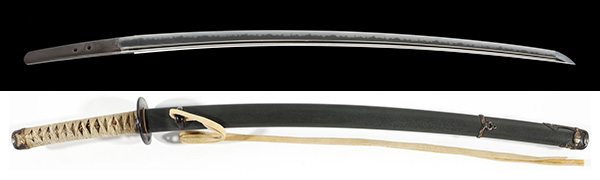
A review of the Items/ Monthly magazine "Ginza Joho" This is a record of an old mei passed down in a sayagaki, and is not a mei that can be confirmed at present. However, when appreciating the Oei Bizen style appearing in the sugata and jitetsu, the lineage told by the Meiji era sayagaki is exceptionally interesting. Sayagaki dated Meiji 25. Old mei "Bishu Osafune Yasumitsu" and dated Oei 24 August. It praises it as a "flawless and peerless josaku," and records the intent to produce koshirae featuring dragon motifs throughout and to maintain it with great care. Nagasa is 2 shaku 2 sun 9 bu 3 rin, approximately 69.5 centimeters. The mihaba is ordinary but the kasane is thick, with a high koshizori leading to a chu-kissaki. In the sugata with bo-hi carved through on the omote and ura, an elegant, antique atmosphere reminiscent of a tachi lingers. The sugata is not delicate, but gives a sense of inner strength. Nevertheless, the overall lines are beautiful, bringing to mind the swords of Oei Bizen.
NihontoWatchOffered by Choshuya
2 on the market


Machine translation from the shop's Japanese · may contain errors ·
Iwaki · around 1861-1864
Fujishiro Chu-jo saku · Tōken Taikan top 76%
2 pieces on the market now
Bakumatsu: the last war market
Perry’s arrival in 1853 unraveled the Tokugawa peace and created the first mass demand for working swords in two centuries. Kiyomaro, called the Masamune of Yotsuya, died on its eve; Munetsugu and Yukihide carried the boom to the end.
Certifies a genuine blade worth preserving: a signature confirmed correct, or, if unsigned, an era, province, and school that the NBTHK can reliably identify.
The NBTHK (Nihon Bijutsu Tōken Hozon Kyōkai, the Society for the Preservation of Japanese Art Swords) is a public-interest incorporated foundation founded in 1948 and supervised by Japan’s Agency for Cultural Affairs (Bunkachō); it is based at the Japanese Sword Museum in Tokyo. Its expert panels physically examine each submitted work (shinsa) and issue a certificate (kanteishō) ranking it by artistic and historical merit. NBTHK papers are the most widely recognized standard of authentication for Japanese swords and fittings.
NBTHK official siteIf, due to our fault, the item differs significantly from its proper condition, the item may be returned. Cooling-off is within one week of the item's arrival.
¥1,000,000