Power sat in Kamakura, but taste was still made in Kyōto. The Awataguchi school’s pear-skin steel became a byword for perfection, and the Rai line supplied dignified tachi to the court, senior warriors, and the great temples alike.
 NihontoWatchNihontoWatch
Fujishima is a place name in Echizen, and the school flourished from the late Kamakura period with the first generation Tomoshige as the founder until the Edo period. The first generation Tomoshige is said to be a pupil of Rai Kunitoshi, and it is said that there are few extant signed works. Furthermore, there is a ubu nakago signed tachi by the first generation Tomoshige from the late Kamakura period designated as an Important Art Object at Atsuta Jingu, but currently, the mei is unclear and cannot be read, making it the same as mumei. Generally, Hokuriku mono from later periods are said to be lower quality works with dark jigane and uneven nie, but works from the late Kamakura period to the Nanbokucho period are completely different and are high quality works. This work is a late Kamakura period piece and is mumei, which is common for the first generation Tomoshige, but it is Tokubetsu Hozon Token and I think the jigane is more beautiful than the tachi at Atsuta Jingu. It is a ubu nakago tachi, healthy without flaws or defects, and from the period kin-paku habaki, its excellent provenance can be glimpsed; I think it is a famous sword that has been carefully passed down through generations. Dimensions Nagasa: 2 shaku 2 sun 5 bu (68.3 cm) Sori: 2.0 cm Motohaba: 2.86 cm Sakihaba: 1.74 cm Motokasane: 5.9 mm Sakikasane: 4.3 mm Toshin weight: 612 g *Please allow for some measurement errors. Shinogi-zukuri, iori-mune, mihaba and kasane are ordinary, with a difference between the motohaba and sakihaba. Kissaki is nearly a ko-kissaki. Kitae is itame-hada well-tightened with mixed mokume, and ji-nie appears. Hamon is gunome choji. Boshi is midare-komi with a kaeri at the tip. Habaki is a period kin-paku habaki. As I am an amateur, my expressions may not be appropriate, so please make your judgment based on the photographs.
NihontoWatchOffered by Winners Auction
This piece has sold
17 on the market
Get an email when new Fujishima School work hits the market.
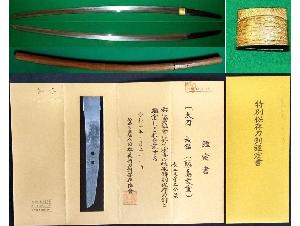
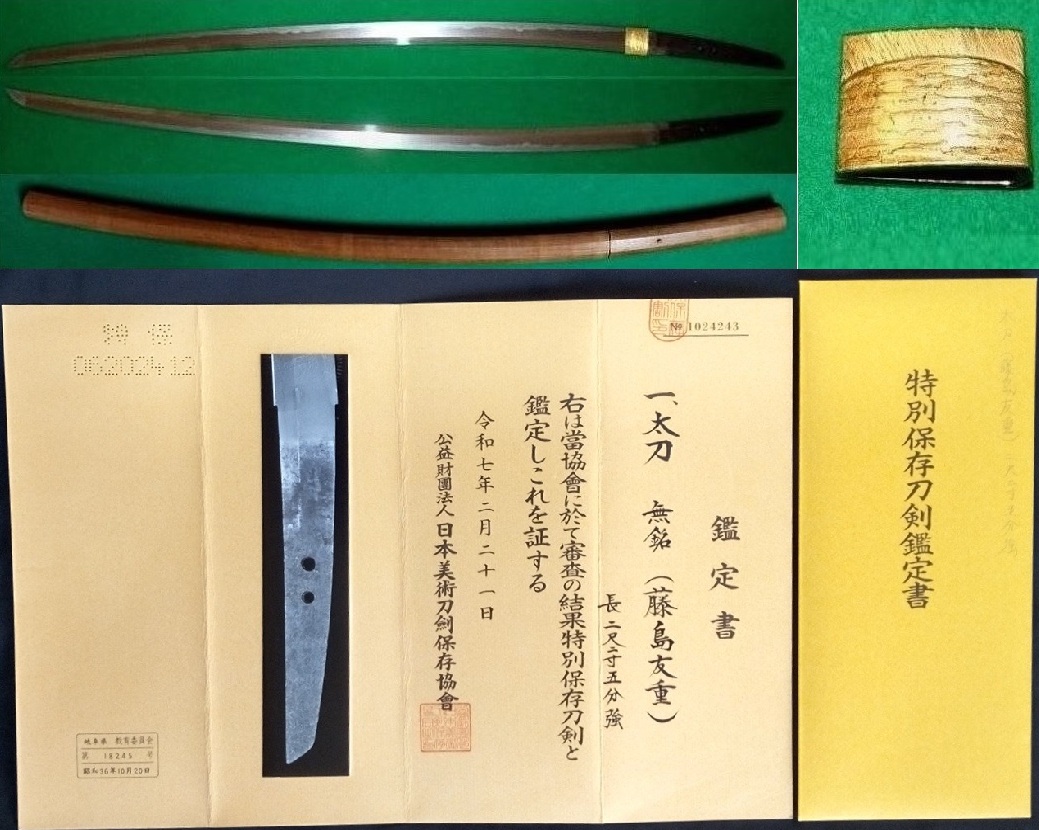
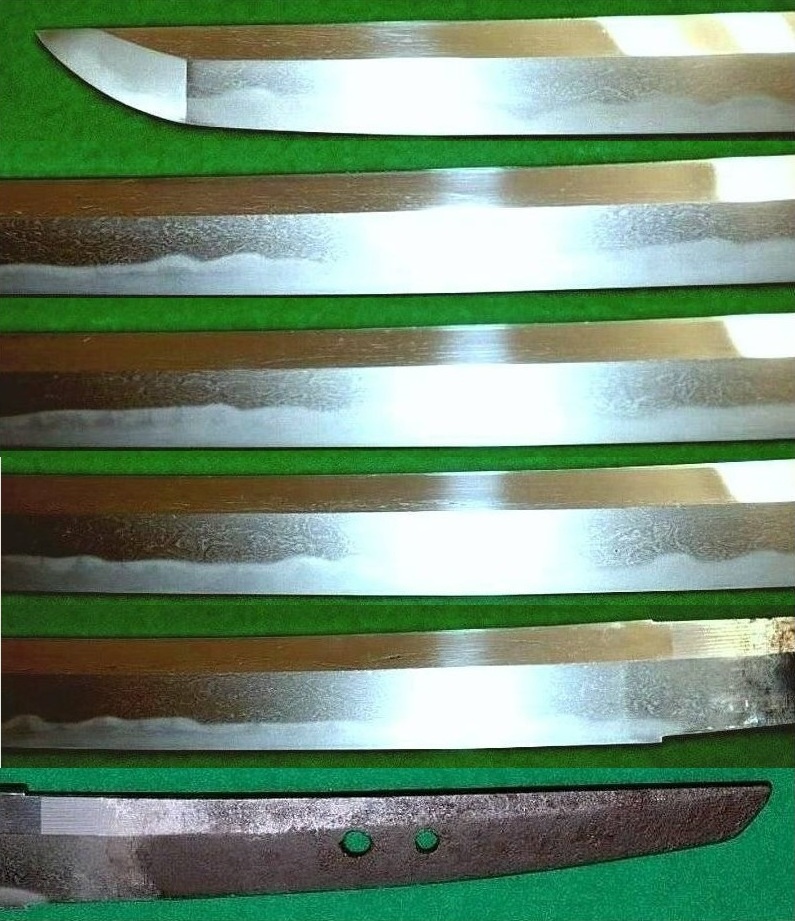
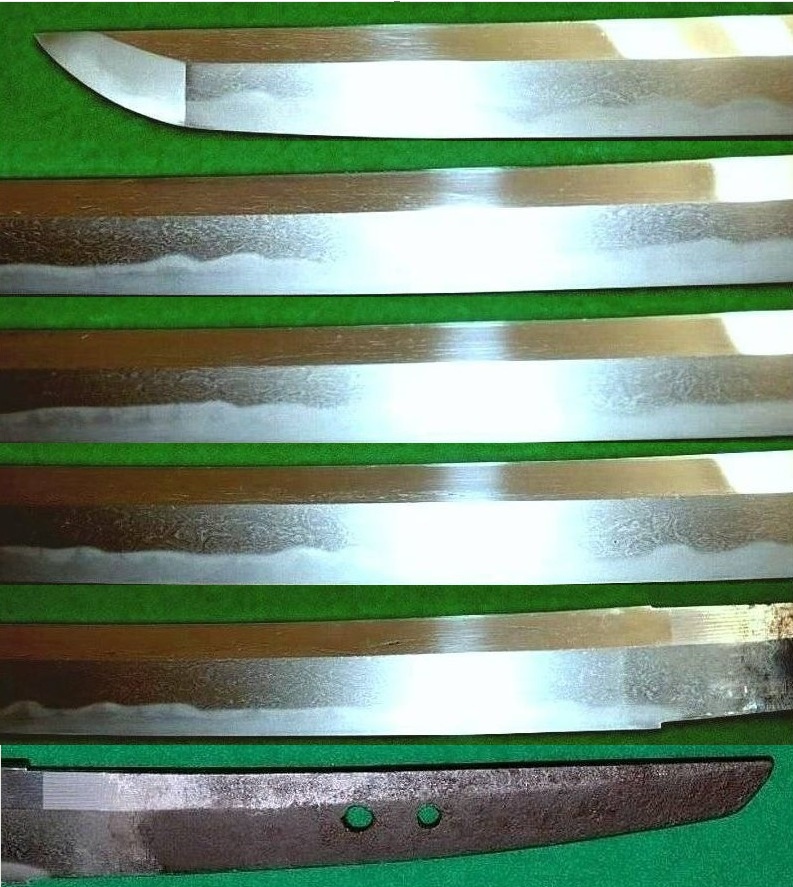
As written by the shop
Machine translation from the shop's Japanese · may contain errors ·
Yamashiro-den · Kaga
17 pieces on the market now
Among the provincial lineages of the Hokurikudo, the Fujishima school took its name and its base from the village of Fujishima in Kaga province, where Tomoshige stands as founder and the name he set down passed through several generations from the close of the Nanbokucho period across the Muromachi and on into the early-modern Shinto era. The members place the chronological anchor with care: the earliest firmly dated work is a tanto of Oei 2 (1395), and the NBTHK finds nothing among the surviving blades that goes back earlier than Nanbokucho. Old documentary tradition reads the first generation as a pupil of Rai Kunitoshi of Yamashiro, alternatively of Kashu Sanekage or Rai Toshimune, but the published sources doubt each reading in turn, finding no stylistic tie to Rai Kunitoshi and a chronological impossibility with Sanekage; judging from the make and the nakago finish, they settle by elimination toward the Yamato tradition, close to the Yamato Shikkake hand. A tachi held at Atsuta Shrine and a two-character ken read as the oldest surviving piece bracket the early end of the line. The recognition of the school lives in its jigane. The members agree on a board-grained itame that mixes in mokume and runs to nagare, standing somewhat open (hada-dachi), the surface gathering ji-nie and chikei, the steel carrying a distinct blackish cast named kan'a-iro and tied directly to the northern provinces as hokkoku-hada; a faint whitish shirake-utsuri rises quietly against this dark ground rather than a bright Bizen reflection. Over that ji the school tempers a gunome-midare into which box-shaped (hako-ba), pointed and angular (togariba) teeth enter together with notare and ko-notare, the ashi running rather long, the ha nie-laden with sunagashi sweeping it and kinsuji entering, small tobiyaki and muneyaki scattered here and there.
The NBTHK reads the feel of it as a make in which Bizen temperament and Mino flavor coexist, the boshi running straight or midare-komi into a ko-maru, often swept with hakikake or running to yakizume. The members also mark the short blades apart: on the tanto the hand can quiet to a ko-itame and a narrow hoso-suguha or low ko-gunome with ko-nie, the nioiguchi sometimes clouding to urumi, the boshi turning jizo-like or returning deep, this the simplest face of the Yamato base while the dark steel keeps its northern mark. To kantei a Fujishima blade the eye works the conjunction rather than any single trait: the standing dark ji read together with the box-and-pointed midare and the constant sunagashi names the school where a clean Bizen choji or a true Yamashiro ko-itame would not. The members note works read variously toward an Aoe air, toward Naoe Shizu and Sekishu Naotsuna, the Mino and northern lines the school sits between, kin in feel to the Etchu and Echizen smiths of the same region. Among the membership Tomoshige carries the name and the standing; Fujishiro rates the founder Chu-jo saku and places others among the middle ranks of the koto smiths, and the most highly regarded work falls in the Oei generation while the Muromachi work survives most often. The single finest piece is a great spear (o-mi-yari) signed Fujishima Tomoshige and carved with a sanko-ken and the deity-name Myoken Daibosatsu, which the published sources judge not merely the best spear of the school but one of the representative famous spears of its age; surviving naginata by the line are noted as rare, their ubu-nakago valued as dating evidence. Provenance gathers around named houses recorded in the blades themselves, an Oei katana descended in the Inaba daimyo house and a tanto recorded in Honma's inventory of the Imperial collection, heritage pieces in long-standing hands; yet the line is not among the unattainable names, and a Juyo Tomoshige remains a realistic if uncommon encounter for the patient collector, valued for the way a single dark-steeled blade carries the whole northern school in its ji. Learn more →
| Smith | Era | Designated |
|---|---|---|
| Tomoshige友重 | 1394-1428 | 15 |
| Tomoshige友重 | 1346-1370 | 5 |
| Tomoshige友重 | 1324-1326 | 5 |
| Fujishima藤島 | 1394-1428 | 4 |
| Yukimitsu行光 | 1340-1346 | 0 |
Yamashiro in the Kamakura period
Power sat in Kamakura, but taste was still made in Kyōto. The Awataguchi school’s pear-skin steel became a byword for perfection, and the Rai line supplied dignified tachi to the court, senior warriors, and the great temples alike.
A Hozon-certified blade judged to show notably superior workmanship and a better state of preservation. The bar is higher: re-tempered blades and most unsigned Muromachi/Edo works are excluded.
The NBTHK (Nihon Bijutsu Tōken Hozon Kyōkai, the Society for the Preservation of Japanese Art Swords) is a public-interest incorporated foundation founded in 1948 and supervised by Japan’s Agency for Cultural Affairs (Bunkachō); it is based at the Japanese Sword Museum in Tokyo. Its expert panels physically examine each submitted work (shinsa) and issue a certificate (kanteishō) ranking it by artistic and historical merit. NBTHK papers are the most widely recognized standard of authentication for Japanese swords and fittings.
NBTHK official siteNo cancellations are accepted after a winning bid is confirmed. Once a bid wins, the winning bidder is obliged to purchase the item.