Around 1800 Suishinshi Masahide argued in his writings that the craft must return to the old masters’ methods: the fukkotō revival. His greatest successor Naotane worked convincingly in Bizen and Sōshū manners that had been dead for centuries.
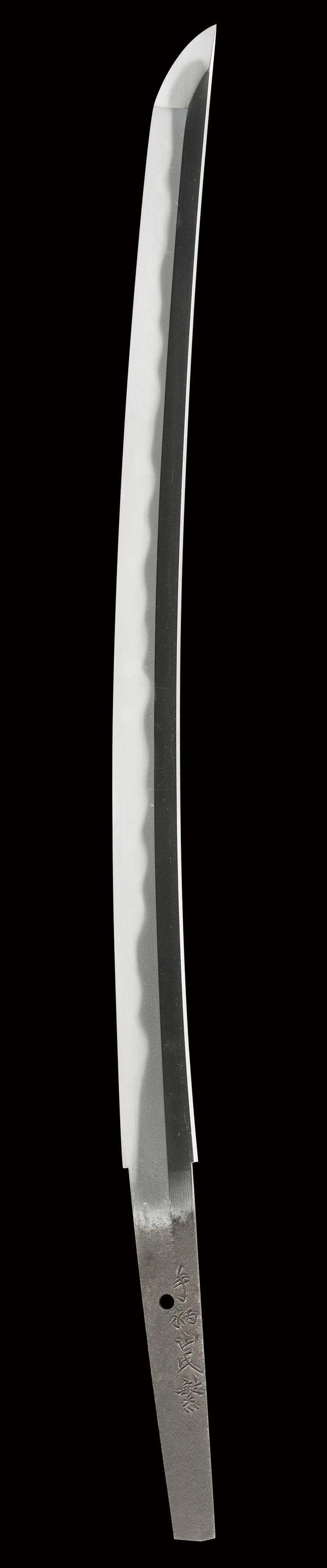
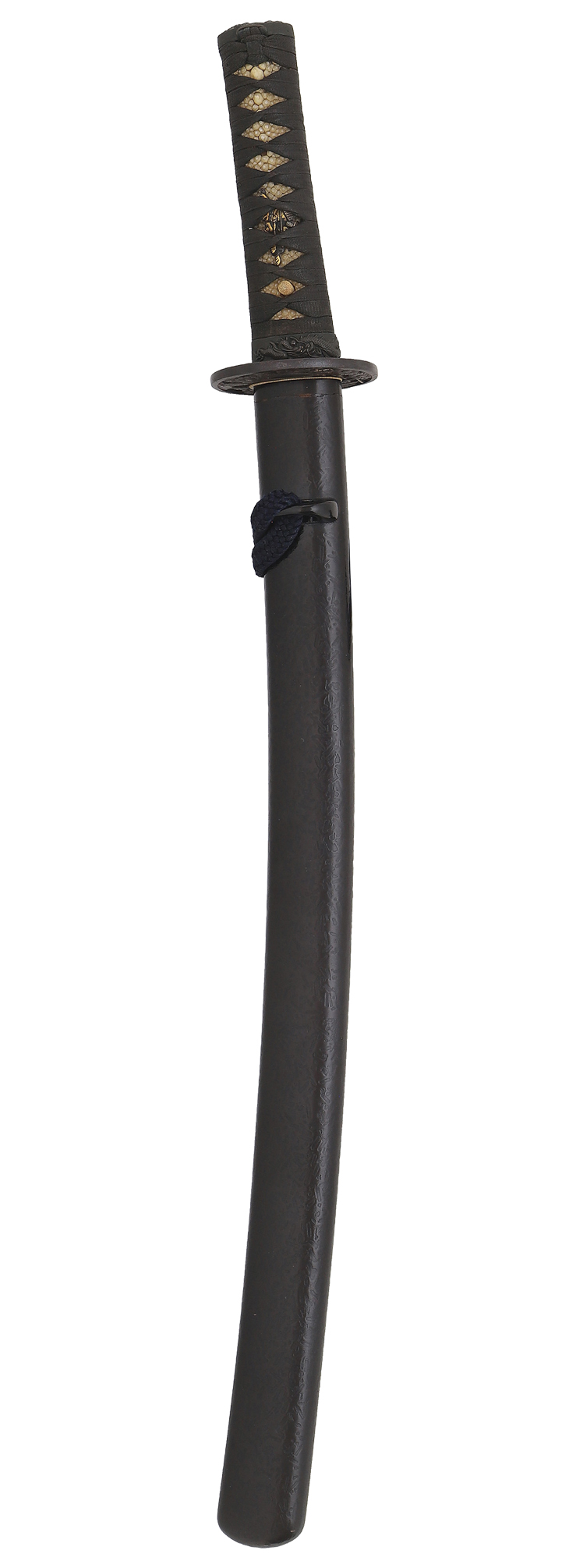
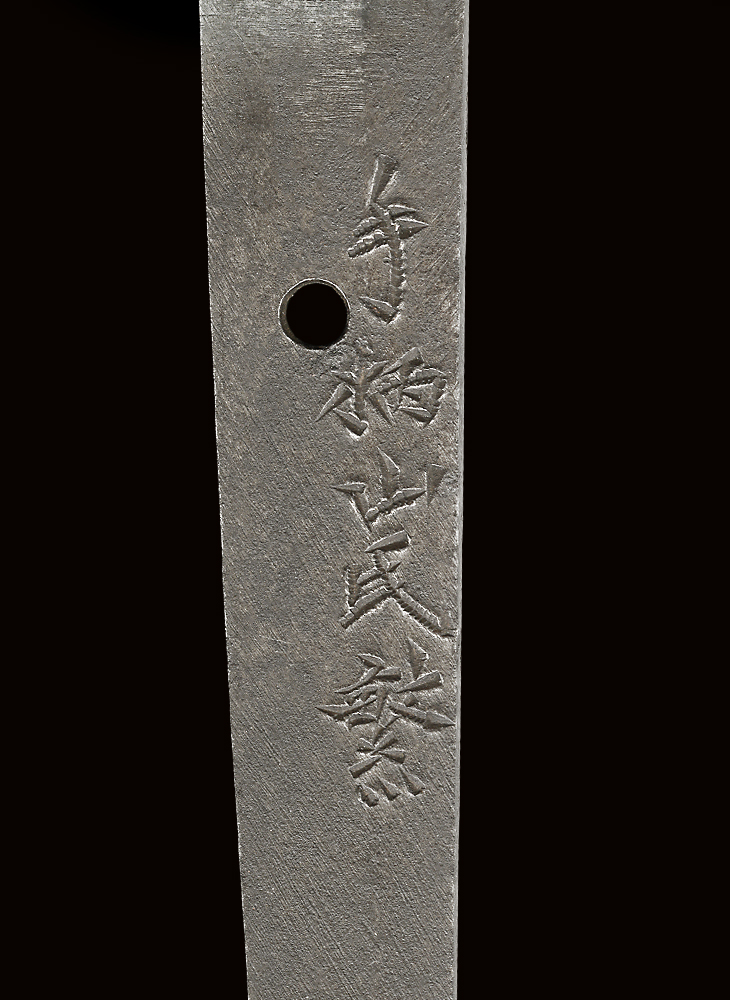
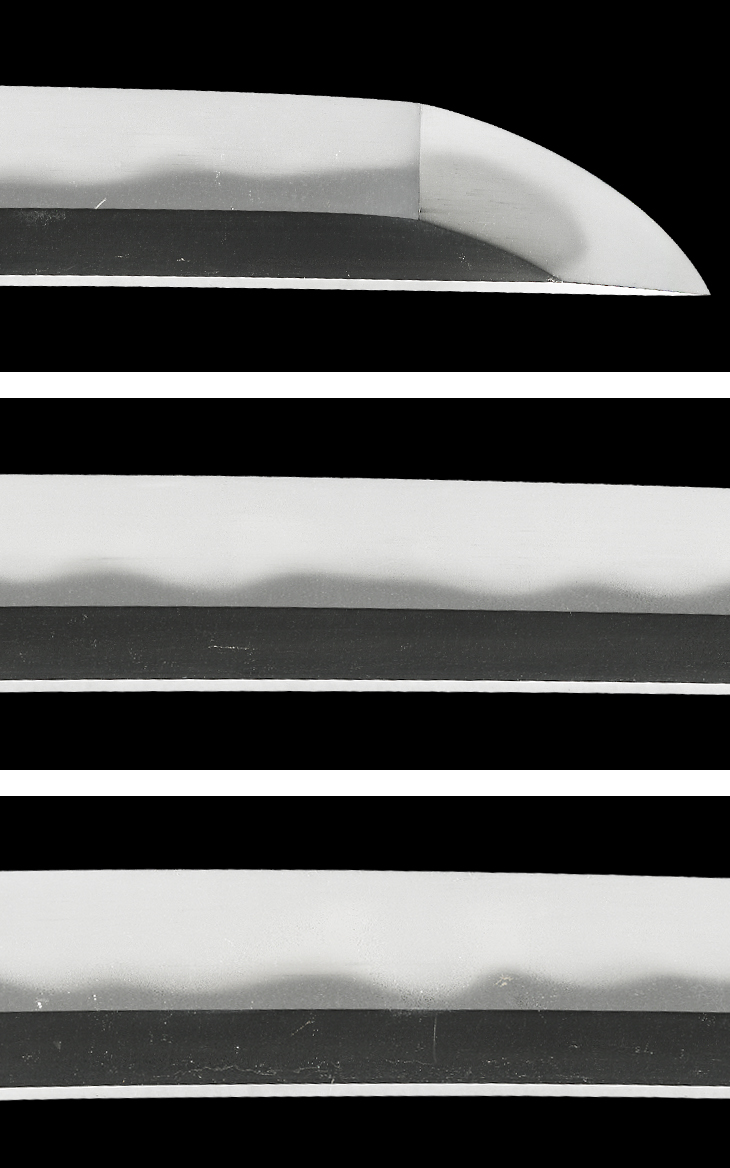
Shinshinto, Harima. Late Edo period. With koshirae. Shinogi-zukuri, shinogi iori-mune junjo, chu-kissaki. Kitae: ko-itame mixed with itame, finely hadadachi, ji-nie attaches well, jitetsu is good. Hamon: primarily toran-style o-gunome midare, habuchi is well-covered in nie with deep nioi, bright and clear, gunome-ashi enter the hachū. Boshi: notare tone, returning long in a ko-maru style. Nakago ubu, tip is shallow iriyama-gata, yasurime keshō o-sujikai (kobako style). Copper with kin-kise habaki. Period polish. In shirasaya. With wakizashi koshirae (total length 66.5. Late Edo period. Saya: black ro-kawari-nuri. Kozuka: shakudo ishime-ji suemon zogan iroe, Kiri-mon chirashi design. Sageo: black. Tsuka: oya-same with asa-nuno tsukamaki. Fuchi-kashira: shakudo nanako-ji takabori, hai-ryu design. Menuki: shakudo katachibori iroe, musha design. Tsuba: tetsu-ji maru-gata nikubori sukashi, slight kin-nunome zogan, kōshi ni edagiku design). The Tegarayama Ujishige school is a representative school of Harima during the Edo period, and its founder was Yamato no Daijo Ujishige. Ujishige was a student of Hitachi no Kami Muneshige (a student of Echizen no Kami Sukehiro), and the same mei continued for three generations, but the third generation Ujishige changed his mei to "Ujishige" in later years; this is considered the first generation Ujishige, and the line continued for six generations until the end of the Edo period. The fourth generation Ujishige is Tegarayama Masashige, who changed his mei to "Masashige" in later years and became a smith for the Oshu Shirakawa clan. Based on the mei style, this work corresponds to the fourth generation Ujishige, the previously mentioned early mei of Tegarayama Masashige. Masashige was born in Horeki 10, a Banshu Himeji smith, the son of the second generation Ujishige and the younger brother of the third generation Ujishige; his first mei was "Ujishige," later succeeding to the fourth generation Ujishige name, and in Tenmei 8, he became a retained smith for the Oshu Shirakawa daimyo Matsudaira Sadanobu (Rakuo-ko), moved to the Matsudaira shimo-yashiki in Kanda, Edo, and changed his name to "Masashige." In Kyowa 3, he received the title "Kai no Kami," and in his late years, he entered the priesthood and took the go Dankasai. He excelled at toran-style o-midare, having self-studied the style of Tsuda Echizen no Kami Sukehiro, and in the Shinshinto period, he was renowned as a master of toran-ba, neither superior nor inferior to his contemporaries Suishinshi Masahide and Ozaki Suketaka. His active period seen in dated works is from Kansei 1 to Bunsei 13, and he is said to have died in that same year at the age of 71. The mei styles are cut as "Tegarayama Ujishige," "Oshu Shirakawa-shin Tegarayama Masashige," "Tegarayama Kai no Kami Masashige," "Kai no Kami Masashige Nyudo Dankasai," etc. As this work has the Ujishige mei, it is a work from before Tenmei 8, when the smith was in his mid-twenties. A typical work of flamboyant toran-style o-midare, the yakiba with deep, full nioi is bright and clear, without large flaws, and comes with Edo period fittings. Early mei by Masashige do not appear often; this Tegarayama Masashige has high collection value.
Offered by Samurai Nippon
9 on the market


As written by the shop
Machine translation from the shop's Japanese · may contain errors ·
Shinshinto · Harima · around 1789-1801
1 piece on the market now
Shinshinto · Harima
9 pieces on the market now
At the foot of Mount Tegara in Himeji, Harima province, a family of smiths took the mountain's name as their own across successive generations, descending from the first-generation Yamato no Daijō Fujiwara Ujishige. The setsumei trace this Banshū line through its best-documented figure, Tegarayama Masashige[[c:1]], commonly called Asashichi or Chōshichi and using the art name Tankasai. He was the younger brother of the third-generation Tegarayama Ujishige, first succeeded to the name of the fourth-generation Ujishige, and only later changed his signature to Masashige. In Tenmei 8 (1788) he entered the service of Matsudaira Sadanobu, lord of Shirakawa in Ōshū, as a retained smith (kakae-kaji) and moved to Edo, where he resided at Surugadai in Kanda; in the fourth month of Kyōwa 3 (1803) he received the honorary title Kai no Kami. One setsumei records that in Edo he studied under Suishinshi Masahide. Around the start of the Bunsei era he forged for a time in Osaka before returning to Edo, and from his lord Rakuō he was granted the two characters "Shinmyō," which he cut on the works he held most successful. The hand the setsumei describe is a Soshu-toned revival built on the tōran-midare of Tsuda Echizen no Kami Sukehiro, whose style Masashige privately admired (shishuku). The forging runs to tightly compacted ko-itame-hada with ji-nie adhering thickly, fine chikei entering, and at times a quiet near-muji ground; the steel reads clear.
Most blades open with a suguha or sugu yakidashi at the base and then rise into a billowing tōran-style large gunome-midare, mixed with notare, slightly pointed (togari-gokoro) elements, and arrow-nock (yahazu) shapes likened to surging waves. The temper carries deep nioi, evenly adhering ko-nie, ashi and yō, with sunagashi and kinsuji threading the edge and tobiyaki, yubashiri, and muneyaki breaking out above it; the nioiguchi tends bright. The bōshi is generally sugu ending in ko-maru, sometimes with hakikake and a long kaeri. Beyond this signature manner he also worked shallow notare of wide yakihaba and plain suguha, so the orderly large gunome that refuses to collapse, the pointed accents within the ha, and the wide mihaba of his forms serve as the readiest marks of his work. Across the register the kantei points cluster around that controlled tōran and its lively ji and ha, while one wakizashi, mingling yahazu into the edge, prompts the observation that Gonnoshin Terukane may also have been in mind. Self-carved horimono recur and aid attribution: jewel-chasing and ascending or descending dragons, bonji, the sankō-tsuka-ken, and hi, with tangs reading "hori dōsaku" to record the smith's own chisel. Several inscriptions carry documentary weight, naming Surugadai and Shundai in Buyō as places of forging, Ishū Dewa iron also used by Katayama Munetsugu, and a commission for Kosugi Tamenaga, a retainer of the Koga domain; a Juyo wakizashi signed "Ōshū Shirakawa kashin Masashige" bears self-cut dragon, bonji, and sankō-tsuka-ken recorded on its tang. The blades signed with bold, thick-chisel mei over ubu tangs finished in keshō ō-sujikai, dated through the Kansei and Kyōwa years, mark Tegarayama as a Himeji-rooted shinshintō line whose strength lay in the recreation of Sukehiro's waves. Learn more →
| Smith | Era | Designated |
|---|---|---|
| Masashige正繁 | 1789-1801 | 13 |
| Ujishige氏繁 | 1751-1764 | 0 |
| Ujishige氏繁 | 1781-1789 | 0 |
| Ujishige氏繁 | 1789-1801 | 0 |
| Masanao正直 | 1804-1818 | 0 |
The Shinshintō revival
Around 1800 Suishinshi Masahide argued in his writings that the craft must return to the old masters’ methods: the fukkotō revival. His greatest successor Naotane worked convincingly in Bizen and Sōshū manners that had been dead for centuries.
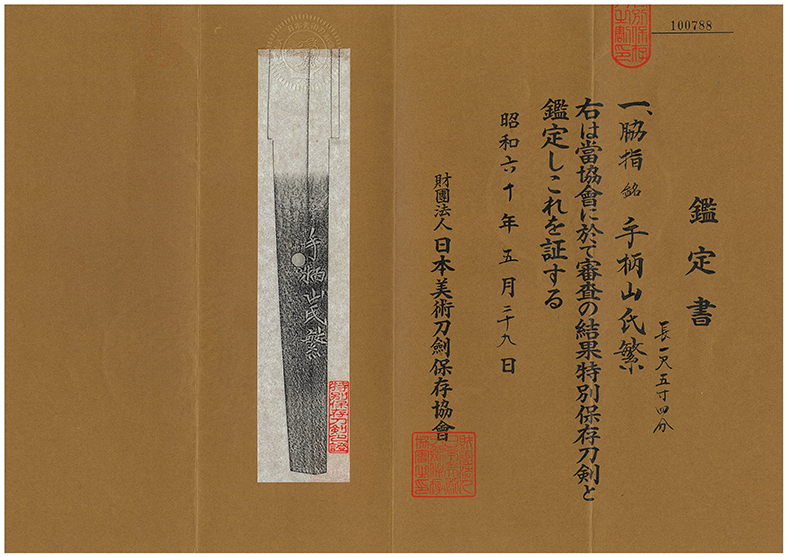
A Hozon-certified blade judged to show notably superior workmanship and a better state of preservation. The bar is higher: re-tempered blades and most unsigned Muromachi/Edo works are excluded.
The NBTHK (Nihon Bijutsu Tōken Hozon Kyōkai, the Society for the Preservation of Japanese Art Swords) is a public-interest incorporated foundation founded in 1948 and supervised by Japan’s Agency for Cultural Affairs (Bunkachō); it is based at the Japanese Sword Museum in Tokyo. Its expert panels physically examine each submitted work (shinsa) and issue a certificate (kanteishō) ranking it by artistic and historical merit. NBTHK papers are the most widely recognized standard of authentication for Japanese swords and fittings.
NBTHK official siteFor one-of-a-kind items such as swords, sword fittings and antiques, other customers may be waiting for the item, so please contact us about a return within 3 days of its arrival and ship it back within 8 days. Refunds are made on the day the returned item arrives.
¥598,000