Although typically defined within the constraints of the Goka-den, various styles among different branches of this philosophy often coalesced into unique swordsmithing practices, which are now classified as “majiwari-mono” in modern terms. Although generally used to denote later works of the Muromachi and more recent periods, examples of this practice originate as far back as the Heian Period, with the practice becoming more common in the era between the late Kamakura Period and the Nanbokucho Period. Such an example will be analyzed in the form of a naginata-naoshi katana from the lesser-understood Ukai School. Looking at the blade’s form, the blade has a thicker kasane and a thinner, straighter frame, denoting its straightening into a katana after shortening. The lack of a prominent kissaki-sori, however, implies a less curved geometry from the conception of this piece, falling into the “Shizuka-gata” classification of naginata blades. Looking to the metallurgy of the blade, the kitae is composed of a tight ko-itame hada with burls of o-mokume interspersed throughout, especially in the shinogi-ji. Ji-nie is abundant, resulting in a sparkling appearance to the steel, alongside a strong, sky-blue coloration. Spots of kitae-ware are present in the blade, which, although unfortunate, are understandable due to both the blade’s age and the use of the weapon as a battlefield implement. Looking toward the cutting edge, the temper is composed of a suguha-based ko-choji midare in nioi-deki. This hamon is particularly active, with hataraki in both horizontal and vertical varieties, including ashi of various sizes, nie-hotsure, sunagashi, and kinsuji within the ha itself. Ko-nie structures also follow along the habuchi and cluster in small areas within the hamon, creating spots of yo and yubashiri, especially approaching the monouchi. This pattern continues throughout the hamon, terminating at the kissaki in a gentle midare-komi boshi with a pronounced kaeri. Parallel to the hamon is an inconspicuous midare-utsuri combined with spots of jifu, calling back to works of Bitchu Province. With the aesthetic features discussed, relevant measurements are listed below.
The nakago of the blade is o-suriage with a kiri-jiri tip. Due to the blade’s shortening, any signature that would have been present on the tang is now absent. Two mekugi-ana have been punched into the nakago, with remnants of a third being present on the nakago-jiri, implying a long history of alterations as battlefield circumstances changed.
The blade’s shape is in shobu-zukuri, with a mitsu-mune. Although used in some tachi and a variety of tanto, this geometry is often used in naginata, likely originating in this type of glaive as early as the Heian Period, continuing use through over a millennium up into the present day. Among different varieties of naginata, this particular piece falls within the “Shizuka-gata” designation, primarily due to its thinner frame and less pronounced curvature, especially at the tip, which often widens and curves greatly in the opposing “Tomoe-gata” form. The blade lacks any intricate horimono carvings, allowing the unique workmanship of this school of smiths to stand out, while also corroborating the blade’s construction as a martial tool rather than a commissioned art piece.
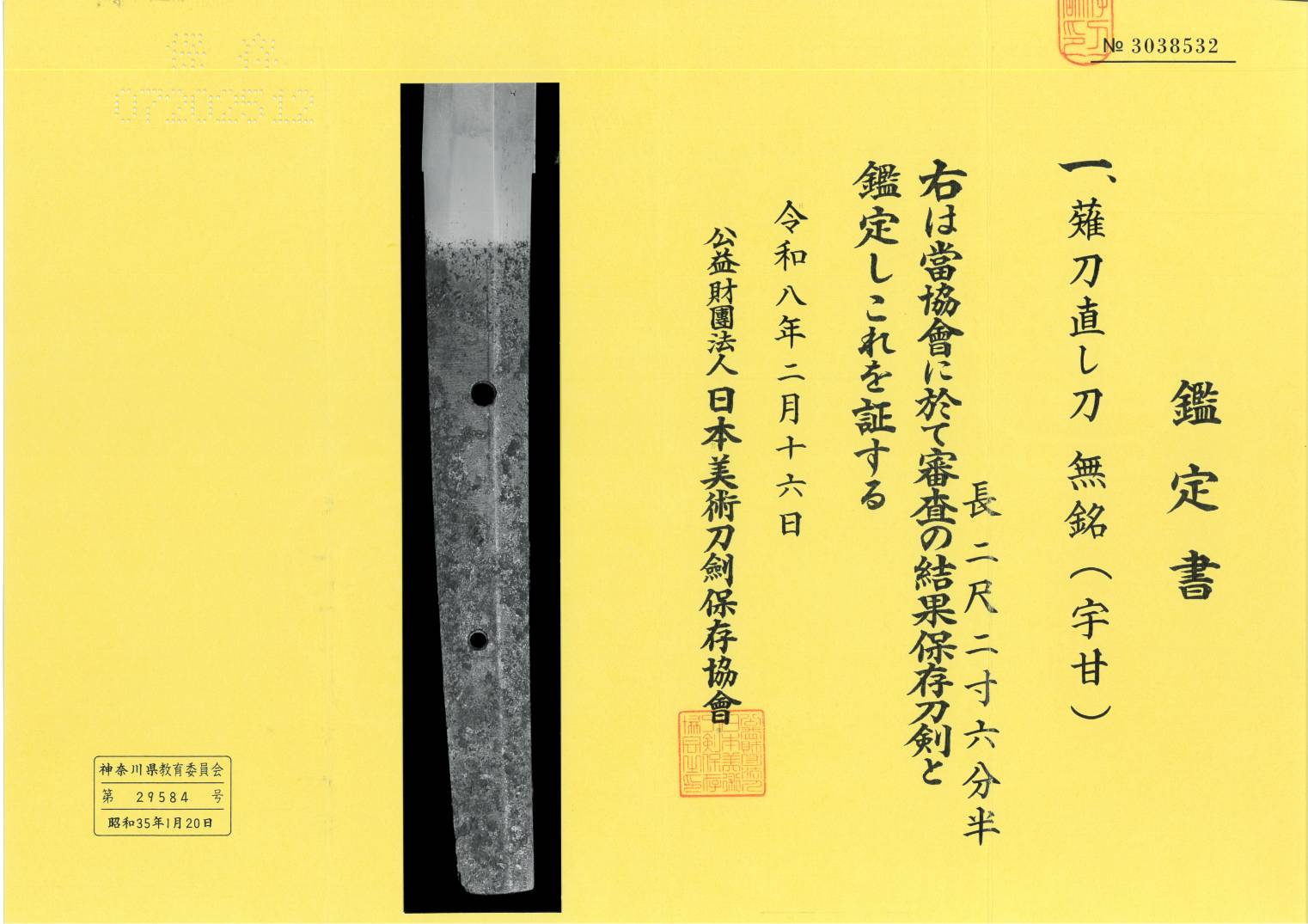
The blade is currently rated “Hozon” by the NBTHK, confirming a baseline degree of quality expected for a Japanese sword. In addition, the receipt of this ranking provides an accurate attribution based on the workmanship and style present in the blade. Although the lowest rank given by the NBTHK, blades of particular merit are capable of increasing their station with subsequent appraisals by the organization, and as such, Hozon should be viewed as a floor for quality rather than a ceiling.
Although swordsmithing in Bizen Province primarily sat upon the Yoshii River and Asahi River via the villages of Osafune and Fukuoka, lesser-known smiths also operated within the region, often originating from provincial villages, including areas such as Hatakeda and Wake-no-Sho. Among the more famous of these sub-groups is the Ukai School, named for its origin in the village of Ukai-no-Sho. These smiths are also collectively known as the Unrui Group due to the presence of the character “Un” (雲), meaning “cloud” in their names. Unlike the province’s representatives in Osafune, these swordsmiths often incorporated other swordsmithing traditions into their work, with debate continuing over whether the school’s founder, Unjo, had origins in either the Yamashiro or Yamato traditions, with Dr. Michihiro Tanobe firmly holding to the Yamato Tradition theory. Other theories, however, hinge on the similarity in forging styles between the Ukai School and the Rai School of Yamashiro, especially in the formation of their jigane, alongside the Aoe School, primarily due to the suguha-based ko-choji hamon practiced by the school, alongside their use of blended utsuri similar to dan-utsuri, often combining elements of a midare and jifu-utsuri. Regardless of the alleged origins of Unjo, what is known is that the smith operated from the year 1293 CE to 1303 CE before stepping down, although no extant blades have been discovered for this smith. As such, his son, who took the name Unsho, is widely regarded as the de facto founder of the school. Operating from 1303 CE to 1315 CE. During this period, the works of the schools maintain a classical style emblematic of the late Kamakura era, including a graceful ko-kissaki and gentler mihaba. This style transitioned with the succession of Unji, the son of Unsho, as grandmaster of the school, due to the shift from the Kamakura to the Nanbokucho Period. Unlike Unsho, who operated within a consistent framework, the dominance of the Soshu School, alongside the coming of civil war between the Imperial Court under Emperor Go-Daigo and the Ashikaga Clan, led to adaptation in creating swords to better account for changing aesthetic trends and military requirements, leading to blades that were, in general, wider and longer, with a longer kissaki, creating a distinctive split between Unji’s early period, which spanned from 1315 CE to 1334 CE, and later period, which spanned into 1350 CE. Of the three smiths who headed this school, Unju most expertly translated the trends of the Nanbokucho Period into steel, working from 1352 CE to 1387 CE and producing many nagamaki (of which many are now o-suriage blades), alongside odachi. Due to the unorthodox shape of this blade, it is difficult to pin it to any one smith from the school directly; however, since the blade was originally a naginata, it is more likely that the sword was a later work, placing it in either the latter half of Unji’s work or into Unju’s volume of works. Overall, this piece is an excellent example of the later Ukai School’s works, displaying a high level of workmanship from one of Bizen Province’s more unorthodox swordsmithing practices. In addition to this, the blade’s original construction reveals a wider variety of weapon types produced by this school, remaining a rare example of such based on the Unrui Group’s preference for tachi, allowing for appreciation from a historical paradigm rather than purely the sword’s workmanship.
~Photographs from Charlie White’s Facebook page; Blade in Possession of Charlie White, article by Nicholas Zogu~
 NihontoWatch