NihontoWatch MonNihontoWatch
MarketEncyclopediaKantei
NihontoWatch MonNihontoWatch
Market
Encyclopedia
Kantei
Overview·Historical importance·Designations·Kantei·Dated Works·Provenance·Blade Forms·Signatures·Lineage·School
OverviewHistorical importanceDesignationsKanteiDated WorksProvenanceBlade FormsSignaturesLineageSchool
  1. Schools
  2. Osafune
  3. Sue-Bizen
  4. Sukemitsu

Osafune Sukemitsu

祐光

Jūyō
Vol. 23, No. 249 · Wakizashi

Osafune Sukemitsu

祐光

8 ranked works

Major smith
ProvinceBizenEraEikyo (1429–1441)PeriodMuromachiSchoolOsafuneTraditionBizen-denGeneration1stTeacherSukemitsuToko Taikan600(top 21%)TypeSwordsmithCodeSUK719
1Gyobutsu
7Jūyō Tōken

Overview

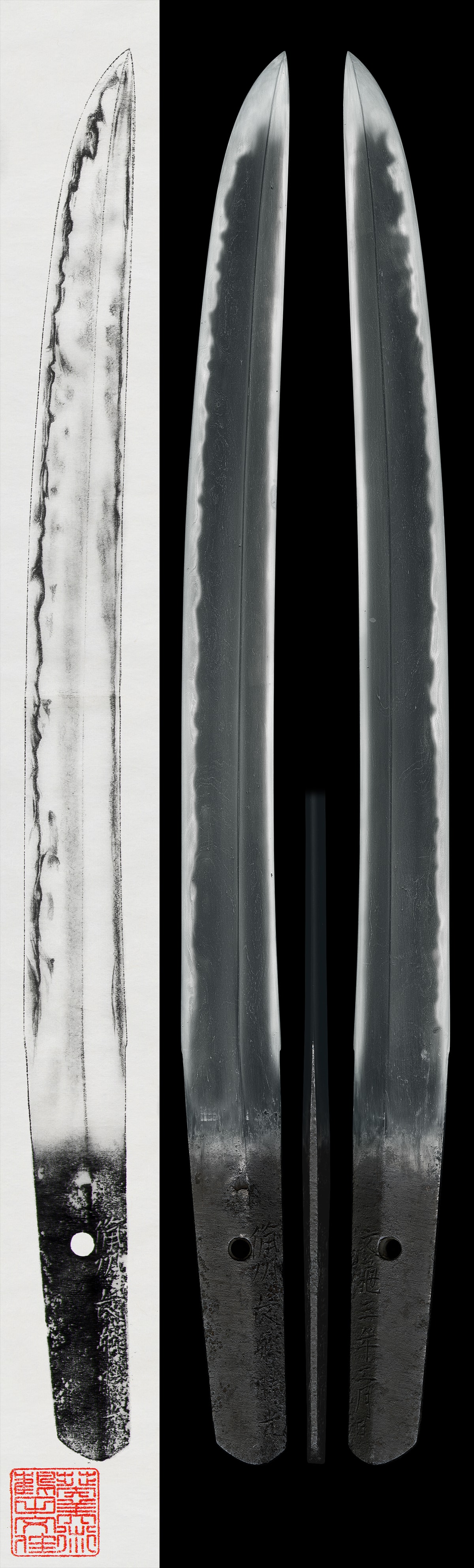
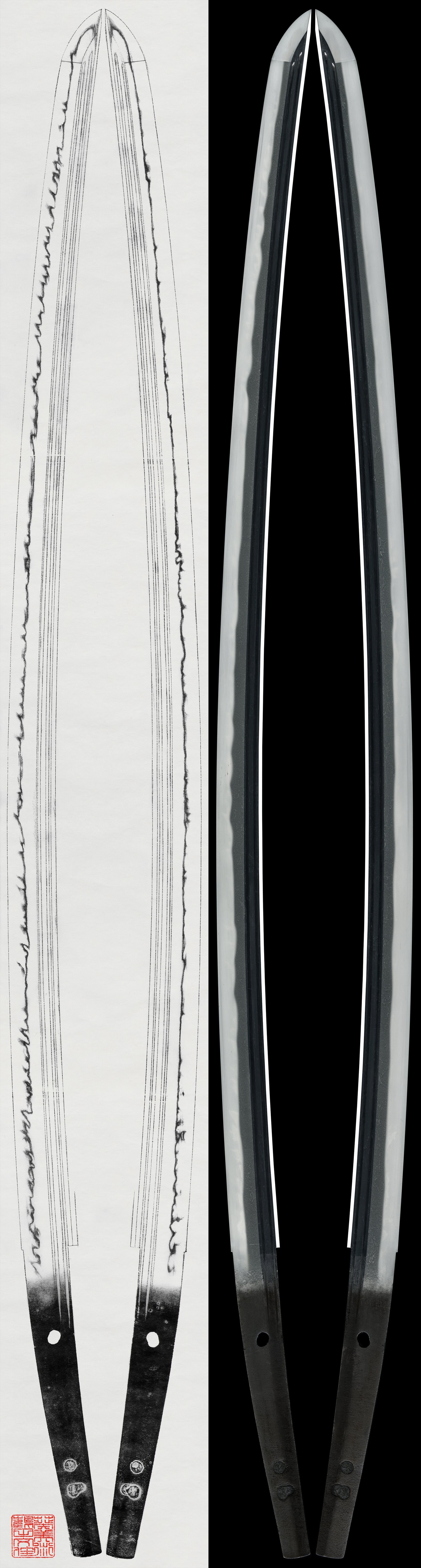
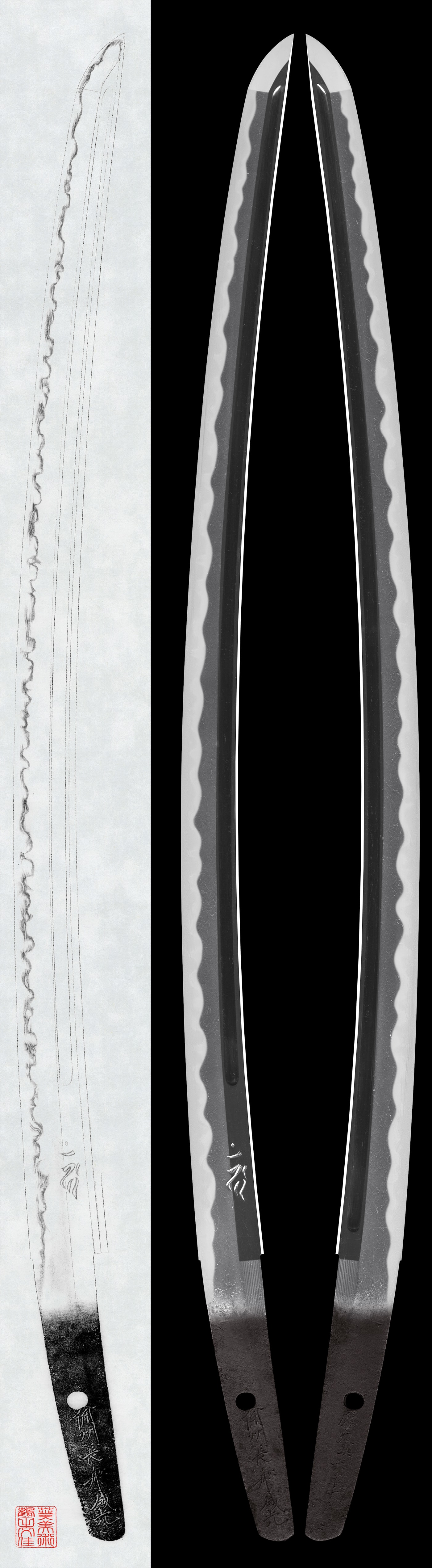
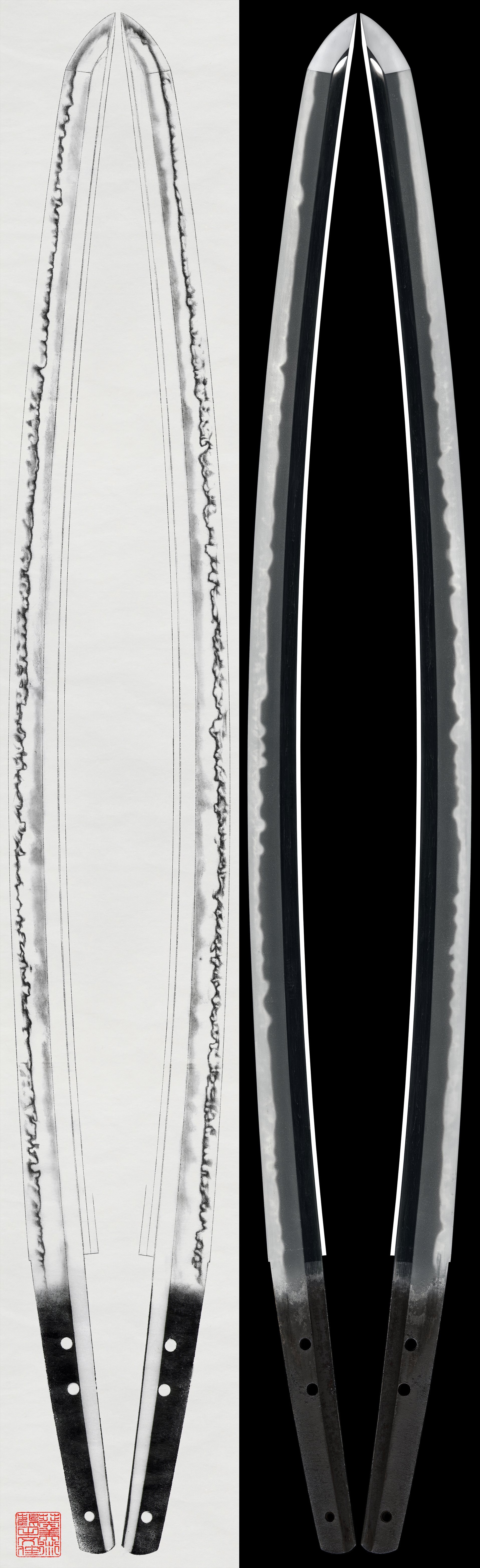
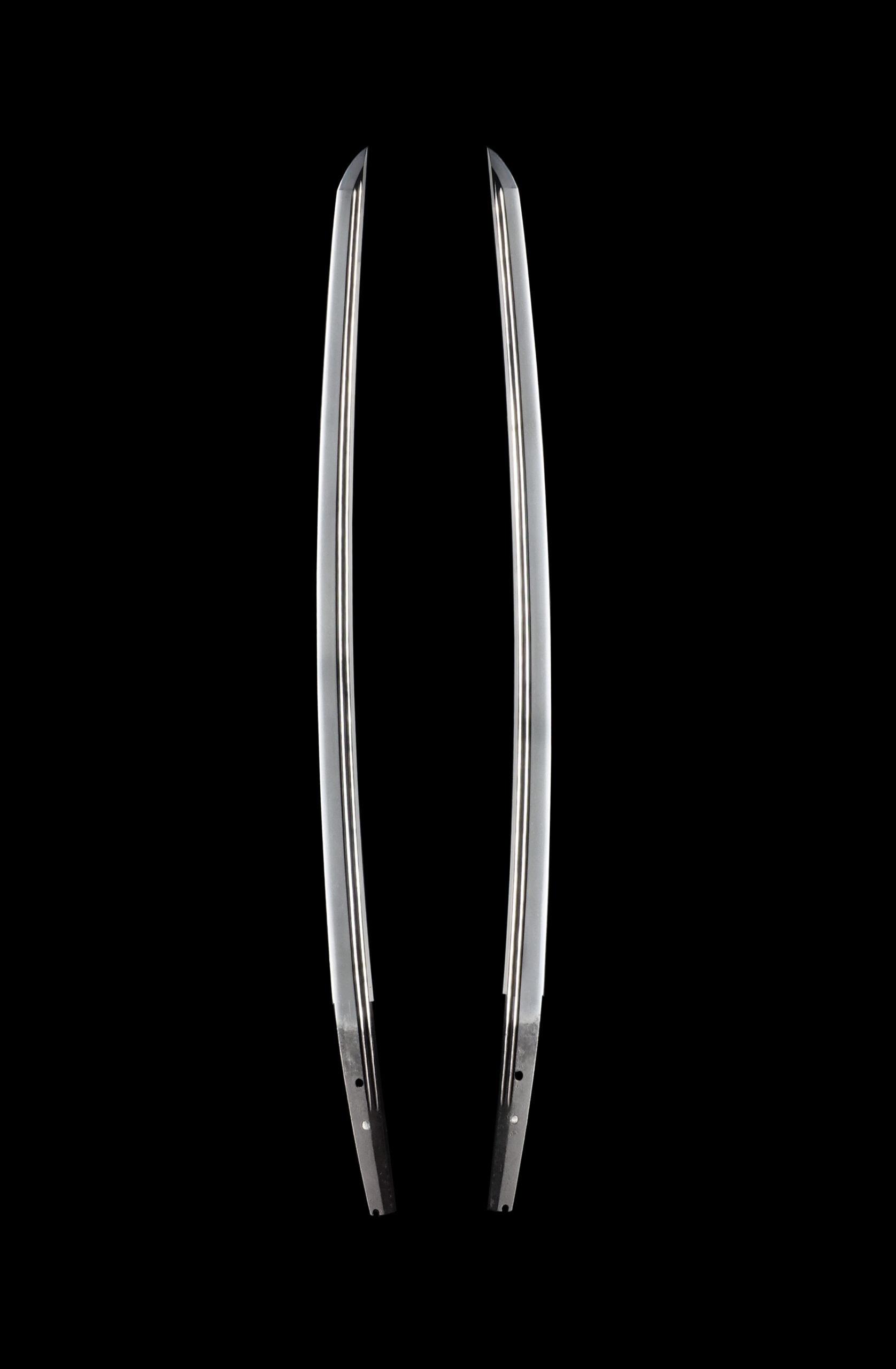
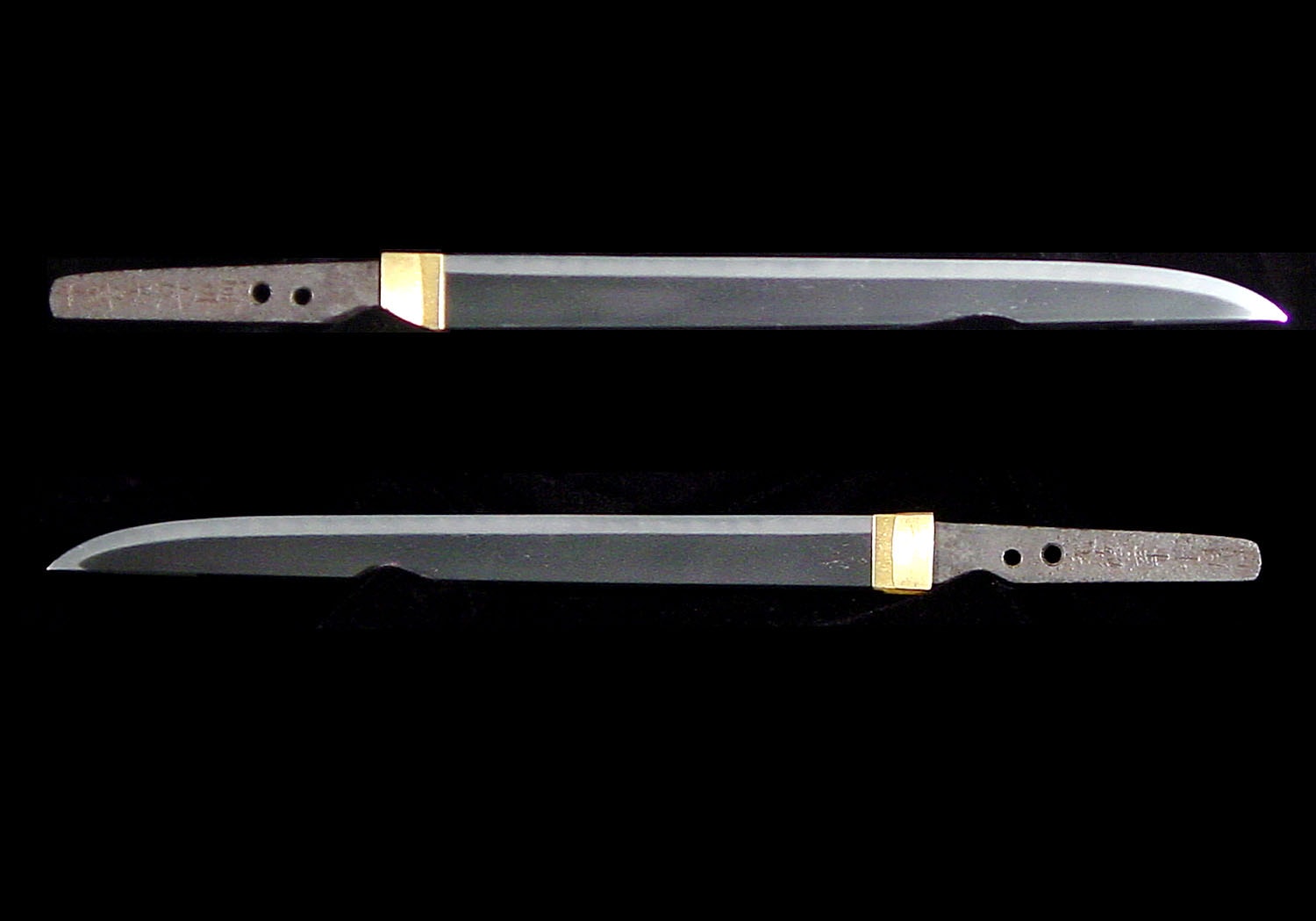
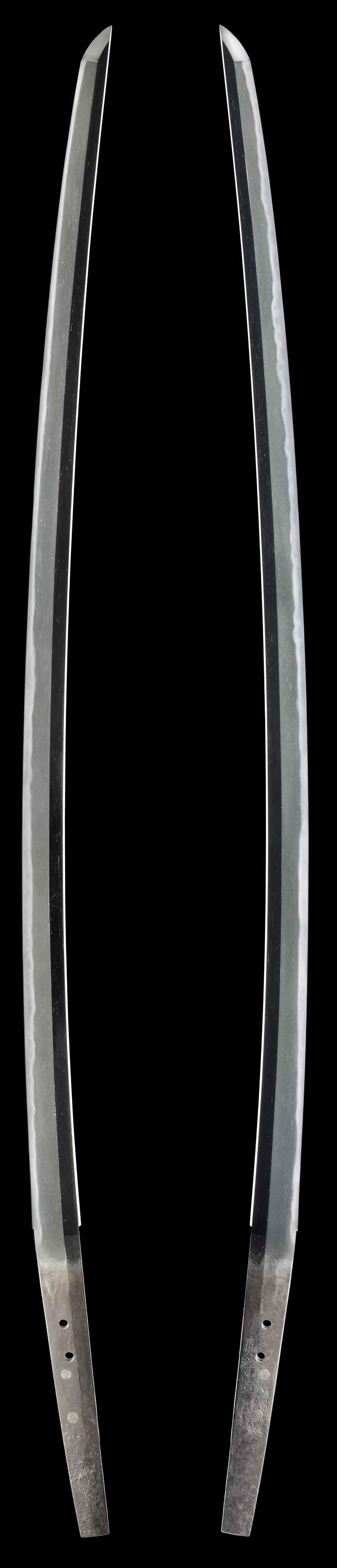
The earliest dated work that survives under Sukemitsu of is a of Eikyo 9 (1437), an , signed blade that displays the manner the published sources call Oei-, and which they pronounce an imposing, dignified piece. The latest is a of Kansho 3 (1462) that carries within its signature the common name and title Rokurozaemon no Jo. Between those two dates lies a span of twenty-five years and a stylistic crossing, for Sukemitsu worked the moment the published record names the move from Oei- into . The lists seven smiths who signed this name, and the , judging from the year inscriptions, reads the dated works gathered here as the among them, the head of the family who fathered the brothers Ukyo no Katsumitsu and Sakyo no Jo Munemitsu. His blades stand at the hinge of that descent, the Oei- manner of the early fifteenth century already turning toward the workmanship his sons would lead.

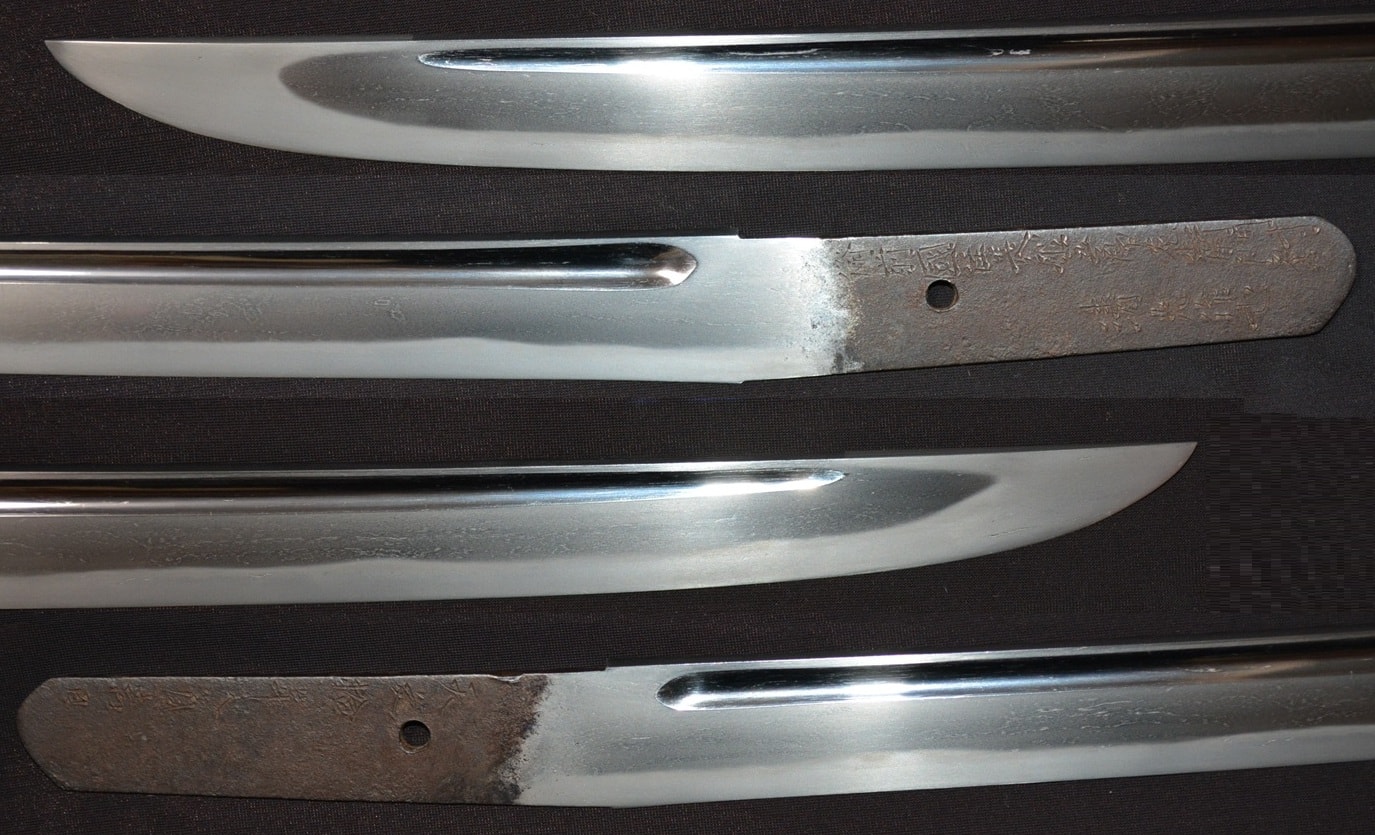
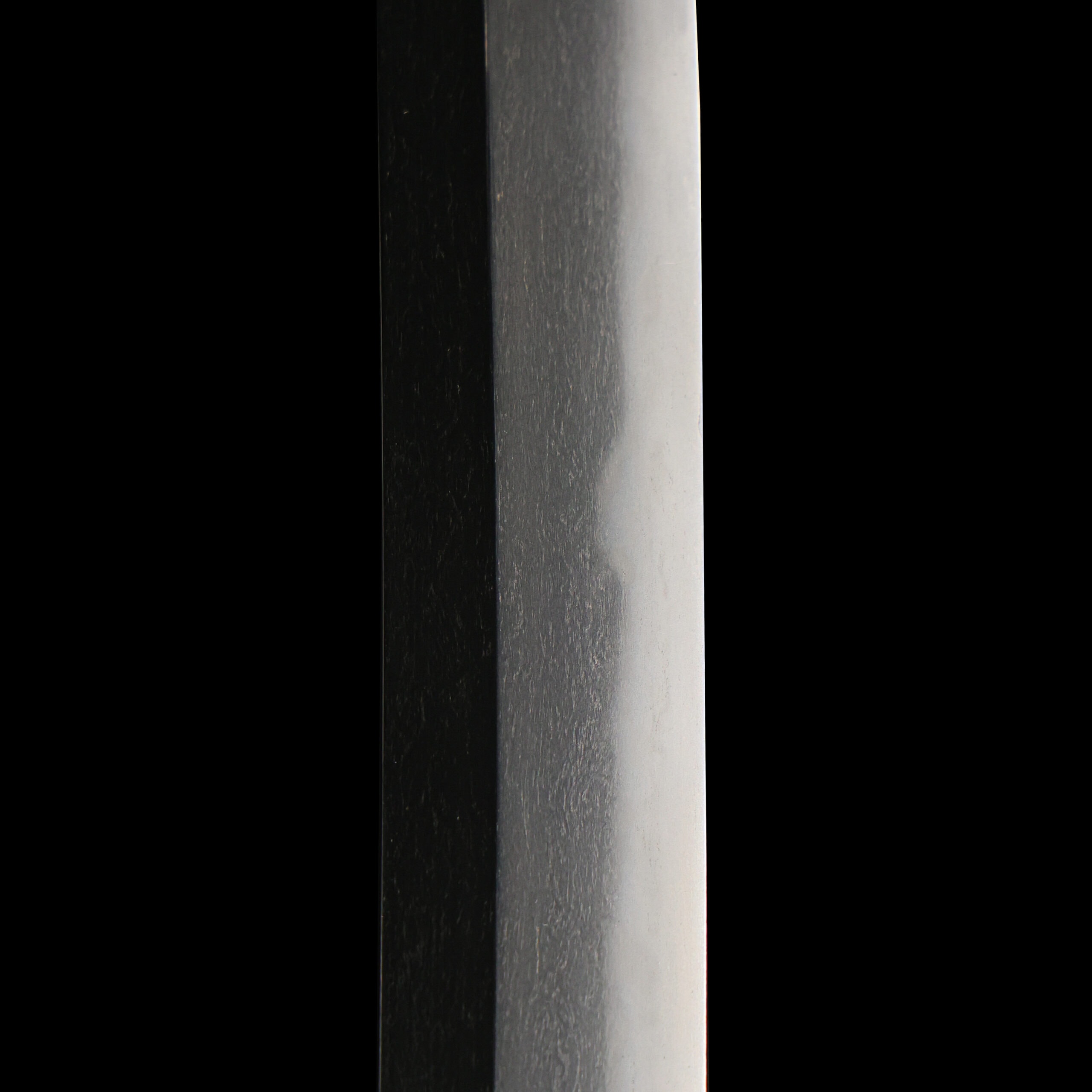
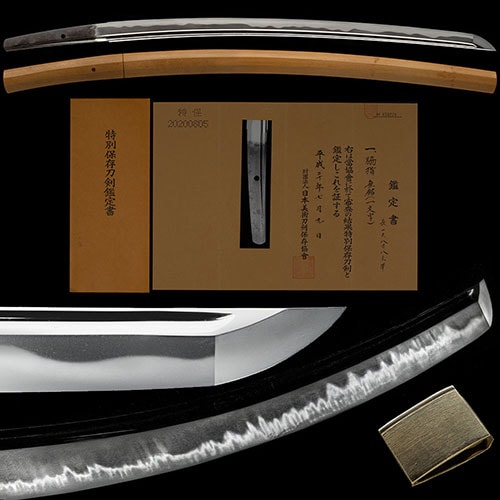
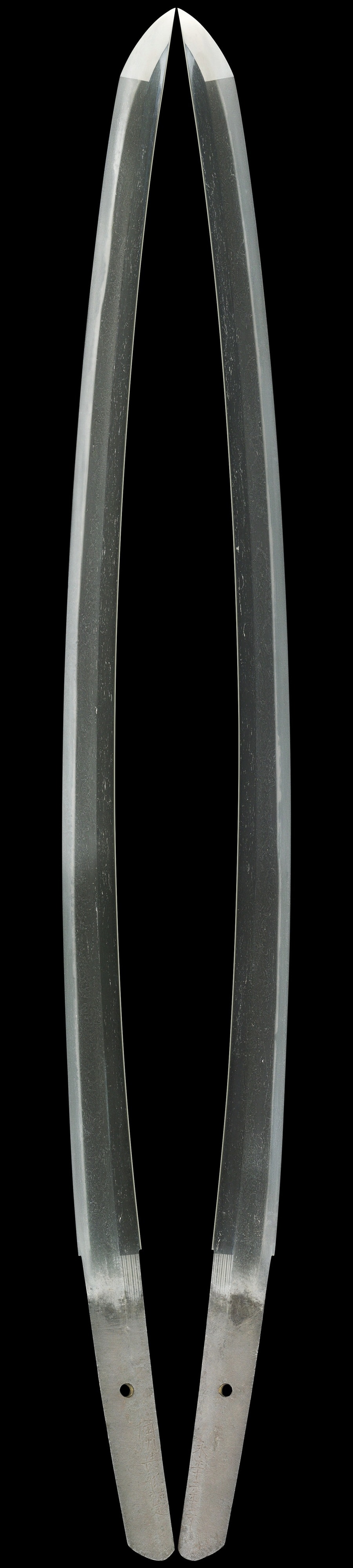
The matter that distinguishes his work is a , a whose valleys open wide at the waist, mixed with a little and built into a varied . It is -dominant with attaching, fine and running within, the at its best bright. On the early Eikyo the temper opens at the waist with pointed elements mixed in, slight and laid over it, and the runs straight with to a pointed tip. On the mature dated pieces the waist-open takes in -ba and angular teeth, in places reminiscent of , the whole still -dominant with and bright in the . The descent of his date is read off the temper itself: of the Kakitsu 3 (1443) the published sources note that the amplitude of the is small and the inconspicuous, and in that quieting of the once-flamboyant Oei- clove pattern they read the period coming down. The waist-open temper is his constant, and its narrowing waves are his clock.

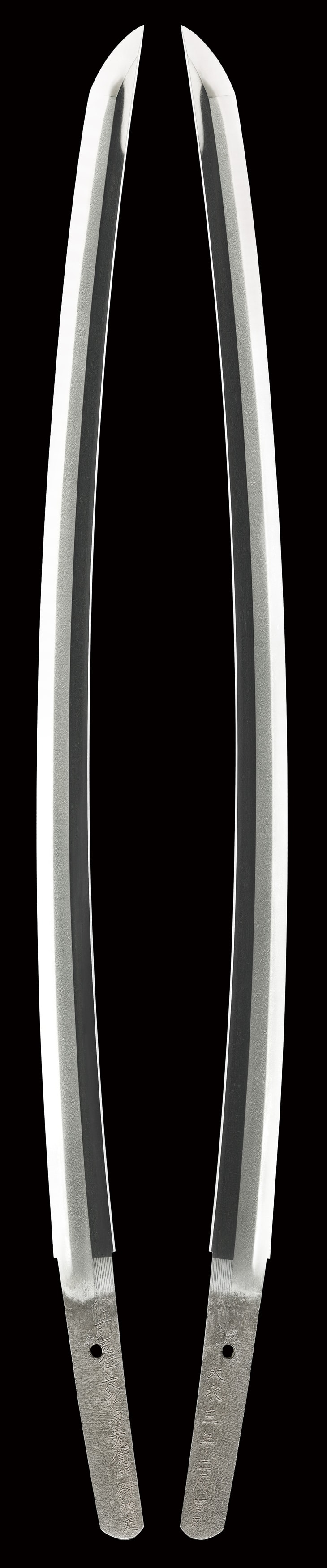
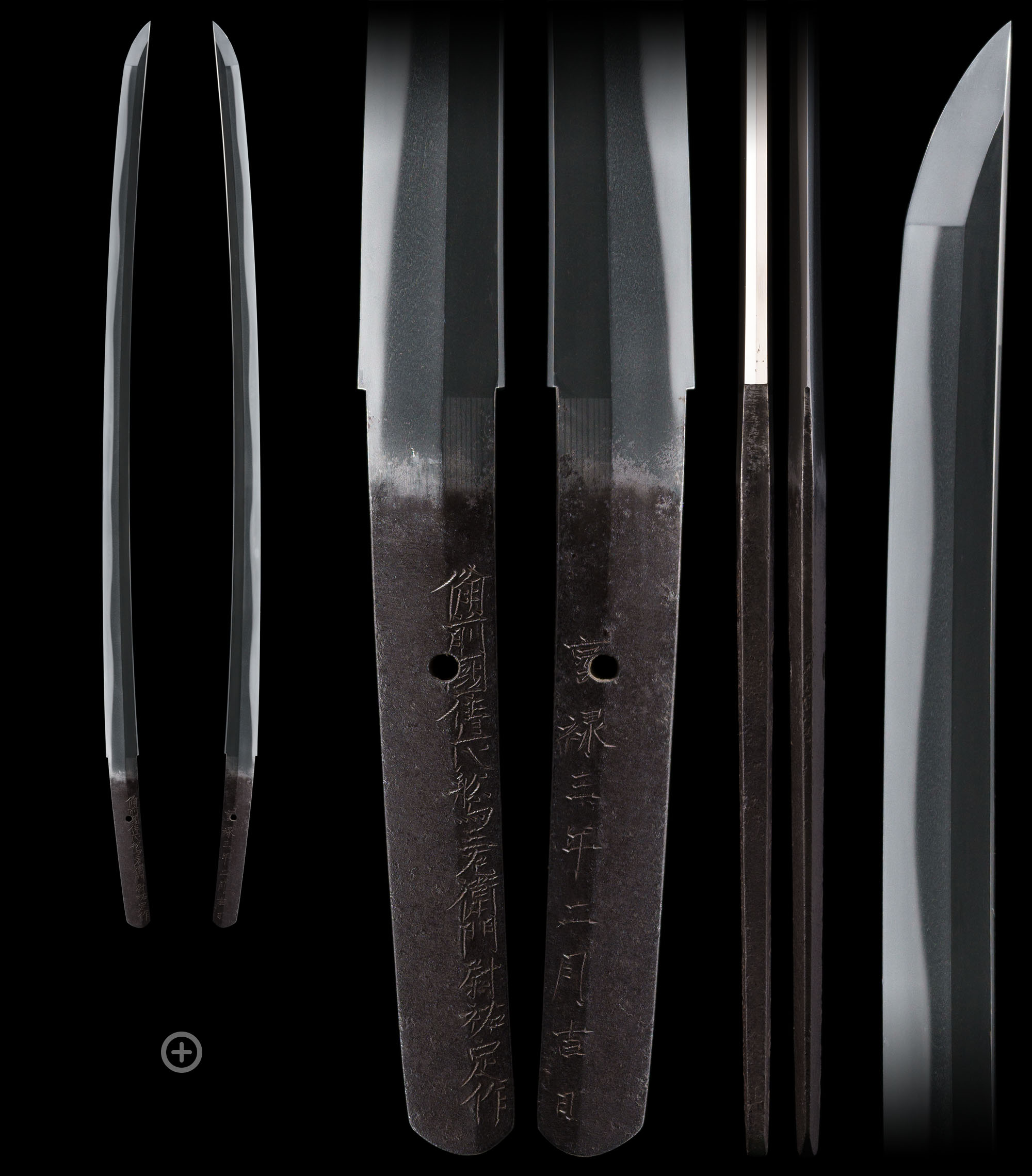
Beneath the lies an mixed with , the grain standing in places, over which a clear rises, the bar-shaped reflection of the steel. The attaches somewhat thickly and enter well; on the broader the grows fine and dustlike, a faint drifting above it. The answers the temper, turning in to a on the agitated blades, running straight to a small round turnback or pointing and returning on the quieter ones. The moves with his dates and forms: the early slender with deep and a in the Oei- stance, the mature of standard width with a noticeable taper and a thick , the and broad pieces, elongated and thick. The carvings are a recurring pleasure of his work, a grass-script and and a sutra text on one blade, twin grooves on another, and on a Bun'an 6 (1449) the incised deity name Ichinomiya Daimyojin. The published sources call that a piece in which Sukemitsu's working range is clearly shown.

The generations are the open question of his name, and the published sources resolve it by date. They observe that several generations of Sukemitsu have been pointed out and that the lists seven of the name, an earlier small-curvature Sukemitsu of around the Eiwa era among them; the dated blades, on the evidence of their year inscriptions, they assign to the first generation. His fatherhood of Katsumitsu and Munemitsu is fixed by a document blade outside the corpus, a Bunmei 9 of Munemitsu inscribed as the work of Sukemitsu's second son, Sakyo no Jo Munemitsu, which the judges say clearly demonstrates the transitional workmanship as moved from Oei- into . His own dated pieces show that hand mid-transition, the Eikyo imposing and Oei- in flavor, the later and calmer in their , the construction and the -and- still carrying an Oei- character while the recedes and the waves narrow. The blades signed with the full Rokurozaemon no Jo title, of which the published sources say extant examples are extremely few, are the ones they treat as the touchstone of the .

Within the school he belongs to the main line at its mid- turn, the generation between the Oei- of Morimitsu and Yasumitsu and the dense workshop his sons would run. His distinction is read not by borrowing a comparison but by his own grounded traits, the waist-open with its subdued , the over a standing , the bright and the pointed and angular teeth that mark the direction of his hand rather than the round clove of the older . The published sources value his blades as material as much as as swords: a signed as made at Takehara in Settsu records the documented movement of smiths to other provinces in this period and is called valuable source material for the study of the late- smiths. Through Katsumitsu and Munemitsu his line became the principal workshop of the late , the names that would lead the school into the mass production of the Eisho and Tenmon eras.

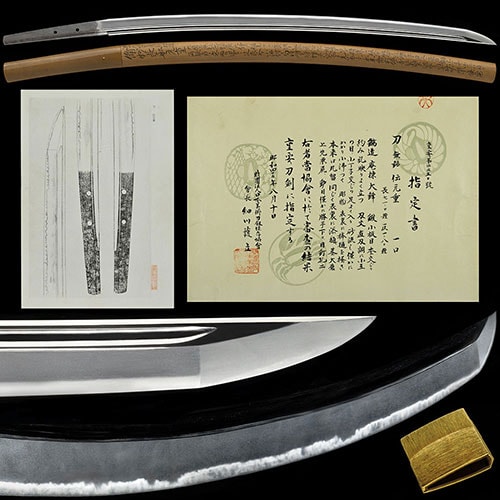
Fujishiro's rating is not recorded for him, and his designation record is modest in scale: seven works on record, all at the level, with a further blade preserved in the Imperial collection, and none of the higher tiers among them. That Imperial blade descends in the Imperial Family and is held today in the Hayashibara Museum of Art, the one clear provenance to survive in his data. The blades are a body of mid- , and held in private and long-recorded hands, and one of recorded whereabouts appears from time to time rather than rarely, a more findable thing than a though not on that account common. The value of his work is partly documentary, for the dated, signed, pieces let the Oei- to crossing be worked out blade by blade. A Bun'an 5 (1448) bears on the a gold-inlaid cutting-test inscription by the celebrated tester Yamano Kaemon-no-jo Nagahisa, evidence that his swords were proven as cutters generations after they left his forge. For a collector the Rokurozaemon no Jo Sukemitsu is the dated, knowable end of the name at its transition, a sword on which the period arc and the family question can be read in the hand, and on the best of which the working range of the smith is fully shown.

Historical importance

Where Sukemitsu stands among comparable artisans: across all of nihontō, and within tradition, era, and period. The tiers (Foremost · Leading · Major · Notable) weigh official designations from the NBTHK and Japan's Agency for Cultural Affairs, together with historical honors of lasting repute such as the Sansaku and Meibutsu-chō.

随一
Foremost
屈指
Leading
有数
Major
著名
Notable

Select a lens to see how it's measured.

Designations

Kokuhō—
Jūyō Bunkazai—
Jūyō Bijutsuhin—
Gyobutsu1
Tokubetsu Jūyō—
Jūyō Tōken7

Elite Standing

Kantei

Dated Works

Provenance

Blade Forms

Distribution across 8 ranked works

Signatures

Signature types across 8 ranked works

Currently Available

Lineage

TeacherSukemitsu
Sukemitsu
Students (3)
  1. 1.Sukemitsu祐光1 for sale8designated
  2. 2.Norimitsu則光1 for sale3designated
  3. 3.Norimitsu法光2 for sale6designated

Osafune School

Other artisans of the Osafune school

  1. 1.Mitsutada光忠60designated
  2. 2.Nagamitsu長光3 for sale244designated
  3. 3.Kagemitsu景光3 for sale143designated
  4. 4.Kanemitsu兼光3 for sale231designated
  5. 5.Sanenaga眞長2 for sale64designated
  6. 6.Chikakage近景4 for sale86designated
  7. 7.Tomomitsu倫光1 for sale61designated
  8. 8.Kagemasa景政2 for sale22designated
  9. 9.Masamitsu政光2 for sale84designated
  10. 10.Motomitsu基光1 for sale38designated
  11. 11.Kagehide景秀23designated
  12. 12.Yoshimitsu義光35designated

More Sue-Bizen works

View all →
Touken Matsumoto
Tokuho
Katana - Tokuho - by Sukesada School - Bishu Osafune SukesadaKatana - Tokuho - by Sukesada School - Bishu Osafune Sukesada

Katana

BySukesada School
¥650,000
Touken Matsumoto
Hozon
Wakizashi - Hozon - by Sukesada School - Bishu Osafune Sukesada, Eisho Juninen NigatsujitsuWakizashi - Hozon - by Sukesada School - Bishu Osafune Sukesada, Eisho Juninen Nigatsujitsu

Wakizashi

BySukesada School
¥650,000
Aoi Art
Hozon
Tanto - Hozon - by Katsumitsu - Bishu Osafune Katsumitsu - Dated February, Bunki 3Tanto - Hozon - by Katsumitsu - Bishu Osafune Katsumitsu - Dated February, Bunki 3

Tantō

ByKatsumitsu
Starting Bid¥800,000
Winners Auction
Tokuho
Tanto - Tokuho - by Kiyomitsu School - Gorozaemonjo KiyomitsuTanto - Tokuho - by Kiyomitsu School - Gorozaemonjo Kiyomitsu

Tantō

ByKiyomitsu School
Starting Bid¥950,000
Samurai Nippon
Jūyō
Katana - Jūyō - by Sukesada - Bizen Osafune Yosazaemonnojo SukesadaKatana - Jūyō - by Sukesada - Bizen Osafune Yosazaemonnojo Sukesada

Katana

BySukesada
Ask
Token-Net
Tokuho
Katana - Tokuho - by Sukesada - Bizen Osafune Sosaemonjo SukesadaKatana - Tokuho - by Sukesada - Bizen Osafune Sosaemonjo Sukesada

Katana

BySukesada
¥1,650,000
Giheiya
Hozon
Katana - Hozon - by Sukesada School - Bizen Kuni Ju Osafune Sukesada with KoshiraeKatana - Hozon - by Sukesada School - Bizen Kuni Ju Osafune Sukesada with Koshirae

Katana

BySukesada School
¥750,000
Asahi Token
Jūyō
Katana - Jūyō - by Sukesada - Bizen no Kuni ju Osafune Yosozaemonjo Sukesada saku, Kyoroku San-nen Ni-gatsu KichijitsuKatana - Jūyō - by Sukesada - Bizen no Kuni ju Osafune Yosozaemonjo Sukesada saku, Kyoroku San-nen Ni-gatsu Kichijitsu

Katana

BySukesada
Ask

More from the Osafune school

View all →
Aoi Art
Jūyō
Katana - Jūyō - by Osafune Shigezane - Mumei (Attributed to Shigezane) - 27th NBTHK Juyo TokenKatana - Jūyō - by Osafune Shigezane - Mumei (Attributed to Shigezane) - 27th NBTHK Juyo Token

Katana

ByOsafune Shigezane
Starting Bid¥4,600,000
Aoi Art
Tokuho
Wakizashi - Tokuho - by Oei-Bizen Morimitsu - Bishū Osafune Morimitsu, dated Ōei 26 (1419) - NBTHK Tokubetsu Hozon TokenWakizashi - Tokuho - by Oei-Bizen Morimitsu - Bishū Osafune Morimitsu, dated Ōei 26 (1419) - NBTHK Tokubetsu Hozon Token

Wakizashi

ByOei-Bizen Morimitsu
Starting Bid¥1,500,000
Aoi Art
Jūyō Bijutsuhin
Daisho - Jubi - by Osafune Nagamitsu - Dai Sho: Katana (Important Art Object): Mumei (Attributed to Nagamitsu) / Wakizashi: Mumei (Attributed to Sekishu Naotsuna)Daisho - Jubi - by Osafune Nagamitsu - Dai Sho: Katana (Important Art Object): Mumei (Attributed to Nagamitsu) / Wakizashi: Mumei (Attributed to Sekishu Naotsuna)

Daishō

ByOsafune Nagamitsu
Ask
Eirakudo
Jūyō
Katana - Jūyō - by Motoshige - Motoshige - Juyo TokenKatana - Jūyō - by Motoshige - Motoshige - Juyo Token

Katana

ByMotoshige
¥6,000,000
Samurai Museum
Tokuho
Wakizashi - Tokuho - by Osafune Kagemitsu - Antique Japanese Sword Wakizashi Attributed to Den Osafune Kagemitsu NBTHK Tokubetsu Hozon CertificateWakizashi - Tokuho - by Osafune Kagemitsu - Antique Japanese Sword Wakizashi Attributed to Den Osafune Kagemitsu NBTHK Tokubetsu Hozon Certificate

Wakizashi

ByOsafune Kagemitsu
¥3,200,000
Nihonto.com
Jūyō
Tanto - Jūyō - by Osafune Kagemitsu - Juyo Tanto by Bizen KagemitsuTanto - Jūyō - by Osafune Kagemitsu - Juyo Tanto by Bizen Kagemitsu

Tantō

ByOsafune Kagemitsu
¥89,500
Samurai Museum
Katana - by Osafune Kanemitsu - Attributed to Den Osafune Kanemitsu - NTHK Yushu Saku Kanteisho CertificateKatana - by Osafune Kanemitsu - Attributed to Den Osafune Kanemitsu - NTHK Yushu Saku Kanteisho Certificate

Katana

ByOsafune Kanemitsu
¥4,300,000
Goushuya
Tokujū
Tachi - Tokuju - by Oei-Bizen Morimitsu - Morimitsu - Tokubetsu Juyo TokenTachi - Tokuju - by Oei-Bizen Morimitsu - Morimitsu - Tokubetsu Juyo Token

Tachi

ByOei-Bizen Morimitsu
Ask

More from the Bizen tradition

View all →
Hyozaemon
Tokuho
Tokuho - by Fukuoka Ichimonji Yoshifusa - Naginata Naoshi Wakizashi by Fukuoka Ichimonji Yoshifusa, a Master of IchimonjiTokuho - by Fukuoka Ichimonji Yoshifusa - Naginata Naoshi Wakizashi by Fukuoka Ichimonji Yoshifusa, a Master of Ichimonji

Naginata Naoshi Wakizashi by Fukuoka Ichimonji Yoshifusa, a Master of Ichimonji

ByFukuoka Ichimonji Yoshifusa
Ask
Eirakudo
Tokuho
Katana - Tokuho - by Katayama Ichimonji School - Katayama Ichimonji - Tokubetsu Hozon TokenKatana - Tokuho - by Katayama Ichimonji School - Katayama Ichimonji - Tokubetsu Hozon Token

Katana

ByKatayama Ichimonji School
¥4,500,000
Eirakudo
Tokuho
Wakizashi - Tokuho - by Ichimonji School - Fukuoka Ichimonji Wakizashi Tokubetsu Hozon TokenWakizashi - Tokuho - by Ichimonji School - Fukuoka Ichimonji Wakizashi Tokubetsu Hozon Token

Wakizashi

ByIchimonji School
¥3,500,000
Tsuruginoya
Jūyō
Katana - Jūyō - by Fukuoka Ichimonji School - Mumei Fukuoka IchimonjiKatana - Jūyō - by Fukuoka Ichimonji School - Mumei Fukuoka Ichimonji

Katana

ByFukuoka Ichimonji School
Ask
Goushuya
Jūyō Bijutsuhin
Tachi - Jubi - by Ukai Unsho - Kumoio - From the collection of the Okouchi family, lord of Otaki Domain, Kazusa ProvinceTachi - Jubi - by Ukai Unsho - Kumoio - From the collection of the Okouchi family, lord of Otaki Domain, Kazusa Province

Tachi

ByUkai Unsho
Ask
Aoi Art
Jūyō
Katana - Jūyō - by Aoe School - Mumei (Aoe school)Katana - Jūyō - by Aoe School - Mumei (Aoe school)

Katana

ByAoe School
¥3,200,000
Hyozaemon
Tokuho
Tachi - Tokuho - by Ko-Aoe Yoritsugu - Ko-Aoe YoritsuguTachi - Tokuho - by Ko-Aoe Yoritsugu - Ko-Aoe Yoritsugu

Tachi

ByKo-Aoe Yoritsugu
¥5,800,000
Tsuruginoya
Jūyō
Tachi - Jūyō - by Hatakeda Sanemori - Hatakeda Sanemori - Formerly owned by General Sadao ArakiTachi - Jūyō - by Hatakeda Sanemori - Hatakeda Sanemori - Formerly owned by General Sadao Araki

Tachi

ByHatakeda Sanemori
¥14,500,000

Sukemitsu

Sukemitsu(祐光) was a Japanese swordsmith of the Osafune school in Bizen province, active during the Eikyo (1429-1441) period.

The work follows the Bizen-den tradition.

Designated works by Sukemitsu include 7 Jūyō.